
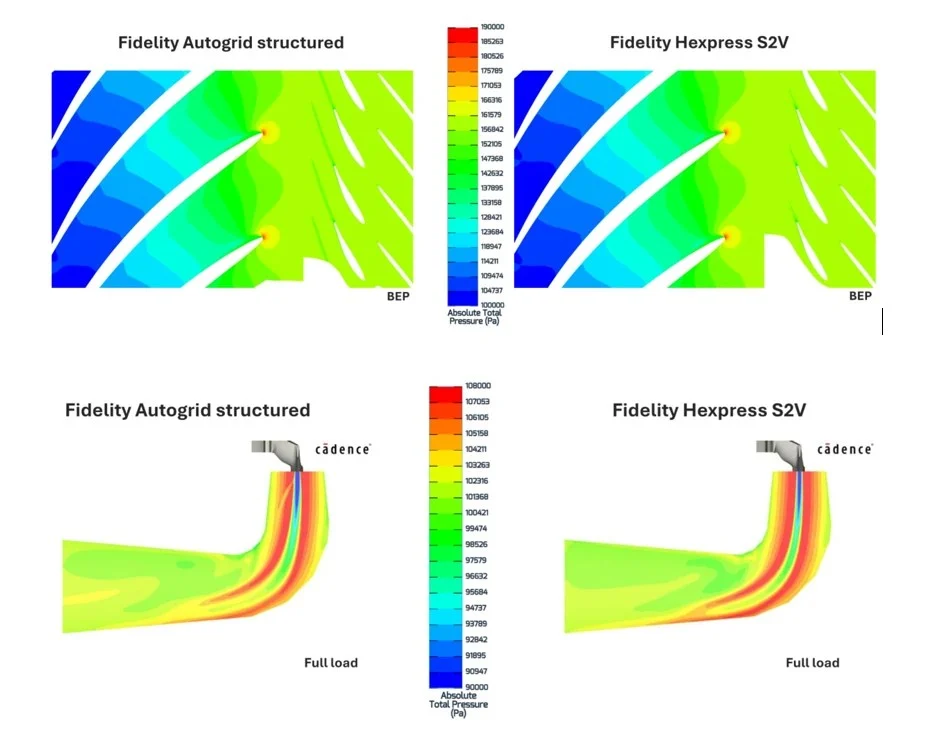

In the rigorous field of computational fluid dynamics (CFD), the pursuit of simulation fidelity is inextricably linked to the quality and architecture of the underlying mesh. For decades, the design and optimization of turbomachinery—ranging from massive hydroelectric turbines to high-performance aircraft engines—have relied on high-quality meshing to predict performance, durability, and efficiency. However, as blade geometries become increasingly complex and market demands necessitate shorter design cycles, the traditional methods of grid generation are being re-evaluated. A comprehensive study recently conducted using the Cadence Fidelity CFD platform has shed light on a pivotal question for the industry: can automated, unstructured meshing workflows match the accuracy of the long-standing gold standard, the structured mesh?
The evolution of CFD has reached a point where the solver’s capability is often limited by the pre-processing stage. Meshing, the process of discretizing a physical domain into smaller geometric cells, is a critical step for achieving reliable simulations. When combined with a robust solver strategy, a well-constructed mesh allows engineers to visualize flow patterns, pressure distributions, and turbulence with high precision. In the context of turbomachinery, this precision is vital because even a one-percent difference in predicted efficiency can result in millions of dollars in lost revenue or operational costs over the lifespan of a turbine.

The Evolution of Meshing: Structured vs. Unstructured Approaches
To understand the significance of this comparative study, one must first distinguish between the two primary meshing methodologies. Structured meshing, long considered the industry standard for turbomachinery, utilizes a block-structured approach where grid points are distributed in a logical i, j, k indexing system. This method is highly efficient for the solver and provides excellent control over the boundary layer, which is essential for capturing the physics of flow near blade surfaces. However, structured meshing is notoriously labor-intensive. Dealing with intricate features such as cooling holes, fillets, and non-standard blade tips often becomes a bottleneck, as the topology must be manually or semi-manually defined. This complexity makes the process difficult to automate, often slowing down the iterative design cycles required in modern engineering.
Conversely, unstructured meshing—specifically the Surface-to-Volume (S2V) workflow—offers a more flexible alternative. Unstructured meshes do not follow a rigid indexing system, allowing them to conform more easily to complex, "dirty," or irregular geometries. The S2V approach in Cadence Fidelity is designed to be highly automated and robust. It generates hex-dominant grids that can handle the most challenging geometries without requiring the extensive manual setup time associated with structured grids. The primary concern among engineers has historically been whether this ease of use comes at the cost of numerical accuracy.
Methodology: The GAMM Francis Turbine Case Study
The study utilized the GAMM Francis Turbine as its primary benchmark. This turbine is a well-documented test case in the hydroelectric industry, known for its complex internal flow dynamics, including secondary flows and pressure gradients that challenge even the most sophisticated CFD solvers. The objective was to compute a full "hill chart"—a comprehensive performance map of the turbine—using both a traditional structured mesh and an unstructured S2V mesh.

A hill chart is a vital tool for turbine operators and designers. It plots efficiency against various operating parameters, such as guide vane openings and rotation speeds. To generate a complete chart, the researchers performed 60 distinct simulations, covering 10 different guide vane openings and 6 different rotation speeds. This large-scale data collection ensured that the comparison between the two meshing types was not limited to a single "best-case" operating point but was instead representative of the turbine’s entire operational range.
Technical Configuration and Computational Framework
The simulations were executed using Fidelity Flow, an unstructured, cell-centered, second-order finite-volume solver. This solver is pressure-based and features full coupling of pressure and velocity, making it particularly well-suited for the incompressible or low-speed compressible flows typically found in hydraulic machinery.
For the structured mesh setup, the team used Fidelity Autogrid. This tool employs a block-structured mesh with automatic topology and grid point distribution. It is optimized for turbomachinery, featuring high-quality blade-to-blade (B2B) smoothing to ensure that the cells near the blade surfaces are orthogonal and well-resolved. This represented the "control" group in the experiment, embodying the conventional standard of excellence.

For the unstructured alternative, the team employed Fidelity Hexpress to create an S2V mesh. This mesh was hex-dominant and utilized an automatic periodic domain creation feature. Key characteristics of the S2V mesh included:
- High Automation: The workflow required significantly less manual intervention to define the volume around the blades.
- Boundary Layer Resolution: Despite being unstructured, the S2V approach maintained high-quality cell layers near the walls to accurately capture turbulent effects.
- Geometric Flexibility: The hex-dominant nature of the grid allowed for efficient volume filling while maintaining the numerical benefits of hexahedral cells.
To handle the computational load of 60 simulations, the study leveraged high-performance computing (HPC) with MPI-based parallelization. Crucially, the simulations utilized both CPU and GPU architectures. The shift toward GPU acceleration is a significant trend in the CFD industry, as it allows for massive parallelization of the solver’s linear algebra operations, drastically reducing the time-to-solution compared to traditional CPU-only clusters.
Comparative Data and Accuracy Results
The results of the study provided a clear answer to the question of accuracy. After analyzing the global performance values across all 60 operating points, the efficiency hill charts produced by both meshing methods were remarkably similar. The most striking finding was that the peak efficiency difference between the Fidelity Autogrid (structured) and the Fidelity Hexpress (unstructured S2V) meshes was a mere 0.2%.

In the world of industrial CFD, a 0.2% variance is often considered within the margin of numerical noise or experimental error, suggesting that for practical engineering purposes, the two methods are equivalent in their ability to predict global performance. The contours of the hill charts—showing the areas of optimal efficiency and the "drop-off" zones where the turbine performs less effectively—mirrored each other almost perfectly across both meshing workflows.
Industry Implications and Expert Analysis
The implications of this study are profound for the future of turbomachinery design. If an automated unstructured workflow can deliver the same accuracy as a manual structured one, the primary barrier to faster design cycles—meshing time—is effectively removed.
Industry experts suggest that this shift will lead to several key changes in engineering departments:

- Democratization of CFD: Highly automated meshing workflows allow engineers who may not be specialized "meshing experts" to perform high-fidelity simulations. This integrates CFD more deeply into the initial design phase rather than keeping it as a final validation step.
- Handling Complex Innovations: As designers explore non-traditional blade shapes, such as those made possible by additive manufacturing (3D printing), the ability to mesh complex geometries without manual topology definition becomes a competitive necessity.
- Optimization at Scale: With the time-per-mesh reduced from days to hours (or even minutes), companies can run much larger optimization loops. Instead of testing 10 design iterations, they can test hundreds, using genetic algorithms or machine learning to find the absolute peak of the hill chart.
Furthermore, the successful use of GPU acceleration in this study highlights a shift in the "cost of accuracy." Historically, high-accuracy simulations were expensive and slow. By combining automated meshing with GPU-resident solvers, the cost and time barriers are falling, allowing for more frequent and more detailed analyses throughout the product lifecycle.
Broader Impact on Renewable Energy
Beyond the technical achievements, the ability to accurately and quickly model hydraulic turbines like the GAMM Francis Turbine has a direct impact on global sustainability goals. Hydraulic power remains a cornerstone of renewable energy. Improving the efficiency of these turbines by even a fraction of a percent through better CFD-led design contributes to higher energy yields and reduced environmental impact.
As the industry moves toward "digital twins"—virtual replicas of physical turbines that monitor performance in real-time—the need for fast, accurate CFD models becomes even more acute. A digital twin must be able to simulate various operational scenarios quickly to provide actionable data to plant operators. The S2V unstructured meshing workflow provides the necessary speed and robustness to support these real-time applications without sacrificing the accuracy required for high-stakes decision-making.

Conclusion
The comparative study of structured versus unstructured meshing in Cadence Fidelity CFD serves as a validation of modern computational techniques. By demonstrating that an automated S2V workflow can achieve a 99.8% match with traditional structured results, the study clears the path for engineers to adopt more efficient workflows. The transition from labor-intensive grid generation to automated, GPU-accelerated simulation represents a new era in turbomachinery design—one where complexity is no longer a bottleneck, and accuracy is more accessible than ever before. As the industry continues to push the boundaries of what is possible in fluid dynamics, the synergy between advanced meshing and high-performance solvers will remain the primary driver of innovation.
