
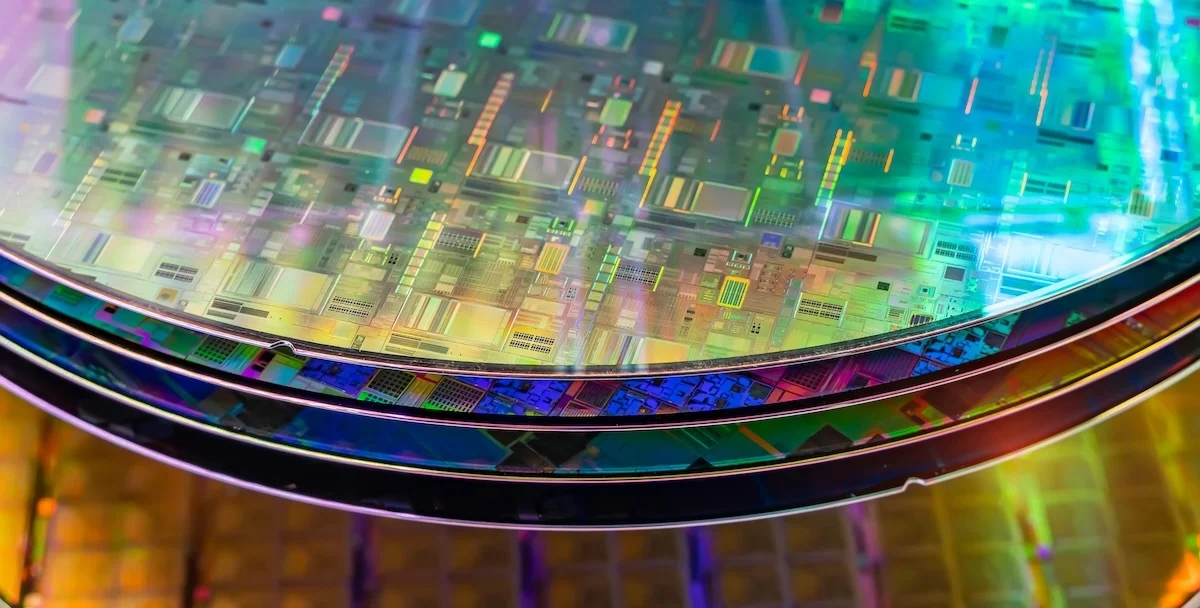

A collaborative research initiative involving scientists from AMO GmbH, RWTH Aachen University, and AIXTRON SE has successfully demonstrated a revolutionary method for the large-scale transfer of two-dimensional (2D) materials using deionized water. Published in the journal npj 2D Materials and Applications in April 2026, the study addresses one of the most persistent bottlenecks in the commercialization of next-generation electronics: the reliable, clean, and scalable integration of 2D materials into standard semiconductor manufacturing flows. By moving away from hazardous chemical etchants and toward a water-based, frame-assisted process, the team has provided a pathway for the mass production of molybdenum disulfide (MoS2) and hexagonal boron nitride (h-BN) on 100 mm (4-inch) wafers without compromising material integrity.
The Evolution of 2D Material Synthesis and Integration
The semiconductor industry is currently facing a fundamental physical limit as traditional silicon-based transistors approach the atomic scale. Two-dimensional materials, characterized by their atomic thickness, have emerged as the primary candidates to extend Moore’s Law. Among these, molybdenum disulfide (MoS2) is highly valued for its semiconducting properties and favorable bandgap, while hexagonal boron nitride (h-BN) serves as an ideal insulating substrate or dielectric layer due to its ultra-smooth surface and lack of dangling bonds.
However, the synthesis of high-quality 2D materials typically requires Metal-Organic Chemical Vapor Deposition (MOCVD) at temperatures exceeding 1,000°C. These extreme temperatures are incompatible with the "back-end-of-line" (BEOL) processes of conventional silicon chips, which generally cannot exceed 400–450°C without damaging existing metal interconnects. Consequently, 2D materials must be grown on specialized crystalline substrates, such as sapphire, and then "transferred" to a final target wafer (such as silicon or glass).
Historically, this transfer process has been the "Achilles’ heel" of 2D electronics. Previous methods relied heavily on wet chemical etching using potassium hydroxide (KOH) or sodium hydroxide (NaOH) to delaminate the 2D layer from the sapphire. These chemicals are not only hazardous to personnel but also introduce ionic contamination and can degrade the electrical properties of the 2D material. Furthermore, manual handling of these delicate atomic layers often leads to cracks, wrinkles, and yield loss at scales larger than a few centimeters.
Technical Methodology: The Frame-Assisted Water Transfer
The research team led by N. Rademacher, L. Völkel, and E. Reato introduced a "frame-assisted" technique that utilizes the interfacial energy between the 2D material and the sapphire substrate. The process begins with the growth of MoS2 or h-BN on a 100 mm sapphire wafer via MOCVD. Following growth, a thin polymer support layer is deposited onto the 2D material to provide mechanical stability.
The innovation lies in the use of a rigid support frame and deionized water. By carefully controlling the immersion of the sapphire/2DM/polymer stack into a water bath, the researchers exploited the fact that water molecules can penetrate the interface between the hydrophobic 2D material and the hydrophilic sapphire substrate. This penetration creates a "wedge" effect, allowing the 2D material to peel away cleanly from the sapphire.
The use of a frame is critical for scalability. In small-scale laboratory settings, 2D materials can be handled with tweezers, but at the 100 mm wafer scale, the material is prone to folding or tearing under its own weight or the surface tension of the liquid. The frame maintains the lateral tension of the 2D film throughout the delamination and subsequent deposition onto the target substrate, ensuring a wrinkle-free transfer.
Chronology of Development and Collaborative Efforts
The development of this water-based transfer method is the culmination of years of iterative research within the European semiconductor ecosystem.
- 2018–2021: Initial research at RWTH Aachen and AMO GmbH focused on understanding the adhesion energy of MoS2 on various oxides. Early experiments showed that moisture in the air could naturally degrade the adhesion of 2D materials over time.
- 2022–2023: AIXTRON SE, a leading provider of deposition equipment, optimized MOCVD recipes to produce high-quality, uniform monolayers of MoS2 across full 4-inch sapphire wafers, a prerequisite for any scalable transfer study.
- 2024–2025: The research team moved from "wet etching" to "water-assisted delamination." The primary challenge was the "yield at scale," leading to the development of the frame-assisted hardware currently described in the 2026 publication.
- April 2026: The formal publication of the results in npj 2D Materials and Applications, confirming that the water-based method is viable for industrial-scale 100 mm wafers.
Supporting Data and Material Verification
To prove that the water-based process did not damage the 2D materials, the researchers conducted an exhaustive suite of metrological tests both "as-grown" on sapphire and "after-transfer" on the target silicon dioxide (SiO2) substrate.

Atomic Force Microscopy (AFM):
AFM scans revealed that the surface morphology remained exceptionally clean. One of the primary risks of transfer is "polymer residue" from the support layer. The water-based method, combined with optimized cleaning protocols, resulted in a surface roughness comparable to the original growth state.
Scanning Electron Microscopy (SEM):
Large-area SEM mapping of the 100 mm wafer confirmed that the MoS2 film remained continuous. There was a significant reduction in the number of "tears" and "pinholes" compared to traditional KOH-based transfers.
Raman Spectroscopy:
Raman spectroscopy provided the most critical data regarding the physical state of the material. The results showed:
- Strain Levels: The transferred MoS2 exhibited lower levels of compressive strain. In growth on sapphire, the difference in thermal expansion coefficients often leaves the material "squeezed." The water-assisted transfer allowed for a degree of strain relaxation, which is beneficial for consistent electrical performance.
- Doping and Contamination: The Raman peaks (specifically the A1g and E2g modes) showed no significant shifts that would indicate chemical doping from the transfer process. This confirms that deionized water is an inert medium that preserves the intrinsic electronic properties of the 2DM.
Industry Implications and Official Perspectives
While official corporate statements often follow the publication of such pivotal research, the collaborative nature of the study suggests a strong alignment with industry roadmaps. AIXTRON SE’s involvement indicates a clear intent to provide a "full-stack" solution to customers—not just the machines to grow 2D materials, but the validated processes to move those materials onto functional chips.
Industry analysts suggest that this breakthrough addresses a major safety and environmental concern for semiconductor fabrication plants (fabs). Modern fabs are under increasing pressure to reduce their chemical footprint. By replacing caustic KOH with deionized water—a substance already used in massive quantities for wafer rinsing—the "Water-based, large-scale transfer" method fits seamlessly into existing "Green Fab" initiatives.
Furthermore, the reuse of sapphire substrates is a major economic factor. Sapphire wafers are expensive; the ability to delaminate the 2D material using only water leaves the sapphire substrate intact and uncontaminated, potentially allowing it to be cleaned and reused for subsequent growth cycles. This could significantly lower the "cost per cm²" of 2D materials.
Broader Impact on the Electronics Landscape
The successful transfer of MoS2 and h-BN at the 100 mm scale is a vital stepping stone toward 200 mm and 300 mm production, which are the industry standards for high-volume manufacturing. The implications of this research extend into several high-growth sectors:
- Flexible Electronics: Because the water-based transfer is relatively gentle, it can be adapted to move 2D materials onto flexible plastic substrates or heat-sensitive organic polymers, enabling a new generation of wearable sensors and foldable displays.
- Optoelectronics: MoS2 is an efficient light emitter and absorber. The ability to transfer it onto silicon photonics platforms without chemical contamination could lead to faster, more energy-efficient optical interconnects in data centers.
- Quantum Computing: h-BN is frequently used as a substrate for graphene-based quantum devices. A clean, large-scale transfer process ensures that the delicate quantum states are not disrupted by impurities trapped at the interface.
- The "More than Moore" Era: As traditional scaling slows, the integration of "non-silicon" materials becomes mandatory. This research proves that 2D materials can be handled with the same level of precision and cleanliness as traditional thin films.
Conclusion and Future Outlook
The paper titled "Water-based, large-scale transfer of 2D materials grown on sapphire substrates" represents a significant shift in the methodology of nano-fabrication. By leveraging the fundamental physical properties of water and interfacial energy, the researchers at AMO, RWTH Aachen, and AIXTRON have bypassed the chemical and mechanical hurdles that have relegated 2D materials to the laboratory for over two decades.
The next phase of this research is expected to focus on the automation of the frame-assisted process. For 2D materials to reach the consumer market, the transfer must be performed by robotic systems in a high-throughput environment. With the "water-bridge" now established, the semiconductor industry is one step closer to a future where atomically thin layers are a standard component of every integrated circuit. The data confirms that the path to 2D electronics is not just through better chemistry, but through a smarter, cleaner application of the most basic element: water.
