
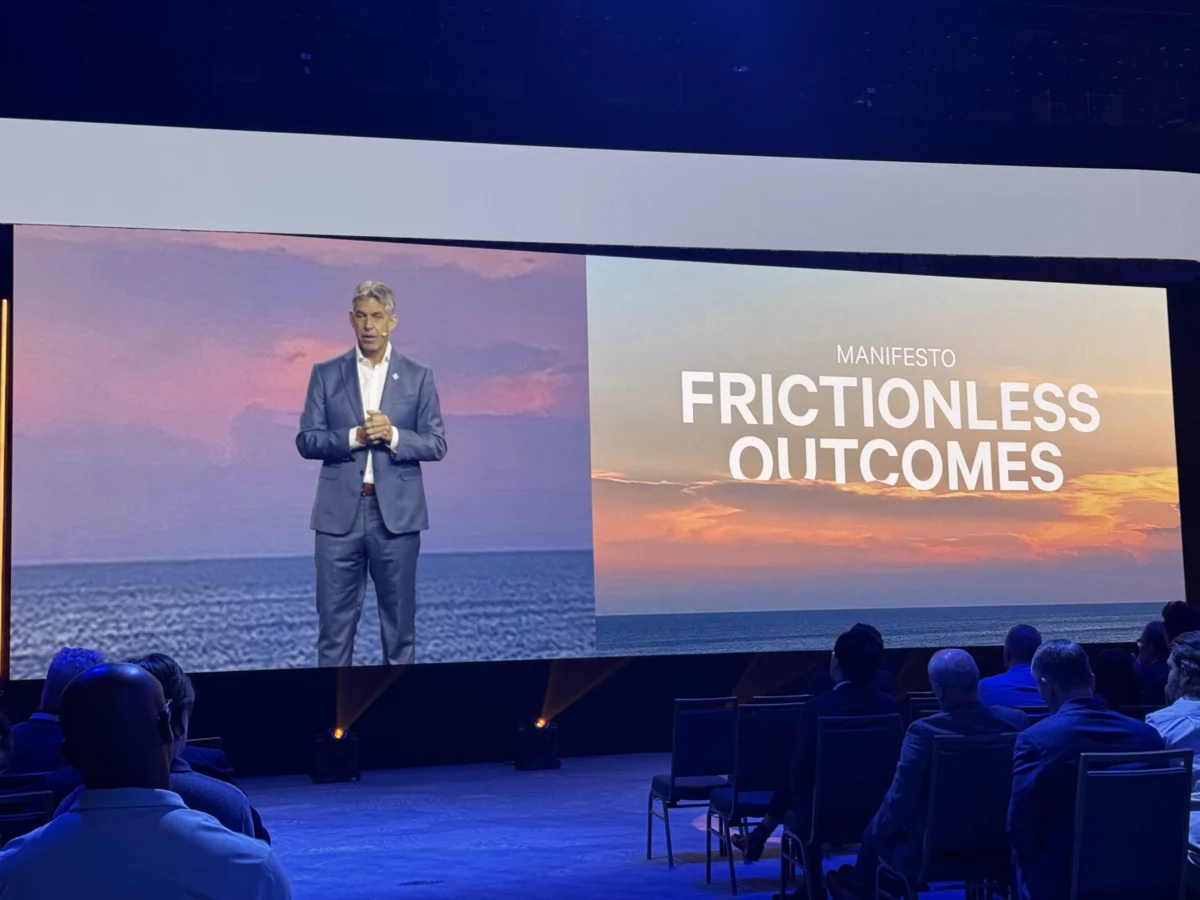

At the annual ICON user conference in San Diego, Blue Yonder CEO Duncan Angove announced a fundamental shift in the company’s commercial strategy, revealing that the supply chain software leader has ceased selling any products outside of its cognitive portfolio. This pivot marks the culmination of a multi-year transformation aimed at replacing legacy systems with a suite of AI-driven, cloud-native supply management tools. The decision to move exclusively to a cognitive-first model represents a significant gamble on the future of autonomous supply chains, underpinned by more than $2 billion in research and development investment over the last five years.
The strategic redirection follows Blue Yonder’s acquisition by Panasonic, a move that has provided the company with the capital and long-term stability required to rebuild its entire technology stack from the ground up. Addressing an audience of customers and industry partners, Angove emphasized that while the technological foundation is now in place, the primary challenge for the industry remains the evolution of business operating models. He argued that the mere adoption of artificial intelligence is insufficient if organizations continue to apply new technology to antiquated workflows.
The Operating Model Crisis: Beyond Technology Adoption
A central theme of the ICON conference was the disconnect between advanced technological capabilities and the rigid operating models that define modern logistics. Angove utilized a poignant analogy to describe this friction, comparing the current state of AI implementation to the introduction of electricity during the industrial era. When factories first transitioned from steam power, many simply replaced a single steam engine with an electric motor while maintaining the same inefficient layouts of belts and pulleys. Consequently, productivity gains were marginal until the factories were redesigned to leverage the decentralized nature of electrical power.
In the context of modern supply chains, Angove noted that many firms treat AI as a "slightly better steam engine" by bolting intelligence onto existing, manual processes. He observed that even simple infrastructure changes, such as the introduction of roundabouts in traffic management, fail to deliver efficiency if drivers continue to treat them like four-way stops. For Blue Yonder, the goal is to move beyond "swivel-chair coordination"—where human operators manually bridge the gap between different software screens—and toward a model where the "agent is the app."
This vision is rooted in network science, specifically the concept of the "price of anarchy." In logistics, this refers to the efficiency gap between a system where individual actors optimize for their own benefit and a system that is coordinated for the performance of the entire network. By utilizing agentic AI, Blue Yonder aims to transition supply chains from fragmented local optimization to a coordinated system that operates at machine speed, similar to how navigation apps like Waze orchestrate millions of independent drivers into a single, fluid traffic flow.
The Cognitive Pivot and the $2 Billion R&D Commitment
The transition to a "nothing but cognitive" sales model is the result of a rigorous five-year roadmap. Since becoming a subsidiary of Panasonic, Blue Yonder has been shielded from the immediate quarterly pressures often faced by publicly traded SaaS (Software as a Service) providers. This has allowed the executive team to prioritize long-term architectural integrity over short-term sales cycles. The $2 billion R&D investment has been directed toward developing "domain agents" across various sectors, including warehouse operations, logistics, inventory management, and commerce fulfillment.
These agents have evolved from simple monitoring tools into autonomous entities capable of building context over time. According to Angove, these agents become "sharper, faster, and more operationally fluent" with every interaction. This evolution allows the software to move beyond static interfaces. In this new paradigm, the user does not simply navigate a dashboard; they engage with an intelligence that handles the "manual operational tedium," elevating human workers to roles focused on strategic decision-making and agent supervision.
Frictionless Outcomes: Redefining Software Deployment
One of the most ambitious components of the conference was the introduction of the "Frictionless Outcomes" manifesto. Angove challenged the traditional software implementation model, which he described as a "linguistic fossil" of the industrial era. Currently, most enterprise software deployments rely on extensive manual labor, including teams of consultants, lengthy statements of work, and time-and-materials contracts. Blue Yonder’s new mandate is to turn the implementation process itself into a product feature, automated by AI.
The company provided several data points to support the viability of this automated deployment model:
- WMS Migration: Timeline for initiating Warehouse Management System (WMS) migrations has been reduced by 87%, dropping from eleven weeks to just seven days.
- Data Ingestion: The time required for data ingestion has been cut from two weeks to as little as eight hours.
- Demand Forecasting: A major North American beverage distributor recently migrated 326,000 demand forecast units across a complex multi-echelon network in 72 hours. This was not a limited pilot but a full migration of the organization’s forecasting and replenishment engine.
By collapsing the effort required for deployment, Blue Yonder argues that the primary constraint on business transformation is no longer technical capacity, but the scale of customer ambition.
The Role of Forward-Deployed Engineers
To bridge the gap between technological potential and operational reality, Blue Yonder has introduced a program of "forward-deployed engineers" (FTEs). These are Blue Yonder employees who are embedded directly within a customer’s operations, working alongside planners and logistics teams. The goal of this initiative is to capture "tribal knowledge"—the tacit workflows and unwritten rules that govern messy, real-world supply chain environments—and translate them into agentic intelligence.
This approach marks a departure from the traditional model of handing off implementation to third-party systems integrators. By placing its own engineers in the field, Blue Yonder seeks to ensure that the operating model change actually takes hold. This strategy serves a dual purpose: it mitigates the risk of implementation failure and acts as a catalyst for cultural change within the customer organization, forcing a break from "yesterday’s workflows."
Case Studies: Sainsbury’s and Australia Post
The conference featured testimonials from high-level executives who have already begun implementing Blue Yonder’s cognitive tools. Simon Roberts, CEO of the UK supermarket chain Sainsbury’s, detailed how the retailer transformed its end-to-end supply chain to focus on specific outcomes like waste reduction and product availability. Roberts reported that Sainsbury’s now maintains a 98% product availability rate across 30,000 SKUs. This efficiency has contributed to the retailer achieving its highest volume market share in a decade, outperforming the UK grocery market for six consecutive years.
Similarly, Paul Graham, Group CEO of Australia Post, described the challenges of managing a 217-year-old organization with 12,000 vehicles and 12.8 million delivery points. Handling 2.2 billion articles annually, the organization previously lacked a "central brain" to regulate its vast nervous system of deliveries. Graham noted that the shift to Blue Yonder’s Transportation Management System (TMS) represents a "revolution" rather than a mere evolution. With same-day delivery expectations projected to rise from 5% to 20% of total volume by 2030, the need for machine-speed orchestration has become a matter of survival for the postal service.
The Microsoft Partnership and Infrastructure Demands
The scale of this AI transition requires massive computational infrastructure, a point highlighted by Microsoft’s Commercial CEO Judson Althoff. Microsoft serves as both a strategic partner and a customer of Blue Yonder. Blue Yonder’s platform is underpinned by Microsoft Azure, and Microsoft uses Blue Yonder’s logistics agents to manage its own global supply chain.
Althoff revealed the staggering demand for AI infrastructure, noting that Microsoft added two gigawatts of data center capacity in the last year alone and still struggled to meet global demand. He emphasized that for any AI solution to be credible in a supply chain context, it must be built on two pillars: intelligence and trust. The "360-degree partnership" between the two companies ensures that Blue Yonder has the scalable cloud resources necessary to process the massive datasets required for autonomous agentic action.
Strategic Implications for the Supply Chain Industry
The "cognitive-only" stance taken by Blue Yonder is a clear signal that the era of traditional SaaS may be transitioning into an era of "Agentic AI as a Service." By being willing to cannibalize its own legacy business models, Blue Yonder is positioning itself ahead of the "SaaSpocalypse"—a term used by industry analysts to describe the potential obsolescence of static software applications in the face of generative and agentic AI.
The move also places significant pressure on global systems integrators and consultancies. If software implementation becomes a product feature that can be completed in days rather than months, the traditional consulting revenue model based on billable hours for deployment will require a total overhaul.
Furthermore, the focus on network-level coordination over individual user optimization suggests a shift in how corporate success will be measured. In the future, the value of a supply chain platform may not be found in its user interface, but in its ability to operate autonomously behind the scenes, reducing the "price of anarchy" and ensuring that global networks function with the precision of a single, coordinated organism. As Duncan Angove concluded, the technology has changed; the onus is now on the industry to ensure the operating model follows suit.
