
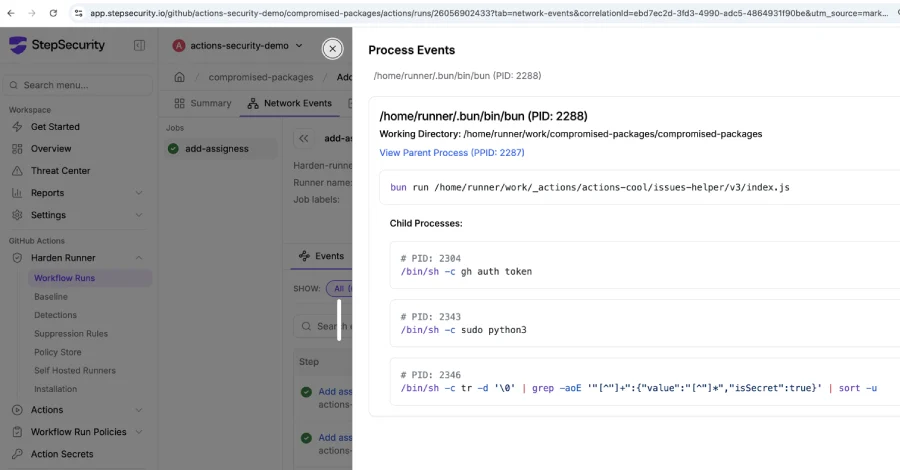

On May 19, 2026, a critical software supply chain attack came to light, revealing that threat actors had successfully compromised a widely-used GitHub Actions workflow, actions-cool/issues-helper. The sophisticated attack leveraged a deceptive technique known as "imposter commits" to inject malicious code into the workflow, enabling the exfiltration of sensitive credentials from Continuous Integration/Continuous Deployment (CI/CD) pipelines to an attacker-controlled server. This incident, brought to public attention by StepSecurity researcher Varun Sharma, underscores the escalating risks inherent in modern software development ecosystems, particularly those relying on third-party components and automated workflows.
Understanding the Imposter Commit Attack Vector
The core of this attack lies in the "imposter commit" technique, a subtle yet highly effective method for injecting malicious code into trusted projects. As explained by StepSecurity and further detailed by other cybersecurity firms, an imposter commit involves manipulating repository tags to point to a malicious commit that does not originate from the project’s legitimate commit history. Instead, this deceptive commit exists solely within an adversary-controlled fork of the repository.
When developers integrate GitHub Actions into their CI/CD pipelines, they often reference these actions by tags (e.g., v1.0.0) or branches (main). This practice simplifies dependency management and ensures that pipelines consistently use a specific version of an action. However, the imposter commit attack exploits this trust model. Threat actors first create a fork of a popular GitHub Action, introduce malicious code into it, and then strategically move existing tags in the original repository to point to their imposter commit in the fork. Because GitHub Actions workflows often resolve tags to specific commit SHAs (Secure Hash Algorithms), any pipeline configured to use the compromised action by its tag will, on its next run, unwittingly fetch and execute the malicious code.
This method effectively bypasses standard security measures such as Pull Request (PR) reviews, which are designed to scrutinize code changes before they are merged into the main branch. Since the malicious commit never formally enters the main branch of the original repository through a PR, it evades detection by human reviewers and automated code analysis tools that typically operate on merged code. The unsuspecting developer, trusting the integrity of the published tags, then triggers the malicious payload within their own CI/CD environment, which often operates with elevated privileges, thus creating a fertile ground for credential harvesting and data exfiltration.
The Compromised GitHub Actions and Malicious Functionality
The primary target identified in this campaign was actions-cool/issues-helper, a popular GitHub Action designed to streamline issue management within repositories. Its utility, which likely includes automating tasks like labeling issues, assigning users, or generating reports, makes it a frequent inclusion in many development workflows. StepSecurity’s investigation revealed that every existing tag in this repository had been re-pointed to an imposter commit. This meant that any project using actions-cool/issues-helper by any of its version tags was immediately vulnerable.
The malicious code embedded within these imposter commits was designed to exfiltrate sensitive credentials from the CI/CD pipelines where the action was executed. While the precise sequence of actions was not fully detailed, typical credential harvesting in CI/CD environments involves:
- Accessing Environment Variables: CI/CD runners often store sensitive information as environment variables, including
GITHUB_TOKEN(which grants permissions to interact with the GitHub API), API keys for cloud providers (e.g., AWS_ACCESS_KEY_ID, AZURE_CLIENT_SECRET), and other secrets required for deployment or testing. The malicious code would attempt to read and collect these variables. - Accessing Mounted Secrets: Some CI/CD systems allow secrets to be mounted as files or passed directly to the runner. The malware could scan common paths or leverage API calls to access these.
- Network Communication: Once collected, the credentials and other sensitive data would be transmitted to an attacker-controlled server. In this specific incident, the exfiltration domain was identified as
t.m-kosche[.]com. This communication would typically occur over standard HTTP/HTTPS protocols, often disguised as legitimate traffic, to evade network-based detection. - Stealth and Persistence: The malicious code would likely attempt to execute quickly and clean up traces to remain undetected, ensuring that subsequent runs of the action appear normal to the developer.
In addition to actions-cool/issues-helper, StepSecurity confirmed that 15 tags associated with another GitHub Action, actions-cool/maintain-one-comment, were also compromised with identical malicious functionality. This indicates a broader, coordinated effort targeting multiple actions within the same "actions-cool" ecosystem, suggesting a deliberate campaign rather than an isolated incident. actions-cool/maintain-one-comment is presumably used to manage comments on GitHub issues or pull requests, another common automation task.
Chronology of Discovery and Response
The timeline of the attack and its subsequent discovery highlights the rapid response required in software supply chain incidents:
- Pre-May 19, 2026: Threat actors successfully execute the imposter commit strategy, manipulating tags on
actions-cool/issues-helperandactions-cool/maintain-one-commentto point to their malicious commits. - May 19, 2026: StepSecurity researcher Varun Sharma publicly discloses the compromise, detailing the imposter commit technique and the exfiltration target. This disclosure immediately alerted the cybersecurity community and affected users.
- Shortly After Disclosure: GitHub, the platform host, swiftly took action. Access to the
actions-cool/maintain-one-commentrepository was disabled due to a "violation of GitHub’s terms of service." While GitHub did not immediately release a detailed statement explaining the full scope of their decision or the specific terms violated, such rapid action typically signifies a confirmed security breach and a concerted effort to mitigate further damage. It is common for platforms to prioritize containment before issuing comprehensive public statements, which often require thorough internal investigations. Developers using these actions were immediately advised to review their CI/CD pipelines.
The prompt identification by StepSecurity played a crucial role in limiting the potential damage, enabling affected developers to take corrective measures and GitHub to respond.
Broader Context: The Rising Tide of Software Supply Chain Attacks

This incident is not an isolated event but rather a stark reminder of the increasing prevalence and sophistication of software supply chain attacks. In recent years, threat actors have shifted their focus from directly attacking end-user systems to compromising upstream components that are widely used in software development. This strategy offers a multiplier effect: by compromising a single component, attackers can potentially gain access to thousands, or even millions, of downstream projects and organizations.
GitHub Actions, along with other CI/CD platforms and package managers (like npm, PyPI, Maven), have become prime targets due to their inherent trust model and the privileged access they often have within development environments. A compromised GitHub Action, for instance, can access:
- Repository code and secrets.
- Cloud provider credentials.
- Internal network resources.
- Deployment targets.
Notable supply chain attacks like SolarWinds (targeting IT management software), Log4Shell (exploiting a critical vulnerability in a ubiquitous Java logging library), and numerous compromises of npm and PyPI packages (where malicious code is inserted into popular open-source libraries) have collectively demonstrated the profound impact these attacks can have, leading to widespread data breaches, intellectual property theft, and operational disruptions. The sheer volume of dependencies in modern software, often spanning hundreds or thousands of open-source components, creates an expansive attack surface that is difficult for organizations to fully monitor and secure.
Technical Analysis: The Exfiltration Domain and Campaign Linkages
A critical piece of intelligence uncovered during the investigation was the exfiltration domain: t.m-kosche[.]com. This domain’s appearance is significant because it has been previously observed in the latest wave of the "Mini Shai-Hulud" campaign. The Mini Shai-Hulud campaign is known for targeting npm packages, a popular JavaScript package manager, with malicious postinstall scripts designed to harvest credentials and other sensitive data during package installation.
The shared use of t.m-kosche[.]com strongly suggests a direct link between the GitHub Actions compromise and the Mini Shai-Hulud campaign. This connection implies several key points:
- Shared Infrastructure: The same command-and-control (C2) infrastructure is being used across different attack vectors, indicating resource efficiency and possibly a centralized threat actor group.
- Broader Campaign: The actors behind Mini Shai-Hulud are not solely focused on npm but are expanding their reach to other critical parts of the software supply chain, such as GitHub Actions. This multi-platform targeting strategy maximizes their potential victim pool and increases the difficulty of attributing and defending against their attacks.
- Consistent Tactics, Techniques, and Procedures (TTPs): The use of credential harvesting as the primary objective aligns with the observed behavior of the Mini Shai-Hulud campaign. This consistency helps security researchers build a more comprehensive profile of the threat actor.
The convergence of these attack vectors—targeting both package managers and CI/CD workflows—highlights a sophisticated adversary group with a deep understanding of modern software development practices and their inherent vulnerabilities. Their ability to adapt TTPs and infrastructure across different components of the software supply chain poses a significant challenge for developers and security teams.
Impact and Mitigation for Developers
The immediate impact of this compromise is severe for any organization that used the affected GitHub Actions. Workflows configured to reference actions-cool/issues-helper or actions-cool/maintain-one-comment by version tags (e.g., actions-cool/issues-helper@v1) would have automatically pulled and executed the malicious code on their next run, potentially exposing all secrets accessible within that CI/CD pipeline.
Crucial Mitigation Strategies:
- Pin to Full Commit SHAs: The most critical recommendation is to pin GitHub Actions to a specific, known-good full commit SHA (e.g.,
actions-cool/issues-helper@a1b2c3d4e5f6g7h8i9j0k1l2m3n4o5p6q7r8s9t0). This practice creates an immutable reference to the exact version of the code, preventing any upstream tag manipulation from affecting your workflow. Workflows pinned to SHAs were the only ones unaffected by this specific attack. - Audit and Revoke Credentials: Developers must immediately audit all credentials that might have been exposed through pipelines running the compromised actions. This includes GitHub tokens, cloud provider API keys, and any other secrets. These credentials should be revoked and rotated as a matter of urgency.
- Review Workflow Logs: Examine CI/CD logs for any suspicious outbound network connections to
t.m-kosche[.]comor other unknown domains, and for unusual command executions. - Implement Least Privilege: Configure CI/CD pipelines and GitHub Actions with the principle of least privilege. Grant actions only the minimum permissions necessary to perform their intended function. For instance, restrict the
GITHUB_TOKEN‘s scope if an action only needs to read repository contents. - Supply Chain Security Tools: Utilize tools and frameworks designed to enhance supply chain security, such as:
- SLSA (Supply-chain Levels for Software Artifacts): A security framework that provides increasing levels of assurance for software supply chain integrity.
- OpenSSF Scorecard: A tool that assesses the security posture of open-source projects.
- Dependency Scanners: Regularly scan project dependencies for known vulnerabilities and malicious code.
- Static Application Security Testing (SAST) and Dynamic Application Security Testing (DAST): Integrate SAST and DAST tools into CI/CD pipelines to identify vulnerabilities in both custom code and third-party dependencies.
- Monitor Outbound Traffic: Implement network monitoring within CI/CD environments to detect and alert on suspicious outbound connections.
- Educate Development Teams: Continuously educate developers on the risks of supply chain attacks, secure coding practices, and the importance of verifying third-party components.
Official Statements and Industry Outlook
While GitHub disabled access to one of the compromised repositories, a more comprehensive official statement detailing the incident, the number of potentially affected users, and broader remediation efforts is anticipated. Such statements are crucial for maintaining trust within the developer community and for guiding affected organizations. Security researchers across the industry are echoing StepSecurity’s warnings, emphasizing the urgent need for developers to adopt more robust supply chain security practices.
This incident serves as a critical wake-up call, reinforcing the idea that "trust but verify" is insufficient in the current threat landscape. The interconnected nature of modern software development means that a compromise in one seemingly innocuous component can have cascading effects across an entire ecosystem. As threat actors continue to innovate and exploit the complexities of software supply chains, proactive and comprehensive security measures, coupled with continuous vigilance, are no longer optional but essential for safeguarding digital infrastructure and data. The long-term implications underscore the need for industry-wide collaboration to develop more resilient supply chain security standards and tools capable of detecting and preventing such sophisticated attacks before they can cause widespread damage.
