
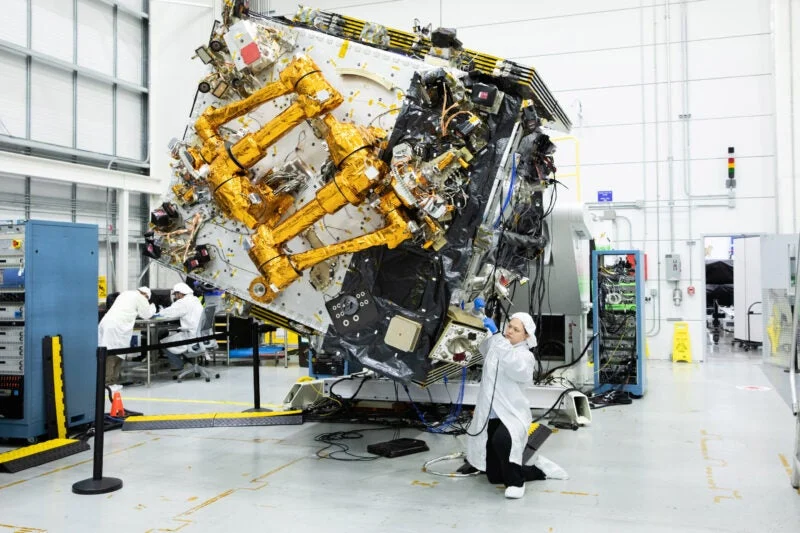

In a significant advancement for the burgeoning orbital logistics sector, Northrop Grumman’s subsidiary, SpaceLogistics, has confirmed it will launch its highly anticipated Mission Robotic Vehicle (MRV) this summer. The announcement, made during a media briefing at the company’s satellite manufacturing facility in Sterling, Virginia, marks a pivotal moment for the In-space Servicing, Assembly, and Manufacturing (ISAM) market. The mission, which will be carried into orbit by a dedicated SpaceX Falcon 9 rocket, represents the next generation of space infrastructure, moving beyond simple life-extension to complex robotic intervention and refueling.
The MRV will not travel alone; it is slated to carry three Mission Extension Pods (MEPs), specialized propulsion devices designed to provide life-extension services for aging satellites in Geostationary Orbit (GEO). This mission serves as the commercial debut of sophisticated robotic servicing, a field that has long been the domain of government-funded research and development but is now rapidly transitioning into a competitive commercial industry. By providing a "toolbox" in space, Northrop Grumman aims to shift the paradigm of satellite operations from "disposable" to "sustainable."
The Mission Robotic Vehicle: A Swiss Army Knife for the Stars
The MRV is the centerpiece of SpaceLogistics’ second-generation servicing architecture. Unlike its predecessors, the Mission Extension Vehicles (MEV-1 and MEV-2), which were designed to dock and stay attached to a client satellite to provide propulsion, the MRV acts as a mobile service hub. It is equipped with two high-dexterity robotic arms developed through a collaboration between Northrop Grumman, the U.S. Naval Research Laboratory (NRL), and NASA.
These arms, combined with a suite of advanced sensors—including visible light cameras, infrared sensors, and LIDAR (Light Detection and Ranging)—allow the MRV to perform high-precision Rendezvous, Proximity Operations, and Docking (RPOD). The vehicle is designed to "grapple" a client satellite by attaching to its liquid apogee engine nozzle, a common feature on most GEO satellites. Once secured, the MRV can install a Mission Extension Pod or perform other maintenance tasks.
According to Rob Hauge, President of SpaceLogistics, the sophistication of the MRV cannot be overstated. While many companies are exploring proximity operations, the act of physical docking and manipulation in the harsh environment of GEO is a feat of engineering that requires extreme precision. The MRV is built with a design life of over 10 years, during which it is expected to service multiple clients, delivering pods and eventually performing refueling operations.
Expanding the Lifespan of GEO Assets: The Mission Extension Pods
The three MEPs launching with the MRV this summer are already spoken for. SpaceLogistics has secured contracts with major international satellite operators, including Australia’s Optus and the global communications giant Intelsat (via SES). These pods are essentially "jet packs" for satellites. Weighing approximately 400 kilograms, they are designed to attach to a 2,000-kilogram GEO satellite and provide an additional six years of station-keeping and orbital control.
The economic logic behind the MEP is compelling. A typical GEO communications satellite costs hundreds of millions of dollars to build and launch. Often, these satellites remain functionally healthy—their transponders and electronics still operational—but they are forced into retirement simply because they have exhausted their onboard fuel. By attaching an MEP, operators can squeeze more revenue out of their existing assets, deferring the massive capital expenditure of a replacement satellite while maintaining service continuity.
The MRV will use its robotic arms to install these pods, then move on to its next mission, leaving the MEP to function independently. This "delivery" model allows the MRV to remain a versatile asset in orbit, capable of responding to new opportunities as they arise.
The Refueling Revolution and the Elixir Mission
One of the most transformative aspects of the MRV program is its focus on on-orbit refueling. In partnership with the U.S. Space Force and the Defense Innovation Unit (DIU), Northrop Grumman has developed the Passive Refueling Module (PRM). This standardized interface is intended to become a "universal gas cap" for future spacecraft.
The U.S. Space Force has recently emphasized a strategy of "maneuver warfare," which requires satellites to have the ability to move frequently to avoid threats or change orbits without the fear of running out of fuel. This concept, often called "maneuvering without regret," is only possible if a refueling infrastructure exists.
The MRV will feature a refueling interface designed for the Space Force’s Elixir mission, which seeks to demonstrate the transfer of hydrazine or other propellants in orbit. Lauren Smith, Northrop Grumman’s program manager for in-space refueling, noted that this infrastructure "opens the aperture" for mission architects. If satellites can be refueled, they can be designed smaller, launched more cheaply, or tasked with more aggressive maneuvers throughout their operational lives.
A Chronology of Innovation: From MEV to MRV
Northrop Grumman’s journey into space servicing began in earnest with the Mission Extension Vehicles.
- February 2020: MEV-1 made history by successfully docking with the Intelsat 901 satellite, which had been moved to a "graveyard" orbit. MEV-1 returned the satellite to service, marking the first time two commercial spacecraft docked in GEO.
- April 2021: MEV-2 achieved a similar feat by docking with Intelsat 10-02 while the satellite was in its active operational orbit, meaning there was no disruption to service for Intelsat’s customers.
- 2023-2024: Development and testing of the MRV and MEPs at the Dulles facility, focusing on miniaturizing the propulsion technology and perfecting the robotic arm integration.
- Summer 2025: Scheduled launch of the MRV via SpaceX.
Following the launch, the MRV will undergo a transit period of approximately one year using its electric propulsion system to reach its target orbit in GEO. Once on station, it will begin the delicate process of deploying its first set of MEPs.
The Economic Landscape: A $15 Billion Opportunity
The drive toward ISAM is fueled by a massive projected market. Research firm Analysys Mason estimates that the global market for in-space servicing, assembly, and manufacturing could reach $15 billion by 2031. This growth is driven by both commercial operators looking for cost efficiencies and government agencies seeking to enhance national security.
James Shoemaker, a program manager at DARPA’s Tactical Technical Office, highlighted the sheer volume of opportunities in GEO. Historically, there are between 20 and 25 "anomalies" or servicing opportunities per year in the GEO belt. These range from deployment failures (where a solar array or antenna fails to open) to the need for standoff inspections or relocation of assets. Having a robotic "mechanic" already in orbit could reduce response times from years (the time it takes to build and launch a new satellite) to weeks or even days.
Competition in the New Space Economy
While Northrop Grumman is a frontrunner, it is not alone in the race to provide orbital services. The market is becoming increasingly crowded with both legacy aerospace firms and agile startups:
- Astroscale: The Japanese-founded company has successfully demonstrated debris removal and is developing the LEXI (Life Extension In-orbit) vehicle.
- Orbit Fab: Known as the "Gas Stations in Space" company, Orbit Fab is working closely with the Department of Defense to establish refueling standards and tankers.
- Infinite Orbits: This French startup recently signed a deal with SES for life-extension services using their Endurance docking vehicle.
- Starfish Space and Impulse Space: Both companies are developing "space tugs" designed for orbital transfers and end-of-life disposal.
This competitive environment is expected to drive down costs and accelerate the adoption of standardized interfaces, making space servicing a routine part of satellite operations.
Broader Implications: Sustainability and Security
The launch of the MRV has implications that extend far beyond the balance sheets of satellite operators. From a sustainability perspective, life extension and repair services are critical for mitigating the growing problem of orbital debris. By keeping satellites operational longer and ensuring they can be safely de-orbited at the end of their lives, companies like SpaceLogistics are helping to preserve the long-term viability of key orbital planes.
From a national security standpoint, the MRV represents a shift toward more resilient space architecture. The ability to inspect a "silent" satellite or repair a damaged one on-orbit provides the U.S. and its allies with a strategic advantage in an increasingly contested domain.
As the MRV undergoes final testing in Virginia, the aerospace community is watching closely. The success of this mission will likely determine the pace at which the world transitions to a circular space economy—one where assets are maintained, upgraded, and refueled rather than abandoned in the dark. Ryan Tintner, Vice President of Northrop Grumman’s Space Superiority Division, summarized the sentiment of the program: "The toolkit that we have right now when there are problems in space is very, very limited. It’s about to be widely expanded."
