
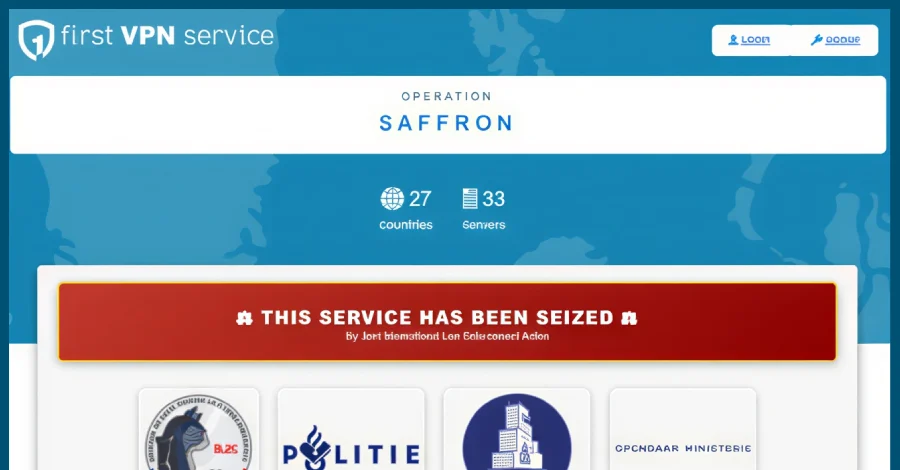

In a sweeping display of international cooperation, law enforcement agencies across Europe and North America have announced the successful dismantling of First VPN Service, a virtual private network (VPN) specifically engineered and widely used by a myriad of criminal actors to conceal the origins of their illicit activities. This significant blow to the cybercrime ecosystem targets a foundational service that provided crucial anonymity for ransomware attacks, extensive data theft, sophisticated network scanning, and disruptive denial-of-service (DoS) campaigns. The operation, which culminated in the seizure of critical infrastructure and the disruption of a long-standing criminal enterprise, underscores the relentless global effort to curb the proliferation of financially motivated cybercrime.
The Anatomy of a Global Operation
The complex investigation into First VPN Service commenced in December 2021, spearheaded by French and Dutch authorities. Over the subsequent months, a formidable coalition of nations joined the effort, including Luxembourg, Romania, Switzerland, Ukraine, the United Kingdom, Canada, Germany, the United States, Spain, Sweden, Denmark, Estonia, Latvia, Lithuania, Poland, and Portugal. This broad participation highlights the transnational nature of modern cybercrime and the indispensable role of cross-border collaboration in countering it.
The operational phase of the takedown unfolded between May 19 and 20, involving a series of meticulously coordinated actions across multiple jurisdictions. These actions included interviewing the service’s administrator, conducting a house search in Ukraine, and crucially, taking down 33 servers that constituted the backbone of First VPN’s hidden infrastructure. The seizure of this infrastructure effectively severed the lifeline for thousands of cybercriminals who relied on the service for their anonymity. Such synchronized actions are critical in preventing criminals from migrating their operations to alternative infrastructure or simply restarting their services elsewhere.
First VPN: A Haven for Cybercriminals
According to Europol, the European Union Agency for Law Enforcement Cooperation, First VPN was not a typical VPN service aimed at privacy-conscious internet users. Instead, it was "designed specifically for criminal use," meticulously crafted to cater to the unique requirements of the illicit underworld. Its business model facilitated anonymous payments, a crucial feature for criminals seeking to evade financial tracking. Furthermore, its sophisticated hidden infrastructure enabled paying customers to obscure their true identities and geographical locations when orchestrating ransomware attacks, executing large-scale fraud schemes, and perpetrating widespread data theft.
The service openly advertised its capabilities on prominent Russian-speaking cybercrime forums, such as Exploit[.]in and XSS[.]is. These forums serve as bustling marketplaces and communication hubs for cybercriminals, where tools and services like First VPN are promoted as essential instruments for evading law enforcement detection. The marketing strategy of First VPN was predicated on promises of unparalleled anonymity, stability, and security. Screenshots captured by the Internet Archive reveal that First VPN explicitly stated, "We do not store any logs that would allow us or third parties to associate an IP address in a specific period of time with the user of our service." It further claimed, "The only data we store is e-mail and username, but it’s impossible to connect the user’s activity on the Internet with a specific user of our service." The service also boldly asserted that it would "not cooperate with any judicial authority" and would "not be subject to any jurisdiction," positioning itself as a "bulletproof" solution for those operating on the fringes of the law.

Ironically, First VPN’s frequently asked questions (FAQ) section contained a disclaimer, stating that it "strictly" prohibited the use of its servers for illicit activities. This contradictory stance, a common tactic among criminal service providers, was an attempt to create a veneer of legitimacy and evade liability, despite the service’s overt design and promotion for criminal purposes. The FAQ even noted, "This facilitates the receipt of complaints about our servers, and as a result, they will be disabled," a clear indication of its awareness of its users’ activities and the potential consequences.
Technical Specifications and Global Footprint
The U.S. Federal Bureau of Investigation (FBI), in a coordinated flash alert, revealed that First VPN Service had been active since approximately 2014, operating for nearly a decade before its takedown. Its extensive network comprised 32 exit node servers strategically distributed across 27 countries, providing a truly global reach for its criminal clientele. The presence of three exit nodes within the United States underscored the direct threat it posed to American interests and cybersecurity.
Beyond the U.S., its exit nodes were spread across a vast geographical area, including Australia, Austria, Belgium, Canada, Cyprus, Finland, France, Germany, Hong Kong, Italy, Latvia, Luxembourg, Moldova, the Netherlands, Panama, Poland, Romania, Russia, Serbia, Singapore, Spain, Sweden, Switzerland, Turkey, Ukraine, and the U.K. This broad distribution allowed cybercriminals to launch attacks from seemingly disparate locations, complicating attribution and defensive efforts for targeted organizations and law enforcement agencies alike.
First VPN offered a diverse array of connection protocols, including OpenConnect, WireGuard, Outline, and VLess TCP Reality, catering to various operational needs of its users. It also supported multiple encryption options, such as OpenVPN ECC, L2TP/IPSec, and PPtP. A particularly insidious feature highlighted by the FBI was its offering of "VLESS" and "Reality" protocols, which possessed the advanced capability to disguise VPN internet traffic as standard HTTPS traffic. This technique allowed criminals to cloak their malicious communications, making them appear as innocuous web browsing over commonly used ports, thereby bypassing many network security measures and firewalls. Technical support for its users was also provided through a self-hosted Jabber server and the Telegram encrypted messaging service, further enhancing the anonymity and operational security for its criminal subscribers.
Fueling the Cybercrime Epidemic
The true scale of First VPN’s impact on the cybercrime landscape is staggering. Law enforcement intelligence indicates that no less than 25 distinct ransomware groups, including the notorious Avaddon Ransomware, extensively utilized First VPN’s infrastructure. These groups leveraged the service for critical stages of their operations, from initial network reconnaissance and penetration to the exfiltration of stolen data and the deployment of ransomware payloads.
The service offered flexible subscription durations, ranging from a single day to a full year, with prices varying accordingly. A one-day subscription cost as little as $2, while a year-long plan could reach $483. This tiered pricing structure made the service accessible to a wide spectrum of cybercriminals, from individual fraudsters to sophisticated organized crime syndicates. Payments were accepted through various cryptocurrency and anonymized digital payment platforms, including Bitcoin, Perfect Money, Webmoney, EgoPay, and InterKass, further reinforcing the service’s commitment to financial obfuscation.

The availability of such "bulletproof" services has played a critical role in the exponential growth of ransomware and other cybercrimes in recent years. Ransomware attacks alone have inflicted immense financial and operational damage globally, with costs running into billions of dollars annually. For instance, reports from cybersecurity firms and government agencies frequently highlight the significant financial impact of ransomware, with the U.S. Treasury Department estimating that ransomware payments in the U.S. reached nearly $1.2 billion in 2021, and the overall global cost of cybercrime projected to reach trillions. Services like First VPN have acted as crucial enablers, providing the essential layer of anonymity that allows criminals to operate with perceived impunity.
Broader Implications and the Road Ahead
The takedown of First VPN Service sends a strong message to the cybercriminal underworld: no service designed to facilitate illegal activities is truly "bulletproof" or beyond the reach of international law enforcement. This operation marks another significant victory in the ongoing battle against cybercrime, following similar successes against other illicit VPN and hosting services such as VPNLab, Safe-Inet, and DoubleVPN in recent years. These repeated disruptions demonstrate an evolving and increasingly effective strategy by law enforcement to target the underlying infrastructure that supports criminal enterprises, rather than merely chasing individual perpetrators.
The immediate impact of this operation will be a significant disruption to the ongoing activities of the ransomware groups and other cybercriminals who relied on First VPN. They will now be forced to scramble for alternative solutions, potentially exposing themselves to greater risks as they migrate to less secure or less established services. This creates a window of opportunity for law enforcement to gather further intelligence and identify more actors within the criminal ecosystem.
For the broader cybersecurity landscape, this takedown reinforces the critical importance of international cooperation. Cybercrime transcends national borders, making coordinated multi-jurisdictional efforts absolutely essential for effective enforcement. Agencies like Europol and Eurojust play pivotal roles in facilitating this cooperation, enabling the complex legal and technical coordination required for such operations.
However, the fight is far from over. The cybercrime landscape is dynamic, and new "bulletproof" services will undoubtedly emerge to fill the void left by First VPN. The cat-and-mouse game between law enforcement and cybercriminals will continue, necessitating constant vigilance, innovation, and sustained international collaboration. This operation also serves as a crucial reminder for legitimate users of VPN services to exercise due diligence in choosing reputable providers that adhere to ethical standards and legal frameworks, distinguishing them clearly from those explicitly designed to aid and abet criminal activities.
Looking forward, law enforcement agencies are expected to continue their focus on dismantling the infrastructure that underpins organized cybercrime. This includes not only criminal VPNs but also illicit hosting providers, cryptocurrency mixers, and other anonymizing services. The increasing sophistication of cybercrime demands an equally sophisticated and unified response from the global community, leveraging intelligence sharing, advanced forensic capabilities, and robust legal frameworks to protect citizens and critical infrastructure from the pervasive threat of digital criminality. The successful disruption of First VPN is a testament to the growing resolve and capability of the international community to counter these evolving threats.
