
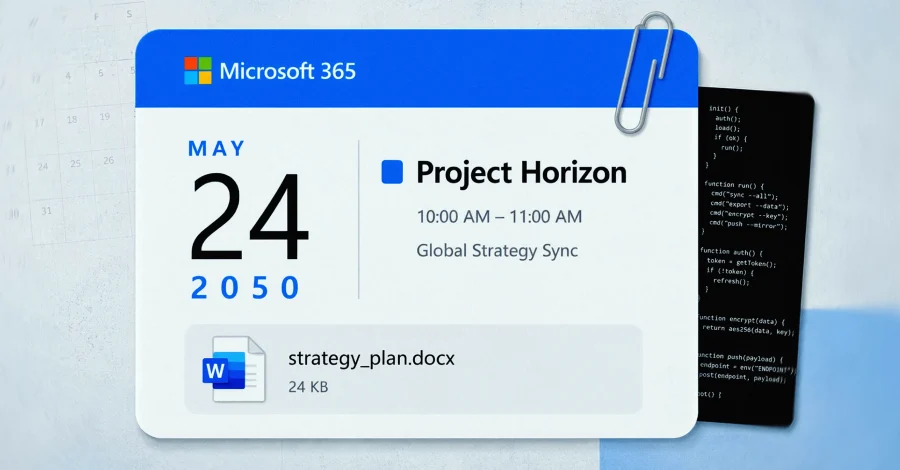

A sophisticated new espionage implant, dubbed HollowGraph by cybersecurity researchers at Group-IB, has been identified exploiting a highly unconventional and stealthy method for command and control (C2). The malware ingeniously uses a compromised Microsoft 365 calendar as its operational hub, embedding operator instructions and exfiltrating stolen data as attachments within calendar events scheduled for the year 2050. This innovative approach allows the threat actor to blend malicious communications seamlessly within legitimate Microsoft Graph API traffic, rendering traditional network security controls largely ineffective as they are typically keyed to flag attacker-owned destinations.
HollowGraph’s Deceptive Mechanics: A Deep Dive into the Calendar "Dead Drop"
The core of HollowGraph’s operational cunning lies in its abuse of the Microsoft 365 calendar function. Group-IB’s analysis reveals that this implant is a .NET Dynamic Link Library (DLL) designed with minimalist efficiency, supporting only two primary commands: get and send. Crucially, it never initiates communication with an external, attacker-controlled server for its payloads. Instead, it transforms the compromised mailbox’s calendar into a two-way "dead drop" – a clandestine communication method where information is left at a pre-arranged location for retrieval by another party, minimizing direct contact.
To receive tasking, HollowGraph queries the victim’s calendar for a specific event planted by the operator. This event is strategically buried on May 13, 2050, a date so far into the future that the legitimate mailbox owner is highly unlikely to ever scroll to or even notice it. The malware then extracts its instructions from a file attached to this future calendar event. The exfiltration process operates in reverse: once a file is stolen from the victim’s system, HollowGraph encrypts it, creates its own new calendar event similarly far in the future, and uploads the sensitive data as one or more attachments to this event.
Every piece of information, whether incoming tasking or outgoing stolen data, is meticulously wrapped in a robust hybrid encryption scheme combining RSA and AES-256. This dual-key system employs separate key pairs for encrypting incoming instructions and outgoing data, further enhancing the security and secrecy of the clandestine communications. The brilliance of this technique lies in its ability to masquerade as routine Microsoft 365 chatter. By leveraging the Microsoft Graph API – the gateway to data and intelligence in Microsoft 365 – the malware’s activity appears as normal interactions within the cloud environment, making it exceedingly difficult for conventional security tools to distinguish malicious actions from legitimate user or application behavior. This "living off the land" technique, where attackers utilize existing, trusted tools and services, represents a significant challenge for modern cybersecurity defenses.
The Understated Secondary DNS Channel for Persistent Access
Beyond the primary calendar-based C2, HollowGraph maintains a cruder, yet vital, secondary channel to ensure persistent access and operational longevity. This channel operates over the Domain Name System (DNS) and is responsible for refreshing the application’s Entra ID (formerly Azure AD) login details. These critical credentials include the tenant ID, client ID, client secret, and the target mailbox.
The implant decodes these values from IPv6 AAAA records that are specifically sent back by an attacker-controlled domain, cloudlanecdn[.]com. Upon successful decoding, these refreshed credentials are then written to a file named logAzure.txt. This file is deliberately disguised to appear as a routine log file, further aiding in its stealth. It is important to note that these stored credentials are client-credentials, not temporary access tokens, granting long-term access. Unlike the meticulously encrypted calendar traffic, this DNS-based channel operates in the clear, meaning the refresh process itself is unencrypted. While seemingly less secure, its function as a backstop for maintaining Graph API access highlights the attacker’s focus on resilience and persistence within the compromised environment. The use of DNS for C2 is a well-documented technique, often chosen for its ability to bypass many network firewalls and proxies, as DNS traffic is typically considered essential and allowed.

Attribution and Link to the Cavern Manticore Framework
Group-IB has established a high-confidence link between HollowGraph and the Cavern modular backdoor framework. This attribution is based on compelling evidence, including shared command syntax and matching internal tasking mechanisms observed in both malware variants. The Cavern framework was previously documented earlier this month by Check Point Research, which attributed it to an Iranian Ministry of Intelligence and Security-linked actor group they named Cavern Manticore. This group is believed to overlap significantly with other known Iranian state-sponsored cyber espionage groups, specifically MuddyWater and Lyceum.
MuddyWater, also known as Static Kitten, Mercury, or Seedworm, is a prolific Iranian threat actor group that has been active since at least 2017, primarily targeting Middle Eastern organizations and occasionally entities in Europe and North America. Their activities typically involve spear-phishing campaigns, deploying various custom backdoors, and focusing on espionage. Lyceum, also known as Hexane, is another Iranian-linked group known for targeting energy and telecommunications sectors in the Middle East, with a focus on collecting sensitive information. It is often considered a subgroup of the larger OilRig (APT34) collective.
Despite the strong technical link to the Cavern framework and its associated Iranian threat actors, Group-IB has exercised caution in directly naming the operator behind the HollowGraph campaign. The firm explicitly stated, "Based on the evidence currently available, we cannot confidently attribute this activity to any previously identified threat actor." While acknowledging a low-confidence overlap with Lyceum, a subgroup of the Iranian actor OilRig, Group-IB emphasizes that their firm link is to the code itself, rather than directly to a specific crew or named group. The compromised exfiltration mailbox was found to belong to an Israeli organization, a common target for Iranian state-sponsored groups; however, Group-IB treats this victim geography as an indicator of targeting rather than definitive attribution of the threat actor. This level of prudence in attribution is standard practice in cybersecurity research, reflecting the complexities of definitively linking specific malware campaigns to human operators, especially when sophisticated nation-state actors are involved.
Scope and Intent: A Case of Targeted Espionage
The deployment footprint of HollowGraph, as observed by Group-IB, was notably small and highly selective. The implant was discovered on at least 12 machines, with only approximately three of these actively communicating with the attacker during the analysis window, which spanned from June 3 to July 9, 2026. This limited and focused deployment suggests a highly targeted espionage operation rather than an opportunistic, widespread criminal endeavor. Nation-state actors often prioritize precision and stealth over broad reach, aiming to extract specific intelligence from high-value targets.
The narrow victim activity window, though extending into a future date, indicates a campaign that was actively operational relatively recently, underscoring the immediate relevance of this discovery. While the technique employed by HollowGraph could theoretically be reused far more widely across numerous campaigns, its current application points to a discerning operator focused on specific intelligence objectives. This pattern aligns with the modus operandi of state-sponsored groups, which typically conduct reconnaissance, gain initial access, and then deploy custom tools tailored to specific targets for long-term data exfiltration or strategic disruption.
The Evolving Landscape of Command and Control: Abusing Legitimate Cloud Services
The emergence of HollowGraph underscores a significant and accelerating trend in the cyber threat landscape: the abuse of legitimate cloud services for command and control. Threat actors are increasingly shifting away from traditional C2 infrastructures that rely on attacker-owned domains and IP addresses, which are easier for security solutions to blacklist. Instead, they are "living off the land" within trusted cloud platforms like Microsoft 365, Google Drive, Dropbox, Slack, and even social media platforms.

This strategy offers several distinct advantages for attackers:
- Stealth and Evasion: Malicious traffic blends seamlessly with legitimate network activity, as it originates from and communicates with trusted domains (e.g.,
microsoft.com,google.com). This makes it extremely difficult for traditional perimeter defenses, such as firewalls and intrusion detection systems, to differentiate between benign and malicious data flows. - Bypass of Network Controls: Many organizations configure their network proxies and firewalls to allow unrestricted access to major cloud services, recognizing their necessity for business operations. Attackers exploit this trust, knowing their C2 traffic will likely pass unimpeded.
- Persistence and Resilience: Cloud services are highly available and resilient, providing a stable C2 infrastructure that is less prone to takedown efforts compared to custom-built infrastructure.
- Leveraging Familiar APIs: Attackers can use legitimate APIs (like the Microsoft Graph API) to interact with the cloud service, further mimicking normal application behavior.
- Data Exfiltration: These services naturally support file uploads and sharing, making them ideal for covert data exfiltration without raising suspicion.
This is not a novel concept; attackers have previously demonstrated similar techniques by leveraging Outlook inboxes, draft folders, and OneDrive accounts for C2. HollowGraph’s use of far-future calendar events is simply the latest iteration of this evolving cat-and-mouse game, pushing the boundaries of stealth by exploiting a rarely inspected corner of a ubiquitous business application. The calendar, particularly events decades away, represents an ingenious "blind spot" that defenders traditionally have had no reason to scrutinize.
Implications for Cybersecurity and Proactive Defense Strategies
Crucially, the HollowGraph implant does not exploit a Microsoft software vulnerability. There is no patch to deploy because the malware rides on compromised account credentials and the normal, intended functionality of the Graph API. This fundamental characteristic shifts the burden of defense from vulnerability patching to a more holistic approach centered on identity, application permissions, and advanced monitoring capabilities.
Key Areas for Enhanced Defense:
- Robust Identity and Access Management (IAM): Since HollowGraph relies on compromised account credentials, strengthening IAM practices is paramount. This includes implementing multi-factor authentication (MFA) across all accounts, especially for administrative and privileged users. Regular credential rotation and enforcing strong password policies are also essential.
- Application Permission Governance: Organizations must meticulously audit and restrict the client-credential OAuth applications that have access to the Microsoft Graph API. Many organizations inadvertently grant overly broad permissions to third-party applications or custom scripts, creating avenues for abuse. Permissions should always adhere to the principle of least privilege. Alerting mechanisms for newly created client secrets or changes in application permissions are critical.
- Advanced Cloud Monitoring and Auditing: Traditional network monitoring is insufficient. Defenders must implement deep monitoring within their Microsoft 365 environments.
- Calendar Activity: Group-IB’s detection advice specifically highlights suspicious calendar events. Security teams should hunt for events characterized by:
- Lack of attendees.
- Unusually long subject lines.
- Multiple attachments.
- Dates far in the future (e.g., 2050-05-13, or any date decades away).
- Encrypted content within attachments or event descriptions.
- Microsoft Graph and Mailbox Activity: Audit logs for Microsoft Graph and mailbox activity should be continuously monitored for application-driven calendar changes. This includes events created, attachments uploaded, or subjects renamed by an application rather than a human user. Anomalous patterns, such as an application creating numerous future calendar events, should trigger alerts.
- Entra ID (Azure AD) Hygiene: Beyond credential management, organizations should deploy Conditional Access policies to restrict access based on location, device, or other contextual factors. Anomalous token detection, which flags unusual usage patterns of access tokens, is also a vital security layer.
- Calendar Activity: Group-IB’s detection advice specifically highlights suspicious calendar events. Security teams should hunt for events characterized by:
- DNS Monitoring and Threat Intelligence Integration: While the DNS channel runs in the clear, it offers specific indicators. Security operations centers (SOCs) should monitor DNS traffic for unusually frequent AAAA queries and the presence of long, high-entropy subdomains pointing to a single suspicious domain, such as
cloudlanecdn[.]com. Integrating threat intelligence feeds that include indicators of compromise (IoCs) like this domain and the specificlogAzure.txtconfig file hash, as provided in Group-IB’s full report, is a fast first pass for detection. - User Awareness and Training: Since initial compromise often begins with phishing or credential theft, ongoing user awareness training is crucial. Employees should be educated on how to spot sophisticated phishing attempts and the importance of reporting suspicious activities.
Broader Impact and Conclusion
The HollowGraph discovery serves as a stark reminder that the battleground for cybersecurity is increasingly shifting into the cloud. As businesses migrate more of their operations and data to cloud platforms, the attack surface expands, and traditional security paradigms become less effective. The stealth and sophistication of techniques like HollowGraph necessitate a proactive and adaptive security posture. Organizations can no longer assume that traffic to legitimate cloud services is inherently safe.
The ongoing nature of the campaign, with victim traffic flowing as recently as July 9, 2026, underscores the immediate need for organizations leveraging Microsoft 365 to scrutinize their environments. Specifically, the "far-future" calendar entries are an immediate and critical inspection point that warrants prompt investigation. Cybersecurity experts consistently warn that the industry must evolve beyond perimeter-centric defenses to embrace a zero-trust model, continuous monitoring of cloud environments, and robust identity governance. The HollowGraph implant is a compelling example of why this evolution is not merely a recommendation but an imperative for protecting sensitive data in an increasingly cloud-dependent world.
