

In the rapidly evolving landscape of artificial intelligence, the promise of autonomous agents capable of performing complex tasks by interacting with various tools has captivated industries worldwide. However, initial enthusiasm often confronts a stark reality: as the number of tools an AI agent can access expands, its accuracy and efficiency in selecting the correct tool for a given task degrade significantly. This critical challenge, often overlooked in early development phases, is not an edge case but a default trajectory for agents deployed in real-world, dynamic environments. New research and practical techniques are now emerging to ensure AI agents remain precise and efficient even as their tool catalogs grow exponentially, offering a smarter approach that doesn’t rely on simply employing larger models.
The Emergence of AI Agents and Their Scaling Challenges
The journey of an AI agent often begins with a streamlined demonstration, performing flawlessly with a limited set of perhaps five tools. Yet, as these agents transition from prototype to production, their operational scope inevitably broadens. Within months, an agent might integrate 40 file operations, CRM access, Slack integration, calendar management, and multiple search APIs tailored for diverse teams. This expansion, while indicative of enhanced capabilities, frequently leads to a dramatic decline in performance. The once-flawless agent may begin to call incorrect tools, hallucinate parameters from unrelated schemas, or stall mid-task due to erroneous tool invocations.
The core issue isn’t a sudden change in the underlying large language model (LLM); rather, it’s the sheer volume and complexity of the tool list presented to it. Research consistently shows that agent accuracy measurably diminishes once the number of active tools surpasses a threshold of roughly 10 to 15. A seminal paper, the RAG-MCP framework, published in May 2025, provided empirical evidence for this decline, but also offered a robust solution. This research highlighted that retrieval-based tool selection could more than triple tool selection accuracy, from a meager 13.62% to a robust 43.13%, while simultaneously reducing prompt tokens by over half on identical benchmark tasks. This finding underscores that intelligent tool selection is not a minor implementation detail to be patched later, but a foundational architectural decision determining an agent’s viability and longevity in a real-world tool ecosystem.
Understanding the Root Causes of Tool Selection Failure at Scale
The degradation of tool selection accuracy at scale stems from fundamental limitations in how LLMs process vast amounts of information within their context window. Each tool’s definition—encompassing its name, description, and parameter schema—must be transmitted to the model with every request, regardless of whether that specific tool is ultimately used. With a catalog of 50 or more tools, this metadata can consume 5% to 7% of the model’s precious context window even before the user’s actual query arrives. This "crowding out" effect reduces the space available for conversation history and complex reasoning, both crucial for effective task execution.
A compounding factor is the "lost in the middle" phenomenon, where LLMs exhibit superior recall for information positioned at the beginning and end of a context window, while struggling with information buried in the middle. When dozens of functionally similar tool definitions are stacked in sequence, the precisely correct tool can often reside in this "dead zone," overlooked not due to a failure in the model’s reasoning capabilities, but because its attention is structurally diverted elsewhere.
The second, and perhaps more critical, failure mode is tool hallucination. As an LLM’s attention is spread thin across numerous similar-sounding tools, it may invent non-existent tool names or invoke the correct tool but populate its arguments with parameters erroneously borrowed from a different tool’s schema. Such errors represent hard failures, as there is no "slightly wrong" way to call a function that doesn’t exist or to use incorrect arguments, leading to immediate task breakdown and a poor user experience. While OpenAI documents a theoretical hard ceiling of 128 tools per agent, practical experience from production teams reveals a noticeable drop in accuracy much earlier, typically around 15 to 20 tools in active rotation. The solution, therefore, is not merely to expand the context window of models, but to intelligently control what information the model sees in the first place.
A Multi-Layered Approach to Intelligent Tool Selection
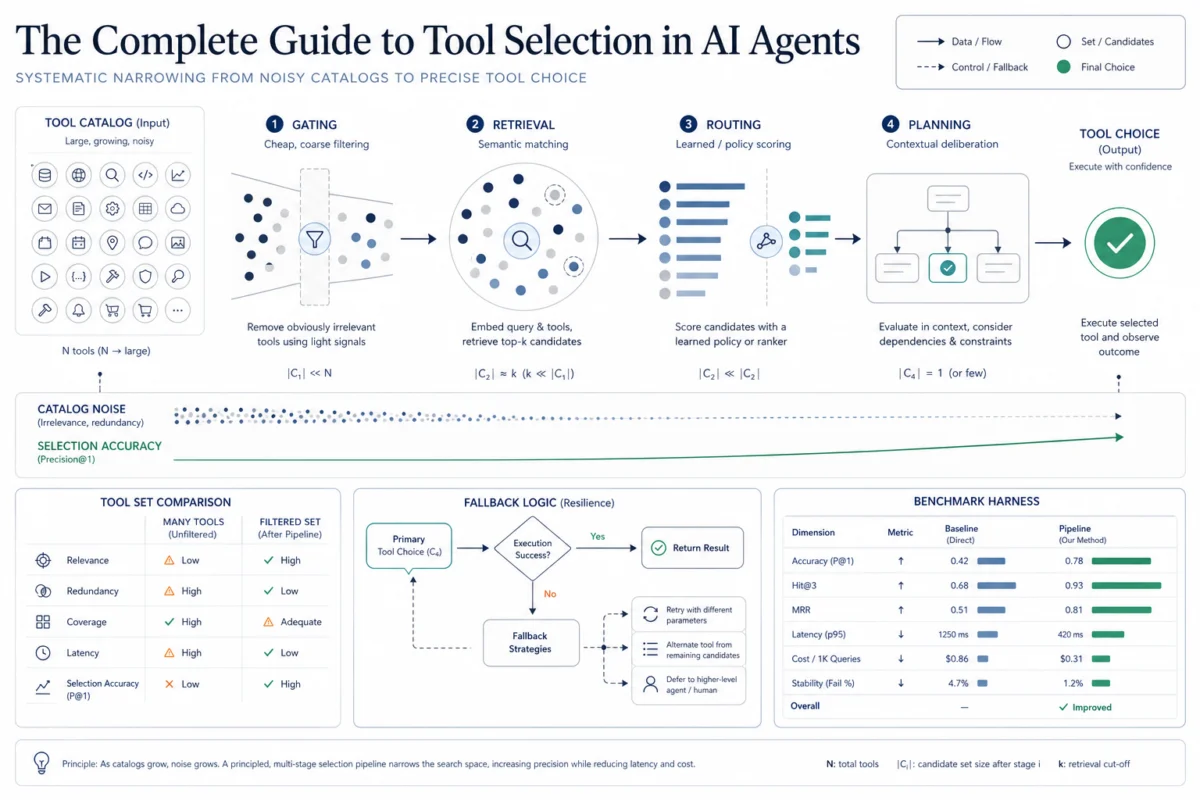
Recognizing these challenges, the AI development community has converged on a suite of six practical techniques designed to enhance tool selection accuracy and efficiency. These strategies are best deployed as layers in a cohesive architecture, rather than competing alternatives:
1. Gating: The Initial Filter for Conversational Turns
Before engaging in complex tool selection logic, the most economical step is to determine if a tool is even necessary for the current conversational turn. A significant portion of agent-user interactions are purely conversational—simple acknowledgments ("thanks"), clarifications ("what do you mean by that?"), or follow-up questions. Running a full retrieval and tool-selection pipeline for such turns incurs unnecessary latency and token costs.
Gating acts as a fast, inexpensive classifier, often a small model call or simple pattern matching, that executes before any more resource-intensive processes. By identifying purely conversational exchanges, gating short-circuits the pipeline, saving computational resources and improving response times. If even 20-30% of an agent’s interactions are conversational, the implementation of a robust gating mechanism immediately yields substantial benefits in both latency and token expenditure, demonstrating its value as a foundational efficiency layer.
2. Retrieval-Based Tool Selection: Precision through Relevance
This technique, backed by compelling empirical evidence, revolutionizes tool selection by moving away from presenting the entire tool catalog to the LLM. Instead, tool descriptions are indexed in a vector store, and the incoming user query is embedded. Only the top-K most semantically relevant tools are then retrieved and presented to the LLM.
The RAG-MCP framework serves as a leading example of this approach. By employing semantic retrieval to pre-filter the vast catalog of MCP (Multi-Component Protocol) tools, it ensures the LLM interacts with a highly curated and relevant subset. The impact of this filtering is profound: the aforementioned study showed tool selection accuracy surging from 13.62% to 43.13%, while simultaneously achieving over a 50% reduction in prompt tokens. This method fundamentally improves accuracy because the LLM is no longer overwhelmed by a deluge of options but instead focuses on a handful of genuinely relevant candidates, reducing cognitive load and the likelihood of errors. For a 15-tool catalog, filtering to the top-3 relevant tools can result in an 80% reduction in the tool definitions sent to the model, leading to both cost savings and a significant accuracy boost.
3. Semantic Routing: Categorizing for Efficiency
While retrieval excels at identifying specific tools from a flat list, semantic routing addresses a different, complementary problem: directing a query to the most appropriate "toolbox" or category of tools. This approach is particularly effective when an agent’s tools naturally cluster into distinct functional domains, such as data operations, communication, or scheduling.
Semantic routing uses a classifier to determine the relevant tool category first. Once a category is identified, only the tools belonging to that specific category are loaded and considered. This pre-categorization prevents the LLM from sifting through irrelevant tools, further narrowing the search space. For instance, a query related to "scheduling a meeting" would be routed to the "scheduling" toolbox, ignoring all data and communication tools. A crucial aspect of robust routing is its ability to gracefully handle ambiguous or out-of-scope queries. A well-designed router should include a fallback mechanism to a "general" category or to seek clarification when confidence in a specific category match is low. This prevents the system from making low-confidence, potentially incorrect selections, prioritizing reliability over forced action.
4. Planner-Based Tool Selection: Orchestrating Complex Tasks
For multi-step tasks that require a sequence of tool calls, a single-turn retrieval or routing mechanism is insufficient. The "God Agent anti-pattern," where a monolithic agent attempts to manage a large, undifferentiated set of tools for an entire complex task, is notoriously brittle. A failure at any point can derail the entire process.
Planner-based tool selection mitigates this by first asking the LLM to output a structured plan. This plan outlines an ordered list of subtasks, each explicitly tagged with the specific capability it requires. Once the plan is established, tools are retrieved and executed on a step-by-step basis, scoped only to the capabilities required for that particular step. For example, a task like "Summarize the latest sales report and email it to the sales lead" might be broken down into: 1) "Search for sales report" (requiring ‘search’ capability), 2) "Read report file" (requiring ‘file_io’ capability), 3) "Summarize key findings" (requiring ‘synthesis’ capability), and 4) "Email summary" (requiring ‘communication’ capability). This modular approach ensures that each step operates with a minimal, highly relevant toolset, making the overall process more robust, transparent, and debuggable.
5. Robust Fallback Logic: Ensuring Graceful Degradation
Even with advanced gating, retrieval, routing, and planning, real-world queries can be ambiguous, underspecified, or genuinely outside the agent’s current tool catalog. How an agent responds to low-confidence matches is critical for user experience and system reliability. Simply crashing or making a "confidently wrong" tool call is far more detrimental than admitting uncertainty.
A robust fallback chain typically involves three tiers:
- High Confidence Resolution: If the initial tool selection yields a high confidence score, the tool is invoked directly.
- Low Confidence Retry: If confidence is low, the system attempts to reformulate the query (e.g., by stripping filler words or asking an LLM to rephrase the intent) and retries the tool selection. This second attempt can often resolve ambiguities.
- Escalation to Clarification: If even the reformulated query fails to produce a high-confidence match, the system escalates by prompting the user for clarification. This "I’m not sure, could you clarify?" approach prevents erroneous actions and allows the user to guide the agent, making the failure recoverable within a single turn, unlike the cascading failures of an incorrect tool call. Implementing this escalation path is paramount for building truly resilient AI agents.
6. Benchmarking Your Tool Selection System: The Empirical Imperative
All the architectural enhancements and theoretical benefits remain hypotheses until empirically validated. Benchmarking is the critical final step to objectively measure the impact of these strategies. The methodology involves creating a labeled dataset of (user query, correct tool) pairs, against which the agent’s tool selection pipeline is evaluated. Key metrics to track include:
- Accuracy: The percentage of queries for which the correct tool (or relevant set of tools) is identified.
- Token Cost: The average number of tokens consumed per query, reflecting the efficiency of the context window usage.
- Latency: The time taken to process a query and select a tool, crucial for real-time applications.
By comparing the performance of a filtered, optimized pipeline against a naive baseline (where the full catalog is presented every time), developers can quantify improvements. Benchmarks like MCPToolBench++, a comprehensive dataset built from over 4,000 real MCP servers, exemplify the rigor required for large-scale evaluation. Even for smaller, custom agents, adopting this disciplined benchmarking approach ensures that changes genuinely improve performance rather than merely offering a "feeling" of betterment. Initial tests often reveal significant reductions in average tokens per query (e.g., 70% reduction) while maintaining or improving accuracy, proving the tangible benefits of intelligent tool selection.
Broader Implications and Future Outlook
These six techniques are not isolated options but synergistic layers that collectively form a robust architecture for scalable AI agents. Gating provides the initial, cheap filter; retrieval and routing intelligently narrow down options; planning structures multi-step tasks; fallback logic ensures graceful recovery; and rigorous benchmarking validates every improvement. The findings from frameworks like RAG-MCP, showcasing a dramatic increase in accuracy and a substantial decrease in token usage, are not anomalies. They represent the predictable outcome of moving beyond a brute-force approach to tool selection.
The era of merely appending tools to an ever-growing list and expecting an LLM to magically handle the complexity is drawing to a close. The future of enterprise AI and autonomous agents hinges on treating the tool list itself as a meticulously designed component of the overall system. By applying these intelligent design principles, developers can unlock the true potential of AI agents, transforming them from impressive demos into reliable, efficient, and scalable workhorses capable of navigating the intricate demands of real-world applications without requiring ever-larger models or context windows. This shift in paradigm ensures that AI agents can not only grow in capability but also maintain their precision and trustworthiness, paving the way for their widespread and impactful adoption across industries.
