

Amazon Web Services has introduced a major operational enhancement for Amazon Aurora PostgreSQL, allowing database administrators and software developers to query data lake storage formats directly from their transactional databases. By embedding the high-performance analytical query processing efficiency of DuckDB directly into the Aurora PostgreSQL architecture, AWS has removed a longstanding technical barrier that previously forced organizations to build and maintain complex Extract, Transform, and Load pipelines. The feature, available immediately across all commercial AWS regions and AWS GovCloud environments at no additional base cost, supports data stored in Apache Iceberg and Apache Parquet formats on Amazon S3, S3 Tables, and external data catalogs compatible with the Iceberg REST Catalog standard.
Elimination of Traditional Data Silos and ETL Pipelines
For decades, enterprise data architectures have maintained a strict division between operational databases—optimized for high-frequency transactional processing (OLTP)—and analytical data lakes, designed for heavy computational queries, historical archiving, and business intelligence (OLAP). Bridging this divide has traditionally required reverse-ETL mechanisms, nightly batch jobs, or specialized data replication services to move historical or aggregated data from cloud object storage into operational instances.
These legacy pipelines introduce significant friction. They generate infrastructure costs, consume engineering hours for maintenance and synchronization, and increase data latency. Furthermore, as organizations increasingly adopt generative artificial intelligence systems and autonomous agents, the limitations of traditional architectures become acute. AI agents require simultaneous, real-time access to live transactional records—such as uncommitted writes or recent customer interactions—and deep historical context. Pre-replicating every conceivable dataset an AI agent might query is practically impossible, leading to fragmented application logic and degraded performance.
The newly deployed capability within Aurora PostgreSQL bridges this gap. By unifying live operational data and archived data lakes under a single, familiar SQL interface, applications can execute complex joins, aggregations, and filtering operations across both storage tiers without duplicating bytes or crossing unnecessary network boundaries.
Integration of DuckDB Technology and System Architecture
The technical foundation of this capability stems from the recent integration of DuckDB technology into Amazon Web Services following the acquisition of the DuckDB maintenance team, DuckLabs. DuckDB is widely recognized within the data engineering community for its vectorized query execution engine and optimized performance on analytical workloads.

By embedding DuckDB directly within the Aurora PostgreSQL process space, query execution remains local to the database instance. When a user submits a query involving external data lake resources, Aurora orchestrates the execution plan by routing analytical scans of Parquet or Iceberg files through the embedded DuckDB engine, while utilizing PostgreSQL’s native engine for operational tables.
To optimize performance and minimize resource consumption, Aurora applies advanced optimization techniques, including predicate pushdown and column pruning. Predicate pushdown ensures that filtering conditions—such as date ranges or specific customer identifiers—are evaluated as close to the storage layer as possible, dramatically reducing the volume of data transferred from Amazon S3. Column pruning ensures that only the columns explicitly requested in the query are loaded and processed.
Additionally, frequently accessed metadata and data lake segments are cached locally within the Aurora instance, accelerating subsequent query execution. Administrators can inspect the operational efficiency of these queries using the newly introduced aurora_analytics_stat_statements() function, which provides granular metrics including scanned row counts, bytes read from Amazon S3, and cache hit ratios.
Compatibility and Configuration Workflow
The direct querying feature is supported natively on two major releases of Amazon Aurora PostgreSQL: Version 17 (beginning with release 17.11) and Version 18 (beginning with release 18.6).
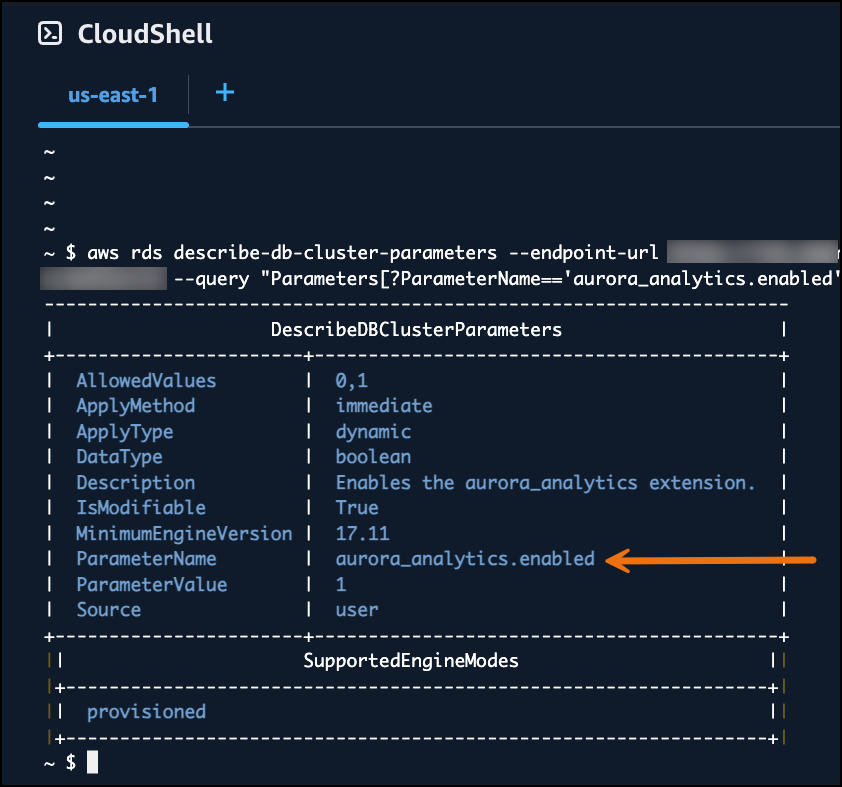
Implementation requires a straightforward configuration sequence. Administrators must first establish an AWS Identity and Access Management role granted with the AuroraAnalytics policy, which authorizes the database cluster to securely read data from designated Amazon S3 buckets and the AWS Glue Data Catalog. Following this, the administrator activates the capability within the database via a standard SQL command:
CREATE EXTENSION aurora_analytics;Once the extension is active, users define foreign tables that point directly to the target Parquet or Iceberg files stored in object storage. For instance, a financial institution maintaining a table of recent transactions inside Aurora can combine it with five years of historical transaction records stored in a Parquet file on S3 by executing a statement such as:

CREATE FOREIGN TABLE transaction_history ()
SERVER aurora_analytics_server
OPTIONS (
    location 's3://enterprise-finance-bucket/transaction_history.parquet',
    format 'parquet'
);
A notable feature of this implementation is schema inference. By utilizing empty parentheses in the CREATE FOREIGN TABLE declaration, Aurora automatically reads the underlying schema metadata directly from the Parquet or Iceberg file, eliminating the administrative overhead of manual schema definition. For large-scale data lake environments containing numerous assets, administrators can execute an IMPORT FOREIGN SCHEMA command to bulk-create foreign tables automatically for an entire AWS Glue Data Catalog database.
Furthermore, federation support extends beyond native AWS services. Through AWS Glue Data Catalog federation, organizations can register external Iceberg REST Catalog-compatible catalogs with Glue once. Aurora can then query these external assets seamlessly, enabling unified queries across multi-cloud or hybrid data estates without altering existing catalog investments or duplicating underlying files.
Practical Application and Materialization Options
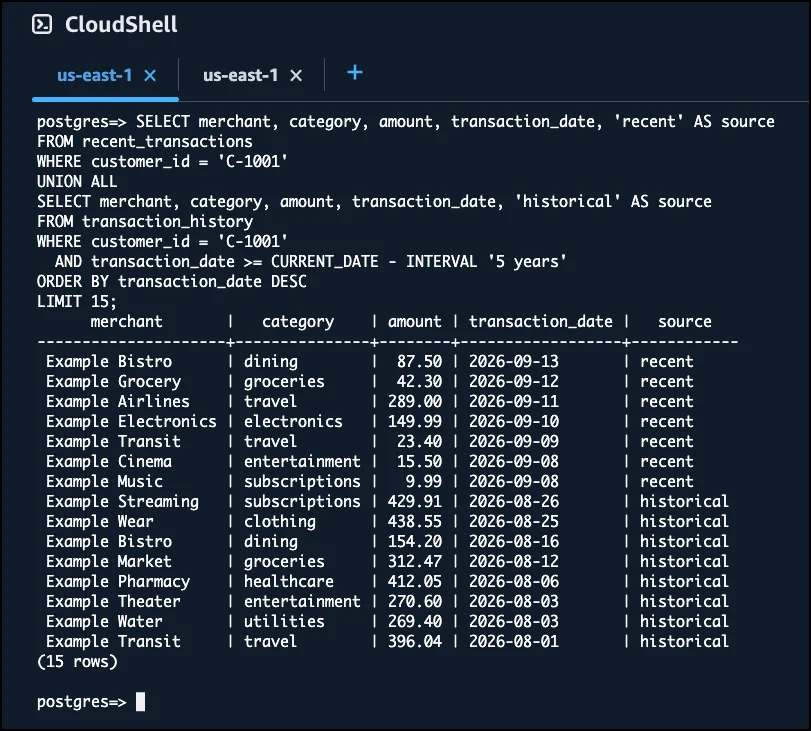
The practical utility of this architecture is demonstrated in scenarios requiring multi-tiered data analysis. For example, a unified query can combine live operational records from the past seven days with historical archives spanning multiple years:
SELECT merchant, category, amount, transaction_date, 'recent' AS source
FROM recent_transactions
WHERE customer_id = 'C-1001'
UNION ALL
SELECT merchant, category, amount, transaction_date, 'historical' AS source
FROM transaction_history
WHERE customer_id = 'C-1001'
  AND transaction_date >= CURRENT_DATE - INTERVAL '5 years'
ORDER BY transaction_date DESC
LIMIT 15;
In this execution model, the database engine retrieves the most recent records directly from operational memory and disk storage, while simultaneously scanning the historical Parquet files on Amazon S3 via DuckDB, presenting a seamless, consolidated result set to the calling application.
For workloads demanding single-digit-millisecond latency for hot analytical data, Aurora provides native materialization pathways. Using standard SQL commands such as CREATE TABLE AS SELECT, INSERT INTO ... SELECT, or MERGE INTO, administrators can copy data lake segments directly into native Aurora PostgreSQL tables. These materialized tables can then be queried with ultra-low latency, and because read queries can be offloaded to any read replica in the Aurora cluster, primary operational workloads remain unhindered by heavy analytical scans.
Industry Implications and Economic Impact
Industry analysts view the introduction of embedded analytical querying within operational databases as a significant architectural shift. For years, the prevailing dogma of enterprise software engineering dictated the strict separation of transactional and analytical storage. While this separation protected transactional performance, it created profound data latency, high operational overhead, and synchronization bottlenecks.
By leveraging advanced embedded query engines like DuckDB, cloud providers are enabling databases to act as intelligent integration layers rather than isolated operational silos. For enterprise software developers, this reduces the cognitive load of designing data pipelines, simplifies application codebases, and accelerates time-to-market for data-intensive features.
The financial model of the new capability further lowers the adoption barrier. AWS has announced that direct querying of Apache Iceberg and Parquet from Amazon Aurora PostgreSQL incurs no additional software licensing or base service charges. Customers pay only for the incremental Aurora compute resources consumed during query execution and standard Amazon S3 request and data retrieval fees. This usage-based cost structure makes advanced data lake federation economically viable for organizations of all sizes, from early-stage startups to multinational enterprises.
As organizations accelerate their deployment of artificial intelligence applications, autonomous agents, and real-time operational dashboards, the ability to query disparate data tiers through a single, unified interface will likely become a foundational requirement for modern cloud architectures. The integration of DuckDB into Aurora PostgreSQL signals a broader industry trend toward hybrid execution engines that blur the historical boundaries between operational databases and analytical data lakes.
