
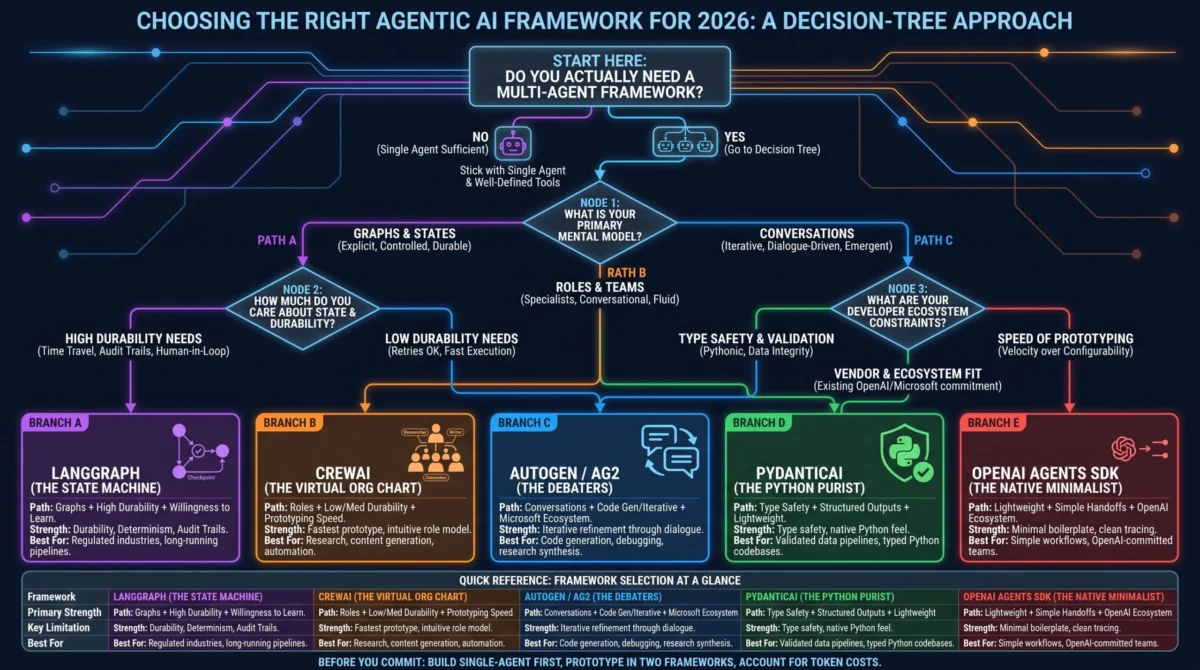

The landscape of artificial intelligence has undergone a fundamental shift from experimental research to enterprise-grade production, necessitating a transition from "toy" models to robust orchestration frameworks. As of mid-2026, the agentic AI sector has matured into a crowded ecosystem where developers must choose architectures that will define their production capabilities for years to come. Unlike the earlier, more chaotic phase of 2023, where GitHub stars and initial ease-of-use served as the primary metrics for selection, contemporary engineering teams are now prioritizing determinism, compliance, and fault tolerance. Selecting the wrong framework for a production-scale application can lead to significant operational debt, as different frameworks optimize for fundamentally different paradigms: state-based graph execution, role-based delegation, or conversational refinement.
The Evolution of Agentic Orchestration
The trajectory of agentic AI can be traced back to the initial release of foundational LLMs, which lacked the ability to execute multi-step logic autonomously. By late 2023, the emergence of early orchestration libraries allowed developers to string together prompts, but these were largely unstable for high-stakes environments. The industry reached a pivotal milestone in 2025 with the release of the OpenAI Agents SDK and the stabilization of project-based frameworks like LangGraph and AG2.
Historical data from industry performance reports indicate that 72% of enterprise AI projects fail during the transition from prototype to production. The primary point of failure is rarely the underlying model’s intelligence; rather, it is the inability to manage the agentic workflow under stress. As of Q3 2026, the industry has recognized that "orchestration tax"—the complexity overhead required to manage multiple agents—is a hidden cost that can negate the efficiency gains of AI automation if not managed through a structured architectural decision-making process.
Assessing the Necessity of Multi-Agent Complexity
Before adopting a multi-agent framework, organizations are advised to conduct a rigorous audit of their workload requirements. The most common pitfall in current development cycles is premature optimization, where teams implement complex multi-agent "crews" to solve problems that a single, well-prompted agent could handle.
Engineering leads suggest that a transition to multi-agent architectures should only occur when a system hits three specific thresholds:
- Domain Segmentation: The task requires distinct, non-overlapping expert knowledge that cannot be condensed into a single system prompt.
- Asynchronous Parallelism: The workflow requires multiple concurrent processes that must converge on a unified output.
- Verification Cycles: The task demands a "critic" layer where a second agent must audit, validate, or refactor the output of a primary generator.
If a workflow does not strictly meet these criteria, developers are encouraged to maintain a monolithic, single-agent structure. This reduces the surface area for failure, simplifies the debugging process, and minimizes the exponential increase in token consumption that multi-agent systems often trigger.
The Strategic Decision Tree: Architectural Paradigms
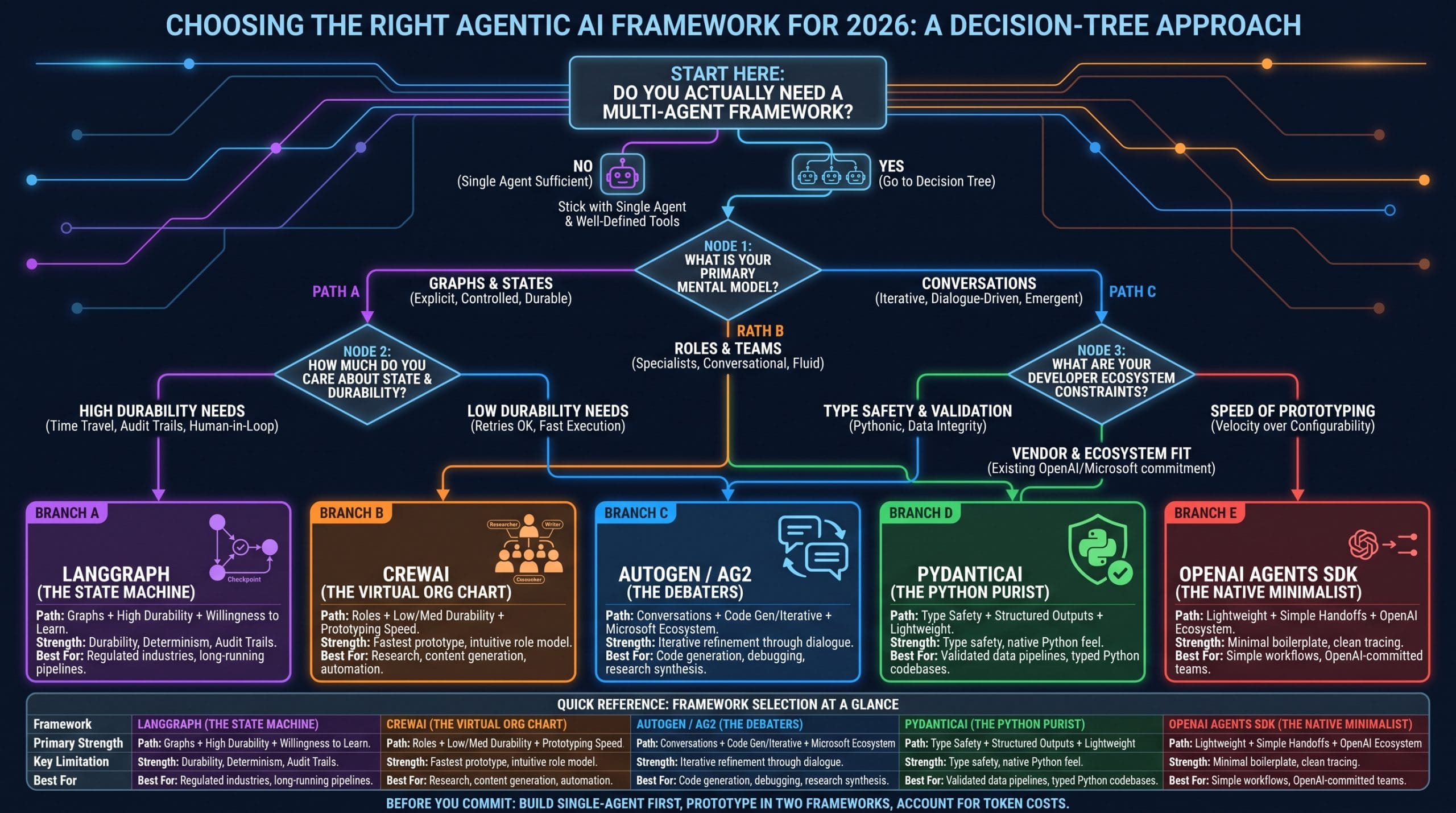
For organizations that have determined multi-agent orchestration is necessary, the selection process must be anchored in three primary nodes: mental modeling, durability, and ecosystem constraints.
Node 1: The Mental Model
Architectural choices often reflect the internal culture of a development team. The "Graph-based" approach, exemplified by systems that treat AI as a state machine, appeals to teams that prioritize predictability and deterministic flows. Conversely, "Role-based" frameworks view agents as autonomous contributors, which facilitates rapid prototyping but introduces higher variability. The "Conversational" paradigm views the agent system as a collaborative dialogue, which is ideal for creative or iterative synthesis but can be difficult to constrain within rigid enterprise boundaries.
Node 2: Durability and Compliance
The requirement for "stateful" operations is a critical differentiator. In regulated sectors—such as finance, healthcare, or legal—a framework’s ability to pause, inspect, audit, and resume an agent’s state is not optional. Frameworks that treat state as a first-class, serializable object are currently the only viable options for environments requiring strict compliance logs.
Node 3: Ecosystem and Typing
The developer experience (DX) is often dictated by the language and existing infrastructure. Teams embedded in the Python ecosystem, particularly those utilizing strict type checking, often prefer frameworks that prioritize Pydantic integration to ensure data integrity at the boundaries of agent interactions.
Framework Analysis: A Comparative Overview
Based on current industry benchmarks, five frameworks have emerged as the primary contenders for production environments:
- LangGraph (The State Machine): As a core component of the modern stack, LangGraph models workflows as directed graphs. Its strength lies in "time travel" capabilities, allowing developers to inspect and modify the state at any point in a multi-step process. This makes it the gold standard for compliance-heavy industries.
- CrewAI (The Virtual Organization): This framework excels in rapid prototyping by utilizing a role-based metaphor. By assigning specific roles (e.g., Researcher, Analyst) to agents, it allows for fast development, though it requires more robust external monitoring to prevent "agent drift."
- AutoGen / AG2 (The Conversationalist): AG2 leverages the power of iterative dialogue. It is particularly effective for code generation and technical debugging. Because agents engage in a back-and-forth refinement process, it is highly efficient for software development tasks but can be difficult to force into linear, predictable workflows.
- PydanticAI (The Python Minimalist): This framework is designed for developers who demand high performance and type safety. It does not provide full-scale orchestration by default but offers the most robust validation layer for agents interacting with downstream systems.
- OpenAI Agents SDK (The Native Solution): Optimized for performance within the OpenAI ecosystem, this SDK offers the lowest barrier to entry. While it lacks the deep, complex orchestration features of LangGraph, it provides superior observability and tracing for teams already heavily invested in OpenAI’s infrastructure.
Implications and Future Outlook
The industry trend for the remainder of 2026 suggests a move toward "framework consolidation." As organizations move past the experimentation phase, the demand for "observability-first" frameworks is rising. Industry analysts note that operational costs are becoming a primary concern; because multi-agent systems can consume significantly more tokens than single-agent setups, the ability to optimize agent paths and cache intermediate states is becoming a key performance indicator (KPI).
Statements from leading AI research labs suggest that the next wave of framework development will focus on "self-correcting" agents. Rather than requiring developers to hard-code every failure scenario, future frameworks will likely integrate native self-reflection loops that can automatically recover from errors without human intervention.
For developers, the mandate remains clear: the choice of framework is a business decision, not merely a technical one. A framework that is easy to build with but impossible to audit will represent a liability in a production environment. Conversely, a highly rigid framework may stifle innovation if the team’s needs are highly dynamic. By applying a structured, decision-tree approach—evaluating the necessity of multi-agent architecture and aligning the framework with the team’s mental model and compliance needs—engineering leaders can ensure their AI systems remain robust, scalable, and cost-effective in the evolving digital landscape.
