

In a significant architectural development for cloud-native database management, Amazon Web Services (AWS) has announced the immediate availability of a native direct-querying capability for Amazon Aurora PostgreSQL. This new feature empowers database administrators and software developers to execute unified queries across live operational data and massive data lakes formatted in Apache Iceberg and Apache Parquet. By embedding the high-performance analytical query engine DuckDB directly into the Aurora PostgreSQL runtime, AWS has eliminated the longstanding requirement for complex, resource-intensive extract, transform, and load (ETL) pipelines. Organizations can now query synchronized transactional data and archived analytical stores simultaneously through standard PostgreSQL syntax, tools, and endpoints, drastically reducing infrastructure overhead and mitigating the data latency challenges historically associated with hybrid operational-analytical processing.
The Evolution of Hybrid Operational and Analytical Processing
For decades, enterprise data architectures have maintained a strict division between Online Transaction Processing (OLTP) systems and Online Analytical Processing (OLAP) environments. OLTP databases, such as Amazon Aurora PostgreSQL, are meticulously optimized for high-throughput, low-latency transactional workloads, handling live user applications, e-commerce checkouts, and real-time operational state tracking. Conversely, massive historical records, compliance archives, and business intelligence datasets are typically offloaded to cost-effective cloud object storage solutions, such as Amazon S3, structured under open table formats like Apache Iceberg or columnar storage standards like Apache Parquet.
Bridging these two distinct domains traditionally demanded reverse-ETL mechanisms, custom data pipelines, and third-party orchestration tools. These pipelines were tasked with periodically extracting data from operational databases, transforming formats, and loading duplicates into downstream data warehouses or data lakes. While effective at separating workloads, this paradigm introduced severe architectural friction. Enterprises incurred escalating infrastructure costs, suffered from data synchronization delays, and faced engineering bottlenecks as data duplication proliferated across disparate systems.
Furthermore, the rapid mainstream adoption of artificial intelligence and autonomous AI agents exposed the critical limitations of pre-replicated data pipelines. Modern AI agents require contextual reasoning over both live, uncommitted operational writes and multi-year historical archives dynamically. Because anticipating every conceivable dataset an AI agent might query is computationally and logistically impossible, static ETL architectures frequently fail to deliver the agility required by contemporary enterprise applications.

The DuckDB Integration and Technical Architecture
The architectural breakthrough underpinning this new Aurora PostgreSQL capability stems directly from a strategic industry acquisition. DuckLabs, the core engineering team behind the highly optimized analytical database project DuckDB, recently joined Amazon. By embedding the DuckDB engine directly into the Aurora PostgreSQL process space, AWS has bridged the transactional and analytical divide without introducing extra network hops, inter-service latency, or intermediary data staging layers.
When a user executes a query combining live transactional tables residing within Aurora and external datasets stored in Amazon S3 or S3 Tables, the embedded DuckDB engine coordinates the analytical execution plan. Query processing happens locally within the database instance boundaries. The system natively supports Iceberg REST Catalog (IRC)-compatible catalogs alongside the AWS Glue Data Catalog, enabling seamless federation across diverse storage endpoints.
To maintain high performance as underlying datasets scale into terabytes or petabytes, Aurora incorporates sophisticated query optimization techniques. The engine applies predicate filters and column pruning directly at the storage boundary, ensuring that only relevant data bytes are read from Amazon S3. Additionally, frequently accessed data lake segments are cached intelligently within the local Aurora instance memory. Database administrators can monitor execution metrics, including rows scanned, bytes read from object storage, and cache hit ratios, using the specialized diagnostic function aurora_analytics_stat_statements().
Implementation, Setup, and Operational Workflow
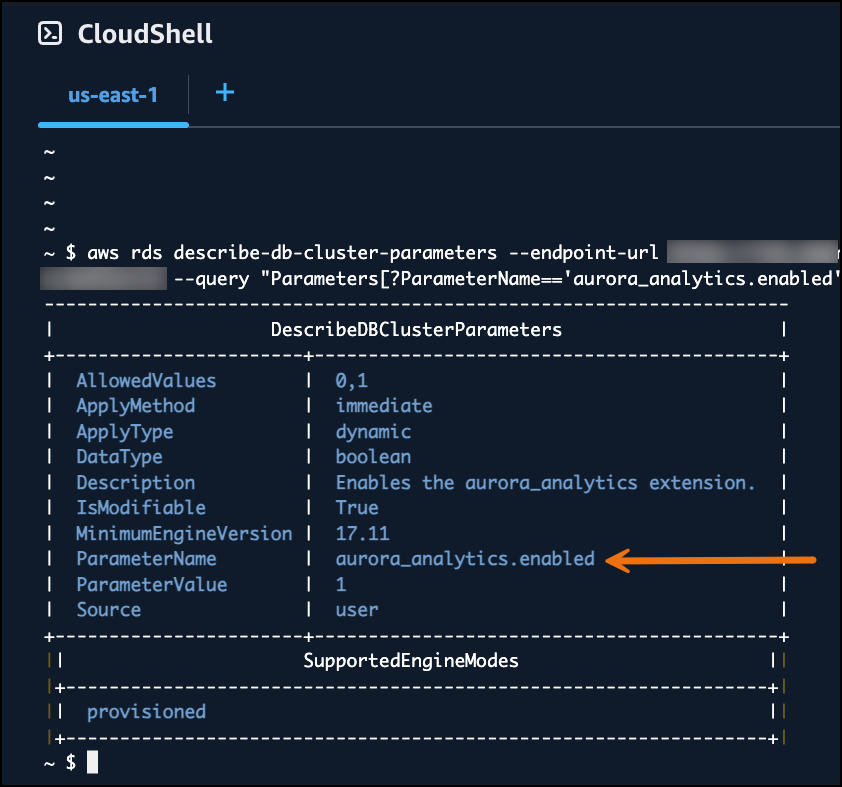
Deploying this capability within an existing cloud environment follows a standardized provisioning workflow. The feature is natively supported on Amazon Aurora PostgreSQL major versions 17 (specifically starting from version 17.11) and 18 (starting from version 18.6) across all commercial and AWS GovCloud regions.
To activate the functionality, database operators must attach a properly configured AWS Identity and Access Management (IAM) role to their Aurora cluster, granting read permissions to designated Amazon S3 buckets and the AWS Glue Data Catalog. Once the cluster is running, administrators connect via standard PostgreSQL management utilities, such as psql or the Amazon RDS console, and execute the extension creation command:

CREATE EXTENSION aurora_analytics;Following extension initialization, operators can register external data lake files as foreign tables. Notably, Aurora simplifies schema management by automatically inferring column definitions from file metadata. For example, pointing to an historical Parquet file requires minimal declarative syntax:
CREATE FOREIGN TABLE transaction_history ()
SERVER aurora_analytics_server
OPTIONS (
    location 's3://<my-bucket>/finance/transaction_history.parquet',
    format 'parquet'
);
For environments managing extensive data lakes containing numerous tables, administrators can bypass manual single-table declarations by utilizing the IMPORT FOREIGN SCHEMA command, which bulk-creates foreign table definitions from an entire AWS Glue Data Catalog database in a single operation.
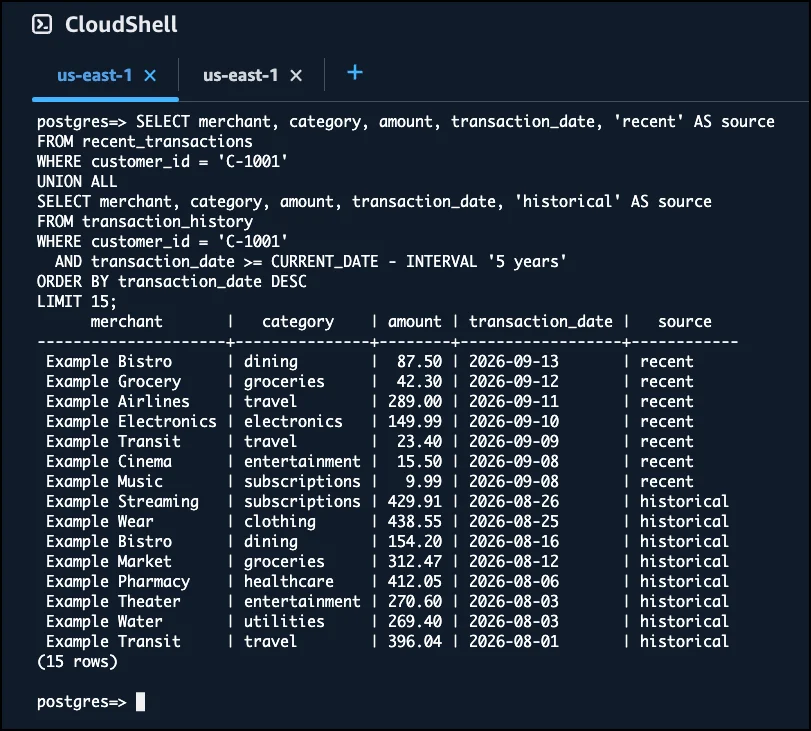
Once configured, complex queries can seamlessly unify operational tables and historical archives. A typical financial query combining the last seven days of transactional data stored natively in Aurora with five years of historical logs stored in S3 executes through a standard UNION ALL statement:
SELECT merchant, category, amount, transaction_date, 'recent' AS source
FROM recent_transactions
WHERE customer_id = 'C-1001'
UNION ALL
SELECT merchant, category, amount, transaction_date, 'historical' AS source
FROM transaction_history
WHERE customer_id = 'C-1001'
  AND transaction_date >= CURRENT_DATE - INTERVAL '5 years'
ORDER BY transaction_date DESC
LIMIT 15;
In scenarios where specific workloads demand single-digit-millisecond read latency, engineers can materialize selected data lake subsets directly into native Aurora PostgreSQL tables using standard commands such as CREATE TABLE AS SELECT, INSERT INTO ... SELECT, or MERGE INTO. These materialized tables reside fully within the transactional database, allowing read queries to be offloaded across any read replica in the cluster while avoiding continuous object storage scans.
Industry Implications and Enterprise Impact
Market analysts and database infrastructure experts have noted that native data lake querying within traditional relational database management systems marks a pivotal shift in modern enterprise data strategy. By removing the mandatory tax of building and maintaining ETL infrastructure, cloud providers are lowering the barrier to entry for advanced analytics and artificial intelligence integration.
Organizations across financial services, healthcare, retail, and SaaS sectors stand to benefit significantly. In fraud detection use cases, for instance, applications can simultaneously evaluate a live transaction against real-time velocity metrics stored in Aurora while cross-referencing behavioral patterns spanning multiple years stored in Apache Iceberg lakes. Similarly, customer support platforms and autonomous AI agents can query comprehensive account lifecycles instantly without triggering asynchronous data synchronization jobs.
Crucially, AWS has made this capability available at no additional licensing or software charge. Customers incur costs solely based on the incremental Aurora compute consumed during query execution and standard Amazon S3 request pricing for reading data lake files. This consumption-based economic model ensures that organizations of all scales can experiment with and deploy unified architectures without incurring prohibitive upfront capital expenditures.
As enterprise data estates continue to expand exponentially, the ability to federate queries across transactional databases and open table formats without data duplication represents an essential architectural maturity. By integrating DuckDB into Aurora PostgreSQL, Amazon Web Services has provided a streamlined path toward unified data access, setting a new benchmark for performance, efficiency, and developer productivity in cloud database engineering.
