


U.S. spot Bitcoin exchange-traded funds (ETFs) concluded a volatile trading week with a narrow positive margin, despite facing significant selling pressure toward the final sessions. According to market data, these financial products experienced net outflows totaling $137.9 million on Friday, marking the second consecutive day of negative sentiment. This late-week downturn partially eroded the substantial gains recorded earlier in the week, where capital inflows reached $1.07 billion between Monday and Wednesday. Despite the late-week retreat, the total net balance for the week remained positive at approximately $301 million, successfully breaking a two-week streak of consecutive losses.
The broader performance for October, however, presents a more challenging picture for investors. While the month is historically associated with positive price action for digital assets—a phenomenon frequently referred to as "Uptober"—the current monthly performance remains in the red. Bitcoin ETFs briefly entered positive territory mid-week, but a sharp reversal on Thursday, characterized by a $635.6 million withdrawal, reset the monthly net flow to a deficit of approximately $314 million. As of the close of trading, cumulative net inflows since the inception of these funds in January 2024 have reached $57.6 billion, with total net assets under management hovering around $100.2 billion.
A Chronology of Weekly Market Sentiment
The week began with a sense of optimism, spurred by institutional commentary. Notably, J.P. Morgan Asset Management released a report projecting 10% annual returns for Bitcoin over the next decade, a forecast that initially provided a tailwind for institutional sentiment. Following this, market participants entered what analysts describe as a "wait-and-see" phase, characterized by cautious positioning as traders looked toward macroeconomic indicators.
By midweek, the market began to reflect broader global instability. A selloff in international equity markets, compounded by rising oil prices—which climbed above $111 per barrel—and a retreat in artificial intelligence (AI) sector stocks, created a risk-off environment. This sentiment quickly permeated the digital asset space. On Thursday, the market experienced its largest single-day exit of the month, with $635.6 million exiting the Bitcoin ETF ecosystem. This aggressive selloff significantly dampened the momentum built during the week’s first three days. Friday’s subsequent $137.9 million outflow confirmed that investor conviction remained fragile as the market headed into the weekend.
Performance of Ethereum and Solana Investment Products
The volatility was not limited to Bitcoin products. Ethereum ETFs, which have garnered $12.7 billion in total net inflows since their launch in July, struggled throughout the week. While they managed to secure a minor inflow of $4.4 million on Friday, this was insufficient to offset the heavy losses incurred during the preceding days. On a weekly basis, Ethereum funds shed approximately $221 million, contributing to a monthly deficit of roughly $1.18 billion.

Solana-based investment products also reflected this trend of tepid demand. After recording an $8.9 million outflow on Thursday, these funds saw net-zero activity on Friday. For the month of October, Solana-focused instruments are down by approximately $68 million. The disparity in performance between these assets highlights a broader trend of capital rotation, where institutional investors appear to be prioritizing liquidity and risk management over exposure to smaller-cap crypto assets during periods of market uncertainty.
Market Infrastructure and Institutional Participation
Spot crypto ETFs have become essential barometers for institutional sentiment because they represent the first time traditional financial firms can gain direct, regulated exposure to digital assets. By holding the underlying asset and trading on established stock exchanges, these products bridge the gap between traditional brokerage accounts and the decentralized crypto ecosystem.
The daily reporting of these flows provides market observers with a high-fidelity look at the behavior of institutional allocators, including hedge funds, pension funds, and family offices. Because the inflows and outflows are often tied to institutional risk-off mandates, the recent, erratic data suggests that professional allocators are currently adjusting their exposure in response to shifting global monetary policies and geopolitical tensions. The fact that cumulative inflows remain high at $57.6 billion indicates that, while short-term sentiment is bearish, long-term conviction in the asset class as an institutional-grade investment remains largely intact.
Price Action and Market Implications
As of Saturday, the price of Bitcoin stood at approximately $80,490, reflecting a 1.1% decline over a 24-hour period and a 1.2% loss for the week. Ethereum and Solana saw more pronounced corrections, with Ethereum falling 2.6% to $2,344 and Solana dropping 2.8% to $101. The total cryptocurrency market capitalization retreated by 1.2%, landing at $2.79 trillion.
The correlation between crypto assets and traditional high-beta sectors, such as AI stocks, has become more pronounced in recent months. The synchronized decline of these sectors suggests that crypto is increasingly being traded as a component of global risk-on portfolios rather than as an independent hedge. This integration, while validating the asset class, also exposes it to broader market shocks that are often outside the control of crypto-native market participants.
Predictive Analytics and Bearish Sentiment
Sentiment on prediction markets, such as Myriad, reflects this growing caution. Traders are increasingly hedging against a further decline in Bitcoin’s value before the month concludes. Current data indicates a 43% probability of Bitcoin falling to $77,500 before the end of October, a significant increase from the 32% probability recorded just 24 hours earlier. Conversely, the probability of a rally toward $87,500 has plummeted from 17% to 10%.
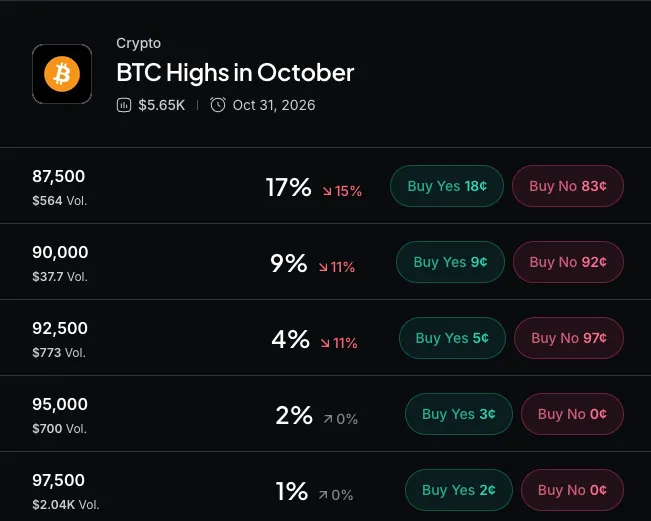
The outlook for other major tokens remains mixed. Solana bulls maintain a slight lead, with a 51.6% probability of the asset hitting $160 before it hits $40, though this reflects a decline from 54.9%. Ethereum’s outlook is more stable, with participants assigning a 61.3% probability of the asset reaching $3,000 before it drops to $1,500. These figures suggest that while investors are bracing for short-term volatility, the majority of market participants are not yet discounting the potential for a mid-to-long-term recovery.
Analyst Outlook and Future Considerations
The current market environment is defined by a lack of clear catalysts. With the initial hype of the ETF launches having settled into a more normalized, albeit volatile, trading pattern, the focus has shifted toward macroeconomic data. Future flows will likely be dictated by upcoming Federal Reserve policy meetings, inflation reports, and the ongoing stability of global energy markets.
Analysts note that the "wait-and-see" approach is a prudent response to the current lack of market direction. For institutional investors, the primary concern remains the cost of capital and the relative attractiveness of alternative risk-free assets. As long as yields on government bonds remain competitive, the flow of capital into crypto ETFs may continue to fluctuate, characterized by bursts of high interest followed by necessary corrections.
While the data from the past week highlights the fragility of the current market, it also underscores the resilience of the ecosystem. Despite nearly $800 million in outflows over two days, the total net assets remain above the $100 billion threshold, indicating that the core capital base is not fleeing in a panic. The industry remains in a state of consolidation, awaiting the next major catalyst to shift the narrative from defensive maneuvering to sustained growth. As we head into the final week of October, the market will remain hyper-focused on whether the seasonal "Uptober" trend can manifest, or if the current macroeconomic headwinds will continue to exert downward pressure on digital asset valuations.
Disclaimer: The views and opinions expressed in this report are for informational purposes only and do not constitute financial, investment, or other professional advice. Investors are encouraged to conduct their own due diligence before making financial decisions.
