
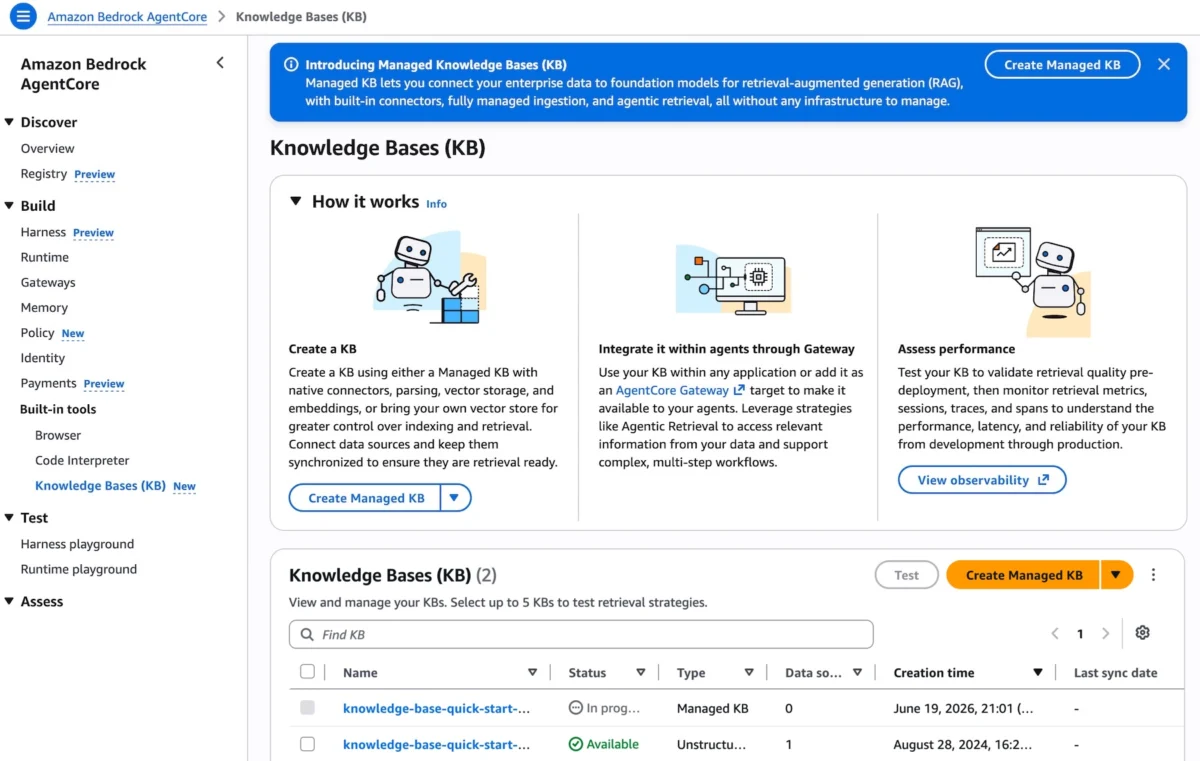

Amazon Web Services (AWS) has announced the immediate availability of Amazon Bedrock Managed Knowledge Base, a comprehensive suite of capabilities designed to empower developers to rapidly construct enterprise-grade generative AI applications leveraging their proprietary data. This significant release addresses critical challenges faced by organizations striving to implement secure, reliable, and continuously updated access to enterprise-wide data, which is essential for delivering accurate, swift, and trustworthy outcomes from agentic AI applications. By abstracting the intricate complexities inherent in building and managing Retrieval-Augmented Generation (RAG) pipelines, the Managed Knowledge Base allows developers to redirect their focus from infrastructure management to achieving crucial business objectives.
The Evolving Landscape of Enterprise Generative AI
The proliferation of generative AI has sparked a transformative wave across industries, with businesses eager to harness its potential for enhanced customer service, accelerated content creation, improved operational efficiency, and deeper data insights. However, integrating large language models (LLMs) with an organization’s internal, proprietary data has presented a formidable hurdle. LLMs, while powerful, are trained on vast public datasets and often lack specific, up-to-date, or confidential enterprise knowledge. This gap necessitates the use of RAG, a technique that allows LLMs to retrieve relevant information from a designated knowledge base before generating a response, thereby grounding their answers in factual, context-specific data and reducing the likelihood of hallucinations.
Prior to solutions like Amazon Bedrock Managed Knowledge Base, developers tasked with building RAG pipelines encountered a series of significant, undifferentiated challenges. These included:
- Complex Data Ingestion and Preparation: Enterprises possess data in myriad formats—structured databases, unstructured documents (PDFs, Word files, presentations), web pages, and internal communication platforms. Preparing this diverse data for effective retrieval, which often involves cleaning, chunking, indexing, and embedding, is a time-consuming and technically demanding process. Ensuring accuracy and maintaining data integrity throughout this pipeline is paramount but often requires extensive manual effort and experimentation.
- Infrastructure Orchestration and Management: A typical RAG pipeline comprises multiple sophisticated components: data storage, retrieval mechanisms (e.g., vector databases), embedding models (to convert text into numerical representations), re-ranking models (to refine search results), and the selection and integration of appropriate foundation models (FMs). Assembling, configuring, and maintaining these disparate elements—each with its own operational overhead—diverts valuable developer resources away from core application logic.
- Scalability, Security, and Reliability: Enterprise-grade AI applications demand high availability, robust security protocols (including fine-grained access control and data encryption), and the ability to scale seamlessly with increasing data volumes and query loads. Building these capabilities from scratch, while adhering to stringent compliance requirements, adds another layer of complexity and risk for development teams.
These challenges collectively forced developers into a cycle of repetitive, undifferentiated work, hindering their ability to innovate and deliver business value through their generative AI applications.
Amazon Bedrock Managed Knowledge Base: A Unified Approach
Amazon Bedrock Managed Knowledge Base directly confronts these issues by consolidating the multitude of infrastructure components traditionally managed individually into a single, cohesive, and fully managed primitive. This abstraction layer encompasses storage, retrieval, embeddings, re-ranking, and foundation model selection, significantly streamlining the development process. By default, the service intelligently selects and manages optimal embedding models, re-ranker models, and foundational models, enabling developers to quickly initiate projects without the burden of manual selection or ongoing maintenance.
Building upon this robust, managed foundation, the service introduces three core innovations that further enhance ease of use and accuracy:
Smart Parsing for Intelligent Data Ingestion
One of the most critical and labor-intensive aspects of building effective knowledge bases is preparing diverse data types for accurate retrieval. Managed Knowledge Base addresses this through Smart Parsing, an automated capability that intelligently determines the optimal parsing strategy for each data type and connector without requiring explicit configuration from the developer.

Smart Parsing employs a sophisticated combination of techniques, including:
- Heuristic-based rules: Predefined rules tailored to common document structures and data types to extract relevant information efficiently.
- Machine learning models: Algorithms trained to identify patterns and relationships within various data formats, enabling adaptive parsing.
- Deep learning techniques: Advanced neural networks capable of understanding complex document layouts and semantic content, extracting meaning even from highly unstructured sources.
This automated approach dramatically reduces the weeks of experimentation typically required to achieve production-quality retrieval accuracy. For instance, parsing a complex PDF document with embedded tables, images, and text boxes traditionally demands intricate coding and fine-tuning. Smart Parsing intelligently dissects such documents, extracting text, preserving table structures, and contextualizing images, all while maintaining the flexibility for developers to customize parsing strategies when specific needs arise. This ensures that the ingested data is clean, well-structured, and ready for effective retrieval, forming the bedrock of accurate generative AI responses.
Agentic Retriever for Advanced Query Handling
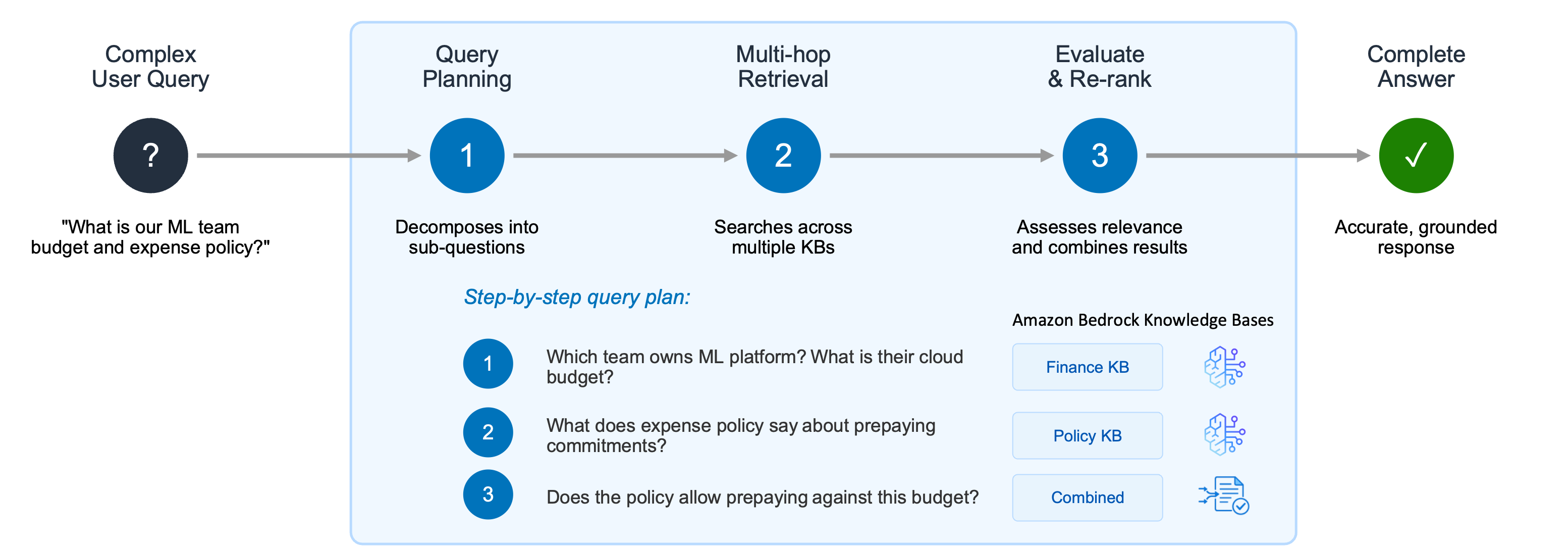
Generative AI applications frequently encounter complex user queries that demand more than a simple, single-step retrieval. These queries often necessitate sophisticated reasoning, recursive multi-step retrieval, and intermediate evaluations of results. A user query such as "What is the cloud infrastructure budget for the ML platform team, and does our expense policy allow prepaying annual commitments for such expenditures?" exemplifies this complexity. A conventional retrieval system might identify documents related to the ML platform team or the expense policy independently, but it would struggle to synthesize this information to provide a comprehensive, grounded answer that connects budget specifics with policy constraints.
The Agentic Retriever capability within Amazon Bedrock Managed Knowledge Base directly addresses this challenge by intelligently creating and executing a step-by-step query plan. For the example query, the Agentic Retriever would decompose it into actionable sub-questions:
- "Which team is responsible for the ML platform, and what is their allocated cloud infrastructure budget?"
- "What are the relevant clauses in the expense policy regarding prepaying annual commitments?"
- "Based on the identified budget and policy, is the ML platform team permitted to prepay against this specific budget?"
The system then performs multi-hop retrieval and reasoning at each step, dynamically gathering relevant passages from potentially multiple knowledge bases. This iterative process allows for intermediate evaluations, refining the search as new information is uncovered. Once sufficient relevant passages are collected to form a complete and accurate answer, the search process concludes, and the top results are returned. By abstracting the complexity of building and orchestrating a separate multi-hop reasoning pipeline, the Agentic Retriever significantly enhances accuracy for intricate queries, allowing developers to concentrate on their agentic search applications rather than on underlying orchestration logic. Developers can test this capability directly within the Amazon Bedrock AgentCore console by selecting "Agentic retrieval only" as the retrieval type, enabling the system to automatically plan and execute multi-step queries.
Seamless Integration with Bedrock AgentCore Gateway
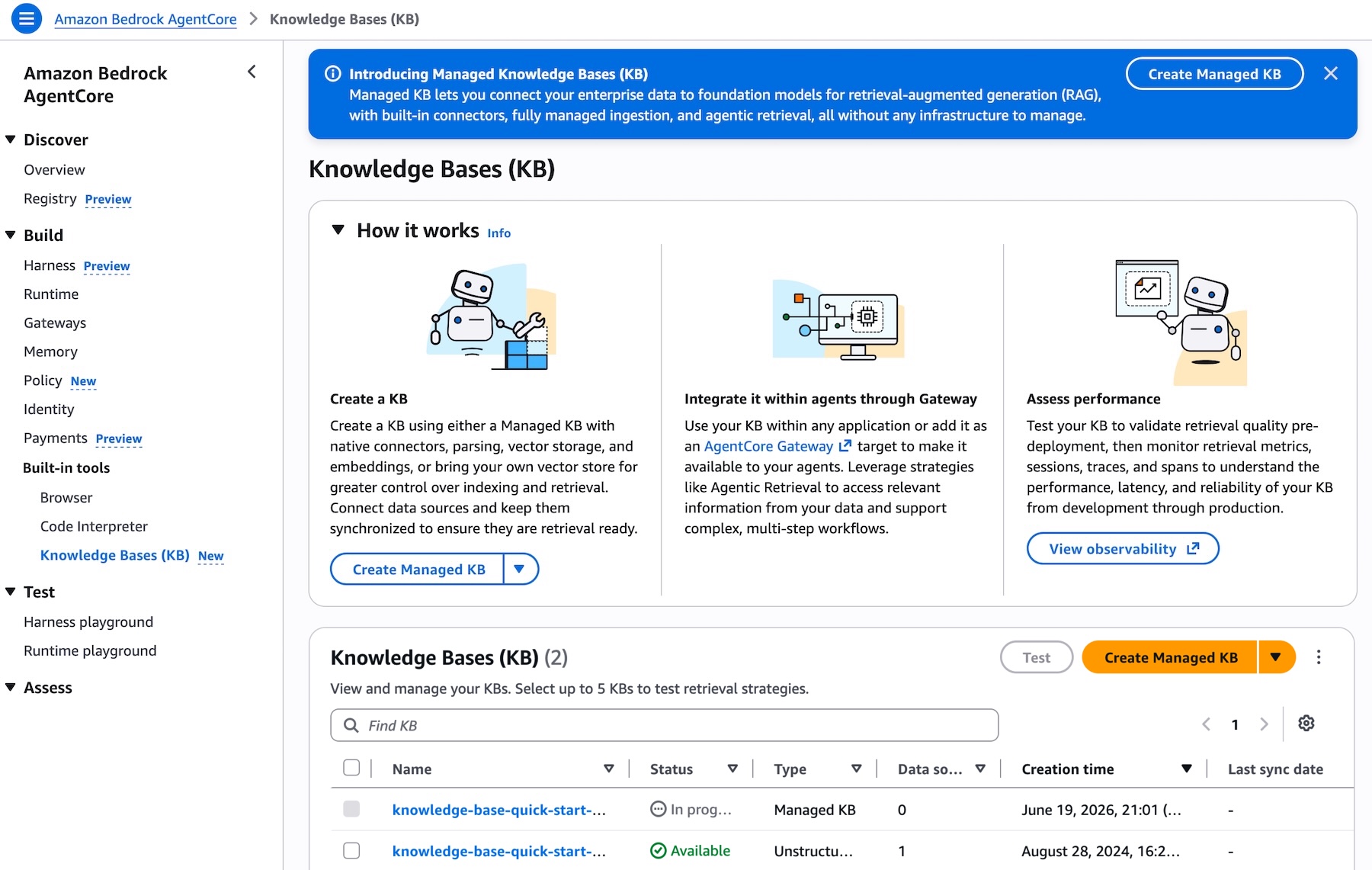
To further streamline the deployment and management of agentic AI applications, Amazon Bedrock Managed Knowledge Base offers seamless, native integration with Amazon Bedrock AgentCore Gateway. This integration eliminates the need for manual setup and provides built-in observability, policy enforcement, and automated permission management, which are crucial for enterprise environments.
When configuring an AgentCore Gateway, developers can select "Knowledge Base" as a pre-built target type, alongside other options like MCP servers, Lambda ARNs, and REST APIs. By simply selecting the desired knowledge base ID, it becomes exposed through the gateway. The Gateway, in turn, exposes the standard Model Context Protocol (MCP), ensuring that knowledge base tools are automatically discovered by clients using any MCP-compatible framework. This includes popular open-source frameworks such as Strands Agents, LangChain, CrewAI, LlamaIndex, and LangGraph, requiring no custom integration code. This level of interoperability and automatic configuration significantly accelerates development and deployment cycles for sophisticated agentic applications.
Getting Started and Operational Flexibility
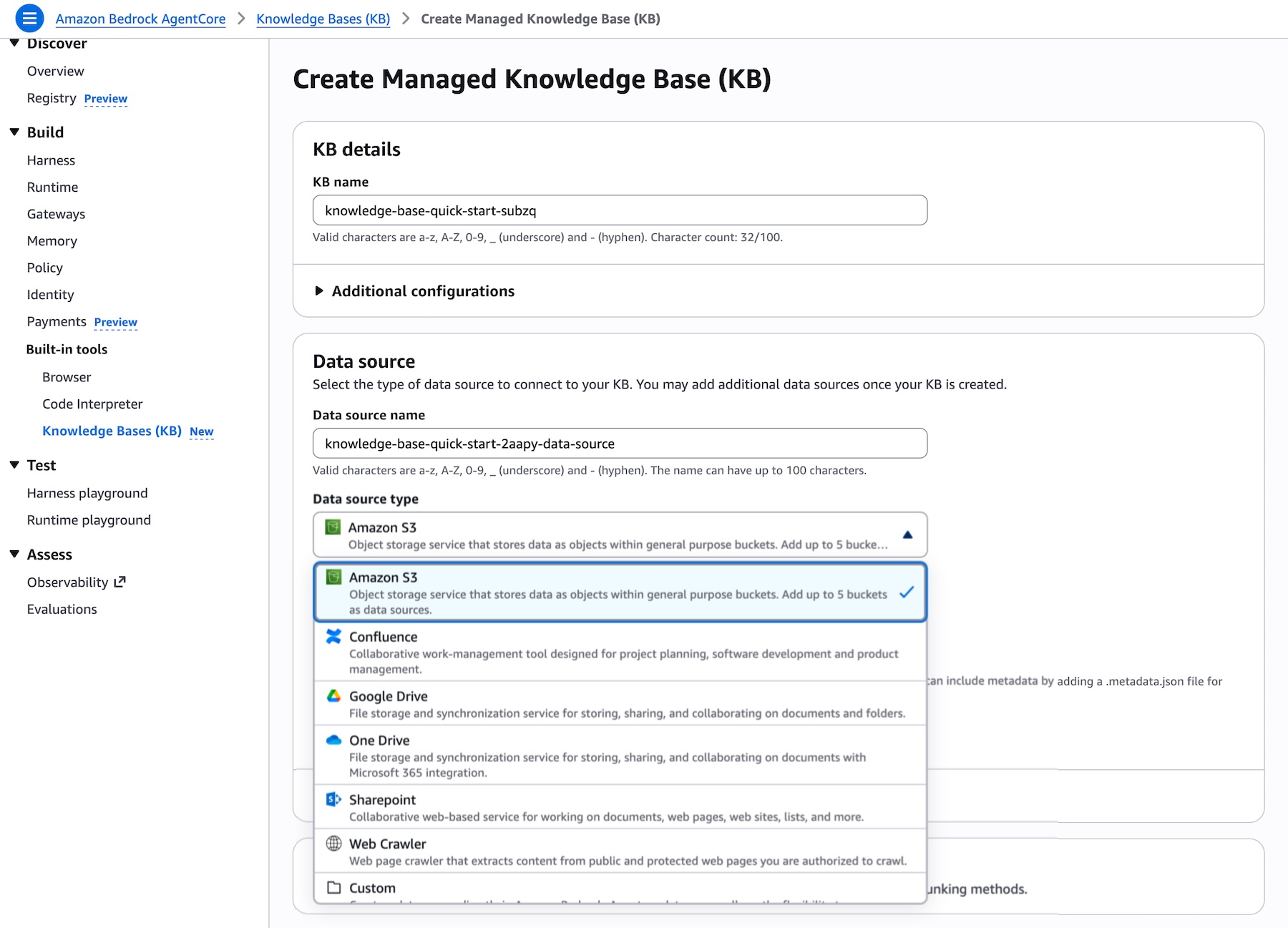
Creating a Managed Knowledge Base is designed to be straightforward, accessible via both the Amazon Bedrock AgentCore console and the Amazon Bedrock console. Developers navigate to the "Knowledge Bases" page and select "Create Managed KB." The user interface guides them through connecting to enterprise data sources, offering a dropdown list of supported connectors including Amazon S3, Confluence, Google Drive, OneDrive, SharePoint, and a Web Crawler. AWS Identity and Access Management (IAM) roles are automatically generated to ensure secure access, with options for developers to fine-tune permissions as needed.
An optimized set of default configurations is presented, allowing for rapid creation of a knowledge base. Once data synchronization is complete, the knowledge base can be immediately integrated with an agent or provided as a tool to a foundation model for querying.
A key differentiator of Amazon Bedrock Managed Knowledge Base is its commitment to developer flexibility and choice. Unlike some managed solutions that might restrict users to specific model providers, Bedrock’s approach separates infrastructure management (connectors, parsing, storage, retrieval orchestration) from model selection. This means:
- Diverse Foundation Model Support: Any foundation model available on Bedrock can be utilized to power the generation step, providing unparalleled choice.
- Optimized Embedding and Re-ranking Models: Developers can select from various embedding and re-ranking models to fine-tune retrieval accuracy and cost-performance for their specific use cases, without altering the underlying infrastructure.
- Vendor Agnosticism: This architecture ensures that developers are not locked into particular model providers, allowing them to adapt to evolving requirements, leverage new model capabilities as they emerge, and optimize for cost or performance over time.
This model-agnostic approach empowers enterprises to maintain control over their AI strategy, ensuring their generative AI applications remain agile and future-proof.
Broader Impact and Market Implications
The launch of Amazon Bedrock Managed Knowledge Base marks a pivotal moment in the enterprise adoption of generative AI. By drastically simplifying the technical complexities associated with RAG pipelines, AWS is effectively democratizing access to advanced AI capabilities for a broader range of businesses and developers.
- Accelerated Enterprise AI Adoption: This managed service significantly lowers the barrier to entry for enterprises, enabling them to integrate generative AI with their proprietary data in a fraction of the time and with fewer specialized resources. This will likely lead to an acceleration in the deployment of AI-powered solutions across various business functions, from internal knowledge management to customer support and personalized marketing.
- Enhanced Developer Productivity: By offloading the "undifferentiated heavy lifting" of infrastructure management and RAG pipeline orchestration, developers can dedicate more time to innovating and building unique, value-added features for their applications. This shift in focus is crucial for fostering creativity and delivering tangible business outcomes.
- Strengthening AWS’s Position in Generative AI: This release solidifies AWS’s strategic commitment to providing a comprehensive, flexible, and enterprise-ready platform for generative AI. By offering both foundational models and the tooling to effectively leverage them with private data, AWS aims to maintain its leadership in the cloud AI space, competing robustly with other major cloud providers and specialized AI platforms.
- Improved AI Accuracy and Trustworthiness: The focus on Smart Parsing and Agentic Retriever directly addresses critical concerns about the accuracy and reliability of generative AI outputs. By ensuring high-quality data ingestion and intelligent multi-step retrieval, the service helps enterprises build AI applications that deliver more grounded, factual, and trustworthy responses, fostering greater confidence in AI-driven decisions.
- Compliance and Security: Leveraging the inherent security and compliance features of the AWS cloud, Managed Knowledge Base provides a secure environment for handling sensitive enterprise data. Automatic IAM role creation and integration with AgentCore Gateway’s policy enforcement capabilities underscore AWS’s commitment to enterprise-grade security.
Availability and Pricing
Amazon Bedrock Managed Knowledge Base is available today in several key AWS regions, including US East (N. Virginia), US West (Oregon), Asia Pacific (Sydney, Tokyo), Europe (Dublin, Frankfurt, London), and AWS GovCloud (US-West) Regions. AWS maintains a public roadmap for regional availability and future enhancements, accessible via its global infrastructure page.
The pricing model for Bedrock Managed Knowledge Base is designed for flexibility, operating on a pay-as-you-go basis with no upfront commitments. Costs are primarily determined by two dimensions: the size of the indexed data stored within the knowledge base and the number of retrievals performed on-demand. New AWS customers can also leverage the AWS Free Tier to explore these capabilities at no initial cost, facilitating experimentation and initial development.
This robust set of capabilities works seamlessly with leading open-source frameworks such as CrewAI, LangGraph, LlamaIndex, and Strands Agents, demonstrating AWS’s commitment to an open and interoperable AI ecosystem. Developers can begin integrating these services using their preferred AI-assisted development environments, including the AgentCore open-source MCP server.
For developers eager to explore these new features and accelerate their generative AI initiatives, comprehensive resources are available. The Bedrock Knowledge Bases Developer Guide provides detailed instructions and best practices, while the Amazon Bedrock pricing page offers transparent information on service costs.
This announcement by Daniel Abib and the AWS Bedrock team represents a significant stride in making sophisticated generative AI applications more accessible, efficient, and reliable for enterprises worldwide, enabling them to unlock the full potential of their proprietary data. The corrected screenshots provided on June 19, 2026, further ensure a smooth and accurate getting-started experience for new users.
