
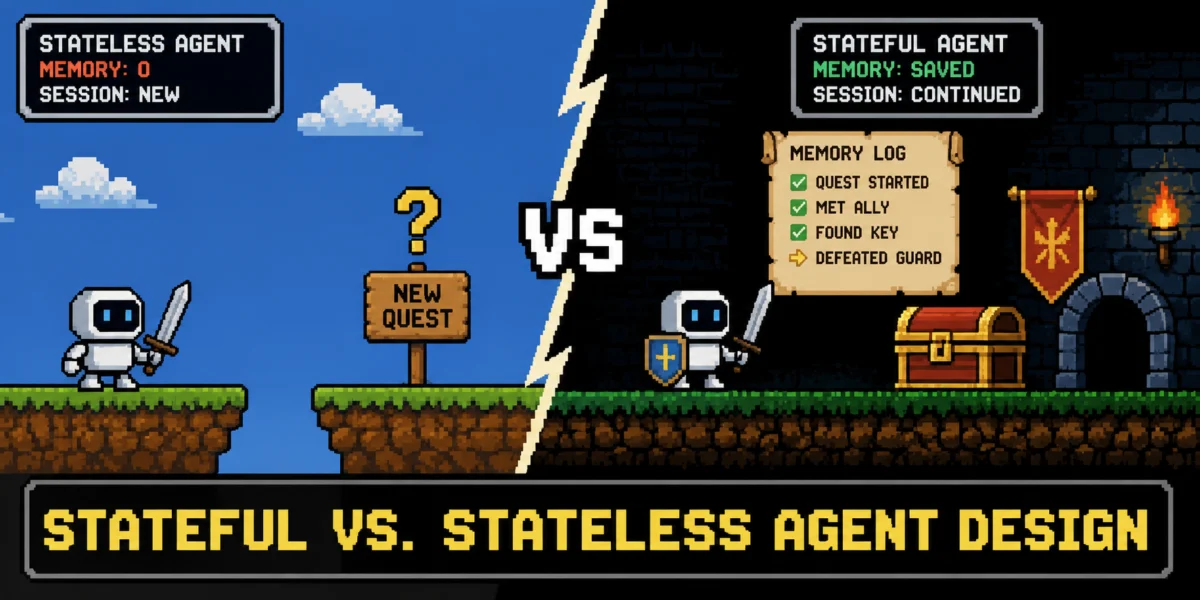

The burgeoning field of artificial intelligence, particularly the rapid advancement of large language models (LLMs) and the proliferation of AI agents, has brought to the forefront critical architectural decisions that dictate the scalability, cost-efficiency, and user experience of deployed AI systems. A fundamental choice for developers and architects revolves around how an AI agent manages its "memory" or "state"—whether it operates in a stateless "fire and forget" mode or a stateful, context-aware manner. This decision, often made at the foundational code level, ripples through the entire deployment infrastructure, influencing everything from load balancing strategies to database requirements and operational complexity.
The Foundational Dilemma: Stateless vs. Stateful AI Agents
As AI agents transition from experimental prototypes to mission-critical components in enterprise and consumer applications, the robustness and efficiency of their underlying architecture become paramount. A previous comprehensive architectural roadmap for AI agent deployment outlined the necessary infrastructure for bringing these intelligent systems into production. Building on that foundation, this analysis delves into the practical implications of state management, a pivotal question that must be resolved long before configuring any network load balancer or scaling out services. The core issue is where the agent’s memory—its accumulated context, conversational history, and past interactions—resides. Different approaches to handling this "state" yield dramatically different system designs and operational tradeoffs.
This article meticulously breaks down the two primary paradigms for managing an agent’s state: stateless and stateful design. To ground these theoretical concepts in practical reality, we will reference a simplified, yet illustrative, implementation using modern open language models served through high-performance APIs like Groq, showcasing how these design choices manifest in real-world scenarios.
The Rise of Conversational AI and Agentic Systems: A Brief Timeline
The journey towards sophisticated AI agents capable of sustained interaction has seen significant milestones. Early conversational AI, often rule-based chatbots in the 1990s and early 2000s, primarily operated in a stateless fashion, each query treated as a new interaction. The advent of statistical natural language processing and machine learning in the 2010s introduced more nuanced context handling, though often still relying on client-side state management. The past five years, marked by the explosion of transformer models and LLMs, have redefined the possibilities for AI agents. Models like OpenAI’s GPT series, Google’s Gemini, Anthropic’s Claude, and Meta’s Llama have enabled agents to understand and generate human-like text with unprecedented fluency, making multi-turn, context-driven conversations a practical reality. This technological leap has underscored the necessity of robust state management strategies for production deployments.
Initial Setup Considerations for AI Agent Development
For developers embarking on AI agent projects, the choice of an underlying language model and its hosting platform is crucial. Platforms like Groq, known for their inferencing speed, offer access to models such as Llama 3.1 8B Instant. This particular model, recognized for its cost-efficiency and generous free-tier support (allowing up to 14,400 requests per day at the time of writing in 2026), presents an ideal testbed for demonstrating stateless and stateful agent paradigms without incurring prohibitive operational costs during development and initial testing phases. The installation of necessary libraries, such as groq via pip, and the secure configuration of API keys are standard preliminary steps in setting up the development environment.
Stateless Agents: The "Fire and Forget" Paradigm
Stateless agents are characterized by their complete disengagement from past interactions. Each incoming request is processed in isolation, as if it were the first and only interaction the agent has ever had. The agent receives a user prompt, invokes its Large Language Model (LLM) inference engine, and delivers an output. Once this execution cycle concludes, all memory of the interaction is purged from the agent’s internal state.
The Tradeoff: Unparalleled Scalability vs. Contextual Burden
The primary advantage of architectures built around stateless agents lies in their remarkable ease of horizontal scaling. Since no user-specific memory or session data is retained on any backend server instance, incoming requests can be routed to any available agent instance via a load balancer. This enables highly resilient and elastic deployments, capable of handling sudden spikes in traffic without complex session management or sticky session configurations. For applications requiring high throughput and low latency for single-turn interactions (e.g., simple question-answering, classification tasks, or one-off content generation), stateless designs are often the optimal choice. Industry data from leading cloud providers indicates that stateless microservices can achieve up to 99.999% availability with appropriate load balancing and auto-scaling configurations, making them staples in high-performance computing.
However, this architectural simplicity comes with a significant limitation, particularly in multi-turn conversational AI: the onus of maintaining conversational context shifts entirely to the client (or frontend application). For the agent to "remember" previous turns, the frontend must re-transmit the entire conversation history with every new request. This "snowballing effect" means the context window—the total input provided to the LLM—grows continuously. This not only increases the size of the data payload transmitted over the network but, more critically, drives up token usage. Given that LLM API costs are typically calculated per token, a rapidly expanding context window can quickly lead to exponentially higher operational expenses. For example, a conversation that might cost pennies for the first few turns could escalate to dollars per interaction if the history spans hundreds or thousands of tokens across many exchanges. This can significantly impact the economic viability of long-running conversational applications.
Illustrative Example: The Stateless Agent in Action
Consider a basic stateless_agent function designed to interact with an LLM. This function, when called, would initialize a system prompt, append any provided history, add the current user prompt, and then make an API call to the Groq model. Crucially, the function itself retains no internal memory. If a user asks, "Hi, my name is Alice and I am learning about API infrastructure," the agent responds appropriately. If the user immediately follows up with, "What is my name and what am I learning about?" without the frontend providing the previous context, the stateless agent would respond with a generic disclaimer, stating it has no memory of the user’s identity or previous statements. This starkly illustrates the contextual void.
To overcome this, the frontend application must meticulously construct a frontend_payload that includes both the user’s initial prompt and the agent’s response, sending this complete history with every subsequent query. This places a significant burden on client-side logic and network bandwidth, especially for mobile applications or environments with unreliable connectivity.
Stateless Agent Output Example (Conceptual):
- Turn 1:
- User: "Hi, my name is Alice and I am learning about API infrastructure."
- Agent (Stateless): "Hello Alice, nice to meet you. Learning about API infrastructure can be a fascinating and rewarding topic. What specific aspects would you like to explore?"
- Turn 2 (Without Client Context):
- User: "What is my name and what am I learning about?"
- Agent (Stateless): "Unfortunately, I don’t have any information about you, including your name. Our conversation just started, so I’m here to help you with any questions."
- Turn 2 (With Client Context):
- User (Frontend sends full history + new prompt): "What is my name and what am I learning about?"
- Agent (Stateless): "Your name is Alice, and you are learning about API infrastructure."
This practical demonstration underscores that while implementation might seem simple on the agent’s side, the overall system complexity shifts to the client, requiring robust context management there.
Stateful Agents: The "Context-driven Continuity" Paradigm
In stark contrast to their stateless counterparts, stateful agents actively manage and maintain their own conversational memory. Under this approach, the client’s responsibility is significantly lighter: it only needs to send the newest user prompt along with a unique identifier, typically a session ID, to the agent. Upon receiving a request, the stateful agent retrieves the entire session history or context associated with that ID from a dedicated persistence layer (e.g., a database or caching system). It appends the new user message to this retrieved history, processes the LLM inference using the complete context, and then updates the persistence layer with the agent’s response and the expanded conversational history.
The Tradeoff: Enhanced User Experience vs. Architectural Complexity
The immediate and most apparent benefit of stateful agents is a much smoother and more intuitive user experience. The client application becomes simpler, as it no longer needs to manage and transmit voluminous conversational histories. This design inherently supports complex and asynchronous workflows, where agents might need to pause, await external tool responses, integrate with other applications, or even seek human approval before resuming an interaction. Such capabilities are crucial for sophisticated AI assistants that guide users through multi-step processes, complete transactions, or manage long-running tasks.
However, this enhanced functionality and simplified client experience come at a considerable architectural and operational cost. Scaling stateful solutions is inherently more challenging. The most significant hurdle is the requirement for a persistent, highly available, and performant database layer to store session states. In horizontally scaled infrastructures, where multiple agent instances might serve requests, maintaining data consistency and avoiding "localized amnesia" becomes critical. Localized amnesia occurs when a session’s history is inadvertently tied to a specific agent instance, and subsequent requests are routed to a different instance that lacks that specific memory.
To mitigate this, advanced strategies are necessary, such as:
- Centralized Memory Caching: Employing distributed caching systems like Redis or Memcached to store session histories, ensuring that any agent instance can access the most up-to-date context. Redis, for example, is widely used in large-scale applications to manage session data, often achieving sub-millisecond latency for retrieval.
- Session Affinity (Sticky Sessions): Configuring load balancers to route all requests from a particular user session to the same agent instance. While simpler to implement, this approach can hinder true horizontal scalability and resilience, as the failure of a single instance can disrupt multiple active sessions.
- Database Sharding and Replication: For very high-volume scenarios, the underlying state database may require sharding (distributing data across multiple database servers) and robust replication strategies to ensure both performance and data durability.
These measures introduce significant complexity in terms of infrastructure management, deployment, and maintenance, often requiring specialized DevOps expertise. According to a 2024 survey of cloud architects, managing state in distributed systems is cited as one of the top three challenges in scalable application development, with infrastructure costs for stateful services often exceeding stateless counterparts by 20-30% due to persistent storage, caching, and more complex orchestration.
Illustrative Example: The Stateful Agent in Action
A stateful_agent function would leverage a database, even a simple in-memory SQLite for illustration, to manage its conversational memory. The function would take a session_id and a new_prompt. It would first query the database for the existing conversation history associated with that session_id. If no history exists, it initializes one with a system prompt. It then appends the new_prompt, makes the LLM call, appends the agent’s response to the history, and finally saves the updated history back to the database, ensuring atomicity and consistency.
Stateful Agent Output Example (Conceptual):
- Turn 1:
- User (Client sends session ID ‘user_123’ and prompt): "Hi, I am Bob and I want to scale my AI app."
- Agent (Stateful): "Hello Bob, scaling an AI app can be a complex process. May I ask: 1. What type of AI technology is your app built on? 2. Are you using any cloud services? 3. What are your scalability goals?"
- Turn 2:
- User (Client sends session ID ‘user_123’ and new prompt): "What was my name again?"
- Agent (Stateful): "Your name is Bob."
This example elegantly demonstrates how the stateful agent, by internalizing memory management, provides a seamless, context-aware interaction without the client needing to re-transmit past dialogue. While using an in-memory SQLite database for simplicity, a production system would integrate with more robust, distributed databases like PostgreSQL, MongoDB, or dedicated managed services.
Hybrid Approaches and Real-World Deployments
It is important to note that many sophisticated AI agent deployments adopt hybrid architectures, blending elements of both stateless and stateful designs. For instance, an initial routing layer might be stateless, quickly directing simple, single-turn queries to specialized stateless agents. More complex, multi-turn interactions, or those requiring long-term memory, would then be handed off to stateful agents, perhaps leveraging vector databases for long-term memory storage beyond the immediate conversational context. This allows for optimized resource allocation, leveraging the scalability of stateless services where appropriate and the richness of stateful interactions where necessary.
Wrapping Up: Strategic Tradeoffs for AI Agent Architectures
The choice between a stateful and a stateless architectural design for AI agents is not merely a technical preference; it is a strategic decision that profoundly impacts an organization’s operational costs, developer experience, system resilience, and ultimately, user satisfaction.
-
Stateless agents excel in scenarios demanding extreme horizontal scalability, high throughput for single-turn interactions, and minimal backend complexity for individual agent instances. They are ideal for use cases where each request is largely self-contained, or where the client is robust enough to manage conversational history (e.g., desktop applications, certain web frontends). However, they introduce client-side complexity and can become costly for long, context-rich conversations due to token usage.
-
Stateful agents are indispensable for delivering rich, continuous, and highly personalized conversational experiences. They simplify client-side development and enable complex, multi-turn workflows. Their primary drawback is the significant increase in architectural complexity, requiring robust persistent storage, sophisticated caching strategies, and careful consideration for distributed system challenges like data consistency and "localized amnesia" when scaling horizontally.
Ultimately, the optimal approach boils down to a careful matching of the infrastructure capabilities to the specific workflow requirements of the AI agent application. As AI agent technology continues to mature, we anticipate the development of more sophisticated, standardized frameworks and managed services that abstract away much of the complexity associated with state management, enabling developers to build powerful, scalable AI agents with greater ease and efficiency. The ongoing evolution of cloud-native technologies, particularly serverless functions and managed databases, will play a crucial role in shaping the future of AI agent deployment, pushing the boundaries of what is possible in intelligent automation.
