
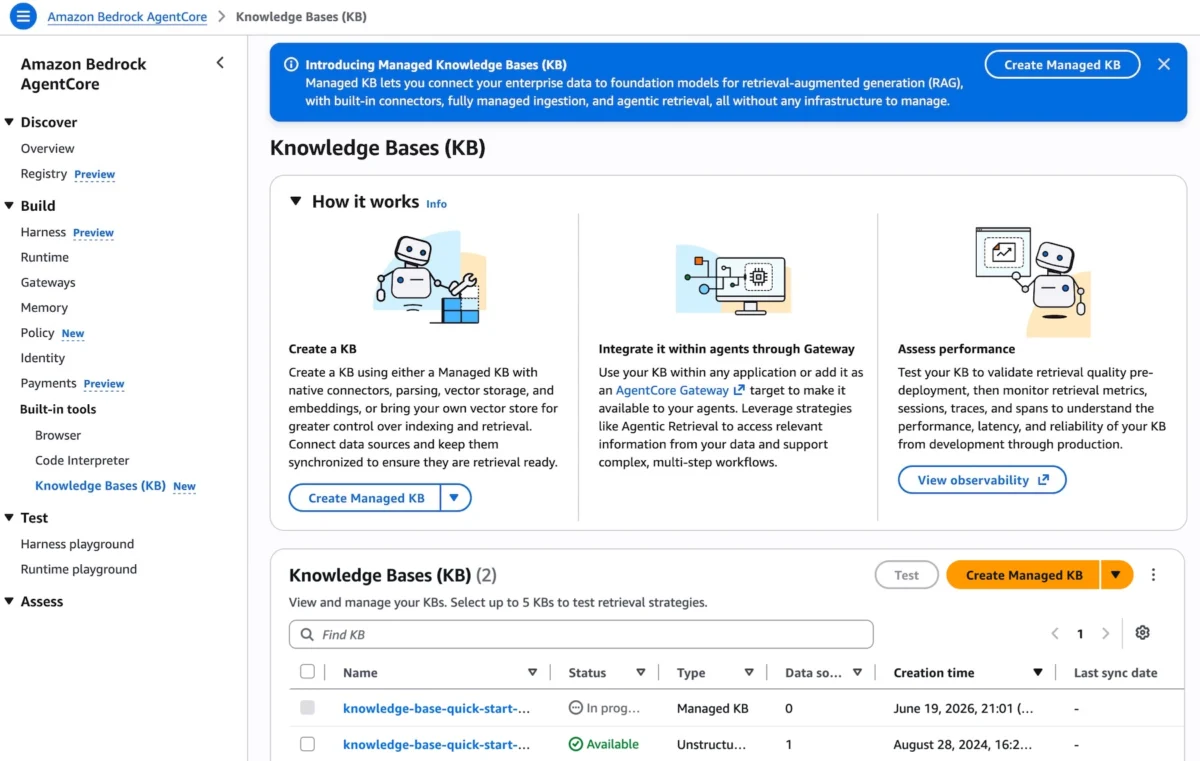

Amazon Web Services (AWS) today announced the launch of Amazon Bedrock Managed Knowledge Base, a comprehensive suite of capabilities designed to empower developers to build sophisticated, enterprise-grade generative AI applications leveraging their proprietary data in a matter of minutes. This new offering significantly simplifies the complex process of integrating internal data sources with large language models (LLMs), abstracting away the considerable infrastructure challenges traditionally associated with developing Retrieval-Augmented Generation (RAG) pipelines. The move is poised to accelerate the deployment of accurate, fast, and trustworthy AI outcomes across diverse organizational contexts, allowing businesses to harness the power of generative AI without the prohibitive overhead of managing intricate underlying systems.
The Evolution of Enterprise AI and the RAG Imperative
The rapid ascent of generative AI has ignited a fervent interest across industries, promising transformative applications from enhanced customer service to streamlined content creation and advanced data analysis. However, a significant hurdle in the enterprise adoption of these powerful models has been their inherent limitation: LLMs are trained on vast, general datasets and often lack access to an organization’s specific, proprietary, and frequently updated internal knowledge. This gap can lead to "hallucinations," where models generate plausible but factually incorrect or irrelevant information, undermining trust and utility in business-critical applications.
Retrieval-Augmented Generation (RAG) emerged as a critical architectural pattern to address this challenge. RAG systems enable LLMs to retrieve relevant information from an external knowledge base – typically an organization’s internal documents, databases, or web content – before generating a response. This process grounds the LLM’s output in factual, up-to-date, and contextually relevant data, dramatically improving accuracy, reducing hallucinations, and ensuring responses align with enterprise policies and specific operational realities.
Despite its undeniable benefits, implementing a robust RAG pipeline has historically been a complex and resource-intensive endeavor. Developers typically faced a multi-stage process involving:
- Data Ingestion and Preprocessing: Extracting data from disparate sources (documents, wikis, databases), cleaning it, and converting it into a suitable format.
- Text Chunking and Embedding: Breaking down large documents into smaller, manageable "chunks" and converting these chunks into numerical representations (embeddings) using specialized embedding models.
- Vector Database Management: Storing these embeddings in a vector database for efficient semantic search.
- Retrieval Logic: Developing sophisticated algorithms to query the vector database and retrieve the most relevant chunks based on a user’s prompt.
- Re-ranking: Further refining retrieved results using re-ranking models to prioritize the most pertinent information.
- Prompt Engineering and Orchestration: Integrating retrieved information into the LLM’s prompt and managing the overall flow of the RAG process.
- Scalability and Maintenance: Ensuring the entire pipeline scales with data volume and user demand, along with continuous updates and monitoring.
These intricate steps often required specialized expertise, significant development time, and ongoing maintenance, diverting valuable developer resources from core business innovation to undifferentiated infrastructure work. Amazon Bedrock Managed Knowledge Base directly confronts these challenges by providing a fully managed service that abstracts away these complexities, offering a streamlined path to building and managing enterprise knowledge bases for generative AI applications.
Key Innovations Driving Ease of Use and Accuracy
The Amazon Bedrock Managed Knowledge Base is built upon a foundation designed to simplify RAG pipeline development while enhancing the accuracy and reliability of generative AI applications. By default, the service intelligently selects and manages optimal embedding models, re-ranker models, and foundational models, allowing developers to immediately leverage best practices without manual configuration. Beyond this managed foundation, three core innovations significantly improve usability and performance:
1. Smart Parsing for Accurate Data Ingestion:
A fundamental challenge in RAG systems lies in effectively ingesting and preparing diverse data types for accurate retrieval. Enterprises house information in myriad formats, from structured databases and spreadsheets to semi-structured documents (PDFs, Word files, presentations), internal wikis (Confluence), cloud storage (Google Drive, OneDrive, SharePoint), and public web pages. Each format presents unique parsing and chunking requirements to ensure semantic integrity and optimal retrieval.

Smart Parsing in Amazon Bedrock Managed Knowledge Base tackles this complexity head-on. Upon connecting to data sources, the service automatically determines the most effective parsing strategy for each data type and connector, eliminating the need for extensive manual configuration or trial-and-error. This intelligent approach combines several advanced techniques:
- Layout-aware Processing: It understands the visual structure of documents, differentiating between headings, paragraphs, tables, and images, ensuring that content is chunked logically rather than arbitrarily. This preserves the context that might otherwise be lost with simple text splitting.
- Multi-modal Understanding: For documents containing both text and images, Smart Parsing can process and extract meaning from both modalities, potentially generating descriptions for images that enrich the textual context.
- Semantic Chunking: Instead of fixed-size chunks, it groups related sentences or paragraphs together based on semantic coherence, leading to more meaningful and relevant retrievals.
- Metadata Extraction: It automatically identifies and extracts critical metadata (e.g., author, date, document type) from documents, which can be used to refine retrieval queries and improve relevance.
This automated and intelligent parsing significantly reduces the "time to production" for enterprise RAG applications, eliminating weeks of experimentation typically required to achieve high-quality retrieval accuracy. Developers retain the flexibility to customize parsing strategies when specific, highly nuanced requirements arise, but the defaults provide an excellent starting point for most use cases.
2. Agentic Retriever for Complex Queries:
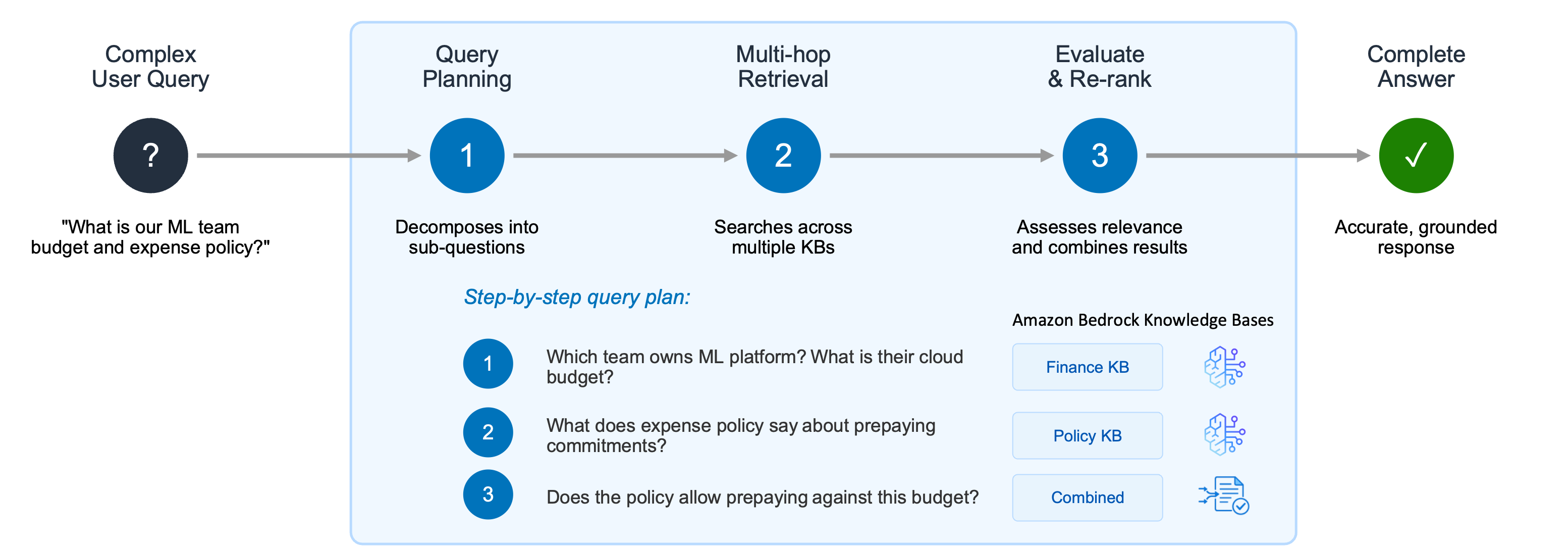
Generative AI applications are increasingly expected to handle sophisticated user queries that demand more than a single-step retrieval. Users often pose questions that require multi-hop reasoning, recursive information gathering, and intermediate evaluations of results. For instance, a query like "What is the cloud infrastructure budget for the ML platform team, and does our expense policy allow prepaying annual commitments for such expenses?" cannot be adequately answered by simply retrieving a single document.
The Agentic Retriever within Amazon Bedrock Managed Knowledge Base is designed to tackle these complex, multi-faceted queries. It operates by intelligently decomposing a complex user query into a step-by-step plan, leveraging a foundational model to reason through the information needed. For the example query, the Agentic Retriever might formulate a plan like:
- Identify the specific ML platform team and its allocated cloud infrastructure budget.
- Consult the company’s expense policy to determine guidelines regarding prepaying annual commitments.
- Synthesize information from both sources to ascertain if the ML platform team’s budget allows for prepaying annual commitments under the existing policy.
At each step, the system performs targeted multi-hop retrieval, gathering relevant passages and evaluating their sufficiency. Once enough information is gathered, it ceases the search process and compiles a comprehensive, grounded response. This capability dramatically improves accuracy for intricate queries by automating the orchestration logic that developers would otherwise have to build manually, allowing them to focus on the higher-level agentic search application design. Developers can test this feature directly within the Amazon Bedrock AgentCore console by selecting "Agentic retrieval only" as the retrieval type, observing how the system plans and executes multi-step queries across their knowledge bases.
3. Seamless Integration with AgentCore Gateway (MCP Enabled):
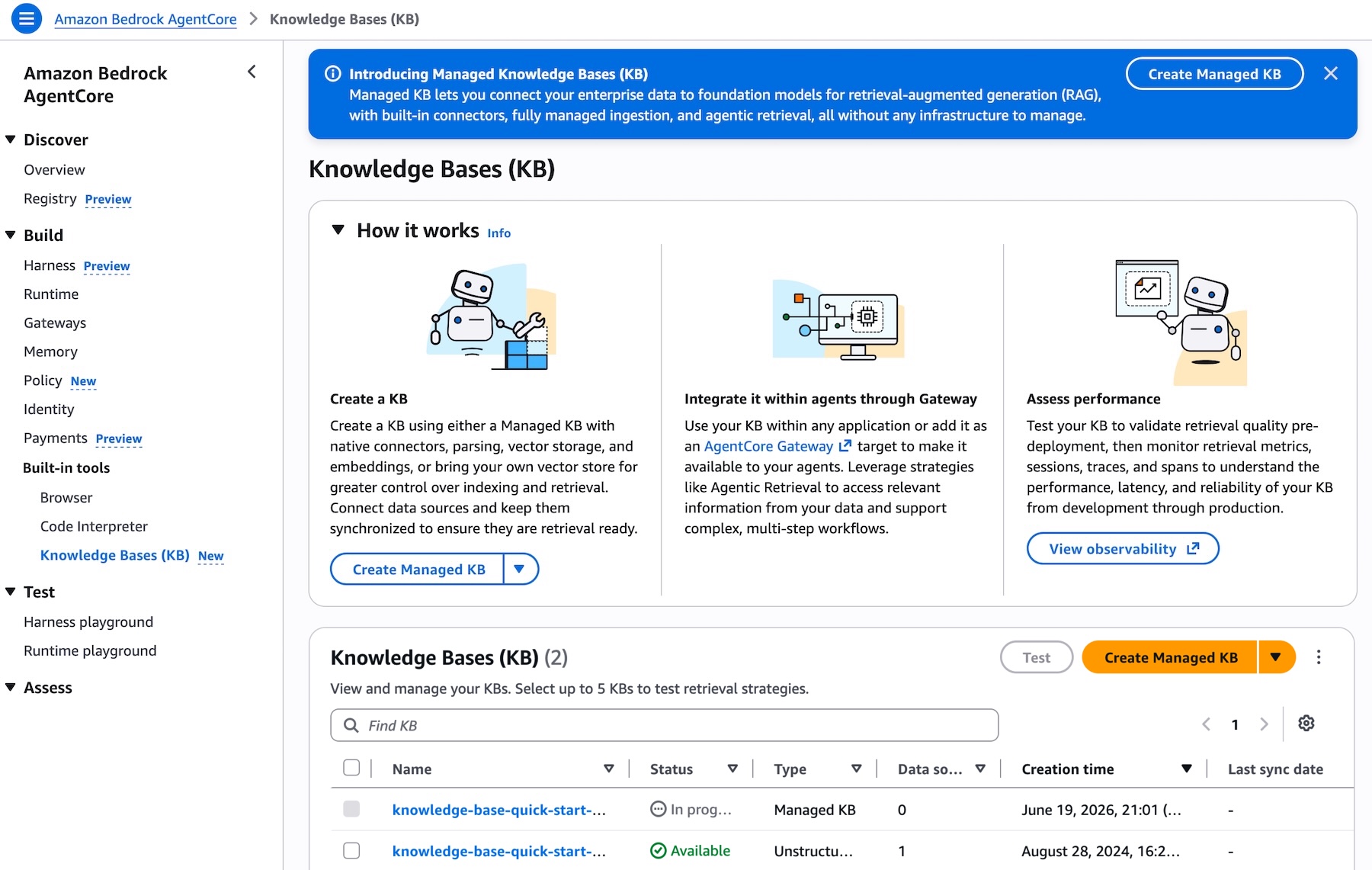
To truly empower the creation of sophisticated AI agents, a knowledge base must seamlessly integrate into a broader agentic ecosystem. Amazon Bedrock Managed Knowledge Base achieves this through native integration with AgentCore Gateway, acting as a pre-built target type. This integration drastically simplifies the process of exposing knowledge base functionalities to agents, eliminating the need for custom integration code.
When adding targets to an AgentCore Gateway, developers can simply select "Knowledge Base" as a pre-built option and specify their knowledge base ID. This action automatically handles critical aspects such:
- Role-based Permissions: Automatic generation and management of AWS Identity and Access Management (IAM) roles, ensuring secure access to data sources.
- Observability: Providing built-in monitoring and evaluation metrics within the AgentCore Observability dashboard, offering insights into agent performance and knowledge base utilization.
- Policy Enforcement: Ensuring that agent interactions with the knowledge base adhere to defined security and access policies.
Crucially, AgentCore Gateway exposes the standard Model Context Protocol (MCP). This adherence to an open protocol means that knowledge base tools are automatically discoverable by clients built using any MCP-compatible framework. This includes popular open-source libraries such as Strands Agents, LangChain, CrewAI, LlamaIndex, and LangGraph. This interoperability significantly reduces developer friction, fostering a vibrant ecosystem for agent development without proprietary lock-in.
Model Choice and Flexibility: A Core Differentiator
A hallmark of Amazon Bedrock’s strategy is its commitment to model choice and flexibility, and the Managed Knowledge Base upholds this principle. Unlike some managed solutions that might restrict users to specific model providers, Amazon Bedrock Managed Knowledge Base separates the infrastructure management (connectors, parsing, storage, retrieval orchestration) from the crucial aspect of model selection. This design philosophy offers developers unparalleled control and future-proofing:
- Foundational Model Agnosticism: Every foundational model available on Bedrock – including models from Amazon, Anthropic, AI21 Labs, Cohere, Meta, and Mistral AI – can power the generation step of the RAG pipeline. This allows organizations to choose the best-fit model for their specific use case, balancing performance, cost, and ethical considerations.
- Optimized Retrieval Components: Developers can select from various embedding and re-ranking models to optimize retrieval accuracy for their unique datasets and query patterns. This fine-grained control enables teams to precisely tune the cost-performance ratio without altering the underlying RAG infrastructure.
- Future-Proofing: The ability to swap models means that as new, more capable, or more cost-effective models emerge, enterprises can seamlessly integrate them into their existing RAG applications without a costly re-architecture. This ensures that their generative AI solutions remain at the cutting edge.
This approach empowers developers to focus their efforts on crafting innovative generative AI applications, confident that they retain the agility to adapt their model choices based on evolving business requirements, technological advancements, or changing cost dynamics.
Getting Started and Global Availability
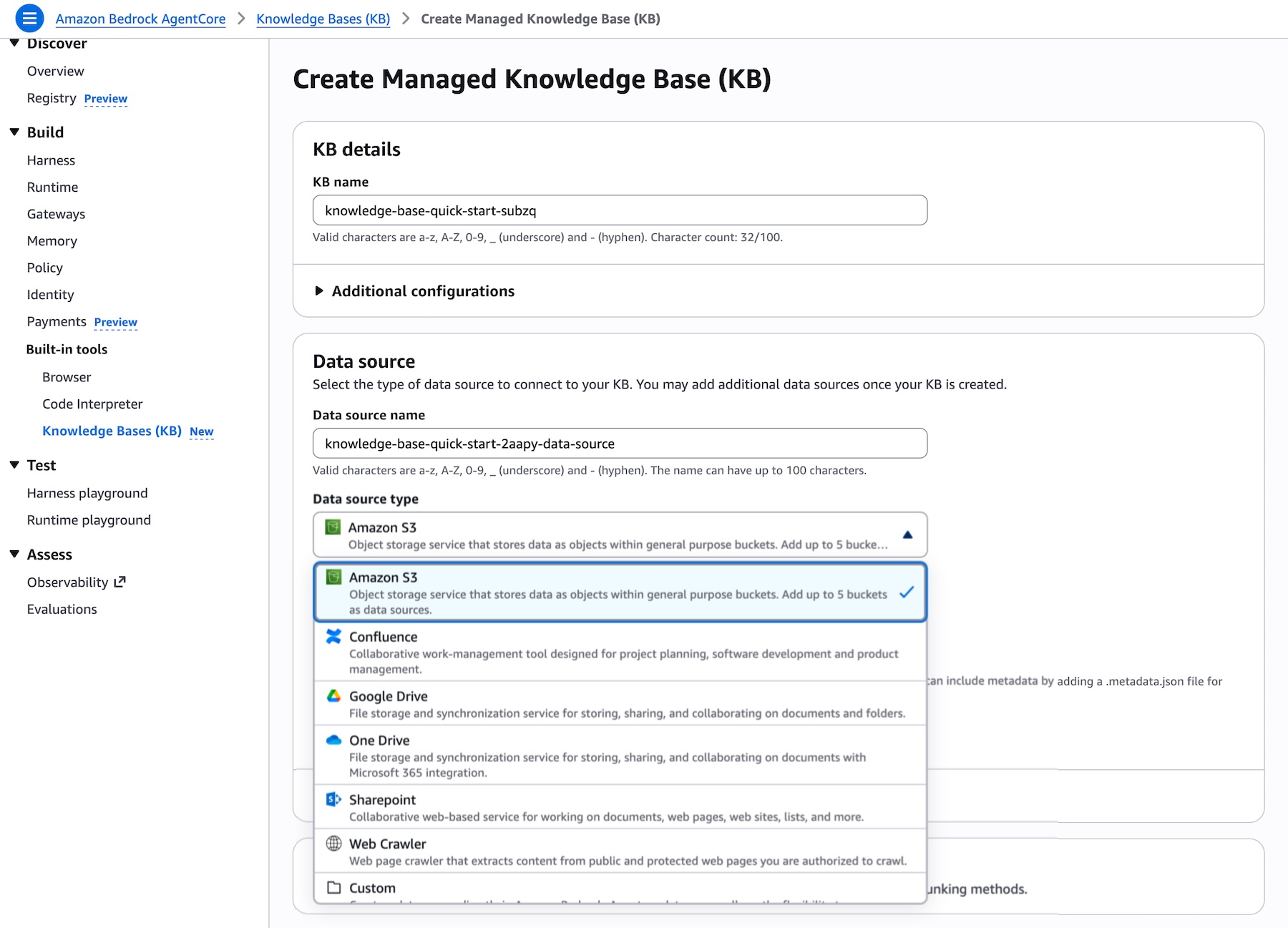
Creating a Managed Knowledge Base is designed to be a straightforward process. Developers can navigate to either the Amazon Bedrock AgentCore console or the Amazon Bedrock console, select the "Knowledge Bases" page, and choose "Create Managed KB." The user interface guides them through connecting to enterprise data sources, offering a dropdown list of supported connectors including Amazon S3, Confluence, Google Drive, OneDrive, SharePoint, and a Web Crawler, alongside a custom option. AWS IAM roles are automatically created to manage permissions, which can be edited if needed. With optimized default settings, a knowledge base can be established in just a few clicks. Once data is synced, it can be integrated with agents or used as a tool for foundational models.
Amazon Bedrock Managed Knowledge Base is immediately available in key AWS Regions, including US East (N. Virginia), US West (Oregon), Asia Pacific (Sydney, Tokyo), Europe (Dublin, Frankfurt, London), and AWS GovCloud (US-West). AWS continues to expand its global infrastructure, and updates on regional availability and future roadmap can be found on the AWS Capabilities by Region page.
The service operates on a pay-as-you-go model, with pricing based on two primary dimensions: the volume of indexed data stored and the number of retrievals performed. This transparent pricing structure eliminates upfront commitments, allowing organizations to scale their usage according to their needs. Furthermore, Amazon Bedrock is part of the AWS Free Tier, enabling new AWS customers to explore the service at no initial cost.
Broader Impact and Implications
The introduction of Amazon Bedrock Managed Knowledge Base marks a significant milestone in the journey towards pervasive enterprise generative AI. Its implications are far-reaching:
- Democratization of Enterprise AI: By significantly lowering the technical barrier to entry for building robust RAG pipelines, AWS is democratizing access to enterprise-grade generative AI. Smaller teams and organizations with limited specialized AI engineering resources can now develop powerful AI applications that leverage their internal data, fostering innovation across a wider spectrum of businesses.
- Accelerated Time-to-Market: The abstraction of complex infrastructure and the automation of critical steps like data parsing and multi-hop retrieval will drastically reduce development cycles. Enterprises can move from concept to production-ready generative AI applications much faster, enabling them to respond to market demands and gain competitive advantages more swiftly.
- Enhanced Accuracy and Trust: By grounding LLM responses in proprietary, up-to-date data, the service inherently improves the factual accuracy and trustworthiness of generative AI outputs. This is paramount for adoption in regulated industries such as finance, healthcare, and legal services, where accuracy and compliance are non-negotiable.
- Shift in Developer Focus: Developers are freed from the "undifferentiated heavy lifting" of infrastructure management. Their efforts can now be redirected towards designing innovative agent behaviors, optimizing business logic, and creating truly transformative user experiences, leading to more impactful AI solutions.
- Competitive Landscape: This offering strengthens AWS’s position in the fiercely competitive cloud AI market. By providing a comprehensive, managed solution for RAG, AWS addresses a critical pain point that many enterprises face, differentiating itself from platforms that might offer only foundational models or require more manual orchestration.
- Catalyst for Agentic AI: The seamless integration with AgentCore Gateway and the advanced Agentic Retriever capabilities are critical enablers for the next generation of AI applications – autonomous agents. These agents, capable of complex reasoning, planning, and execution, will be able to leverage reliable knowledge bases to perform sophisticated tasks, marking a significant leap in AI capabilities within the enterprise.
Industry analysts widely agree that simplifying the development and deployment of enterprise-grade generative AI is crucial for its mainstream adoption. "Services like Amazon Bedrock Managed Knowledge Base are essential for accelerating the integration of generative AI into core business processes," noted one leading analyst. "By providing robust, scalable, and secure RAG capabilities out-of-the-box, AWS is empowering organizations to unlock the true value of their proprietary data with AI, without getting bogged down in infrastructure complexities."
The Amazon Bedrock Managed Knowledge Base is more than just a new feature; it is a strategic offering that reflects AWS’s understanding of the evolving needs of enterprise AI. By abstracting complexity, ensuring flexibility, and prioritizing accuracy, AWS is setting a new standard for how organizations can build, deploy, and scale their generative AI initiatives securely and efficiently. With these capabilities now broadly available, the path for enterprises to transform their operations with intelligent, data-driven AI applications has never been clearer. For those looking to dive deeper, the Bedrock Knowledge Bases Developer Guide offers comprehensive resources to get started.
