
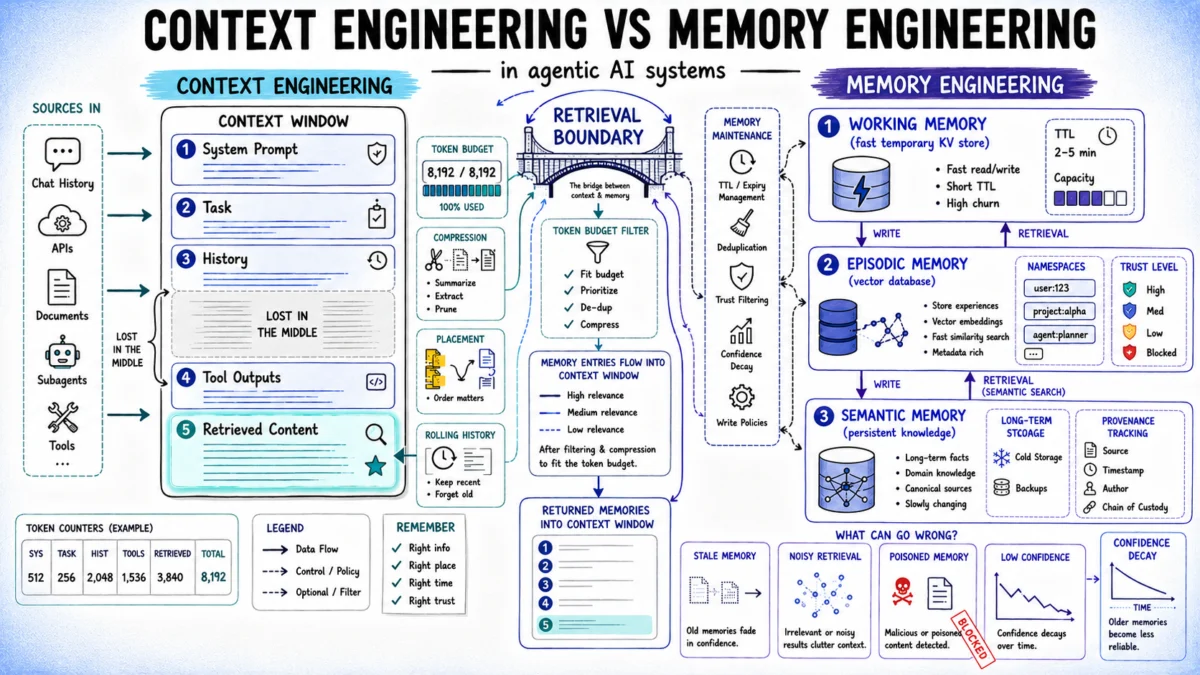

The proliferation of AI agents across increasingly complex workflows and multi-session applications has brought to the forefront a critical challenge: ensuring these systems maintain coherence, relevance, and efficiency over time. As agents navigate intricate tasks, common failure patterns emerge—constraints are inexplicably dropped mid-task, irrelevant information resurfaces, or context from an earlier, unrelated step bleeds into the current operation. Pinpointing the root cause of these failures often proves difficult because no single component appears overtly flawed. Most frequently, the problem lies within two often-conflated or overlooked disciplines: context engineering and memory engineering. While related, these fields are distinct, address different failure modes, and demand specialized systemic approaches for effective implementation.
This article delves into the core principles of both context and memory engineering, elucidating their individual functions, detailing their respective challenges, and highlighting their crucial intersection point where retrieved knowledge enters an AI model’s active processing window. Understanding these two facets, both in isolation and in concert, is paramount to developing agentic AI systems that perform robustly across real-world workloads, from sophisticated customer service bots to autonomous research assistants.
The Emergence of Agentic AI and the Need for Enhanced Intelligence
The journey of artificial intelligence has seen a rapid evolution from rule-based systems and narrow AI to the current era of large language models (LLMs) and, more recently, agentic AI. Early LLMs, while powerful in generating human-like text, were largely stateless. Each interaction was a fresh start, devoid of memory beyond the immediate prompt. This limitation quickly became apparent as developers sought to build applications requiring sustained engagement, personalized experiences, or multi-step reasoning.
The concept of "agentic AI" emerged to address this, envisioning systems capable of independent reasoning, planning, tool use, and persistent interaction over extended periods. These agents are designed to break down complex goals into sub-tasks, execute them, and learn from their experiences. However, this increased autonomy introduced a new set of architectural challenges. Unlike a human, who effortlessly draws upon past experiences and filters immediate perceptions, an AI agent needs explicit mechanisms to manage both transient and long-term information. This necessity gave rise to context engineering and memory engineering as foundational disciplines for building truly intelligent and reliable AI agents.
Context Engineering: Shaping the Immediate Cognitive Landscape
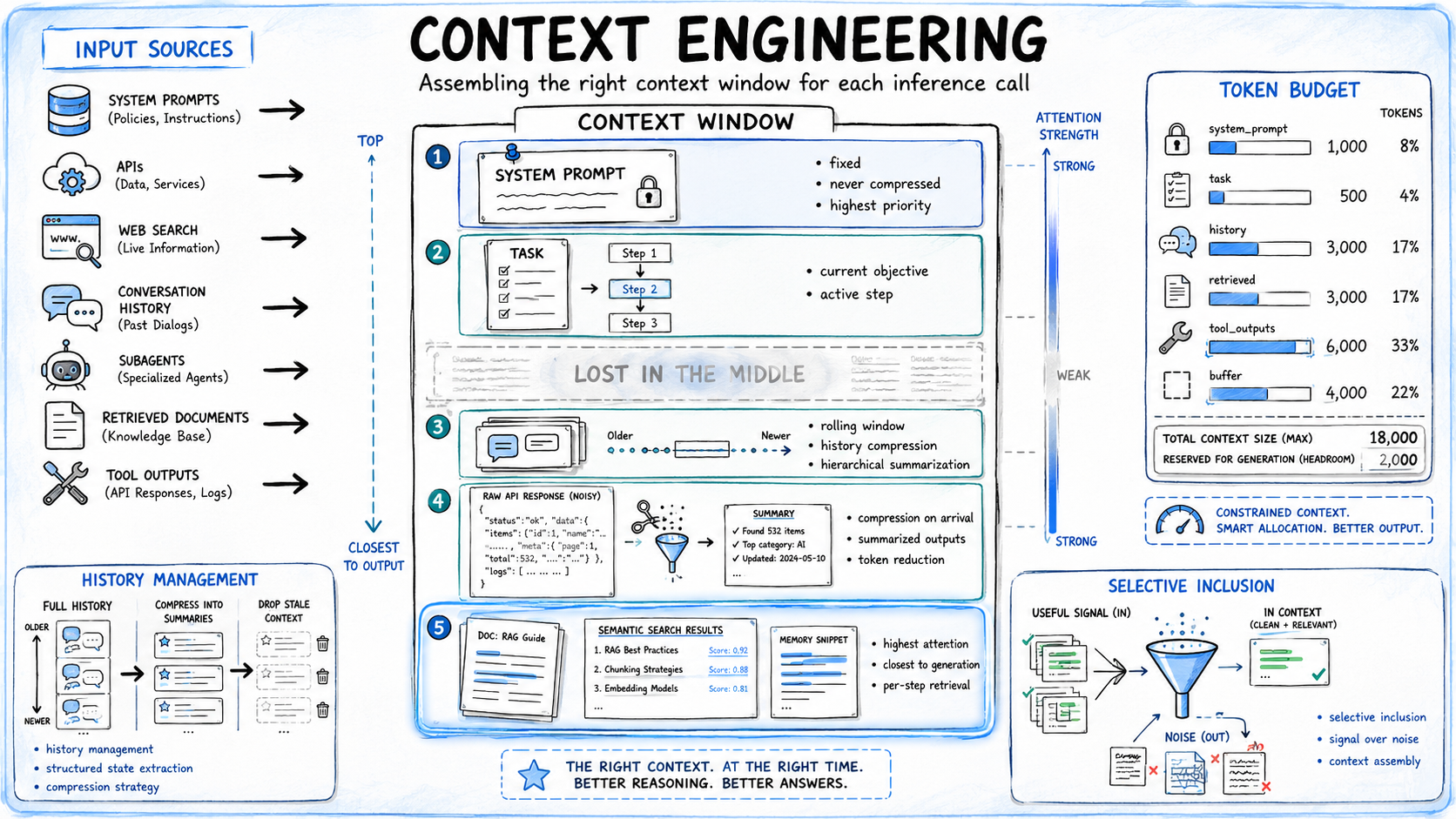
Context engineering focuses on the meticulous design of a single inference call to an AI model. It governs what information is presented to the model, how it is organized, what is compressed, and what is ultimately discarded once the call concludes. Everything within this scope is ephemeral; upon completion of the inference, the processing window is cleared, ready for the next distinct operation. The primary goal is to ensure the model receives the most relevant, concise, and optimally structured information required for its current task, preventing information overload or critical data omissions.
Selective Inclusion: The Art of Information Curation
One of the most significant challenges in context engineering is managing the sheer volume of potentially relevant data. Not every piece of information available should enter the model’s context window. For instance, a database query might return hundreds of rows, a web search could yield five comprehensive articles, or a code executor might log verbose output. Injecting all this raw data directly into the context window can quickly lead to "token bloat," exhausting the model’s capacity and significantly degrading its reasoning quality even before the token limit is physically reached.
The decision of what to include verbatim, what to summarize into key facts, and what to discard entirely is a deliberate design choice, not a default. Effective context engineering employs intelligent filtering and summarization mechanisms to ensure only high-signal information makes it into the prompt. This proactive management prevents the model from getting overwhelmed by noise and allows it to focus its computational resources on the most pertinent details.
Structural Placement: Leveraging Attention Dynamics
The physical placement of information within the context window profoundly impacts how reliably an AI model utilizes it. Research, notably the "lost in the middle" effect, has demonstrated that models tend to attend more strongly to content positioned at the beginning and end of long contexts, while material in the middle receives significantly less weight. This cognitive bias necessitates strategic placement.
Critical instructions, hard constraints, and immutable task parameters are best placed at the top of the context window to ensure they are consistently prioritized. Conversely, retrieved information most relevant to the immediate sub-task should be positioned near the end of the context window. The current user query or active objective typically follows this retrieved information, placing both the immediate goal and its supporting context as close as possible to the point where the model generates its response. This arrangement maximizes the likelihood of the model effectively leveraging the retrieved data for its output.
Compression on Arrival: Preventing Context Bloat
Efficient context management also dictates that information from external tools or previous steps should be compressed before it enters the context window for a subsequent inference call, not reactively after the window begins to fill. A raw API response that consumes 3,000 tokens, for example, should be summarized to its essential 150 tokens as soon as it’s received, rather than waiting until the model’s context is nearly full and then scrambling to truncate. Proactive compression at the source prevents context bloat and ensures a more stable and predictable token budget for each step.
Conversation History Management: A Dynamic Record
Conversation history is arguably the fastest-growing component of an agent’s context. For long-running agents, carrying the full transcript of every past interaction into every subsequent call rapidly escalates costs and diminishes reliability. A robust conversation history management strategy is essential. This could involve a rolling window that retains only the most recent interactions, hierarchical summarization that condenses older turns into higher-level summaries, or structured state extraction that pulls out key facts and entities from the conversation. These compression strategies should be applied at defined intervals or based on explicit policies, rather than only when the context window is on the verge of overflowing.
Memory Engineering: Designing Persistent AI Knowledge Systems
In contrast to context engineering’s focus on ephemeral, single-call interactions, memory engineering is concerned with what information persists beyond a single model interaction. It encompasses the comprehensive systems and policies responsible for writing, storing, retrieving, updating, and governing information so that it can be effectively utilized in future interactions, across sessions, or by other agents. When an agent recalls a user preference from weeks ago, coordinates with another agent using shared knowledge, or applies a learned successful action pattern, it is memory engineering at play.
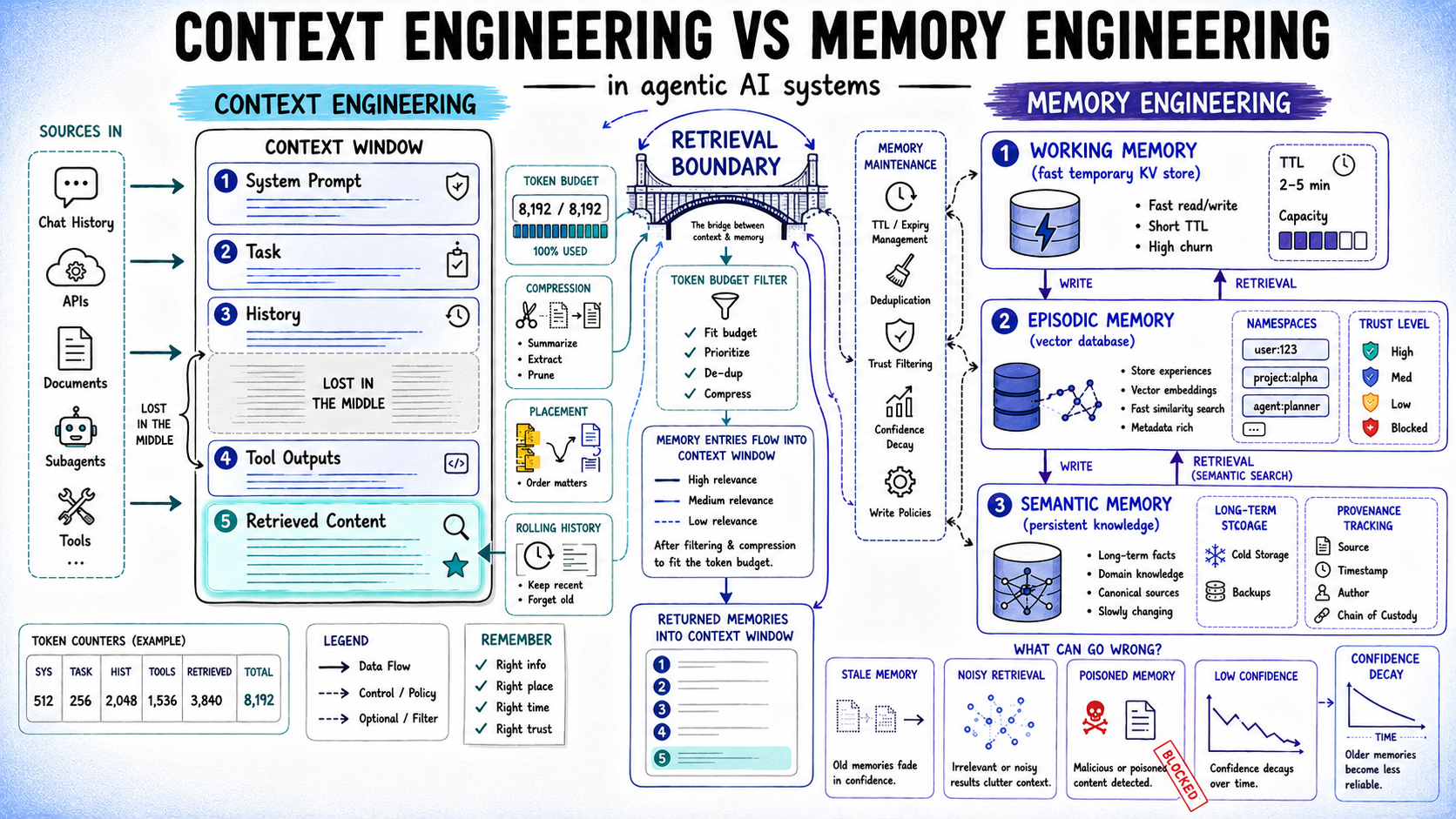
Memory engineering ensures that an AI agent can build a cumulative knowledge base, learn from experience, and maintain continuity over time, mirroring a human’s ability to draw upon long-term memory.
Write Policy Design: The Foundation of Quality Memory
One of the most frequently overlooked yet disproportionately impactful aspects of memory engineering is the design of a robust write policy. While retrieval systems often garner the most attention, the quality of retrieval is fundamentally constrained by the quality of the information initially written into the memory store.
A meticulously defined write policy specifies:
- What information to store: Not all generated outputs or observed data is equally valuable.
- When to store it: Specific triggers for committing information to memory.
- How to transform it: Summarization, extraction, or normalization before storage.
- What metadata to include: Importance scores, confidence levels, provenance, and expiry dates.
- Trust levels: Assigning a degree of reliability to different sources (e.g., internal system facts vs. user input vs. external web search).
Without explicit write policies, systems often default to storing excessive information, assigning equal trust to all entries, and retaining data indefinitely. Over time, this leads to an accumulation of low-value, outdated, or even contradictory memories, causing signal-to-noise ratios to decline and retrieval quality to degrade. The result is a memory system that continuously grows in size but progressively diminishes in usefulness.
Storage Layer Selection: Matching Memory to Purpose
Different types of memory serve distinct purposes and, consequently, require different storage backends and retrieval methods. The choice of backend also dictates the available retrieval strategies.
- Working Memory: Stores active task state, intermediate results, and short-term variables. It requires extremely fast access. Storage Backend: In-memory caches or short-lived key-value stores like Redis. Retrieval Method: Direct key lookup.
- Episodic Memory: Records past interactions, complete task runs, decisions made, and their outcomes. It helps agents learn from experience. Storage Backend: Vector stores (e.g., Pinecone, Weaviate, Chroma) for semantic search. Retrieval Method: Semantic similarity search.
- Semantic Memory: Holds persistent facts, user preferences, domain knowledge, and learned concepts. This is the agent’s long-term factual knowledge. Storage Backend: A hybrid of vector stores for conceptual search and key-value or relational databases for structured facts. Retrieval Method: Semantic search or exact key lookup.
- Procedural Memory: Encapsulates learned workflows, successful action patterns, and strategic approaches. Storage Backend: Structured databases, rule engines, or even direct prompt injection of learned heuristics. Retrieval Method: Pattern matching, direct retrieval of learned procedures.
The distinction between retrieval-based memory (treating past interactions as loosely related documents) and structured state-based memory (extracting typed, validated facts) is crucial for use cases requiring continuity. Structured state extraction offers more consistent results for facts that need reliable application across sessions, mitigating brittleness to phrasing variations and conflicting updates inherent in purely semantic search.
Retrieval Strategy: Intelligent Information Access
Reading from memory is rarely a single, monolithic operation. A well-designed retrieval layer employs a multi-stage strategy. It typically checks working memory first due to its speed and low cost for exact lookups. If nothing relevant is found, it falls back to semantic search across episodic or semantic memory. Crucially, before returning results, it applies metadata filters (e.g., for recency, trust level, or provenance) and then injects only the most relevant, compressed information needed for the current step. Advanced strategies may include re-ranking retrieved documents based on current task relevance or using a small LLM to synthesize retrieved facts before presentation.
Memory Maintenance: Preserving Quality Over Time
A memory store without a proactive maintenance policy inevitably degrades. Entries accumulate, stale facts compete with current ones, and retrieval quality plummets as the signal-to-noise ratio diminishes. Essential maintenance routines include:
- Confidence Decay: Volatile facts or those with lower initial confidence scores can have their confidence decay over time, making them less likely to be retrieved.
- Deduplication: Identifying and merging or removing semantically similar entries to prevent redundancy.
- TTL-based Expiry: Applying Time-To-Live (TTL) policies to working memory and time-sensitive data ensures outdated information is automatically purged.
- Periodic Compression: Old episodic records can be compressed into higher-level session summaries, reducing storage footprint and improving retrieval efficiency for long-term trends rather than minute details.
A robust memory entry schema, incorporating fields like content, type, importance, confidence, trust level, creation/expiry timestamps, and provenance, significantly simplifies the implementation of these write and maintenance policies, making the system easier to reason about and manage.
The Retrieval Boundary: Where Memory Meets Context
Memory engineering and context engineering, though distinct, are profoundly interconnected and function as two layers of a unified system. Both disciplines exist to solve the fundamental problem of providing the AI model with the right information at the right time. Memory systems are responsible for producing candidate information, drawing from the agent’s accumulated knowledge. Context assembly then takes over, deciding:
- What subset of retrieved information is truly relevant to the current task.
- How much of that information can fit within the model’s token budget.
- Where to strategically place that information within the context window for maximum impact.
Effectively managing this boundary is what transforms a collection of disparate memory components into a coherent and intelligent agent system.
Failure Mode #1: Retrieval Without a Context Budget
One of the most prevalent failure modes occurs when retrieval is treated in isolation from context assembly. A memory search might return a substantial set of relevant entries, and the context assembler, without proper constraints, injects all of them into the prompt. As more memories are added, the context window rapidly fills with retrieved content, leaving insufficient room for crucial instructions, tool outputs, reasoning traces, and task-specific information.
This often manifests in misleading symptoms: the agent might "forget" instructions, generate incomplete responses, or hallucinate information. Developers might incorrectly assume the memory system failed, when in reality, the retrieval was successful, but the context assembly lacked a budgeting mechanism. The true failure lies in the interface between memory and context.
A more effective approach is retrieval-aware context assembly. Instead of retrieving first and budgeting later, the context layer proactively allocates a specific token budget before initiating retrieval. The memory system then returns only the highest-value, most relevant memories that fit within that predetermined budget. This ensures retrieval operates within the constraints of the active context, preventing token overflow and maintaining the integrity of the prompt.
Failure Mode #2: Poor Placement of Retrieved Information
Even if retrieved memories are highly relevant and adhere to budget constraints, their efficacy can be nullified by incorrect placement within the context window. A common issue is treating retrieval purely as a search problem, appending retrieved memories wherever they arrive without considering their functional role in the current reasoning step.
This problem is exacerbated in longer contexts, where the model’s attention is not uniformly distributed. Information buried deep within a lengthy context often receives significantly less influence than information positioned at the beginning or end. This can lead to a subtle but impactful failure: the memory system successfully retrieved crucial information, but the model failed to utilize it effectively due to poor placement. The agent might "miss" a critical detail or struggle to connect retrieved facts to the immediate objective.
Context assembly must therefore optimize both the selection and placement of retrieved information. Relevant memories that are critical to influencing the current step should be strategically positioned near the active reasoning region of the prompt, rather than arbitrarily appended. This conscious arrangement maximizes the likelihood of the model attending to and integrating the retrieved knowledge into its decision-making process.
Broader Impact and Future Outlook
The sophisticated interplay between context and memory engineering is not merely a technical detail; it is foundational to the next generation of AI systems. For enterprises, reliable agentic AI translates into more efficient operations, personalized customer experiences, and automated knowledge work. For individual users, it means more capable, trustworthy, and context-aware personal AI assistants.
The implications extend to the scalability and cost-effectiveness of AI. By intelligently managing context and memory, organizations can optimize token usage, reducing the operational expenses associated with large language models. Furthermore, robust memory systems contribute to the safety and alignment of AI agents by ensuring consistent adherence to learned preferences, constraints, and ethical guidelines across interactions.
As AI models continue to grow in complexity and context window sizes expand, the need for these engineering disciplines will only intensify. The future of AI agents hinges on their ability to not just process information, but to genuinely understand, remember, and intelligently apply knowledge over time. The continuous development and refinement of context and memory engineering will be pivotal in unlocking the full potential of artificial general intelligence, moving beyond mere task execution to systems that exhibit genuine understanding, adaptability, and persistent learning.
Summary
Context and memory engineering represent two indispensable layers of a cohesive system that dictates what an AI model knows, when it knows it, and how that knowledge is applied.
Context engineering operates dynamically at inference time, meticulously shaping the active information window for immediate processing. It addresses questions like "What should the model see right now, and how?" Its primary artifact is the assembled context window for each inference call, with token management, compression of tool outputs and history, and strategic placement being key concerns. Failures typically involve context overflow, attention degradation, or noisy assembly.
Memory engineering, conversely, operates across time, dictating what information persists beyond a single interaction and how it can be reliably retrieved later. It answers "What should the system retain, and for how long?" Its output comprises persistent memory entries across calls and sessions, managed through robust write policies, diverse storage backends, and intelligent retrieval strategies. Memory maintenance, including confidence decay, deduplication, and archival, is crucial to prevent poisoning, staleness, and unbounded growth.
The critical intersection, or "retrieval boundary," is where memory engineering delivers candidate information, and context engineering makes the final decisions on inclusion, compression, and placement within the active prompt. An agentic system truly excels only when both layers are harmoniously aligned: memory determines the pool of available knowledge, and context determines which of that knowledge becomes actionable in the present moment. This integrated approach is the cornerstone of building intelligent, reliable, and scalable AI agents.
