

The modern enterprise software landscape has experienced an unprecedented paradigm shift over the past several years, transitioning rapidly from traditional, deterministic cloud architectures to sophisticated, agentic artificial intelligence systems. While these autonomous agents—capable of planning, reasoning, executing multi-step workflows, and leveraging external tools—promise transformative efficiency gains for businesses across every sector, they introduce profound operational and engineering challenges. Unlike legacy applications characterized by predictable inputs and outputs, AI agents behave non-deterministically. A minor alteration to a system prompt or a subtle shift in contextual data can severely degrade response quality or alter decision-making pathways, often while standard infrastructure metrics register zero errors.
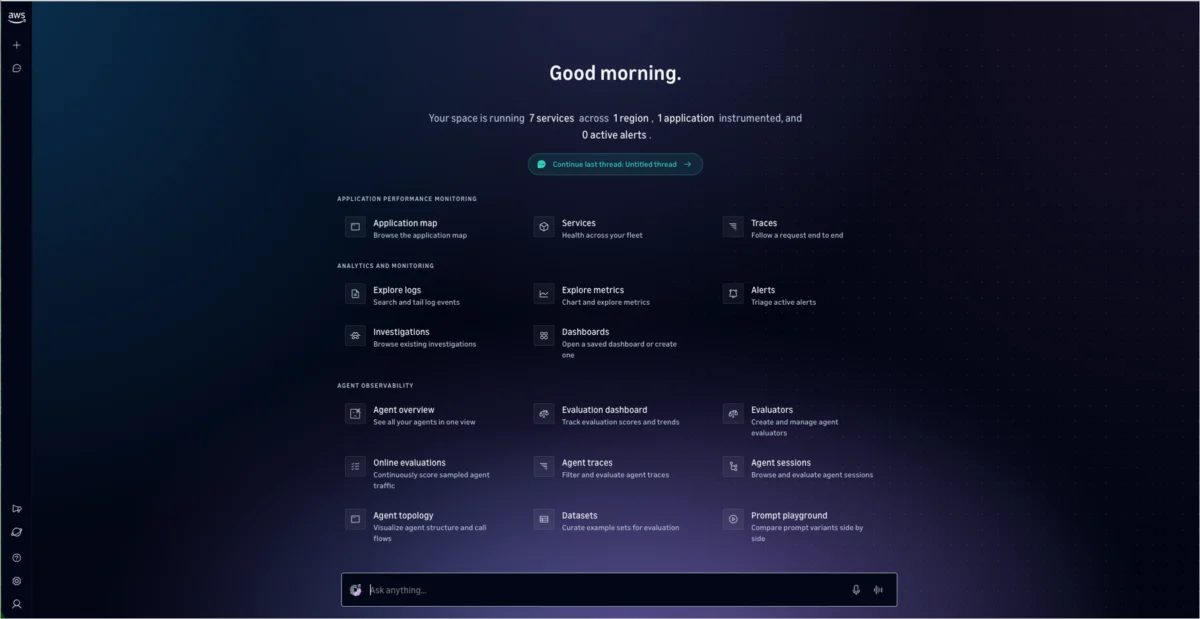
Addressing this critical industry bottleneck head-on, Amazon Web Services (AWS) has officially announced the general availability of Amazon CloudWatch Omni, a unified, app-centric, and AI-powered observability platform. Designed explicitly for modern application workloads and autonomous AI agents, CloudWatch Omni breaks away from traditional console-bound monitoring tools. By combining evaluation-driven workflows, open standards integration, and dual-surface delivery directly into developer environments and standalone web dashboards, the new solution aims to give engineering and operations teams unprecedented visibility into the black-box nature of generative artificial intelligence systems.
The Operational Crisis of Non-Deterministic AI Systems
For years, software engineering teams relied on conventional application performance monitoring (APM) tools to track CPU utilization, memory thresholds, HTTP response codes, and database latencies. However, these foundational metrics are fundamentally inadequate for monitoring large language model (LLM) orchestration and multi-agent systems. When an AI agent fails to complete a task or hallucinates an incorrect output, developers are routinely forced to spend countless hours manually parsing through sprawling logs across disconnected systems. They must attempt to reconstruct a complex chain of reasoning steps, tool invocations, and sub-agent calls entirely via guesswork.
Furthermore, existing generative AI monitoring solutions have historically suffered from severe fragmentation. Organizations frequently find themselves forced to choose between siloed standalone AI observability platforms that lack infrastructure context, or conventional cloud dashboards that cannot evaluate semantic nuances like coherence, helpfulness, and factual correctness. This architectural divide forces developers and site reliability engineers (SREs) into a state of constant context-switching between localized coding environments and browser-based monitoring dashboards, drastically slowing down debugging cycles and deployment velocities.
CloudWatch Omni was engineered to eliminate these operational silos. By unifying telemetry, tracing, evaluation, and experimentation into a single cohesive experience, the platform enables development and operations teams to bridge the historical gap between local code creation and production-grade fleet management.

Dual-Surface Architecture: Bridging Development and Operations
A cornerstone of the CloudWatch Omni release is its innovative dual-surface architecture, which recognizes that developers and system operators have vastly different workflows yet require access to identical underlying telemetry data.
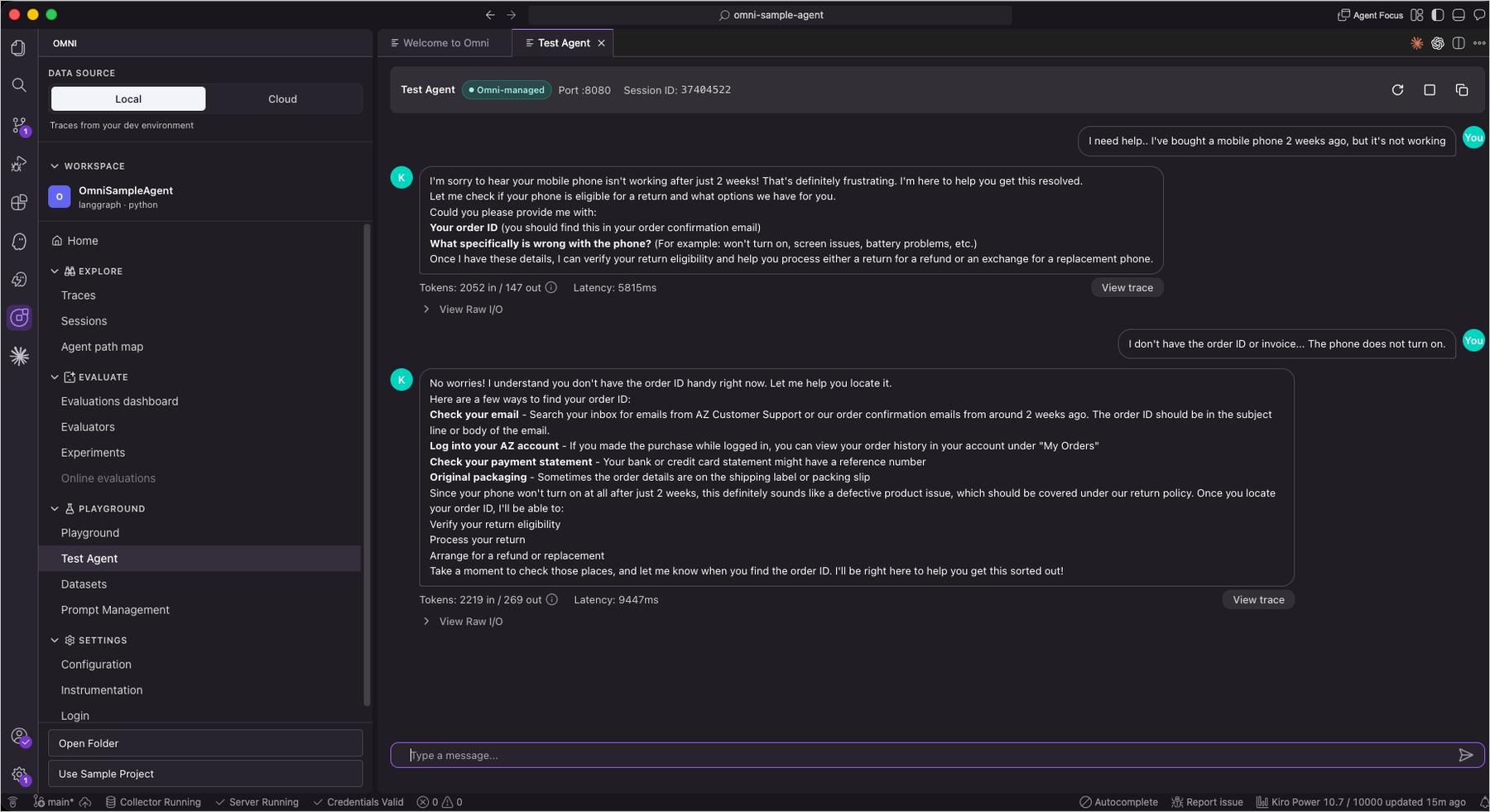
For developers, CloudWatch Omni delivers a native extension seamlessly integrated into modern integrated development environments (IDEs), specifically supporting Visual Studio Code and Kiro at launch. As developers run, test, and iterate on their AI agents locally, execution traces populate dynamically within the IDE sidebar. With a single click, engineers can launch a built-in playground, execute evaluations, and analyze performance metrics without ever leaving their coding workspace.
Conversely, operations and SRE teams require a bird’s-eye view of production fleets without the clutter of development tools or the requirement of navigating the complex AWS Management Console. CloudWatch Omni addresses this through a dedicated, standalone web experience accessible via secure Single Sign-On (SSO). This web interface provides comprehensive application monitoring, analytics, and fleet-wide agent observability. Crucially, both surfaces share a single source of truth: the exact trace a developer uses to debug a localized failure in their IDE is the exact trace an operator investigates when analyzing an incident in production.
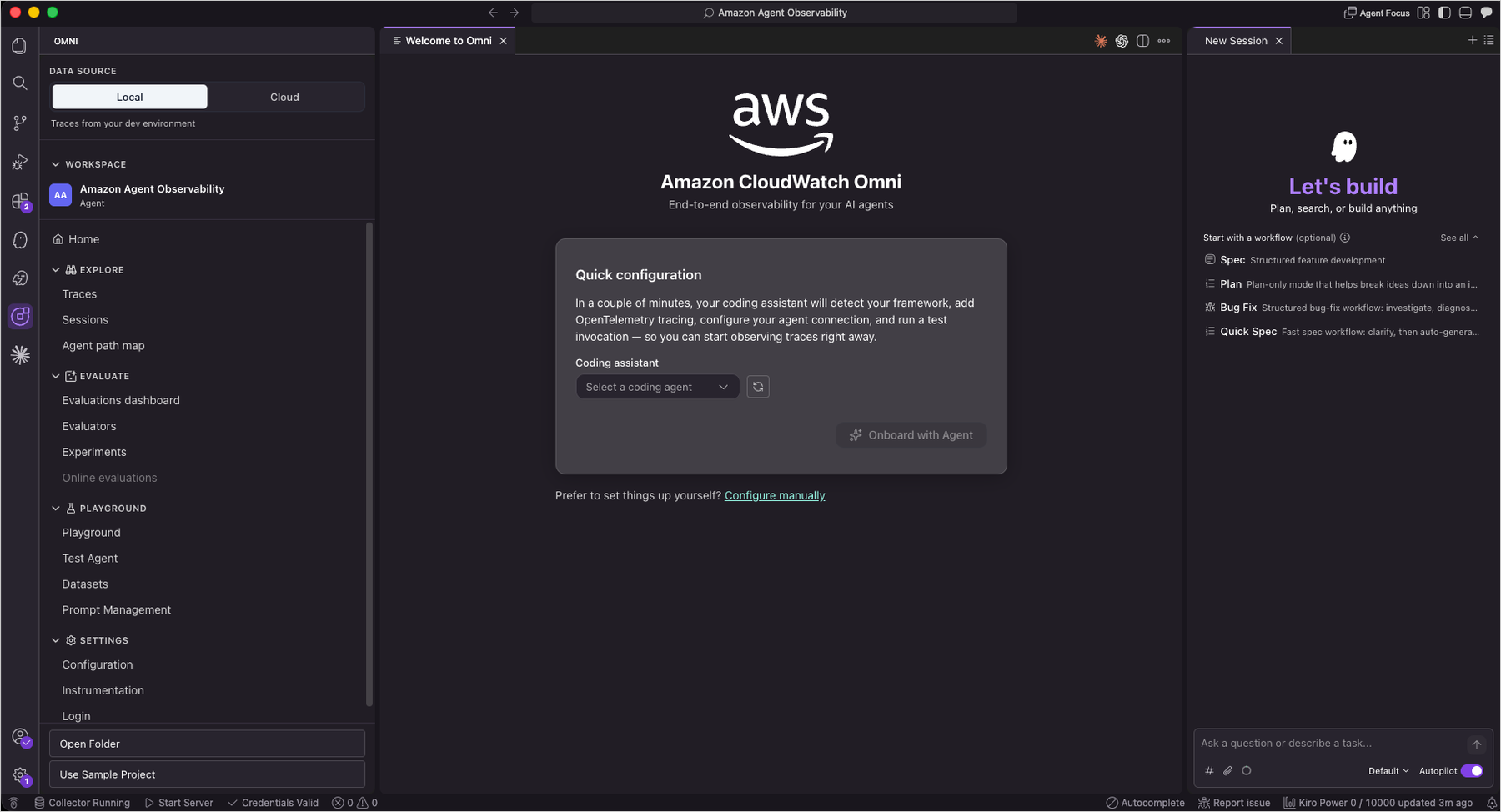
To facilitate a frictionless transition from local development to cloud-scale monitoring, CloudWatch Omni introduces a secure Cloud Login feature. This capability connects local IDE environments to an organization’s AWS account, enabling teams to securely persist telemetry data, share complex traces across distributed engineering groups, and access production dashboards. Importantly, this connection is entirely optional; developers can utilize CloudWatch Omni locally throughout the entire prototyping phase and establish cloud connectivity only when they are fully prepared to deploy their agents to production environments.
Deep Tracing, Automated Evaluation, and Experimentation
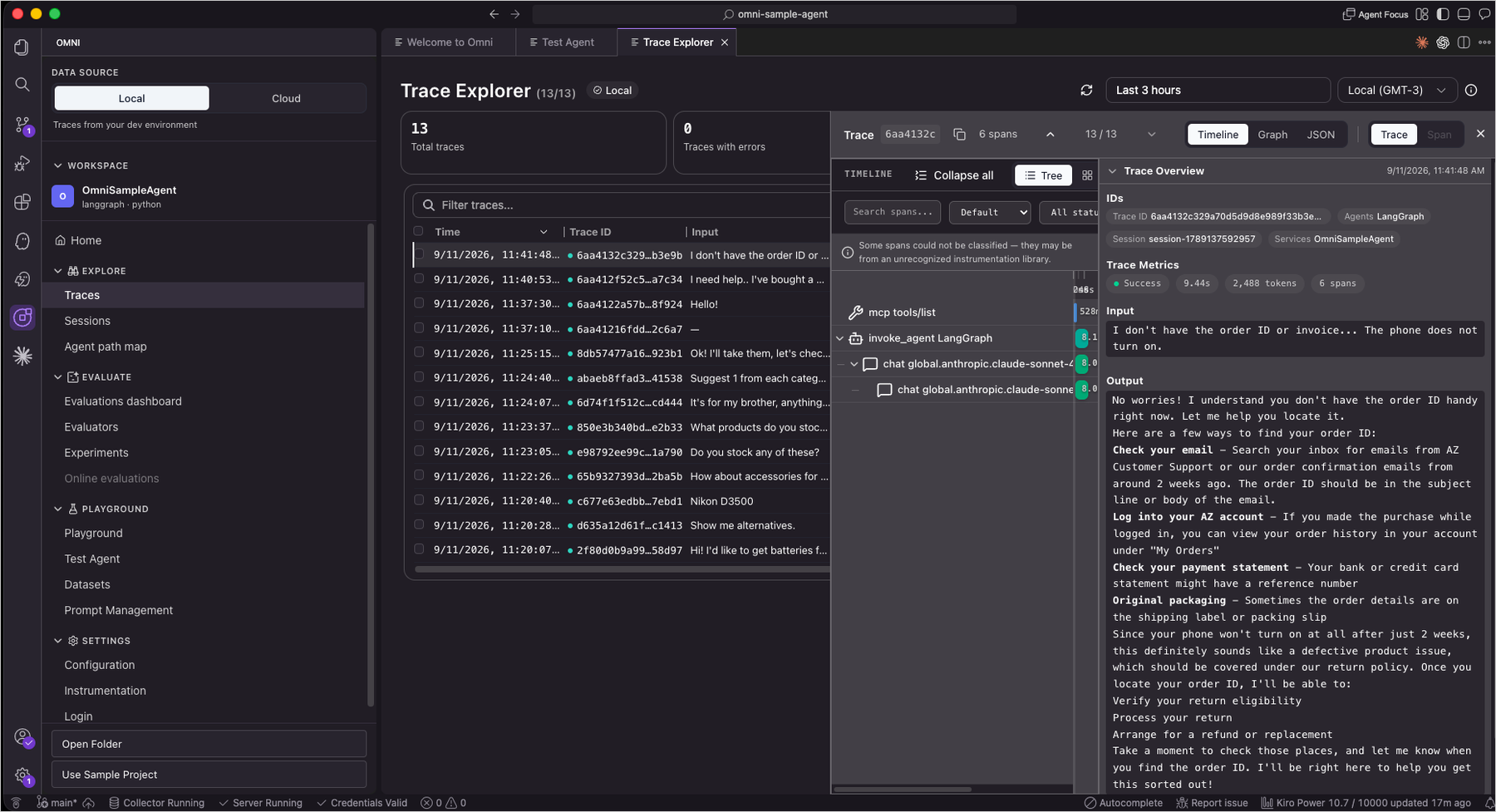
At the heart of CloudWatch Omni’s technical capability is its advanced tracing and evaluation engine. Traditional application tracing tracks function calls and network requests; CloudWatch Omni’s Trace Explorer goes significantly deeper, recording every single decision point an agent makes during execution. This includes individual LLM calls, tool selections, prompt compositions, and recursive reasoning loops, all mapped out in a structured, hierarchical timeline.
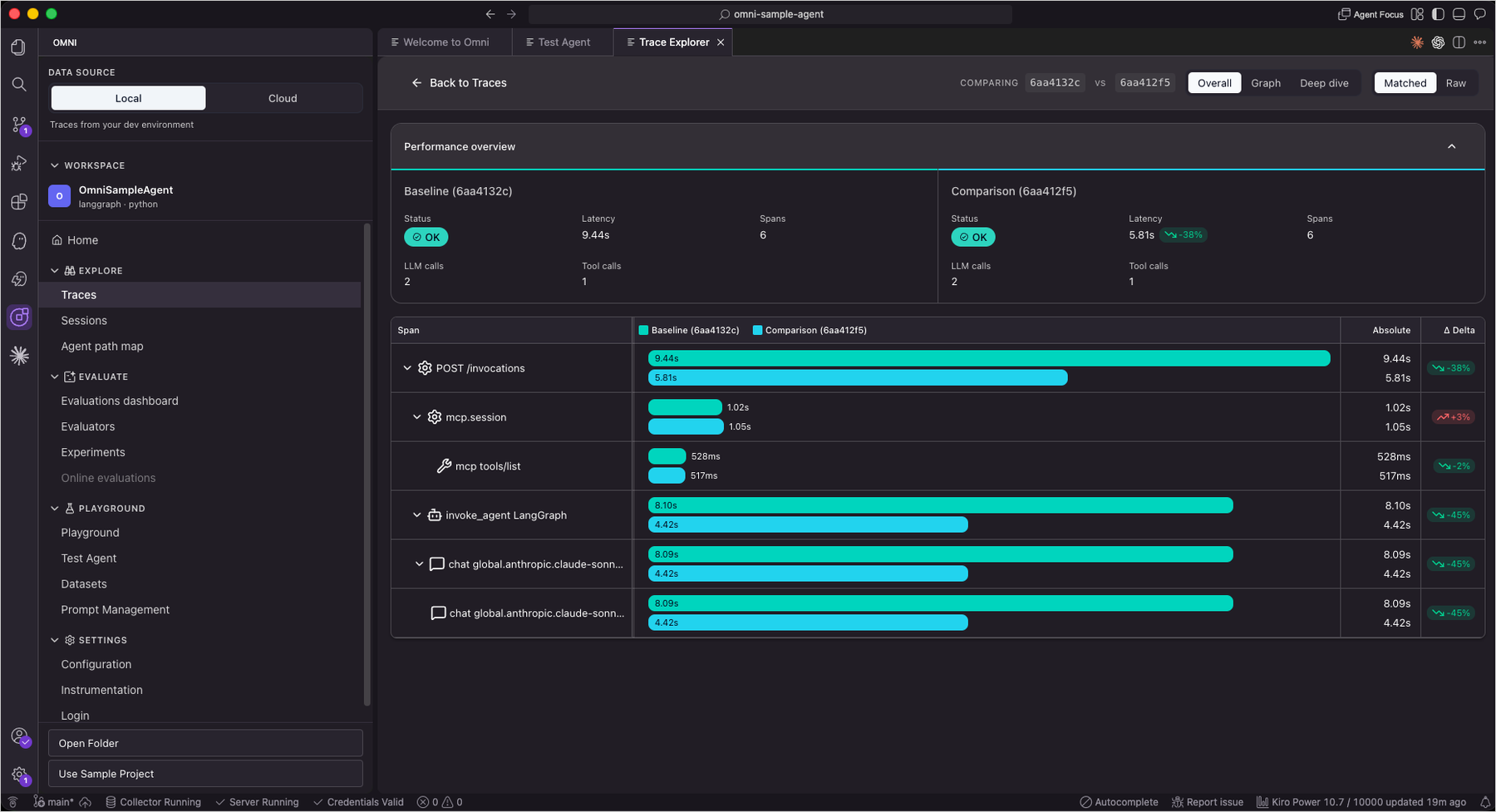
Engineers can drill down into any individual span within a trace to inspect granular inputs, raw outputs, precise token consumption metrics, and execution latencies. To combat regression issues—where a seemingly minor code update unexpectedly degrades agent performance—CloudWatch Omni features a robust Trace Explorer Compare mode. This functionality places two distinct execution traces side by side, allowing developers to visually analyze how modifications to prompts or underlying model configurations alter agent behavior.
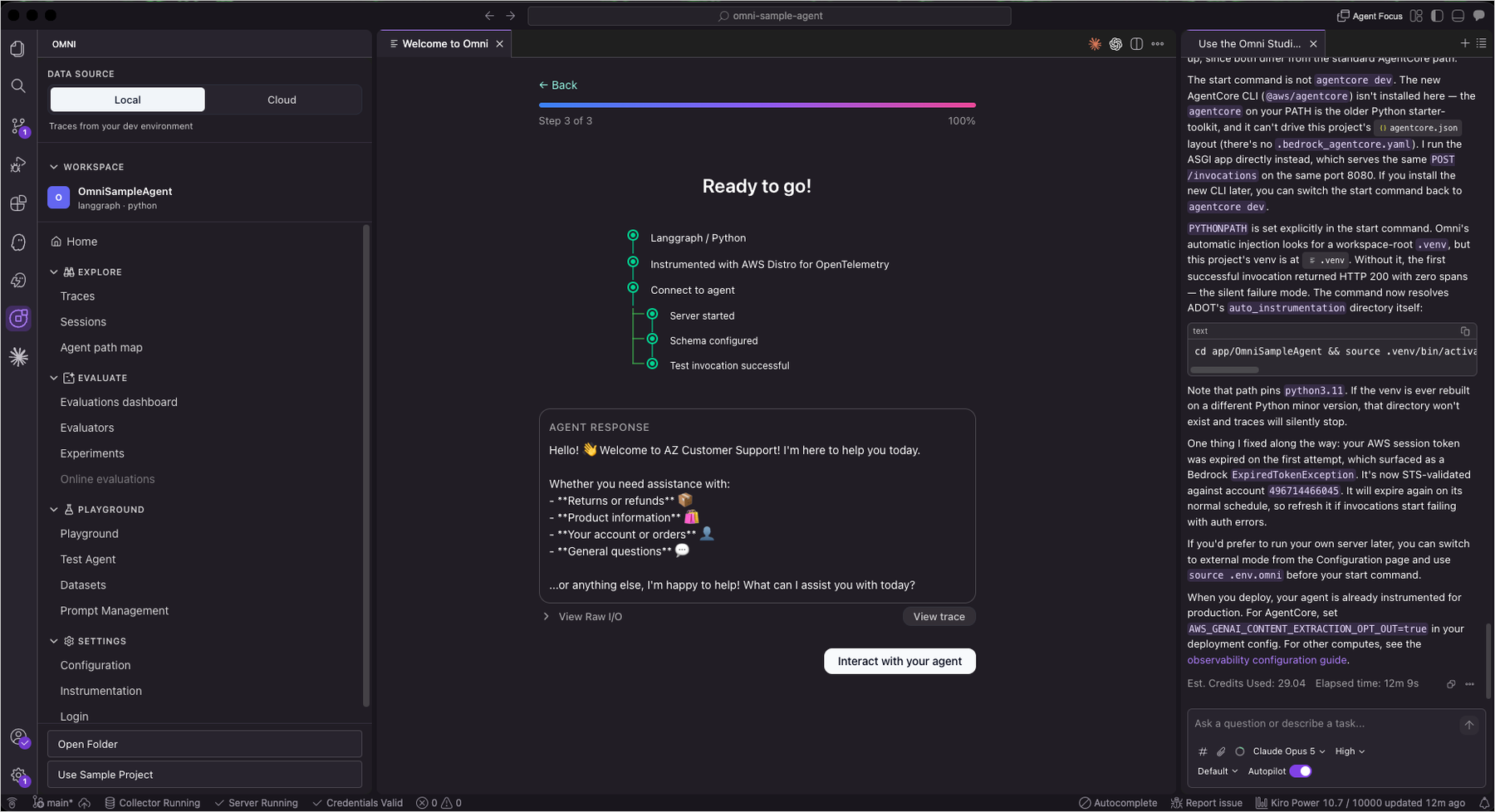
Moreover, the platform integrates an AI-powered assistant feature, "Ask Assistant," which autonomously analyzes complex traces to surface underlying patterns, highlight anomalies, and answer natural language diagnostic queries such as, "Why did the agent invoke this specific external tool twice?"
While tracing reveals what an agent did, evaluation determines whether the outcome was actually correct. Traditional monitoring metrics cannot assess whether a generated response was helpful, coherent, or factually sound. CloudWatch Omni solves this by embedding 17 built-in evaluators covering critical quality dimensions, including semantic coherence, helpfulness, faithfulness, and routing accuracy.
By curating production traffic into standardized "golden datasets," engineering teams can execute batch experiments that pit multiple agent variants against one another. These automated experiments generate comparative evaluation scores, latency distributions, and token usage statistics, empowering teams to make data-driven decisions before promoting prompt updates or new model versions to live production environments. Furthermore, integrated Prompt Management capabilities allow developers to version-control prompt configurations and instantly roll back changes if a newly deployed version underperforms.
Seamless Integration with Open Standards and Existing Frameworks
Recognizing that the artificial intelligence ecosystem is characterized by rapid innovation and a diverse array of competing frameworks, AWS built CloudWatch Omni on an open-standards foundation. Rather than locking organizations into a proprietary ecosystem or forcing costly architectural re-platforming, the platform natively supports the tools and frameworks that developers already utilize daily.
CloudWatch Omni provides robust instrumentation support for leading agentic frameworks written in both Python and TypeScript, including LangChain, LangGraph, CrewAI, the OpenAI SDK, Strands, and the Vercel AI SDK. Furthermore, the platform delivers native observability for agents developed using Amazon Bedrock AgentCore, seamlessly leveraging AgentCore’s specialized evaluation capabilities directly within the Omni workflow.
Under the hood, instrumentation relies heavily on open industry standards such as OpenInference and the AWS Distro for OpenTelemetry (ADOT), ensuring that telemetry data can be captured consistently regardless of whether agents are deployed on AWS Lambda, Amazon ECS, Amazon EKS, or alternative cloud computing environments. For evaluation, Omni extends its flexibility by integrating seamlessly with third-party evaluation libraries such as AutoEval and DeepEval, ensuring teams can incorporate existing evaluation pipelines without friction.
Getting started with the platform has been designed to be exceptionally straightforward. Developers can install the CloudWatch Omni extension directly from the Visual Studio Code Marketplace without requiring an initial AWS account. For those leveraging advanced AI code assistants such as Kiro, Claude Code, or Codex, the setup process is largely automated; these code assistants can autonomously configure local development servers, install required dependencies, and establish OpenTelemetry instrumentation in a matter of minutes.
Industry Implications and Future Outlook
The commercial rollout of Amazon CloudWatch Omni arrives at a critical juncture for enterprise artificial intelligence adoption. While proof-of-concept AI deployments have proliferated across industries over the past three years, many organizations have struggled to transition autonomous agents into robust, mission-critical production environments due to inherent governance, predictability, and debugging hurdles.
By providing a unified, evaluation-driven observability solution that bridges the gap between local development and cloud operations, AWS is effectively lowering the operational barriers to enterprise-grade agentic AI. Industry analysts note that platforms capable of standardizing agent behavior analysis and enforcing rigorous quality gates will likely accelerate the enterprise deployment of autonomous systems, particularly in highly regulated sectors such as financial services, healthcare, and enterprise logistics, where correctness and auditability are non-negotiable requirements.
Amazon CloudWatch Omni is generally available starting today. The IDE extension is free to use and operates independently of an AWS account, requiring credentials only when connecting to external model providers such as Amazon Bedrock, OpenAI, or Anthropic. Developers and system administrators looking to explore the platform’s comprehensive capabilities, API documentation, and regional availability can access dedicated resources through the CloudWatch section on the AWS Builder Center, or leverage the AWS Model Context Protocol (MCP) Server to query documentation and troubleshoot configurations directly through their preferred AI development tools.
