

Operating production software at hyperscale means confronting infrastructure degradation, network partitions, and resource bottlenecks not as anomalies, but as everyday operational certainties. As modern cloud-native architectures expand to support complex workloads such as high-performance artificial intelligence inference and massive microservices ecosystems, the tolerance for manual intervention shrinks considerably. Within the shared responsibility model of cloud computing, hyperscale orchestrators face mounting pressure to minimize operational friction by embedding intelligent failure recovery directly into platform layers. Recent architectural advancements from Amazon Elastic Container Service (ECS) illustrate a decisive industry shift toward autonomous resilience, transforming how distributed platforms detect, isolate, and mitigate underlying compute and networking anomalies without human intervention.
Architectural Foundations of Hyperscale Resilience
The engineering philosophy governing resilient cloud orchestration rests upon static stability, capacity pre-scaling, and rigorous workload isolation. Historically, cloud architects relied on custom detection loops, external monitoring tools, and elaborate remediation runbooks to manage anomalies ranging from fading hardware to saturated logging backends. However, manual or script-driven incident response introduces latency and human error during high-stress scenarios.
Under the AWS shared responsibility model, infrastructure resilience—or resilience of the cloud—remains the provider’s mandate, while application resilience—resilience in the cloud—typically falls to the engineering team. ECS has progressively bridged this divide by exporting the internal telemetry and self-healing patterns used to secure its own control planes directly to the customer data plane. By providing sensible, highly tuned defaults, the platform absorbs routine failure states, freeing engineering teams to focus exclusively on business-logic durability.
Deconstructing Compute-Layer Degradation and GPU Auto-Repair
Among the most difficult infrastructure disruptions are those originating beneath the application container, specifically at the foundational compute instance. When an underlying virtual machine or bare-metal host begins to degrade, tasks scheduled upon it face systemic latency or termination. Left unchecked, impaired instances broaden the blast radius, trapping workloads and exhausting service limits with stranded tasks.
This vulnerability is acute in specialized workloads, such as GPU-accelerated machine learning inference clusters. Traditional hypervisor-level status checks often fail to capture internal GPU faults because accelerators are passed directly through to the instance. Consequently, hardware errors manifest merely as unexplained latency or sudden task failures. To counter this, ECS integrates natively with NVIDIA’s Data Center GPU Manager (DCGM). By continuously tracking critical error classes that denote genuine hardware failures rather than transient blips, the orchestrator identifies damaged accelerators instantly.
Concurrently, ECS monitors vital data plane components, including the ECS agent and container runtimes. A sustained loss of agent connectivity effectively turns an instance into a black box, preventing telemetry transmission and halting remote task management. ECS automatically recognizes prolonged communication dropouts, isolates the damaged hardware, drains active workloads, provisions fresh capacity, and deregisters the compromised node. This continuous monitor-and-repair loop operates natively across both EC2 and AWS Fargate launch types, establishing a hands-free remediation pipeline that preserves cluster health without manual administrator paging.

Mitigating Availability Zone Disruption and Zonal Rebalancing
Multi-zone deployments offer critical fault isolation within a single geographic region, yet managing traffic and capacity during a zonal degradation historically required delicate, error-prone adjustments. When a single Availability Zone experiences elevated launch failures or network latency, surviving tasks outside the affected zone often experience severe load imbalances. Furthermore, inter-zone traffic patterns can inadvertently widen the incident’s blast radius.
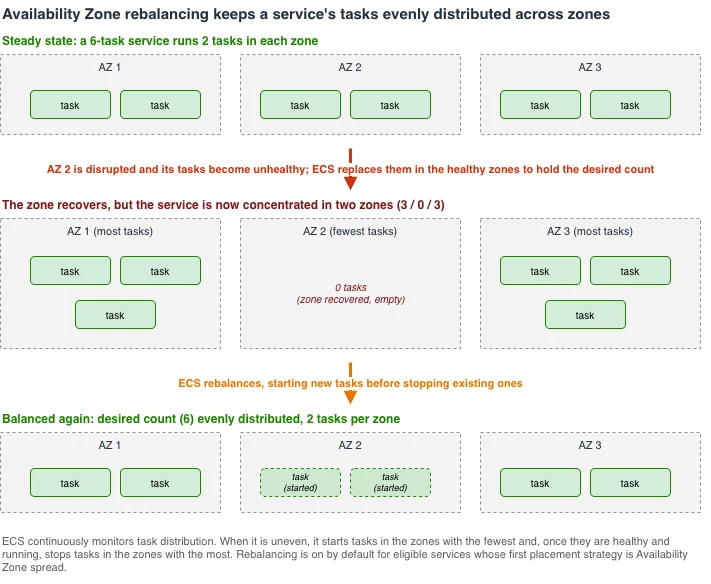
To address these vulnerabilities, ECS automates placement intelligence and zonal rebalancing. When the control plane detects operational strain within a specific zone, it dynamically steers new task and instance deployments toward healthy infrastructure. Once stability returns, Availability Zone rebalancing systematically restores an even distribution of workloads.
This process executes with minimal application disruption by initiating replacement tasks in healthy zones before terminating workloads in overcrowded regions. Complementing this, ECS Service Connect introduces zone-aware routing, ensuring that inter-service communication remains local to the caller’s Availability Zone during normal operations, thereby insulating applications from external zonal turbulence.
Granular Container-Level Recovery and Image Fallback Mechanisms
Traditional orchestration workflows often treat a failing container inside a multi-container task as a total failure, tearing down the entire unit and forcing the scheduler to spin up a completely new task. This aggressive rescheduling introduces unnecessary churn into the scheduler and discards healthy compute states.
Container restart policies change this dynamic by enabling in-place recovery for sidecars, such as auxiliary proxies or metrics agents. If a sidecar crashes due to a recoverable error, ECS restarts the specific container in place, allowing the primary application to continue servicing traffic uninterrupted. Administrators retain fine-grained control through exit-code filtering, ensuring that non-recoverable application faults immediately surface rather than triggering endless restart loops.
Similarly, resilience has been embedded into container image acquisition. During task launches on managed instances, ECS attempts to pull the latest image version from the registry. However, if registry throttling, transient network partions, or upstream outages block the pull, the platform falls back to a locally cached copy of the image, provided it exists on the host. This failsafe prevents transient third-party infrastructure blips from stalling application deployments.
Paradigm Shifts in Default Behaviors: Failing Open on Logging Backends
Platform safety is frequently defined by default configurations. Historically, many container orchestrators enforced blocking log delivery, meaning that if a centralized logging backend slowed down or suffered an outage, standard output and error buffers filled up, eventually stalling or crashing the application container. In these scenarios, an auxiliary logging dependency could inadvertently take down core application availability, despite logging residing outside the critical user path.

Recognizing that availability should supersede guaranteed delivery for the vast majority of distributed workloads, ECS updated its platform defaults to non-blocking log delivery. Workloads now fail open during logging degradation: the platform drops undeliverable logs rather than exerting backpressure on the application. Organizations requiring strict audit or regulatory compliance retention can still explicitly override this setting via account-level configurations or individual task definitions, preserving absolute architectural control.
This philosophy of proactive, safety-first defaults extends across the entire ECS ecosystem. By distributing tasks evenly across Availability Zones by default, executing rolling deployments that prioritize existing stable versions over unverified new builds, and automating capacity scaling, the platform eliminates common configuration traps.
Validating Resilience through Fault Injection
Proactive architecture requires empirical validation. To ensure that self-healing mechanisms and application-level retry logic behave as intended under duress, ECS integrates natively with AWS Fault Injection Service (FIS). Engineers can orchestrate controlled experimentation frameworks directly against running tasks, injecting precise failure modes such as network latency, packet loss, or compute resource exhaustion.
By executing network fault injection experiments across Fargate and EC2 launch types, development teams can verify timeout behaviors, circuit breakers, and fallback routines before production systems encounter real-world volatility. These simulation capabilities bridge the gap between theoretical resilience design and empirical operational readiness.
Implications for Modern Cloud-Native Operations
The convergence of autonomous instance repair, intelligent zonal rebalancing, granular in-place container recovery, and fail-open default configurations marks a maturing phase in container orchestration. By shifting the burden of routine infrastructure monitoring and mechanical remediation from human operators to the orchestrator control plane, platforms like Amazon ECS redefine operational efficiency.
As distributed systems scale in complexity, the ultimate measure of cloud infrastructure is no longer just the absence of failure, but the velocity and autonomy of recovery. By codifying resilience lessons directly into managed runtime environments, cloud providers and engineering organizations alike are establishing a new standard for always-on digital infrastructure.
