
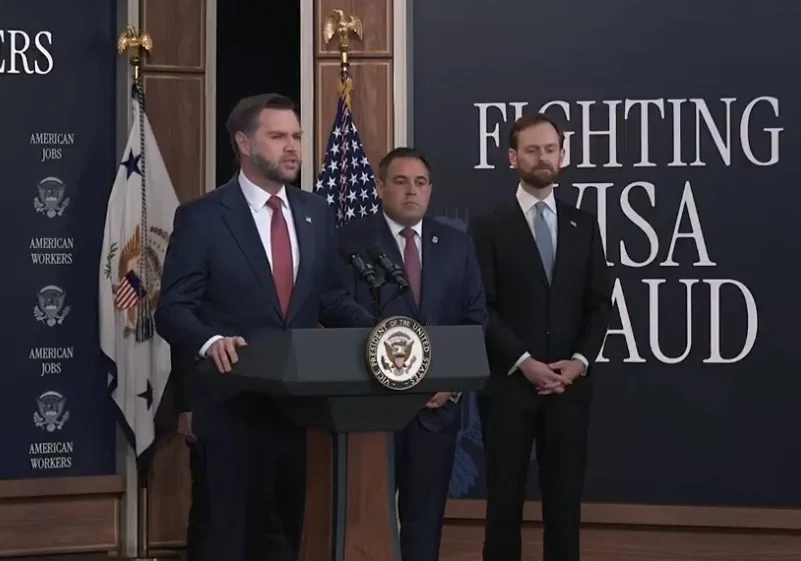

The landscape of American technology policy under the second Trump administration is defined by a striking paradox. While Silicon Valley’s leading executives increasingly align with the executive branch’s broader political and regulatory objectives, the White House has simultaneously escalated its populist rhetoric and policy actions regarding foreign labor. This duality became starkly apparent when President Donald Trump publicly honored Microsoft CEO Satya Nadella at a White House ceremony, celebrating his contributions to the American economy. Yet, concurrently, Vice President JD Vance launched a severe policy assault against Microsoft and several multinational outsourcing firms, accusing them of systematic visa fraud and exploiting the H-1B visa program to the detriment of domestic workers.
This political schizophrenia highlights a turbulent relationship between the federal government and the technology sector. Major firms that once openly resisted MAGA policy doctrines—such as Meta, Google, and Apple—have largely fallen in line, publicly reaffirming their fealty to the administration. However, this corporate compliance has not insulated companies from targeted enforcement actions designed to appeal to the domestic electorate ahead of upcoming mid-term elections. By severely restricting talent acquisition pathways, the administration is attempting to project a staunchly protectionist stance on American labor, setting the stage for a high-stakes clash between corporate innovation needs and nationalist labor policies.
Background Context of the H-1B Visa Program and Recent Restrictions
At the center of this friction is the H-1B non-immigrant visa program, a decades-old framework that allows United States companies to temporarily employ foreign workers in specialty occupations that require theoretical or technical expertise. Established by the Immigration Act of 1990, the program was designed to help employers bridge domestic talent shortages in fields such as information technology, engineering, and science.
Under current federal regulations, the H-1B program operates under a strict statutory cap of 85,000 new visas issued annually—65,000 for regular applicants and an additional 20,000 reserved for individuals holding a master’s or higher degree from a U.S. institution. To qualify, hiring firms must demonstrate that a domestic labor shortage exists and that the employment of a foreign national will not adversely affect the wages and working conditions of similarly employed American workers. Furthermore, employers are legally mandated to pay H-1B workers wages that are at least equal to the actual wage paid to other workers with similar experience and qualifications, or the prevailing wage for the occupation in the area of intended employment.
Despite these safeguards, the program has faced persistent criticism from labor advocates and populist politicians who argue it is systematically abused to suppress wages. Critics contend that some corporations utilize the framework to replace domestic professionals with lower-cost foreign contractors, a narrative aggressively amplified by Vice President Vance in his recent policy announcements.
The Escalation and Official Enforcement Actions
The recent escalation materialized when the White House, through the Department of Labor and statements by Secretary of Labor Keith Sonderling, formally barred Microsoft and a group of primarily international IT services firms from processing new or pending Permanent Labor Certification Program (PERM) applications. The PERM process is a critical prerequisite for sponsoring foreign workers for employment-based green cards.
Alongside Microsoft, the administration singled out several other firms, including Adobe, Capgemini, Cognizant, HCL Technologies, Infosys, Tata Consultancy Services (TCS), and Wipro. Administration officials accused these entities of operating as "visa mills" that deliberately bypass domestic recruitment channels. Vice President Vance leveled particularly harsh criticisms at Microsoft, asserting during a press briefing that the company had abused the system to favor foreign labor over American citizens.
"No company in the US has abused this system more than Microsoft," Vance stated, arguing that corporations frequently post job advertisements in obscure venues to manufacture a lack of domestic interest before hiring foreign nationals. He characterized the practice as an effort to introduce underpaid labor into the domestic economy, claiming that foreign outsourcing firms pay significantly less than prevailing market rates for comparable roles filled by American citizens.
Comparative Data and Labor Market Realities
To evaluate the administration’s claims, labor economists and industry analysts frequently examine Department of Labor statistics and corporate visa sponsorship disclosures. According to data from the U.S. Bureau of Labor Statistics (BLS), the total civilian labor force in the United States stands at approximately 170.3 million workers. The annual cap of 85,000 new H-1B visas represents roughly 0.05 percent of the total available domestic workforce, indicating that the program forms a minute fraction of overall employment metrics.
Furthermore, utilization data compiled from federal immigration filings reveals that domestic technology giants are among the most prolific sponsors of H-1B visas. In recent fiscal years, major U.S.-headquartered corporations—such as Amazon, Meta, Microsoft, and Google—consistently ranked among the top corporate users of the visa framework to secure specialized engineering and research talent. For instance, in the previous fiscal year, Amazon led all corporate applicants in visa approvals, followed closely by Meta, Microsoft, and Google, with international outsourcing firms occupying a distinct minority of the top utilization slots.
Microsoft’s formal defense directly challenged the administration’s characterization of its hiring practices. In a comprehensive statement, the company emphasized that the vast majority of its U.S. workforce consists of American citizens and that its visa filings are overwhelmingly directed toward extending the legal status of existing, long-term employees rather than introducing unvetted new arrivals.
"Of the approximately 6,000 H-1B visa applications we submitted in the last fiscal year, 80 percent were to extend or change the status of existing Microsoft employees," the company stated. "These were not to hire new people. Microsoft only files H-1B petitions for those who meet the rigorous standards of this visa category, and we pay our employees some of the highest compensation in the tech sector."
Political Reactions and Legislative Opposition
The administration’s punitive actions against legal immigration pathways drew immediate and sharp rebukes from Democratic lawmakers and immigration reform advocates. Representative Pramila Jayapal, the ranking member of the House Immigration Sub-Committee, condemned the White House’s actions as a heavy-handed measure that damages the nation’s economic competitiveness.
"Our economy, our communities, and our families depend on immigrants in many sectors, including the tech sector, and heavy-handed attacks like this only hurt efforts to build a strong, stable, and diverse base of workers," Jayapal said. "You don’t fix a broken immigration system by taking a hammer to legal immigration."
Representative Suzan DelBene similarly criticized the policy shift as a misuse of executive authority that injects unnecessary volatility into an already fluctuating labor market. "Haphazardly taking away the pathway to a lawful green card for skilled workers at certain American companies is a biased and punitive misuse of the law," DelBene noted. "This move will have no impact on purported H-1B visa abuse. It simply undercuts a legal way for people to work, stay with their family, and become a part of our communities."
Conversely, the policy received robust endorsement from political allies and conservative commentators, who viewed the restrictions as a necessary fulfillment of the administration’s "America First" mandate. Proponents argue that constraining access to foreign labor incentivizes domestic corporations to invest heavily in training and recruiting American workers, particularly in regions historically underserved by the technology sector.
Implications for Innovation and Offshoring Risks
Independent analysts suggest that restricting access to foreign talent via legal visa channels could carry unintended long-term consequences for the U.S. innovation economy. Industry studies, including data from the National Skills Coalition and the International Data Corporation (IDC), consistently highlight a persistent skills gap within the domestic labor market, with a significant percentage of IT leaders reporting difficulties in sourcing specialized talent for advanced roles in artificial intelligence, cloud computing, and cybersecurity.
If major technology enterprises face insurmountable regulatory barriers in sponsoring and retaining international specialists domestically, economists warn of a potential acceleration in corporate offshoring. Rather than hiring exclusively within the United States, multinational firms may increasingly establish engineering hubs and research facilities in foreign jurisdictions—such as India, Canada, and parts of Europe—where skilled technical labor is readily accessible without immigration constraints. Such a shift would directly contradict the administration’s stated objective of repatriating high-value technology jobs and maintaining undisputed American leadership in critical emerging technologies.
The broader international reaction also underscored the global nature of talent mobility. The Government of India issued a formal response defending the contributions of Indian professionals to the U.S. economy, noting that bilateral talent exchange enhances productivity, research, and competitiveness for American enterprises while driving significant shareholder value.
A Concluding Irony
The policy conflict is further underscored by the juxtaposition of executive branch actions occurring simultaneously in Washington. While Vice President Vance publicly upbraided Microsoft for its labor practices, President Trump bestowed the National Medal of Technology and Innovation upon Microsoft CEO Satya Nadella, praising his leadership and impact on the national economy.
Similar honors were presented to other industry leaders, including AMD CEO Lisa Su, NVIDIA CEO Jensen Huang, Google co-founder Sergey Brin, and entrepreneur Elon Musk. Notably, many of these prominent figures—including Nadella, Su, Huang, and Musk—were born outside the United States and immigrated to pursue professional opportunities, serving as prominent examples of the historical contributions foreign-born talent has made to the American technology sector. As the administration navigates the complex intersection of populist domestic politics and global economic realities, the long-term viability of its immigration restrictions remains one of the defining challenges of Trump 2.0.
