

Amazon Elastic Container Service (ECS), a cornerstone of modern cloud-native architectures, has unveiled a substantial enhancement to its service auto scaling capabilities, marking a critical advancement for applications requiring rapid and precise resource adjustments. The update introduces support for high-resolution (20-second) metrics and optimized metric publishing, allowing ECS service auto scaling to detect and respond to load changes with unprecedented speed. This improvement translates into dramatically faster scale-out times and quicker provisioning of new tasks, directly impacting application performance, resilience, and cost efficiency across various industries.
A Deeper Dive into the Core Enhancement
At the heart of this update is the shift from standard 60-second metric resolution to a granular 20-second resolution for key performance indicators. This three-fold increase in data frequency empowers the auto scaling engine to make more informed decisions much faster. Previously, an application experiencing a sudden surge in traffic might have to wait up to a minute for new metric data to be available before a scaling action could even be triggered. With 20-second metrics, this detection window shrinks considerably, allowing the system to react almost instantaneously to demand spikes.
AWS benchmarking tests underscore the profound impact of this change. The time required to trigger a scale-out event improved by an impressive 76%, plummeting from an average of 363 seconds to just 86 seconds. Furthermore, the total time to scale out and provision new tasks saw a 72% acceleration, reducing from 386 seconds to a mere 109 seconds. These figures represent a 4.2x and 3.5x improvement, respectively, signifying a paradigm shift in how quickly containerized applications on ECS can adapt to fluctuating workloads.

The Foundational Role of Amazon ECS in Cloud Architectures
To fully appreciate the significance of this update, it’s essential to understand the context of Amazon ECS. Launched in 2014, Amazon ECS quickly became a pivotal service for deploying, managing, and scaling Docker containers on AWS. It provides a fully managed orchestration service that simplifies the complexities of running containerized applications, freeing developers from managing the underlying infrastructure. ECS supports various compute options, including AWS Fargate (serverless containers), ECS Managed Instances, and Amazon Elastic Compute Cloud (EC2), offering flexibility for diverse operational needs. Its integration with other AWS services, such as Amazon Virtual Private Cloud (VPC), AWS Identity and Access Management (IAM), and Amazon CloudWatch, establishes a robust ecosystem for building highly available and scalable applications.
The evolution of cloud-native development, characterized by microservices architectures and continuous delivery, has placed increasing demands on container orchestration platforms. Applications are expected to be highly elastic, capable of scaling from zero to thousands of instances in moments, and equally adept at scaling down to optimize costs. Auto scaling is not merely a feature but a fundamental requirement for achieving these goals, ensuring that applications remain performant and available while optimizing resource utilization.
Evolution of Auto Scaling on ECS: A Chronology of Adaptability
When Amazon ECS was initially introduced, basic auto scaling capabilities were available, primarily through integration with Application Auto Scaling. This allowed users to define scaling policies based on CloudWatch metrics like CPU and memory utilization. Over the years, AWS progressively enhanced these capabilities to meet the growing sophistication of cloud workloads.

- Initial Auto Scaling (Post-Launch): Early iterations focused on reactive scaling, where metrics would trigger scaling actions after a predefined period. This was foundational but could sometimes lead to delays during sharp traffic increases.
- Predictive Scaling (Later Enhancements): Recognizing the need for proactive resource management, AWS introduced predictive scaling. This capability leverages machine learning algorithms to analyze historical traffic patterns and forecast future demand, allowing ECS to scale out resources before a spike occurs. This is particularly effective for applications with recurring daily or weekly traffic patterns.
- Scheduled Scaling (For Planned Events): For predictable events like marketing campaigns, product launches, or seasonal sales, scheduled scaling was introduced. This allows users to pre-configure scaling actions to occur at specific times, ensuring capacity is ready precisely when needed.
- Target Tracking Scaling (Real-Time Responsiveness): Target tracking policies simplified auto scaling by allowing users to specify a target value for a metric (e.g., maintain 50% average CPU utilization). ECS then automatically adjusts task counts to keep the metric as close to the target as possible. This method became a popular choice for dynamic, real-time adjustments.
This latest update, with its high-resolution metrics, directly augments the power of target tracking scaling. While predictive and scheduled scaling remain invaluable for their respective use cases, target tracking benefits most from the increased metric granularity, enabling it to respond to unpredictable real-time demand changes with unparalleled agility.
Operationalizing Faster Auto Scaling: How It Works for Developers
Implementing faster service auto scaling is designed to be straightforward, integrating seamlessly with existing AWS tooling. The process involves two primary steps: enabling high-resolution metrics and then configuring a target tracking scaling policy that leverages these metrics.
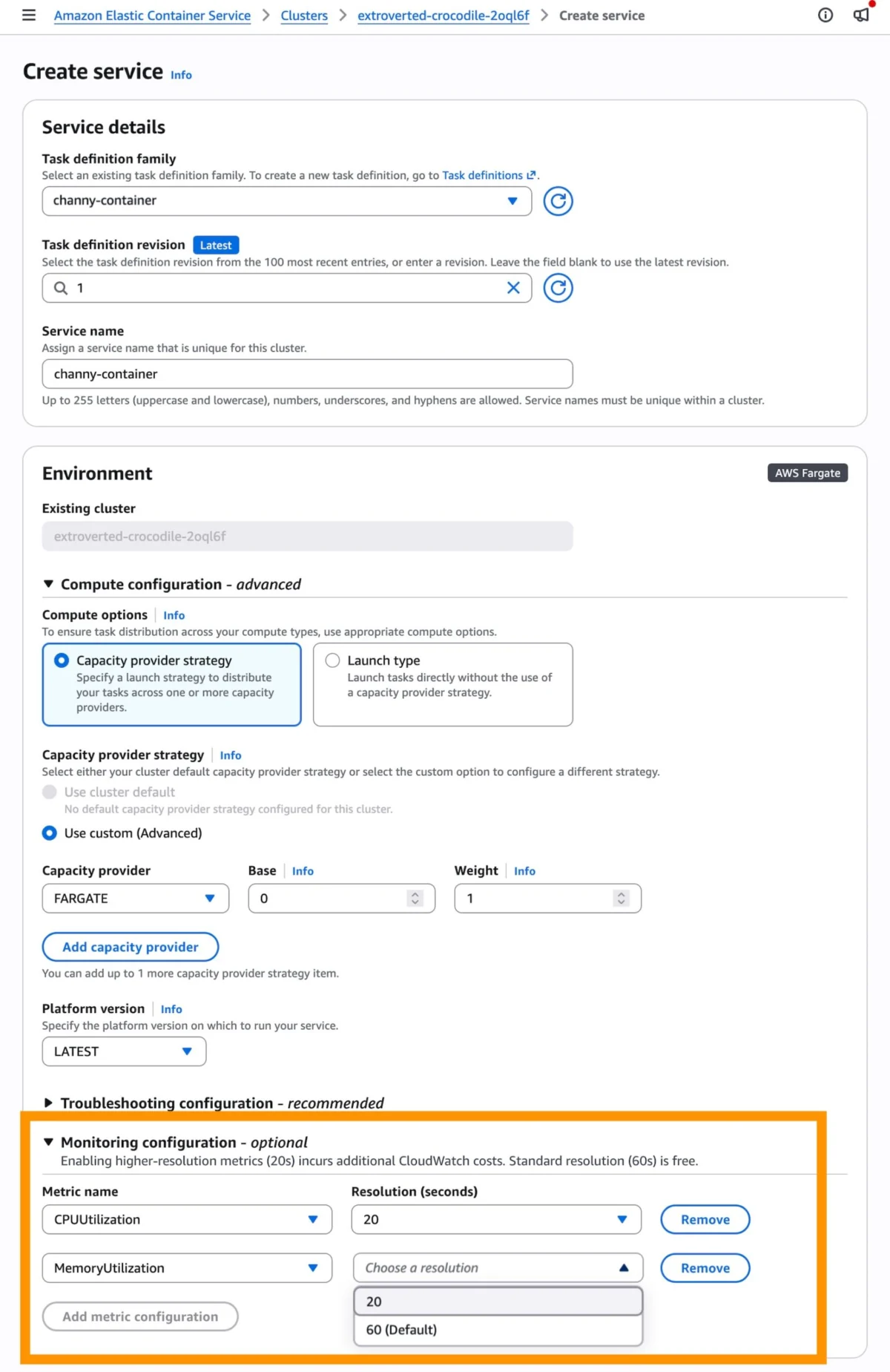
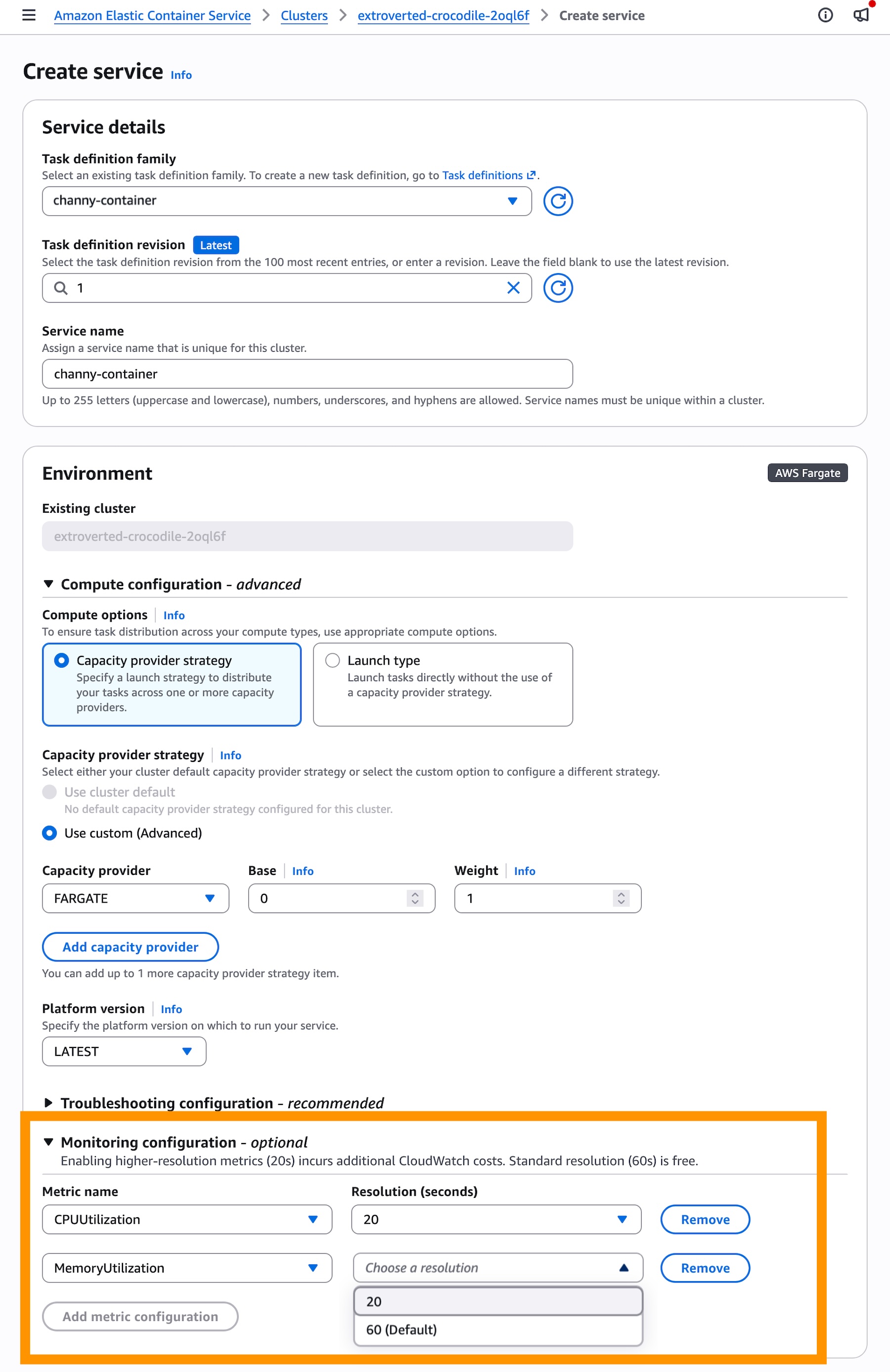
Developers can enable these enhanced metrics during the creation of a new ECS service or when updating an existing one. This can be done through the intuitive Amazon ECS console, offering a graphical interface for configuration. Within the "Monitoring configuration" section, users can now select the 20-second resolution for metrics. It is crucial to note that while standard 60-second resolution CloudWatch metrics are free, high-resolution metrics incur additional CloudWatch costs, a trade-off many businesses will find justified by the performance benefits.
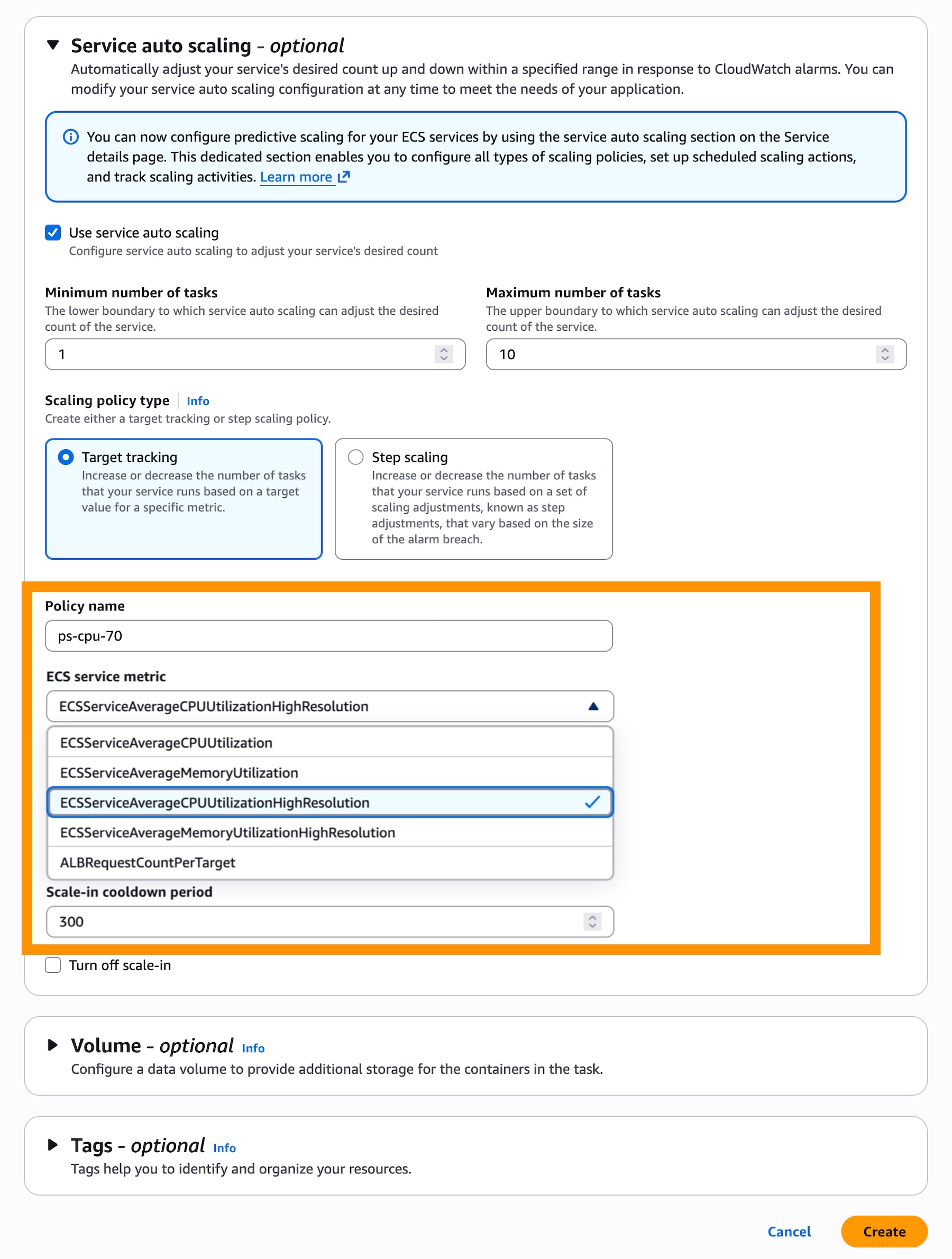
Once high-resolution metrics are enabled, the next step is to configure the auto scaling policy. In the "Service auto scaling" section of the ECS console, users select "Target Tracking" as the scaling policy type. New, high-resolution specific metrics, such as ECSServiceAverageCPUUtilizationHighResolution or ECSServiceAverageMemoryUtilizationHighResolution, become available for selection. By choosing one of these and setting a target value, the ECS service is configured to evaluate scaling decisions at 20-second intervals.
For those preferring programmatic control, the feature is fully supported via AWS SDKs and tools, as well as AWS CloudFormation. This allows for infrastructure-as-code practices, enabling automated deployment and management of services with faster auto scaling. The AWS Command Line Interface (AWS CLI) also provides comprehensive options to enable and manage these settings through Application Auto Scaling. This flexibility ensures that organizations can integrate this enhancement into their existing CI/CD pipelines and operational workflows.
Broader Impact and Strategic Implications
The implications of faster ECS auto scaling extend beyond mere technical improvements, touching upon critical business and operational aspects:
- Enhanced Application Responsiveness and User Experience: In today’s digital economy, milliseconds matter. Whether it’s an e-commerce platform during a flash sale, a streaming service experiencing a viral content surge, or a gaming platform during a major event, delays in scaling can lead to degraded user experience, increased bounce rates, and ultimately, lost revenue. The 76% faster scale-out trigger time means applications can maintain peak performance even under sudden, unpredictable load changes, directly contributing to higher customer satisfaction and loyalty.
- Optimized Resource Utilization and Cost Efficiency: While high-resolution metrics have an associated cost, the overall effect on resource utilization can lead to significant cost savings. Faster scale-out means resources are provisioned precisely when needed, preventing performance bottlenecks. Equally important, faster scale-down capabilities (implied by quicker metric detection) mean that excess resources are de-provisioned sooner after a traffic spike subsides. This reduces the duration of over-provisioning, leading to more efficient cloud spending. Businesses can operate closer to their actual demand curves, minimizing idle capacity costs.
- Improved Operational Resilience and Reliability: Unforeseen traffic patterns, malicious attacks (like DDoS), or sudden popularity spikes can overwhelm even robust systems. The ability to react rapidly to such events is a critical component of operational resilience. By reducing the time to react and provision new tasks, ECS services become inherently more robust against these unpredictable challenges, contributing to higher availability and service reliability. This reduces the risk of service disruptions and ensures business continuity.
- Empowering Cloud-Native Development: This update further strengthens AWS’s position as a leading platform for cloud-native applications, particularly those built on microservices architectures. In such environments, individual services may have highly variable and independent scaling requirements. Faster auto scaling allows these granular services to react independently and quickly, maintaining the agility and responsiveness inherent in microservices design principles. Developers can focus more on business logic and innovation, with greater confidence that the underlying infrastructure will handle dynamic scaling demands seamlessly.
- Competitive Landscape: The cloud computing market is intensely competitive, with providers continually innovating to offer superior performance and features. By significantly improving container auto scaling capabilities, AWS reinforces its leadership in the container orchestration space, providing a compelling advantage for businesses considering where to host their demanding workloads. This move is a strategic one, aimed at retaining and attracting customers who prioritize agility and performance.
Statements and Industry Reception (Inferred)
An AWS spokesperson, in a hypothetical statement, might emphasize, "This enhancement to Amazon ECS service auto scaling represents our unwavering commitment to providing customers with the most agile and resilient infrastructure for their mission-critical containerized applications. By dramatically accelerating our response to real-time load changes, we are empowering businesses to deliver unparalleled user experiences while optimizing their operational efficiency and cost structures. This is a direct response to the evolving demands of dynamic cloud workloads."
Industry analysts are likely to view this update as a significant step forward. "The shift to 20-second metrics for ECS auto scaling is more than just a technical tweak; it’s a strategic move that fundamentally changes how quickly applications can adapt to real-world traffic," commented a leading cloud analyst. "For sectors like e-commerce, media, and gaming, where traffic can explode in an instant, this capability transitions from a ‘nice-to-have’ to a ‘must-have,’ directly impacting revenue and customer satisfaction." Developers and cloud architects working with highly volatile workloads are expected to welcome the newfound agility, which translates into less manual intervention and more predictable performance.
Availability and Future Outlook
Faster service auto scaling with high-resolution metrics for Amazon ECS is available immediately across AWS regions where ECS is offered. While the feature itself carries no additional cost, the consumption of high-resolution CloudWatch metrics introduces a new pricing dimension, which customers should review on the CloudWatch pricing page. This nuanced approach to pricing reflects the added value and granular data collection involved.
This advancement is not merely an isolated feature but a testament to the continuous innovation within the AWS ecosystem. It underscores the trend towards more intelligent, proactive, and highly responsive cloud infrastructure, moving closer to truly self-optimizing systems. As applications become even more distributed and dynamic, the ability of orchestration services to react with sub-minute precision will become increasingly vital. Customers are encouraged to experiment with this new capability, leveraging the enhanced responsiveness to build more robust, efficient, and user-centric applications on Amazon ECS, providing feedback through AWS re:Post for ECS or their standard AWS Support channels.
