
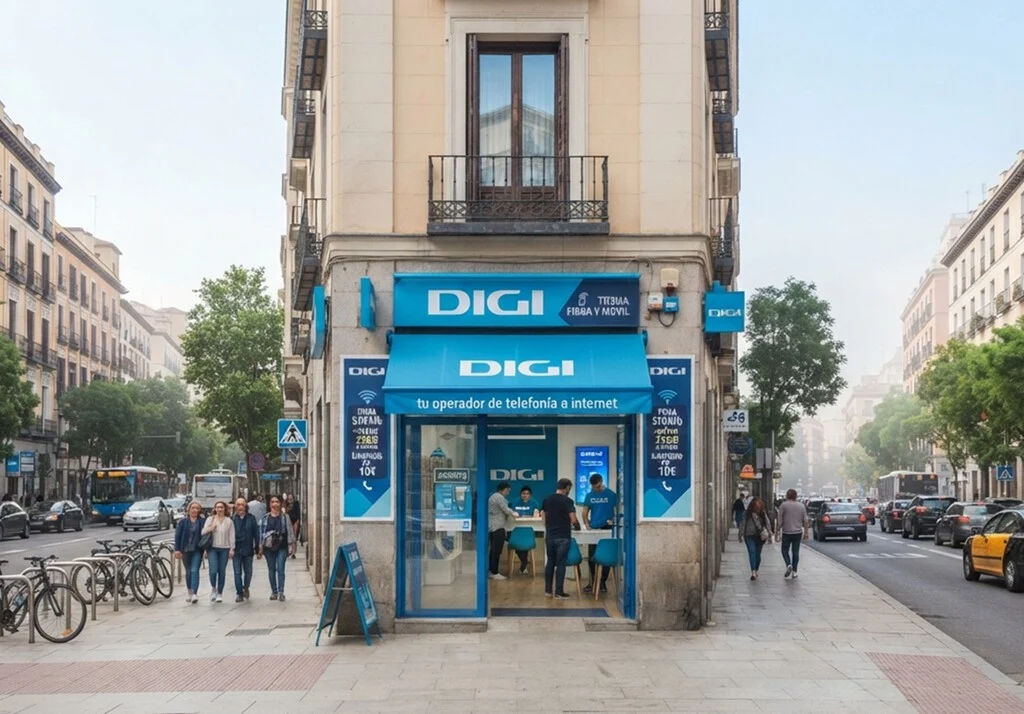

In a significant move impacting its rapidly growing customer base, Digi, one of Spain’s most dynamic telecommunications operators, recently adjusted its permanence clauses and associated penalties for fiber optic services. This strategic shift, which saw early termination fees for fiber services increase from a standard €60 to a maximum of €100, coupled with potential additional charges for unreturned equipment, has prompted a closer examination of the operator’s contractual terms and their ramifications for consumers. The core permanence period for fiber services remains set at three months, calculated from the day the service becomes operational, designed to cover the initial costs of network installation and connectivity equipment provision. This policy, detailed in Digi’s official Tariff Details, underscores the company’s efforts to balance aggressive market expansion with cost recovery and customer retention in Spain’s highly competitive telecom arena.
The Spanish telecommunications market is renowned for its intense competition, characterized by a diverse ecosystem of established giants like Telefónica (Movistar), Vodafone, and Orange, alongside agile low-cost operators and Mobile Virtual Network Operators (MVNOs) such as Digi, MásMóvil, and O2. Digi, a subsidiary of the Romanian telecom group RCS & RDS, has emerged as a formidable challenger, rapidly expanding its footprint and attracting millions of subscribers primarily through competitive pricing and a growing proprietary fiber network, known as Fibra Smart. This aggressive growth strategy, often involving significant upfront investment in infrastructure deployment, naturally leads to policies designed to protect these investments, such as permanence clauses. For consumers, navigating these terms is crucial, particularly when unexpected circumstances necessitate early termination of services. Understanding the nuances of Digi’s updated policies, including specific exceptions that can mitigate financial penalties, is therefore paramount.
Background: Digi’s Ascent in the Spanish Telecom Market
Digi’s journey in Spain has been marked by remarkable expansion since its initial entry as an MVNO in 2008, leveraging Telefónica’s network. However, a pivotal shift occurred with the company’s decision to invest heavily in its own fiber optic infrastructure. This deployment of Fibra Smart has been a key differentiator, allowing Digi to offer high-speed internet services at highly competitive prices, often undercutting established players. By building out its own network, Digi gains greater control over service quality, operational costs, and the ability to innovate with new offerings like 10 Gbps fiber. This strategy has fueled its subscriber growth, consistently positioning it as one of the fastest-growing operators in the country. As of late 2023 and early 2024, Digi continued to report robust gains in both mobile and fiber lines, solidifying its position as a major force in the Spanish market. The move to reinforce permanence clauses, therefore, can be seen as a natural evolution for a company transitioning from a purely low-cost, minimal-investment model to one that actively builds and maintains significant infrastructure.
The regulatory environment in Spain, overseen by entities like the Comisión Nacional de los Mercados y la Competencia (CNMC), plays a critical role in shaping telecommunications practices. Consumer protection laws mandate transparency in contractual terms, including permanence clauses and early termination fees. While operators are generally permitted to establish permanence periods to recover installation costs, these clauses must be clearly communicated and proportionate. The common practice across the industry for fiber installations often involves permanence periods ranging from 3 to 12 months, with associated penalties covering a portion of the installation and equipment costs. Digi’s three-month permanence is relatively short compared to some competitors, which might offer longer periods in exchange for promotional pricing. However, the recent increase in the early termination fee aligns Digi more closely with the upper end of standard installation cost recovery charges seen in the market, making the details of its exceptions more critical.
Chronology of Policy Adjustments
While a precise public timeline for the penalty increase isn’t always widely disseminated, reports indicated that Digi began implementing these higher early termination fees "a few months ago," likely in late 2023 or early 2024. Prior to this adjustment, the standard penalty for prematurely canceling fiber service was typically around €60. The new structure elevated this to a maximum of €100 for installation-related costs, alongside potential charges for unreturned equipment. This change reflects a broader industry trend where operators continually review their terms to adapt to market dynamics, infrastructure investment levels, and churn rates. It also highlights the ongoing challenge for operators to balance aggressive customer acquisition with sustainable business practices.
Detailed Breakdown of Digi’s Permanence Policy and Penalties
Digi’s permanence requirement for fiber optic services is explicitly stated as three months (90 days). This period begins on the first day the fiber service is fully operational at the customer’s domicile. The rationale behind this three-month commitment, as per the company’s official documentation, is to amortize the expenses associated with the installation of the fiber optic network in the customer’s home – provided there is fiber coverage – and the provision of necessary connectivity equipment, typically a router.
Should a customer decide to terminate their fiber service before the completion of this 90-day period, they face two potential categories of charges:
-
Installation Cost Penalty: This is the primary early termination fee, capped at a maximum of €100. This amount is not a flat fee but is prorated based on the number of full days remaining in the permanence period. Essentially, the cost is calculated at approximately €1.11 per day (€100 / 90 days). For example, if a customer cancels after 60 days, leaving 30 days remaining, the penalty for installation costs would be 30 days * €1.11/day = €33.30. This prorated structure offers some fairness, ensuring customers only pay for the unfulfilled portion of the commitment period.
-
Equipment Non-Return or Damage Penalty: Beyond the installation cost, Digi also imposes penalties related to the connectivity equipment provided during installation. Customers are required to return all equipment in good condition upon service termination. Failure to do so, or returning damaged equipment, incurs additional charges:
- Standard Fiber Equipment: A compensation fee of €50. This typically applies to routers and optical network terminals (ONTs) provided for standard fiber speeds.
- PRO-DIGI 10 Gb Fiber Equipment: For customers subscribed to Digi’s ultra-fast 10 Gbps PRO-DIGI service, the compensation fee for unreturned or damaged equipment is significantly higher, set at €150. This reflects the higher cost and specialized nature of the equipment required to support such high speeds.
Combining these potential charges, a customer who breaches the permanence period and fails to return their PRO-DIGI 10 Gb equipment could face a maximum penalty of €250 (€100 for installation + €150 for equipment). For standard fiber, the maximum would be €150 (€100 + €50). This structure makes it imperative for customers to be fully aware of their obligations when signing up for Digi’s fiber services.
Key Exceptions to Digi’s Permanence Policy
Despite the clear penalties, Digi has outlined specific scenarios where customers can avoid paying the early termination fee for breaching the three-month permanence. These exceptions demonstrate a degree of flexibility, acknowledging common life events and internal company strategies.
-
Change of Domicile (Mudanza):
This is perhaps the most common and consumer-friendly exception. If a customer needs to move to a new address before their 90-day permanence period concludes, Digi offers a waiver of the early termination penalty for the current service. The critical condition for this waiver is that the customer must re-contract fiber services with Digi at their new domicile, provided that fiber coverage is available there.
- Implications: While beneficial for avoiding the penalty, it’s important for customers to understand that the permanence period restarts from zero at the new address. If a customer had, for instance, only 40 days remaining on their original 90-day commitment, those days are annulled, and a new 90-day permanence period begins upon activation of service at the new home. This effectively ties the customer to Digi for another three months at the new location. This policy aims to retain customers during a relocation, a period when many consider changing service providers, while also recovering the new installation costs. Customers should verify Digi’s fiber coverage at their new address beforehand to ensure they qualify for this exception.
-
Migration from Indirect Fiber to Fibra Smart:
This exception is specifically designed to facilitate and incentivize customers on Digi’s indirect fiber service (which utilizes rented infrastructure, primarily from Telefónica’s NEBA network) to transition to Digi’s proprietary Fibra Smart network. As Digi expands its own fiber footprint, it actively encourages customers to migrate to its direct network, which offers better control over service delivery and often allows for higher speeds and potentially better pricing in the long run.- Implications: For customers who migrate from indirect fiber to Fibra Smart before completing their initial 90-day permanence, the good news is that the permanence period does not restart. Instead, the remaining days from the original permanence period simply carry over to the new Fibra Smart installation. For example, if a customer had 40 days left on their indirect fiber permanence, those 40 days will continue to count towards the Fibra Smart service. This is a significant advantage for consumers as it avoids extending their contractual commitment. This policy reflects Digi’s strategic priority to onboard customers onto its own network, reducing reliance on third-party infrastructure and optimizing its operational efficiency. It’s a win-win: customers get potentially better service without extending their commitment, and Digi strengthens its own network utilization.
Digi’s Stated Rationale and Industry Context
Digi’s rationale for establishing permanence clauses and associated penalties is consistent with industry standards: to recoup the significant upfront costs involved in fiber optic installation and equipment provision. Deploying fiber to a customer’s home involves labor, materials, and specialized equipment. Without a minimum commitment period, operators face the risk of customers signing up, incurring installation costs, and then churning rapidly, leading to financial losses. The recent increase in penalties likely reflects updated cost structures for installation, potentially higher labor costs, or a strategic decision to align more closely with competitors’ penalty structures.
From an industry perspective, such clauses are a delicate balancing act. While necessary for operators to ensure profitability and continued infrastructure investment, they must also remain transparent and fair to consumers. Consumer advocacy groups in Spain and across the EU regularly monitor these contractual terms to prevent abusive clauses and ensure that early termination fees are genuinely reflective of unamortized costs rather than punitive charges. Digi’s prorated penalty for installation costs is generally viewed as a fair approach, as it directly correlates the penalty to the unfulfilled portion of the commitment.
Technical Considerations and Equipment Return
An important aspect of Digi’s policy, particularly in the context of avoiding equipment penalties, revolves around the customer’s choice of router. Digi, unlike some other operators, is generally permissive about customers using their own "neutral" routers (third-party routers not provided by the operator). They typically provide the necessary PPPoE (Point-to-Point Protocol over Ethernet) credentials, allowing customers to configure their preferred device. This flexibility is appreciated by tech-savvy users who seek advanced features, better Wi-Fi coverage, or specific networking capabilities that standard operator-provided routers might lack.
However, there’s a notable exception: for the PRO-DIGI 10 Gbps service, Digi has reportedly blocked the bridge mode functionality, meaning customers cannot easily use their own router as the primary device while still benefiting from the full 10 Gbps speeds without complex configurations. This limitation, according to some reports from technicians, is designed to ensure optimal performance and compatibility with their highest-tier service, which requires specialized hardware.
Even when customers use their own routers for standard fiber, Digi strongly recommends keeping the operator-provided router readily accessible. This recommendation is pragmatic: in the event of technical issues, having the Digi router available allows their technical support team to perform diagnostic tests on their own equipment, simplifying troubleshooting and potentially expediting problem resolution. More importantly, it ensures the customer has the equipment at hand for return if they decide to terminate the service, thereby avoiding the €50 or €150 equipment penalty. The email communication from Digi providing PPPoE keys often includes this advisory, underscoring the importance of equipment retention and its eventual return.
Broader Impact and Implications
Digi’s updated permanence policies have several broader implications for the Spanish telecommunications market and consumer behavior:
-
Consumer Decision-Making: These policies require consumers to exercise greater diligence when selecting an internet service provider. While Digi remains highly competitive on price, understanding the full contractual terms, including permanence and potential penalties, becomes as crucial as comparing monthly fees and speeds. This might lead some customers to prefer operators with no permanence clauses, even if it means slightly higher monthly costs, for the sake of flexibility.
-
Market Competition and Churn: By increasing penalties, Digi aims to reduce customer churn, especially short-term churn, which is costly for operators. This move could slightly dampen the hyper-fluidity of the Spanish market, where customers frequently switch providers in pursuit of better deals. Other operators will be closely watching Digi’s experience to assess whether similar adjustments are warranted for their own permanence policies.
-
Transparency and Information: The need for clear and easily accessible information about contractual terms is paramount. Operators are increasingly expected to present these details in a simple, understandable format, avoiding jargon. Digi’s detailed tariff document and the explicit listing of exceptions are steps in this direction, but ongoing communication and consumer education remain vital.
-
Regulatory Scrutiny: Any significant shift in consumer-facing policies, particularly those involving penalties, can attract the attention of regulatory bodies like the CNMC. Regulators typically ensure that such clauses are proportionate, non-discriminatory, and do not create undue barriers to switching providers, which is essential for maintaining a competitive market.
-
Investment Protection vs. Consumer Flexibility: The ongoing tension between an operator’s need to protect its substantial infrastructure investments and a consumer’s desire for flexibility is a constant in the telecom sector. Digi’s current policies represent its attempt to strike a balance, offering some exceptions for common scenarios like moving, while still enforcing a minimum commitment for its costly fiber deployments.
In conclusion, Digi’s revised permanence policies for fiber optic services, while increasing potential penalties for early termination, also provide clear exceptions designed to accommodate common customer needs like relocation or network migration. For Spanish consumers, this development reinforces the importance of a thorough understanding of contractual terms before committing to an internet service provider. As Digi continues its aggressive expansion and solidifies its position as a major player in the market, these policies will play a critical role in managing its customer base and ensuring the sustainability of its significant investments in fiber infrastructure. The interplay between competitive pricing, robust network expansion, and transparent contractual terms will continue to define the landscape of Spain’s dynamic telecommunications sector.
