

Amazon Web Services (AWS) has announced a significant enhancement to its managed Kubernetes offering, Amazon Elastic Kubernetes Service (EKS), with the introduction of Kubernetes version rollbacks. This new feature provides cluster administrators with a crucial safety net, allowing them to reverse a Kubernetes version upgrade within a seven-day window if unforeseen issues arise post-upgrade. This capability marks a pivotal shift in Kubernetes cluster management, addressing a long-standing operational challenge that has historically forced organizations into complex and often risky upgrade processes.
The announcement comes as a welcome development for enterprises grappling with the inherent complexities of managing Kubernetes at scale, particularly in environments requiring high availability and stringent compliance. Upgrading a Kubernetes control plane has traditionally been a "one-way door" operation within the open-source community, meaning that once an upgrade was initiated and completed, there was no native mechanism to revert to a previous version. This architectural constraint has compelled organizations to devise elaborate compensating mechanisms, including extended "bake periods" for new versions, staggered deployment groups, automated sign-offs, and protracted upgrade cycles spanning months. With Kubernetes releasing three minor versions per year, the burden on teams managing hundreds of clusters, especially in highly regulated sectors such as finance, healthcare, and government, has been immense. Many have opted to delay upgrades entirely, leading to clusters becoming stuck on older, potentially vulnerable versions, missing out on critical security patches, and eventually running up against extended support timelines.
The End of the One-Way Door: Addressing a Core Operational Challenge
For years, the absence of a native rollback feature in open-source Kubernetes has been a major pain point for DevOps and platform engineering teams. The community has recognized this challenge, with ongoing efforts like Kubernetes Enhancement Proposal (KEP-4330) introducing concepts such as "emulated versions" to facilitate easier rollbacks. While these community-driven initiatives represent progress, they often involve keeping a cluster in a transitional or "holding state." Amazon EKS’s new version rollback feature, however, offers a more robust solution by returning a cluster to a fully validated previous version that demonstrably ran in production, rather than an emulation. This distinction is critical for production environments where stability and predictability are paramount.
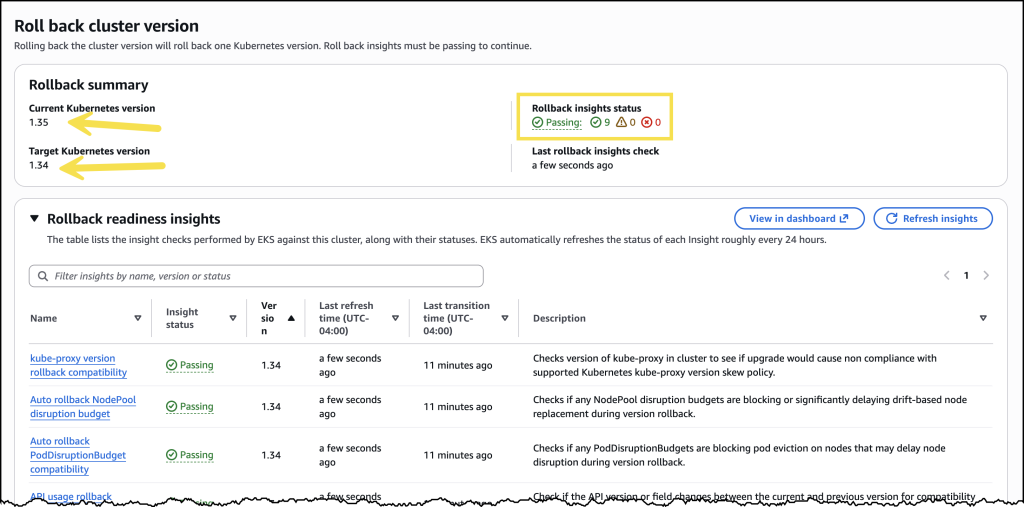
Consider a scenario where an organization upgrades an EKS cluster from Kubernetes 1.34 to 1.35. If, after the upgrade, compatibility issues with critical applications or third-party add-ons are discovered, administrators can now initiate a rollback to 1.34 within the specified seven-day window. This eliminates the frantic scramble to troubleshoot under pressure, the need to rebuild entire clusters from scratch, or the costly downtime associated with prolonged incident resolution. It fundamentally functions as an "undo button" for Kubernetes version upgrades, drastically reducing the operational risk and cognitive load on engineering teams.
A Phased, Intelligent Approach to Rollbacks
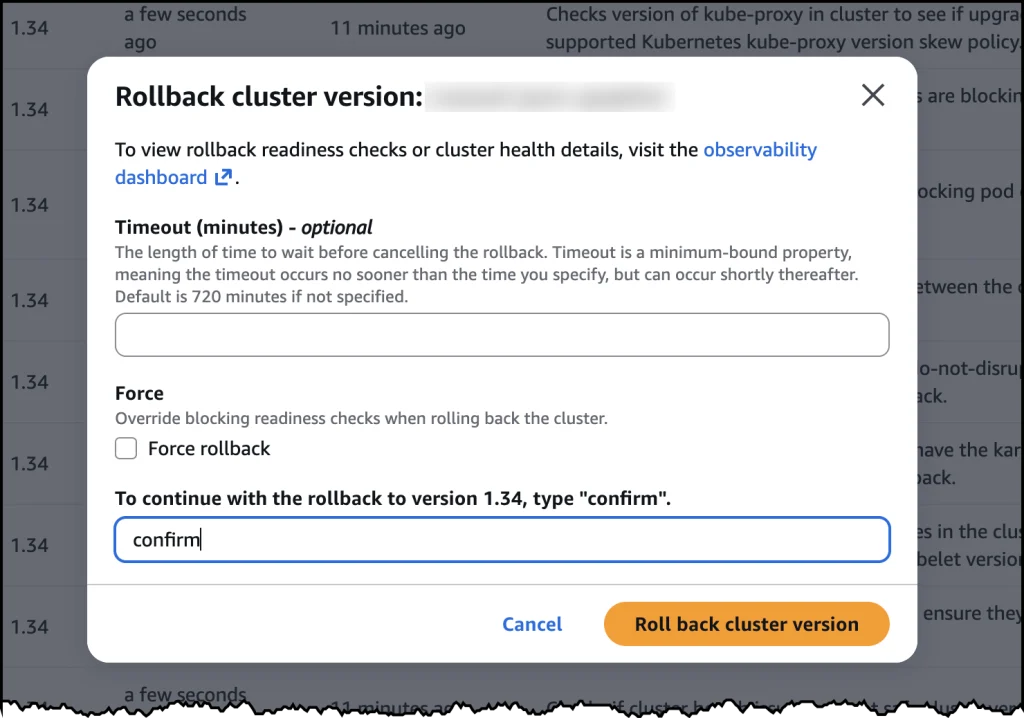
The EKS version rollback feature supports reverting one minor version at a time, mirroring the incremental approach EKS already employs for upgrades. This ensures a controlled and predictable process. A key aspect of the feature is its integration with EKS’s existing intelligence capabilities. Before initiating a rollback, EKS automatically evaluates the cluster’s readiness through its "cluster insights" mechanism. This proactive assessment flags potential issues such as node version compatibility or add-on dependencies, providing administrators with critical information to make informed decisions. For experienced users who have already assessed their situation and require rapid action, a --force flag is available to bypass these checks, offering flexibility without compromising safety for the majority of use cases. This intelligent pre-check system is available for all EKS clusters, regardless of whether customers manage their own worker nodes or leverage AWS-managed options.

Enhanced Rollback Capabilities for EKS Auto Mode
For customers who have fully embraced managed infrastructure solutions, the rollback capability extends even further. EKS Auto Mode, designed for one-click deployment of production-ready Kubernetes clusters, automates compute, networking, and storage management, allowing users to concentrate purely on their applications. In Auto Mode, version rollbacks involve both the control plane and the managed nodes, which must be rolled back synchronously. Given that node rollbacks respect pre-defined pod disruption budgets (PDBs), the process duration can vary depending on the cluster’s configuration and the specified PDBs, which are crucial for maintaining workload stability during infrastructure changes.
To provide granular control over this potentially time-consuming process, AWS has introduced a cancel API. This allows administrators to stop a node rollback at any point. If, for instance, a rollback is taking longer than anticipated or the team decides on an alternative remediation strategy, they can cancel the operation and adjust disruption budgets to accelerate subsequent attempts or pursue a different path. Critically, EKS prioritizes workload stability by never bypassing disruption budgets during a rollback by default. This design choice underscores AWS’s commitment to minimizing service interruptions. However, customers retain the autonomy to modify or remove disruption budgets manually if they deem it necessary to expedite the process, balancing speed with desired stability levels.
A Practical Demonstration: The User Experience
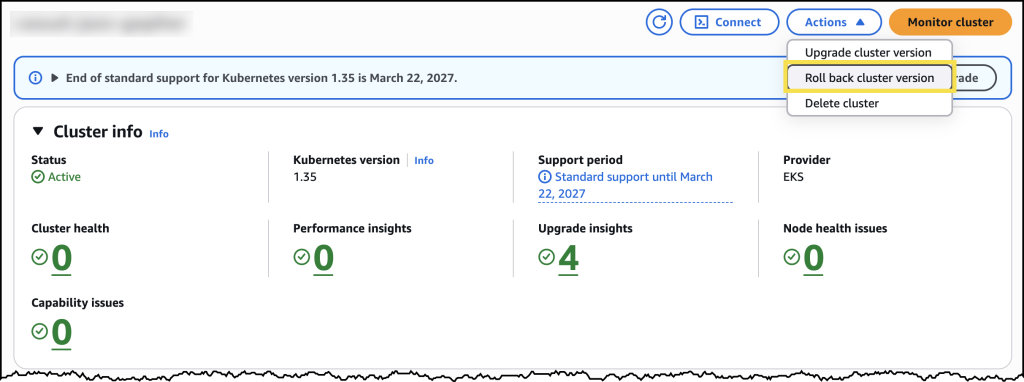
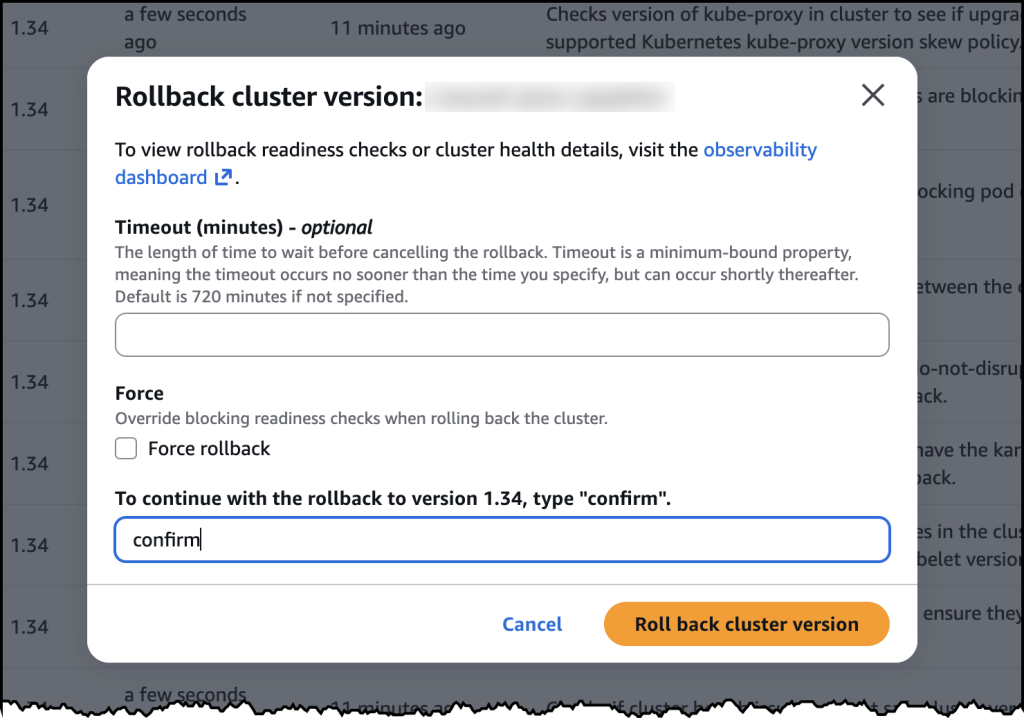
To illustrate the seamless nature of this new feature, a typical workflow begins in the Amazon EKS console. An administrator navigating to a recently upgraded cluster will find a clear option to initiate a version rollback, accompanied by information detailing the current rollback window—a crucial indicator that the seven-day period is still active.
Before proceeding, the administrator is prompted to review "rollback insights." These insights provide a comprehensive overview of the cluster’s state, highlighting node statuses and flagging any potential issues that should be addressed prior to initiating the rollback. This proactive information empowers administrators to anticipate and mitigate problems, ensuring a smoother transition.
Upon confirmation, the rollback process commences. Throughout this operation, the cluster remains functional, ensuring minimal disruption to ongoing workloads. The control plane rollback typically completes within approximately 20 minutes, a timeframe comparable to a standard upgrade. For EKS Auto Mode clusters, the managed nodes are gracefully rolled back in accordance with the configured pod disruption budgets, further emphasizing the stability-first approach. Once the process is complete, the cluster is restored to its previous, fully operational Kubernetes version, running as expected and validated for production use.
Availability, Cost, and Broader Implications
Kubernetes version rollbacks for Amazon EKS are available immediately at no additional cost in all commercial AWS Regions where Amazon EKS is offered. Customers will only incur the standard EKS and compute costs they would typically pay for their cluster operations. This means there are no extra charges specifically for utilizing the rollback capability, making it an accessible and valuable tool for all EKS users.
The feature extends its support to control plane rollbacks for all EKS clusters. Node rollbacks, designed for the managed node experience, are available for clusters operating in EKS Auto Mode. Furthermore, version rollbacks are compatible with clusters running Kubernetes versions covered by both EKS standard support and extended support, ensuring a wide applicability across the EKS customer base.
This announcement carries significant implications for the broader cloud-native ecosystem and enterprise adoption of Kubernetes. According to a 2023 CNCF survey, over 80% of organizations use Kubernetes in production, highlighting its foundational role in modern IT infrastructure. However, operational overhead, particularly around upgrades and maintenance, remains a top challenge. The introduction of EKS version rollbacks directly addresses this pain point, empowering organizations to adopt new Kubernetes versions more frequently and confidently. This accelerated adoption can lead to improved security postures, as clusters can stay current with the latest patches, and faster access to new features, driving innovation.
Industry analysts suggest that this feature will significantly lower the total cost of ownership (TCO) for Kubernetes deployments on EKS. By reducing the need for extensive manual workarounds, elaborate testing procedures, and potential downtime, organizations can reallocate valuable engineering resources from maintenance to innovation. "The ability to roll back a Kubernetes upgrade with a single command within EKS is a game-changer for enterprises," states a hypothetical spokesperson for AWS EKS. "It fundamentally shifts the paradigm from ‘upgrade at your own risk’ to ‘upgrade with confidence,’ allowing our customers to embrace the rapid evolution of Kubernetes without fear of irreversible consequences. This commitment to operational excellence is at the core of what EKS delivers."
For DevOps engineers and platform teams, the new rollback capability provides peace of mind, transforming what was once a high-stakes operation into a manageable process with a built-in safety net. This not only reduces stress but also fosters a more agile development and deployment culture. CIOs and IT leaders can view this as a crucial step towards de-risking their Kubernetes investments, ensuring business continuity, and maintaining compliance with evolving security standards.
To get started and explore this transformative feature, interested parties can visit the comprehensive Amazon EKS documentation or directly access the Amazon EKS console to experience the new rollback capabilities firsthand. This enhancement solidifies Amazon EKS’s position as a leading managed Kubernetes service, continually innovating to meet the evolving operational demands of cloud-native enterprises worldwide.
