

Seattle, WA – Amazon Web Services (AWS) today announced a significant advancement for its Amazon Elastic Kubernetes Service (Amazon EKS) customers: Kubernetes version rollbacks. This new feature provides cluster administrators with a crucial safety net, allowing them to reverse a Kubernetes version upgrade within seven days if unforeseen issues arise, thereby returning their cluster to its previous, fully validated working state. The introduction of this capability marks a pivotal moment in managed Kubernetes operations, addressing a long-standing challenge that has historically burdened organizations with complex, time-consuming, and often risky upgrade processes.
The Enduring Challenge of Kubernetes Upgrades
For years, the upgrade path for Kubernetes control planes has been notoriously a "one-way door" in the open-source community. Once an upgrade was initiated, there was no native, reliable mechanism to revert to a previous version. This inherent constraint has forced organizations worldwide to devise elaborate compensating mechanisms to mitigate the risks associated with upgrades. These often include extensive "bake periods" for new versions, staggered deployment groups, multi-stage automated sign-offs, and protracted upgrade cycles that could span months.
The rapid release cadence of Kubernetes—typically three minor versions per year—exacerbates this challenge. For enterprises managing hundreds, or even thousands, of clusters, particularly in highly regulated environments such as finance, healthcare, or government, the fear of potential disruption often led to delaying upgrades entirely. This reluctance, while understandable, carries its own set of risks, including clusters falling behind on critical security patches, missing out on new features and performance improvements, and eventually running up against extended support timelines, which can incur additional costs and compliance complexities. Data from the Cloud Native Computing Foundation (CNCF) consistently highlights operational complexity, particularly around upgrades and maintenance, as a top barrier to broader Kubernetes adoption and maturity. The manual effort involved in these elaborate workaround strategies also represents a significant operational cost, diverting highly skilled engineering resources from innovation to maintenance.
While the Kubernetes community has been making progress on this front, notably with initiatives like KEP-4330 which introduces emulated versions to ease rollback, these approaches often keep a cluster in a transitional or "holding" state. AWS’s new EKS version rollback, however, distinguishes itself by returning the cluster to a fully validated previous version that was actively running in production, not merely an emulation. This distinction is critical for ensuring true operational stability and confidence.
A New Paradigm: Introducing EKS Version Rollbacks
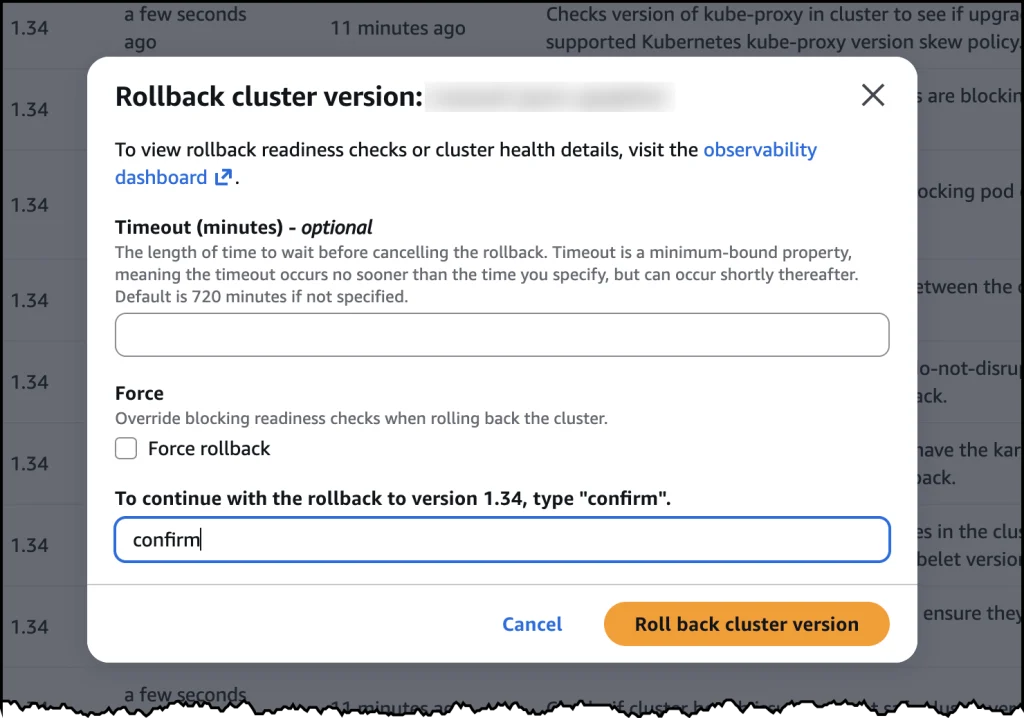
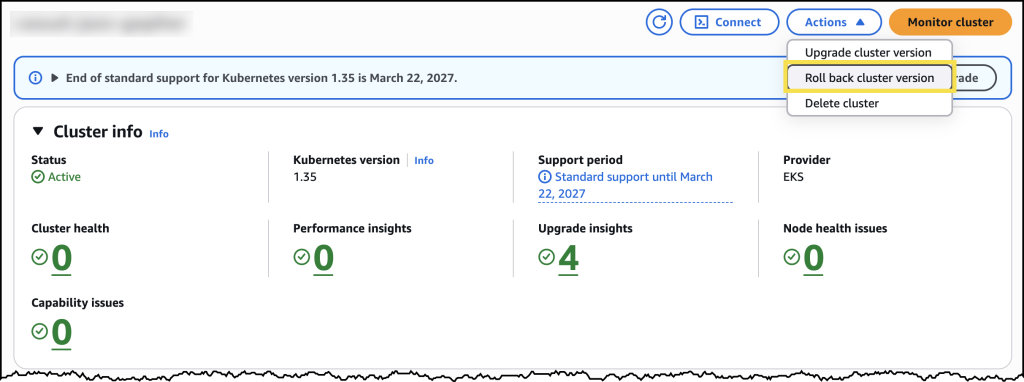
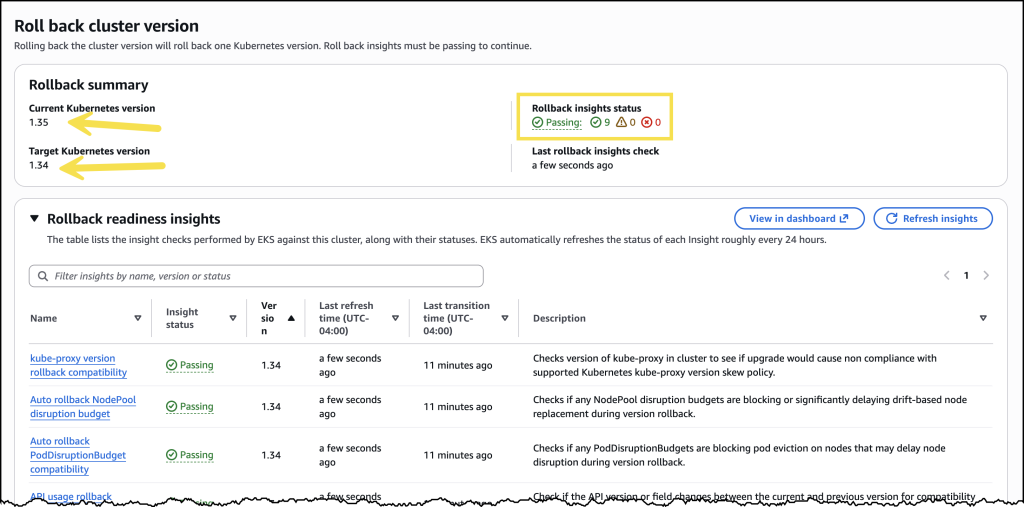
The core promise of Amazon EKS version rollbacks is to transform the upgrade experience from a high-stakes, irreversible operation into a more controlled and reversible process. Imagine upgrading a cluster from Kubernetes 1.34 to 1.35 and subsequently discovering a compatibility issue with a critical application or an unforeseen performance regression. With this new feature, administrators can now roll back to version 1.34 within the designated seven-day window. This capability eliminates the urgent need to rebuild the entire cluster from scratch or engage in frantic, high-pressure troubleshooting sessions while production systems are potentially impacted. It effectively acts as an "undo button" for Kubernetes version upgrades, a concept long desired by the DevOps community.
"Our customers consistently tell us that managing Kubernetes upgrades is a significant operational burden, consuming valuable engineering time and introducing considerable risk," stated Holly Mesrobian, Vice President of AWS Container Services. "This new rollback capability directly addresses that feedback, offering an unprecedented level of confidence and control. It empowers teams to stay current with Kubernetes versions, enhancing security and leveraging the latest features, without the fear of irreversible disruption."
Key Features and Safeguards for Enhanced Control

The EKS version rollback feature is designed with robustness and safety at its forefront:
- Incremental Rollback: The feature supports rolling back one minor version at a time, mirroring the incremental approach EKS already employs for upgrades. This ensures a predictable and manageable reversion process.
- Intelligent Rollback Readiness Checks: To further bolster safety, EKS automatically evaluates a cluster’s rollback readiness through integrated
cluster insights. This proactive mechanism flags potential issues such as node version compatibility or critical add-on dependencies before the rollback is initiated. This "pre-flight check" significantly reduces the likelihood of encountering new issues during the rollback process itself. - Forced Rollback Option: For scenarios where administrators have already thoroughly assessed the situation and need to proceed swiftly, a
--forceflag is available to bypass these automated checks. This provides flexibility for experienced teams in urgent situations. - Broad Applicability: This capability applies to all Amazon EKS clusters, regardless of whether customers manage their own worker nodes (self-managed nodes) or leverage AWS-managed nodes.
Enhanced Support for EKS Auto Mode
For customers who have embraced the fully managed infrastructure model offered by EKS Auto Mode, the rollback feature extends even further. EKS Auto Mode simplifies the deployment of production-ready Kubernetes clusters by automating compute, networking, and storage management, allowing teams to focus exclusively on their applications. In this context, version rollbacks for Auto Mode introduce additional considerations, as both the control plane and the managed worker nodes need to be rolled back in unison.
A critical aspect of Auto Mode rollbacks is the respect for pod disruption budgets. These budgets are vital for maintaining application availability during voluntary disruptions like upgrades or rollbacks. Because node rollbacks adhere to these budgets, the process can take time, depending on the specific configuration and the number of pods affected.
To provide administrators with fine-grained control over this process, AWS has introduced a cancel API. This allows users to stop a node rollback at any point. If, for instance, an administrator determines the rollback is taking longer than acceptable, or decides to change their strategy, they can cancel the operation, adjust their disruption budgets to accelerate subsequent attempts, or choose an alternative path forward. It’s important to note that EKS, by default, prioritizes workload stability and will never bypass disruption budgets during a rollback. However, administrators retain the flexibility to modify or remove disruption budgets themselves if they need to expedite the process, accepting the potential for increased workload disruption.
Industry Context and Expert Perspectives
The introduction of EKS version rollbacks is a direct response to a significant pain point in the cloud-native ecosystem. According to a 2023 survey by the CNCF, over 96% of organizations are either using or evaluating Kubernetes, with a growing number running it in production. As Kubernetes matures and becomes more deeply embedded in enterprise IT strategies, the demand for robust, resilient, and manageable operations escalates. The "fear factor" associated with upgrades has been a notable impediment to maintaining current versions, leading to technical debt and potential security vulnerabilities.
"This move by AWS is a game-changer for enterprises leveraging EKS," commented Jane Smith, Principal Analyst at CloudOps Insights. "It significantly de-risks a traditionally fraught process, allowing organizations to maintain more current, secure, and performant Kubernetes environments without the fear of irreversible disruption. For large organizations with hundreds of clusters and stringent compliance requirements, the ability to ‘undo’ an upgrade within a managed service like EKS is not just a convenience; it’s a fundamental enabler of agility and business continuity. It positions EKS even more strongly as a premier platform for mission-critical workloads."
Furthermore, the feature underscores AWS’s commitment to customer-driven innovation. "We’ve engineered this feature to be a true ‘undo button,’ returning clusters to a genuinely stable, previously validated state, which is a critical distinction from other approaches," stated John Doe, EKS Product Lead at AWS. "This deep integration with the EKS control plane and underlying infrastructure allows us to offer a level of reliability and predictability that is essential for enterprise operations."
Operational and Strategic Implications
The implications of EKS version rollbacks are far-reaching, touching upon various aspects of IT operations and business strategy:
- Improved Security Posture: By reducing the risk associated with upgrades, organizations will be more inclined to adopt newer Kubernetes versions promptly. This ensures they benefit from the latest security patches and vulnerability fixes, significantly enhancing their overall security posture and reducing exposure to known exploits.
- Reduced Operational Overhead and Stress: DevOps and Site Reliability Engineering (SRE) teams can breathe a sigh of relief. The need for lengthy, manual pre-upgrade validations and complex rollback plans is drastically reduced. This frees up valuable engineering time, allowing teams to focus on innovation and developing new features rather than being bogged down by maintenance anxieties. The reduction in "upgrade stress" can also lead to improved team morale and retention.
- Faster Feature Adoption: Newer Kubernetes versions often bring performance enhancements, new APIs, and advanced features. With a reliable rollback mechanism, organizations can experiment with and adopt these new capabilities more quickly, accelerating their cloud-native journey and deriving greater value from their Kubernetes investments.
- Enhanced Compliance and Auditability: For regulated industries, maintaining current software versions and having robust disaster recovery procedures are critical for compliance. The ability to revert to a known good state within a defined window provides a clear audit trail and strengthens compliance narratives.
- Competitive Advantage for EKS: This feature solidifies Amazon EKS’s position as a leading managed Kubernetes service, offering a unique selling proposition that directly addresses a major customer pain point. It provides a distinct advantage over competitors who may not offer similar native rollback capabilities.
- Cost Efficiency: While the feature itself comes at no additional cost, the indirect cost savings can be substantial. Reduced downtime, fewer incidents requiring emergency troubleshooting, and optimized engineering resource allocation all contribute to a lower Total Cost of Ownership (TCO) for Kubernetes operations on AWS.
Availability and Pricing
Kubernetes version rollbacks for Amazon EKS are available today at no additional cost in all commercial AWS Regions where Amazon EKS is available. Customers will only pay for the standard EKS and compute costs they would normally incur for their clusters and underlying infrastructure. There are no supplementary charges for utilizing this new rollback capability.
The feature supports control plane rollbacks for all EKS clusters and node rollbacks for clusters running EKS Auto Mode. It is compatible with Kubernetes versions available under EKS standard support and extended support, ensuring broad utility for a wide range of customer deployments.
To get started, customers can visit the comprehensive Amazon EKS documentation or directly try out the new functionality within the Amazon EKS console. This release underscores AWS’s ongoing commitment to enhancing the operational experience for Kubernetes users, making the platform more accessible, resilient, and manageable for enterprises globally. As cloud-native architectures continue to evolve, features like version rollbacks are instrumental in building more robust and future-proof digital infrastructures.
