
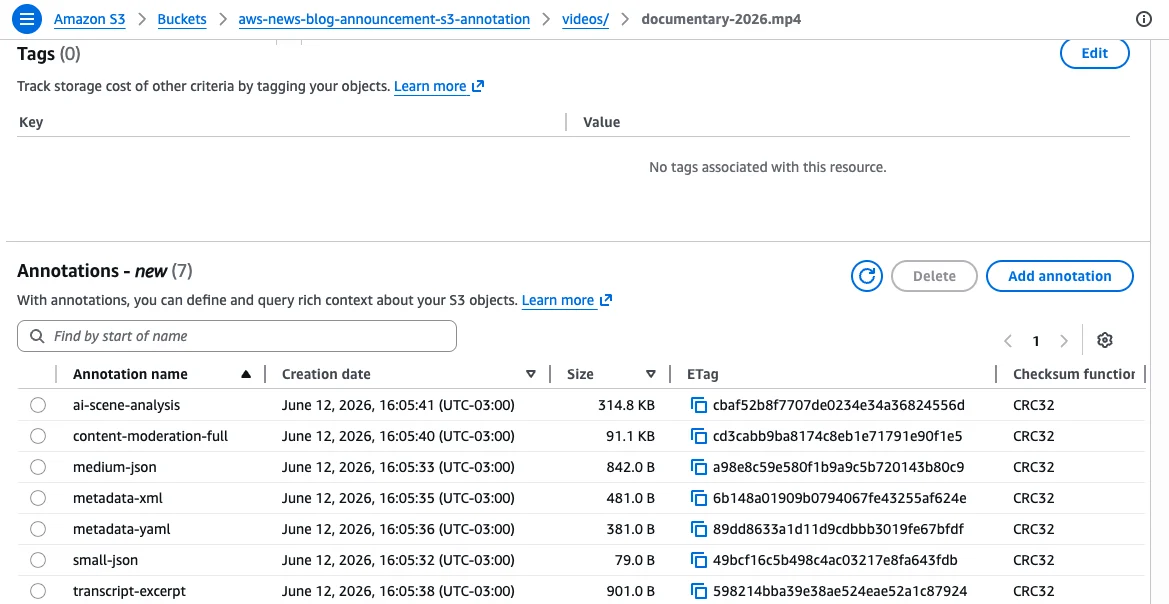

Amazon Web Services (AWS) today announced a significant enhancement to its industry-leading Amazon Simple Storage Service (Amazon S3) with the introduction of "annotations," a new metadata capability designed to attach rich, large-scale business context directly to stored objects. This innovation marks a pivotal step in enabling advanced AI agents and autonomous workflows to discover, understand, and act on data without human intervention, addressing a long-standing challenge in managing petabytes of unstructured data. The new feature allows users to store up to 1,000 named annotations per object, each up to 1 MB in size, culminating in a substantial 1 GB of contextual information per object. These annotations can be formatted flexibly using JSON, XML, YAML, or plain text, offering unprecedented versatility in describing data assets. Crucially, annotations can be modified or deleted at any time without requiring the underlying object to be rewritten, ensuring that object context remains current and dynamic.
The Evolving Landscape of Data Management and AI’s Demands
The announcement comes amidst a global surge in data generation and the accelerating adoption of artificial intelligence and machine learning across all industries. Organizations worldwide are grappling with exponentially growing volumes of unstructured data—ranging from media files and sensor readings to financial documents and scientific research—predominantly stored in object storage solutions like Amazon S3. As data lakes expand into petabyte and exabyte scales, the ability to efficiently manage, discover, and derive insights from this data becomes paramount. Traditional metadata solutions, while serving specific purposes, have struggled to keep pace with the complex, evolving contextual demands of modern AI systems and highly automated operational workflows.
Before the advent of S3 annotations, customers often resorted to building and maintaining separate, often complex, metadata management systems. This typically involved storing metadata in external databases, creating sidecar files, or leveraging the limited capabilities of existing S3 metadata options like user-defined metadata or object tags. These approaches presented several inherent challenges: synchronization complexities between objects and their external metadata, scalability limitations when dealing with billions of objects, increased operational overhead, and the financial burden of managing disparate systems and potentially incurring retrieval charges for querying metadata. The immutable nature of user-defined metadata, set only at upload time, also restricted its utility for dynamic contexts. Object tags, while mutable, are limited to ten per object and are primarily designed for operational tasks such such as access control, lifecycle management, and cost allocation rather than rich business context.
The drive towards "agentic workflows"—autonomous systems capable of intelligently navigating, processing, and making decisions based on data—necessitates metadata that is not only rich and scalable but also natively integrated with the data, mutable, and easily queryable. This is where S3 annotations fundamentally transform the paradigm. By embedding detailed context directly alongside the objects, AWS aims to eliminate the friction points that have historically hindered the development and deployment of truly autonomous data processing systems.
Deep Dive into Annotation Capabilities and Technical Superiority
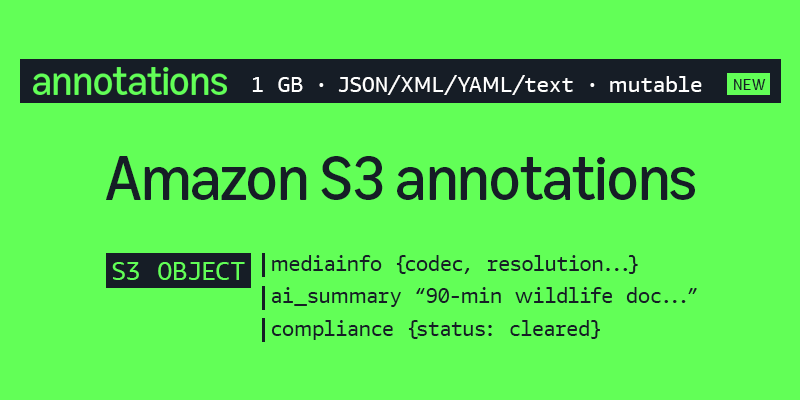
S3 annotations represent a significant leap forward in metadata management. Their core strength lies in their scale, flexibility, and native integration. With the capacity for 1,000 annotations, each up to 1 MB, a single S3 object can now carry up to 1 GB of descriptive context. This massive expansion from the 2 KB limit of user-defined metadata or the limited key-value pairs of object tags allows for highly detailed information, such as AI-generated transcripts, comprehensive content ratings, intricate technical specifications, compliance documentation, or even historical processing logs, to reside directly with the data it describes.
The support for flexible formats like JSON, XML, YAML, or plain text is crucial. This enables developers and data scientists to store structured, semi-structured, or unstructured metadata tailored precisely to their application’s needs, without rigid schema constraints that often plague traditional databases. For instance, a media company can embed a detailed JSON object containing video codecs, resolutions, audio tracks, and frame rates, while simultaneously attaching a plain-text AI-generated summary of the content to the same video file.
A key differentiator of annotations is their mutability. Unlike user-defined metadata, which is immutable once an object is uploaded, annotations can be modified or deleted at any time through dedicated API calls (PutObjectAnnotation, DeleteObjectAnnotation). This dynamic capability is essential for evolving data contexts, such as when AI models refine their understanding of content, compliance statuses change, or new insights are generated. Furthermore, annotations inherently benefit from S3’s robust object lifecycle management: they move automatically with the object during copy, replication, and cross-region transfers, and are automatically removed when the object is deleted, ensuring data consistency and simplifying governance. This also applies across all S3 storage classes, meaning annotations for objects in S3 Glacier can be queried without incurring retrieval charges for the main object, offering significant cost efficiencies for archival data.
To illustrate the stark contrast and the distinct advantages of annotations, a comparison with existing S3 metadata capabilities is helpful:
- System-defined metadata: Fixed properties like size, storage class, and creation time, immutable. Best for core object attributes.
- User-defined metadata: Small (up to 2 KB), set at upload, immutable. Suitable for small, static custom key-value pairs.
- Object tags: Up to 10 tags, 128/256 characters per key/value, mutable. Ideal for operational tasks like access control and cost allocation.
- Annotations: Up to 1 GB (1,000 x 1 MB), mutable. Designed for rich business context in flexible formats.
This clear delineation positions annotations as the go-to solution for comprehensive, dynamic, and queryable metadata directly attached to objects.

Unlocking Insights: Querying Annotations at Scale with S3 Metadata Tables
The true power of S3 annotations is realized when they are queried at scale. AWS has integrated annotations with S3 Metadata, a feature that allows S3 to automatically index object metadata into fully managed Apache Iceberg tables. When S3 Metadata annotation tables are enabled on a bucket, all annotations attached to objects within that bucket automatically flow into a dedicated annotation table, making them queryable with Amazon Athena and any other Iceberg-compatible analytics engine.
This integration eliminates the need for complex Extract, Transform, Load (ETL) processes that traditionally precede large-scale metadata analysis. The annotation tables are designed to automatically adapt to the varying structures of JSON, XML, or YAML content, removing the burden of predefined schemas or schema migrations. Each annotation effectively becomes a row in the table, with its content stored in a text_value column, enabling seamless querying across diverse metadata structures. For instance, an Amazon Athena query can quickly filter all video assets across an entire bucket to find those with more than eight audio tracks by extracting the relevant field from the mediainfo JSON annotation.
SELECT DISTINCT bucket, object_key
FROM "s3tablescatalog/aws-s3"."b_my_media_bucket"."annotation"
WHERE name = 'mediainfo'
AND CAST(json_extract_scalar(text_value, '$.audio_tracks') AS INTEGER) > 8
Furthermore, S3 Metadata also provides journal tables that track changes to annotations in near real time. This capability is invaluable for building event-driven architectures that can respond instantly to new annotations, updates, or deletions, fostering dynamic data workflows.
SELECT bucket, key, version_id, record_timestamp, annotation.name
FROM "s3tablescatalog/aws-s3"."b_my_media_bucket"."journal"
WHERE record_timestamp >= (current_date - interval '1' day)
AND annotation.name IS NOT NULL
AND record_type IN ('CREATE_ANNOTATION', 'DELETE_ANNOTATION')
Perhaps one of the most transformative aspects for the AI era is the ability to leverage the S3 Tables MCP server to enable natural language queries against annotations through tools like Amazon SageMaker Unified Studio. This empowers AI models and human users alike to discover data based on semantic context, such as asking, "find all PG-rated movies with Spanish subtitles from 2023," and receive results in seconds. This capability significantly reduces the time and complexity traditionally associated with searching across disconnected metadata systems, accelerating insights and streamlining data discovery for AI agents.
Industry Implications and Diverse Use Cases
The introduction of S3 annotations carries profound implications across a multitude of industries, addressing complex metadata challenges that have historically been bottlenecks for data-driven innovation.
- Media and Entertainment: Beyond technical specifications and AI-generated summaries, annotations can store content ratings, intellectual property rights, licensing information, compliance markers (e.g., age restrictions, regional availability), and even historical versions of content descriptions. This streamlines asset management, rights enforcement, and content delivery workflows.
- Healthcare and Life Sciences: Annotations can be used to attach anonymization statuses to patient data, experimental parameters to research datasets, consent forms, regulatory compliance flags (e.g., HIPAA, GDPR), and data lineage information. This is critical for maintaining data integrity, ensuring compliance, and accelerating scientific discovery while safeguarding privacy.
- Financial Services: For vast archives of financial transactions, annotations can store audit trails, compliance flags, data sensitivity levels, and detailed transaction metadata, simplifying regulatory reporting and fraud detection.
- Manufacturing and IoT: Sensor data from industrial equipment can be enriched with context such as device IDs, calibration dates, maintenance logs, environmental conditions, and quality control parameters, enabling predictive maintenance and optimizing operational efficiency.
- E-commerce: Product images and data can be annotated with AI-generated classifications, customer reviews, inventory status, and detailed product attributes, enhancing search capabilities and personalized recommendations.
Broadly, S3 annotations will significantly reduce the operational overhead associated with managing metadata externally, enhance data discoverability for both human analysts and autonomous systems, and accelerate the development of more intelligent and context-aware AI/ML models. By centralizing rich metadata alongside the objects themselves, organizations can foster improved data governance, auditability, and compliance, while simultaneously driving down costs by eliminating the need for separate metadata infrastructure and avoiding object retrieval charges for metadata queries.
Getting Started and Availability
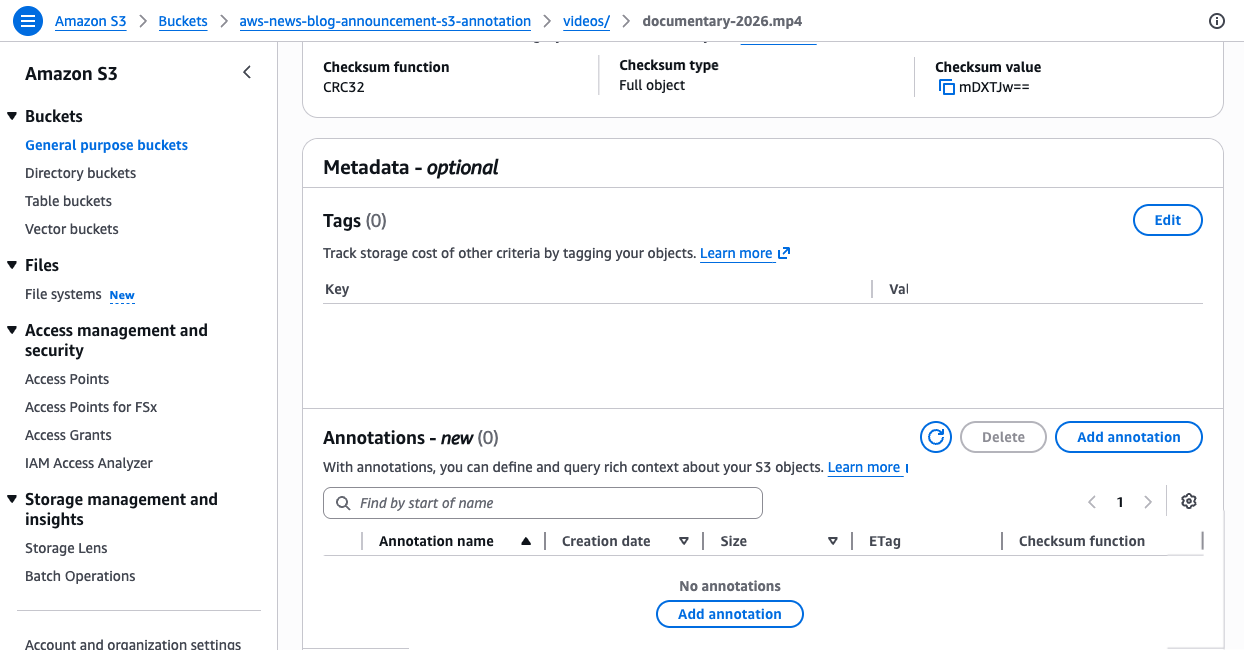
To begin leveraging S3 annotations, AWS Identity and Access Management (IAM) policies or bucket policies must grant permissions for s3:PutObjectAnnotation and s3:GetObjectAnnotation actions. Users can then add annotations to any existing or new S3 object using the PutObjectAnnotation API via the AWS Command Line Interface (AWS CLI), SDKs, or the S3 console. Updates to existing annotations are performed by calling PutObjectAnnotation again with the same annotation name, overwriting the previous content.
Enabling annotation tables for query at scale involves configuring S3 Metadata on a bucket. This can be done via the S3 console or the CreateBucketMetadataConfiguration API. If a bucket already has a metadata configuration, the UpdateBucketMetadataAnnotationTableConfiguration API can be used to enable annotation tables. Once enabled, annotations automatically flow into the managed Apache Iceberg table within approximately one hour. For buckets with existing annotated objects, S3 automatically backfills these annotations into the table, a process that runs in the background and can take several hours to days depending on the volume of objects.
Amazon S3 annotations are available today in all AWS Regions, including the AWS China Regions. Annotation tables are available in all AWS Regions where S3 Metadata is available. Annotation storage is consistently billed at S3 Standard rates, regardless of the parent object’s storage class, offering predictable and transparent pricing. This new capability underscores AWS’s commitment to continuously enhancing S3 as the foundational data lake for enterprises, equipping them with the tools necessary to thrive in an increasingly data-driven and AI-centric world. Industry analysts view this as a strategic move by AWS to further solidify S3’s position at the heart of AI-driven data strategies, directly addressing a critical bottleneck in large-scale data processing and accelerating the journey towards truly autonomous systems.
