
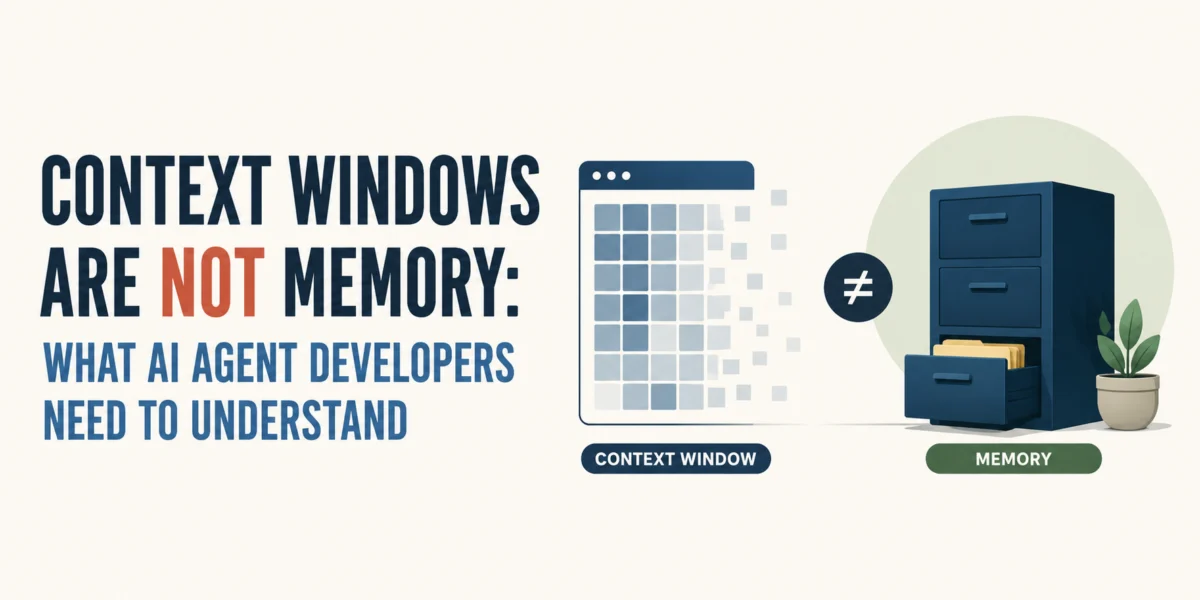

The rapid evolution of artificial intelligence, particularly large language models (LLMs) and the burgeoning field of AI agents, has introduced a lexicon of terms that, while seemingly intuitive, often mask critical architectural distinctions. Among these, the concept of a "context window" is frequently conflated with "agent memory," a misunderstanding that can lead to significant developmental challenges, performance bottlenecks, and unreliable AI behavior. This article aims to clarify why a vast context window, even those extending to millions of tokens, is fundamentally different from a robust agent memory system, and how sophisticated techniques like retrieval-augmented generation (RAG), data compression, intelligent summarization, and external memory persistence collectively form an agent’s true cognitive stack.
The Illusion of Infinite Recall: Understanding Context Windows
At its core, a context window in an AI model functions as a temporary, stateless scratchpad. It represents the maximum amount of input (tokens) an LLM can process and "attend to" at any given moment to generate a coherent response. When AI labs announce models with expansive context windows—ranging from tens of thousands to upwards of two million tokens—it’s understandable that developers might instinctively perceive this as a panacea for memory issues, envisioning scenarios where entire codebases or vast conversational histories can simply be "shoved into the prompt."
However, this perspective overlooks the inherent statelessness of LLMs. Each API call to a model begins anew, as if from "step zero." When an agent processes a conversation history spanning hundreds of thousands of tokens, it isn’t "remembering" past interactions in a persistent sense. Instead, it is rapidly re-reading its entire "universe" for that specific interaction, a process that, while incredibly fast (often in milliseconds), is computationally intensive and costly.
Consider this architectural parallel: mistaking a vast context window for agent memory is akin to a professional acquiring a colossal 25-foot-wide office desk, believing it negates the need for a filing cabinet. While every document can be laid out for immediate access during a working session, the moment that session concludes, the "desk’s" contents are effectively wiped clean—by the digital "cleaning staff" that resets the model’s state. This "snowballing effect" of resending entire histories with every turn introduces several critical pitfalls for agent-based environments: escalating API costs, increased latency, and a phenomenon known as "lost in the middle," where models struggle to attend to crucial information buried within excessively long contexts.
To illustrate, consider a typical agent interaction where a user is asking a follow-up question:
model.generate(
    messages=[
        "role": "user", "content": "Step 1: Let's call this variable `session_id`.",
        "role": "assistant", "content": "Got it, I'll use `session_id` going forward.",
        # ... every intervening turn must be resent, every single time ...
        "role": "user", "content": "Step 47: What variable name did we agree on back in step 1?"
    ]
)
In this scenario, to answer "Step 47," the agent isn’t recalling "session_id" from memory; it’s re-processing all 46 prior turns and the current query within its context window. This constant re-ingestion is neither efficient nor scalable for complex, long-running agentic tasks.
Beyond the Desk: Introducing Retrieval-Augmented Generation (RAG)
The limitations of context windows necessitate external mechanisms for information access and retention. Retrieval-Augmented Generation (RAG) systems emerged as a powerful solution, acting like a sophisticated library or a comprehensive bookshelf in an office, capable of fetching static, existing data relevant to the current task in a just-in-time fashion. These systems leverage vector databases and embedding models to represent and search through vast corpora of information. When a user poses a question, RAG systems retrieve the top-K semantically relevant document chunks and inject them into the LLM’s context window, augmenting its knowledge base for that specific query.
The integration of RAG has been a game-changer for grounding LLMs in factual, external data, significantly reducing hallucination and enabling access to proprietary or frequently updated information. However, when agents are involved, the simplicity of basic RAG pipelines can break down. Vector similarity, while powerful for identifying related concepts, is not always equivalent to semantic truth or temporal relevance in dynamic conversational flows.
Consider the example: a user instructs a scheduling agent to "move a meeting to Friday," and later, in the same session, says, "cancel Thursday, Alice is sick." A naive vector search might retrieve both statements due to their semantic relevance to "scheduling" or "meeting." The challenge lies in the potential for contradiction. An intelligent agent, unlike a simple RAG system, must act as an "accountant" or a "decision-maker," capable of reconciling conflicting information and determining which statement accurately reflects the current reality. This often involves applying additional logic, such as favoring the most recently recorded statement or evaluating the confidence level of each piece of information.
retrieved_chunks = [
    "text": "Move meeting to Friday", "timestamp": "2025-01-10T09:00:00",
    "text": "Cancel Thursday, Alice is sick", "timestamp": "2025-01-12T14:30:00"
]

# Reconcile contradictory chunks before they ever reach the prompt
latest_relevant = max(retrieved_chunks, key=lambda chunk: chunk["timestamp"])
This single line of reconciliation logic is the crucial difference between an agent that might confidently restate a stale instruction and one that correctly understands the meeting has been cancelled. Advanced RAG implementations for agents often incorporate temporal filters, explicit conflict resolution rules, and even lightweight reasoning modules to ensure the retrieved context is not just relevant, but also accurate and up-to-date. The ability to dynamically select and prioritize information based on factors beyond pure semantic similarity is a hallmark of a sophisticated agent’s cognitive capabilities.
Optimizing Bandwidth: The Role of Compression
While RAG addresses the issue of accessing external knowledge, the sheer volume of information, even when retrieved, can still strain the context window. This is where compression techniques become vital. Analogous to compressing large files into a ZIP archive, algorithmic token reduction aims to shrink the "physical footprint" of data within a prompt while preserving its essential underlying information.
Compression is primarily a bandwidth optimization strategy. Techniques range from simple methods like stripping stop-words and redundant phrasing to more advanced approaches using specialized compression models, such as LLMLingua, or prompt caching mechanisms. The goal is to distill large payloads—like a 15,000-token JSON API response—down to a more manageable size, perhaps 5,000 tokens, thereby freeing up valuable scratchpad space for the LLM’s primary reasoning tasks.
In practice, this might involve routing a large data payload through a compression pipeline before it ever reaches the main prompt:
raw_payload = json.dumps(large_api_response)  # roughly 15,000 tokens
compressed_payload = compress_with_llmlingua(
    raw_payload,
    target_token_count=5000
)
prompt = f"Given this data: compressed_payloadnnAnswer the user's question."
The underlying facts, critical for the agent’s decision-making, survive this trip largely intact, only their representation within the context window shrinks. This allows agents to handle more complex data inputs and maintain longer, more nuanced interactions without exceeding token limits or incurring prohibitive costs. The trade-off, however, lies in ensuring that the compression process is truly "lossless" in terms of critical information, or that any loss is strategically acceptable for the agent’s task.
Abstracting Reality: The Power and Peril of Summarization
Distinct from compression, summarization involves a more profound transformation: it removes the original data and replaces it with a distilled abstraction. This is a fundamentally irreversible process, a "one-way trip" that replaces detail with high-level understanding. While incredibly useful for maintaining a concise overview of past interactions, it demands careful implementation to avoid losing critical information permanently.
A best practice for applying context summarization is the "forked storage" pattern. This involves dumping raw transcripts or detailed interaction logs into inexpensive, durable storage (e.g., AWS S3 buckets, basic SQL tables) before generating and passing only the synthesized summary into the active prompt. This ensures that if a later step requires the original granular detail, it can always be retrieved from cold storage, maintaining an audit trail and the ability to "rewind" to the full context if necessary.
This two-step write pattern can be elegantly implemented:
def summarize_turn(raw_transcript, session_id, turn_id):
    # 1. Persist the raw, unabridged transcript to cold storage
    s3_client.put_object(
        Bucket="agent-transcripts",
        Key=f"session_id/turn_turn_id.json",
        Body=raw_transcript
    )
    # 2. Generate a compact summary for the active prompt
    summary = summarizer_model.generate(raw_transcript)
    # 3. Only the summary re-enters the context window
    return summary
Summarization allows agents to maintain a high-level understanding of long-running dialogues or complex tasks without the prohibitive cost and cognitive load of re-processing every detail. Recursive summarization techniques can further condense evolving narratives, providing a dynamic "memory" that abstracts away redundant or less critical information over time. This approach is crucial for building agents that can engage in truly extended interactions, maintaining context over days or even weeks.
True Agent Memory: Persistence as a State Machine
While context windows, RAG, compression, and summarization enhance an agent’s ability to handle information in the short term, genuine, long-term memory persistence requires an external, structured knowledge base. For an AI agent to possess "memory" in a meaningful sense, it must not act as the database itself, but rather as the database administrator. This paradigm shift empowers the agent to explicitly manage and interact with structured information stores, making its knowledge durable and accessible across sessions.
Consider a user stating, "My dog’s name is Goofy, but we might rename him Pluto." A truly intelligent agent wouldn’t just hold this in its context window; it would trigger a specific tool-call to update an external entity graph or database:
  "tool": "update_entity_graph",
  "params":
    "subject": "User_Dog",
    "attribute": "Name",
    "value": "Goofy",
    "notes": "Considering Pluto"
This explicit manipulation of an external state machine—be it a standard SQL table, a sophisticated knowledge graph, or a Redis instance—is the cornerstone of true agent memory. The agent is taught to query this state machine at the beginning of every turn to retrieve relevant information and to commit any updates at the end of that turn. This "query-then-commit" discipline forms a fundamental loop for stateful agents:
def agent_turn(user_message, entity_graph):
    # Query existing state at the START of every turn
    current_state = entity_graph.query(subject="User_Dog")
    response = model.generate(
        messages=["role": "user", "content": user_message],
        context=current_state  # Inject relevant state into the context
    )
    # Commit any updates at the END of every turn
    for call in response.tool_calls:
        entity_graph.update(**call.params)
    return response
This architecture offers numerous advantages: it provides scalable, accurate, and long-term recall, drastically reduces token usage by only injecting relevant facts, and enables robust multi-turn conversations and task execution. This external memory becomes the agent’s persistent knowledge base, allowing it to remember user preferences, ongoing tasks, and historical interactions over extended periods, far beyond the ephemeral confines of a context window.
Building a Robust Cognitive Stack: Implications and Future Outlook
The distinction between context windows and true agent memory is not merely semantic; it’s foundational for building reliable, scalable, and genuinely intelligent AI agents. The industry is increasingly recognizing that simply expanding context windows, while offering temporary relief, is not a sustainable solution for complex agentic behavior. Leading AI researchers and developers are converging on hybrid architectures that judiciously combine the strengths of LLMs with sophisticated external memory management systems.
The implications for AI development are profound. Developers must shift from a "stuff everything into the prompt" mentality to designing agents with a layered cognitive stack. This involves:
- Strategic Context Management: Understanding that the context window is a precious, temporary resource to be optimized.
- Intelligent Retrieval: Employing RAG not just for static data, but for dynamically updated information, with robust conflict resolution.
- Efficient Data Handling: Utilizing compression for bandwidth optimization and summarization for irreversible, high-level context maintenance, always backed by durable storage.
- External State Persistence: Implementing true memory through structured databases and tool-use, allowing agents to manage and update their knowledge base explicitly.
This integrated approach enables the creation of agents that are not only capable of processing vast amounts of information but also of learning, adapting, and maintaining coherent interactions over extended periods. The future of AI agents lies not in models with infinitely large "desks," but in agents equipped with sharp "pencils" and the architectural intelligence to optimally leverage a diverse array of filing cabinets, libraries, and external knowledge systems to do their job effectively. This nuanced understanding and strategic implementation of an agent’s cognitive stack will be critical in unlocking the next generation of truly intelligent and autonomous AI applications.
