
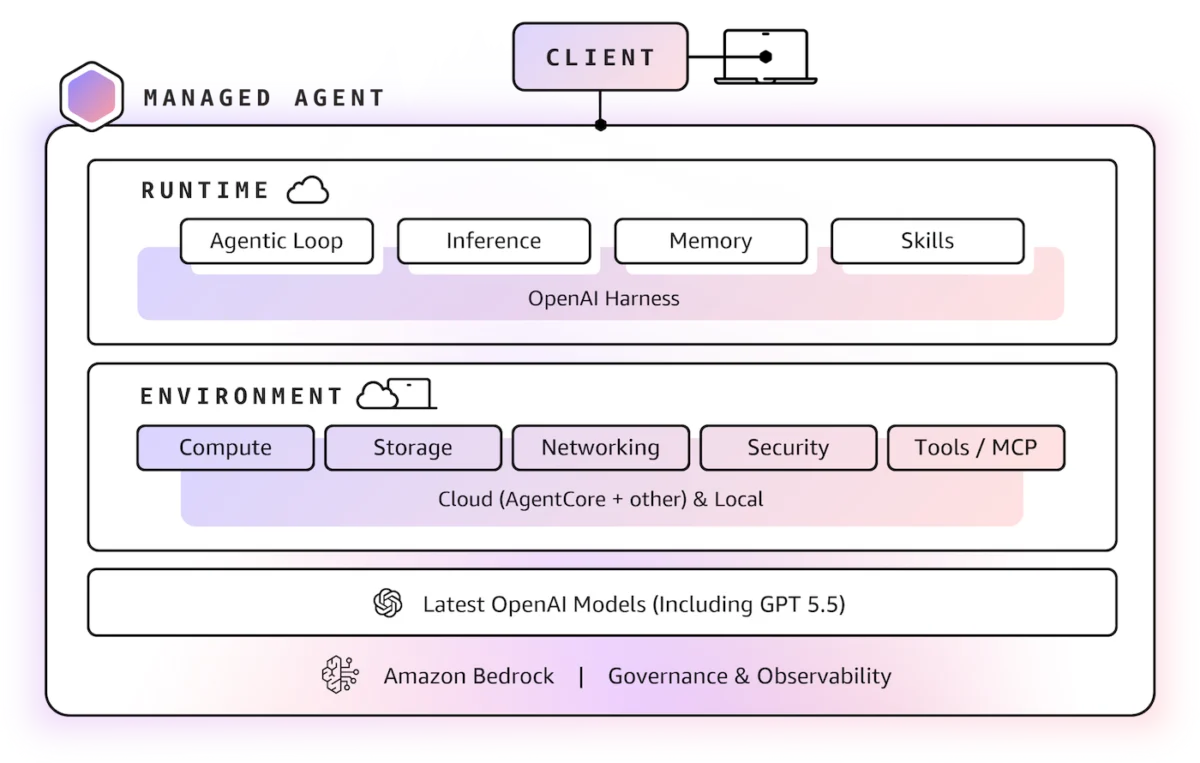

Amazon Web Services (AWS), a subsidiary of Amazon.com specializing in cloud computing platforms, has officially announced the public preview of Amazon Bedrock Managed Agents powered by OpenAI. Revealed during the company’s weekly product and service updates, this development represents a significant integration of OpenAI’s advanced artificial intelligence architectures into the AWS ecosystem. Built upon a customized version of OpenAI’s Agents API, the new capability is engineered to be natively compatible with AWS infrastructure, allowing enterprise customers, developers, and data scientists to deploy sophisticated AI agents directly within their existing AWS environments.
The announcement highlights a broader industry trend toward interoperability between leading frontier model providers and hyper-scale cloud infrastructure. By bridging OpenAI’s capabilities with AWS-native security, identity management, and governance frameworks, the collaboration seeks to address long-standing enterprise concerns regarding data privacy, compliance, and multi-cloud architectural complexity.
Main Facts and Technological Integration
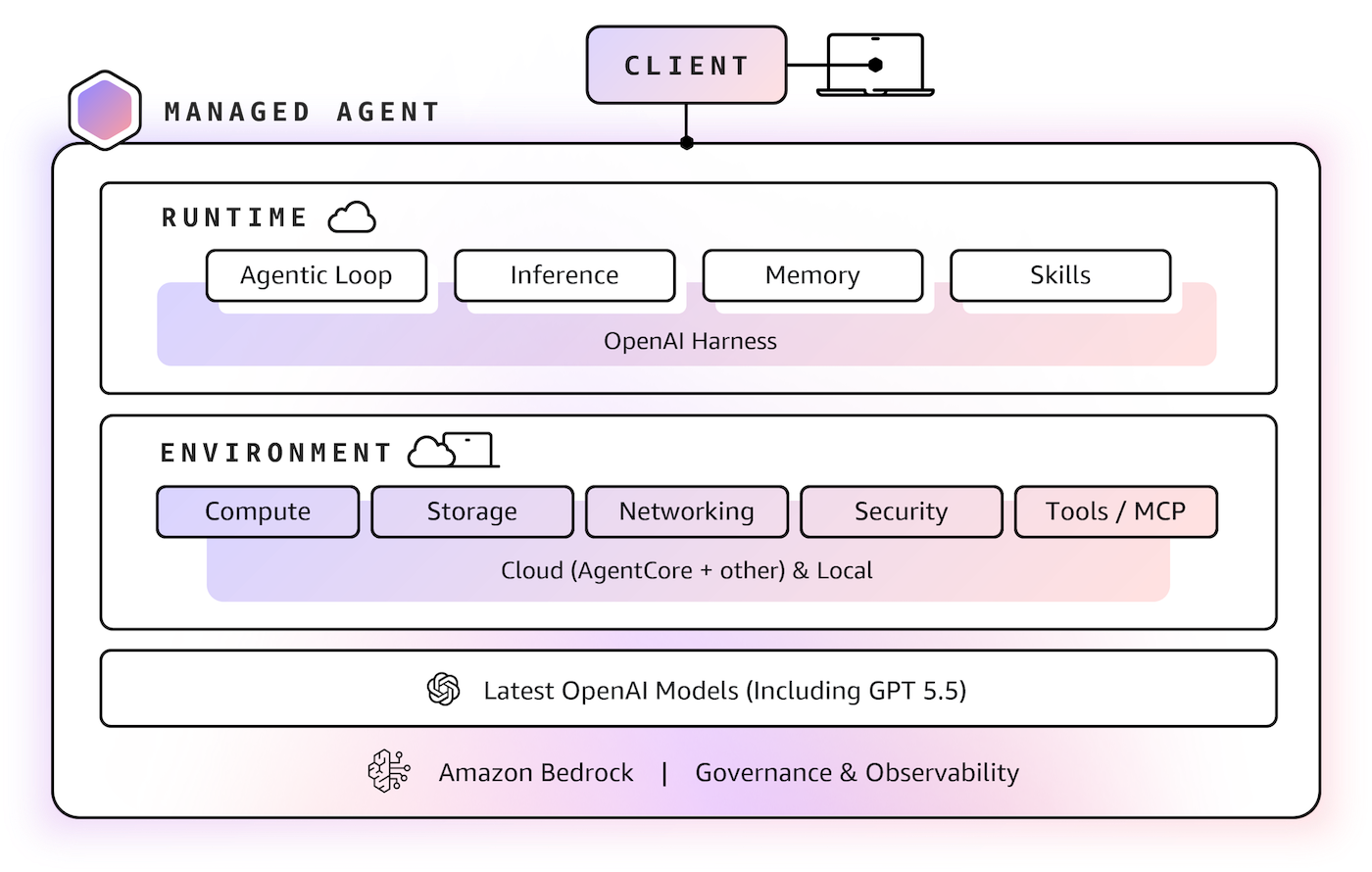
The newly introduced Amazon Bedrock Managed Agents powered by OpenAI allow organizations to construct, test, and deploy autonomous AI agents optimized specifically for OpenAI models while operating entirely within the boundaries of an AWS account. This ensures that all data exchanges, model inferences, and orchestration tasks adhere to the strict governance, access control policies, and compliance mandates already established by corporate IT administrators.
According to technical documentation released alongside the announcement, developers are given flexibility regarding how and where they execute these workloads. Users can choose between two distinct execution environments:
- Self-Hosted Compute: Organizations can utilize existing development machines, self-managed containers, or custom on-premises and cloud-based compute environments to run their agent logic, maintaining granular control over the underlying hardware and network configurations.
- Amazon Bedrock AgentCore Runtime: This fully managed service handles runtime sessions natively within the cloud. It provides configurable storage options and automatic scaling within the customer’s AWS account, minimizing the operational overhead typically associated with maintaining persistent agent infrastructures.
The architecture is designed to leverage AWS Identity and Access Management (IAM), AWS CloudTrail, and other core security services to ensure that AI agents operate under the principle of least privilege. This integration enables enterprises to harness advanced reasoning and tool-using capabilities from OpenAI models without exposing sensitive corporate assets to external third-party endpoints outside established enterprise agreements.
Chronology and Product Lifecycle Updates
The public preview rollout is part of a broader cadence of updates managed by AWS product teams throughout late September and early October 2026. Alongside the artificial intelligence announcements, AWS updated its product lifecycle documentation on September 29, 2026, outlining scheduled transitions for various cloud services and features.
Cloud platform providers routinely update their product lifecycles to phase out older architectures, transition customers to modern alternatives, and optimize resource allocation for high-demand technologies such as generative AI and serverless computing. The September 29 lifecycle updates delineated three distinct categories of service phase-outs:
- Services Moving to Maintenance: These services will no longer be accessible to new customers starting October 29, 2026. Existing customers are advised to initiate migration assessments to prevent operational bottlenecks.
- Services Entering Sunset: These components have begun their formal wind-down processes, with predefined timelines for complete deprecation.
- Services Reaching End of Support: As of September 29, 2026, specific older service tiers and legacy features have officially ceased receiving security patches, technical assistance, and operational updates.
AWS engineering teams have published dedicated migration guides and product alternative documentation to assist enterprise engineering departments in transitioning workloads away from deprecated services with minimal downtime. Support channels and specialized account teams have also been mobilized to assist organizations navigating complex architectural migrations.
Supporting Data and Ecosystem Expansion
The introduction of OpenAI-powered managed agents on Amazon Bedrock arrives during a period of rapid expansion for the managed artificial intelligence sector. Industry analysts note that enterprise adoption of generative AI has shifted from exploratory proof-of-concept projects to production-grade deployments requiring robust orchestration frameworks.

Amazon Bedrock, which initially launched to provide a managed service for accessing foundation models from major AI labs via a single API, has progressively expanded its catalog to include diverse models from Anthropic, Cohere, Meta, Mistral AI, and now deeper integrations with OpenAI. This multi-model strategy is designed to prevent vendor lock-in and allow engineering teams to select the optimal model architecture for specific use cases, ranging from automated customer service routing and complex data retrieval to autonomous software testing and supply chain optimization.
Data compiled from enterprise cloud deployment metrics indicates that security and data sovereignty remain the primary evaluation criteria for Chief Information Officers (CIOs) when selecting AI vendors. By integrating the Bedrock Managed Agents directly into the AWS Virtual Private Cloud (VPC) framework and enabling localized logging and monitoring, AWS aims to capture a larger share of regulated industries, including finance, healthcare, and public sector organizations that previously faced regulatory hurdles in adopting external AI APIs.
Official Responses and Stakeholder Perspectives
While third-party software providers and cloud infrastructure competitors continue to jockey for market share in the generative AI space, industry observers have noted that hybrid ecosystems are becoming the de facto standard for large enterprises.
Independent cloud architects and enterprise technology consultants have offered generally favorable preliminary assessments of the Bedrock Managed Agents preview. Analysts point out that managing stateful, multi-step AI agents—systems capable of invoking external APIs, querying databases, and executing multi-stage workflows—traditionally required complex custom engineering involving orchestration frameworks like LangChain or Semantic Kernel hosted on raw EC2 instances or Kubernetes clusters. By offering a managed runtime environment via Amazon Bedrock AgentCore, AWS significantly reduces the engineering burden required to build production-ready agentic workflows.
Conversely, some compliance and security experts emphasize that while the infrastructure is managed securely by AWS, the underlying reasoning models developed by third parties still require careful prompt engineering and output validation to mitigate risks associated with hallucinations, data leakage, and unintended API calls. Consequently, organizations deploying these agents are encouraged to implement rigorous human-in-the-loop validation mechanisms, particularly for agents granted write permissions to enterprise databases or financial transaction systems.
Broader Impact and Industry Implications
The convergence of OpenAI model capabilities with AWS-native managed agents signals a maturing market where foundational model providers and cloud infrastructure giants increasingly collaborate despite competing in certain application layers. For software developers and enterprise architects, this partnership streamlines the deployment lifecycle of advanced AI applications.
As enterprises scale their artificial intelligence initiatives, the ability to govern agent behavior using established cloud IAM policies, monitor agent actions through centralized logging systems, and execute workloads within compliant regional data centers will likely accelerate enterprise AI adoption. Furthermore, the scheduled deprecation of legacy AWS services underscores the relentless pace of technological evolution in cloud computing, where infrastructure investments must continually pivot toward high-efficiency, AI-ready architectures.
AWS has encouraged developers and IT administrators to review the comprehensive documentation available on the official Amazon Bedrock user guide website to begin testing the public preview of OpenAI-powered managed agents. As the preview phase progresses toward general availability, user feedback and enterprise telemetry will guide further feature enhancements, pricing structures, and scalability optimizations across the AWS global infrastructure network.
