

Amazon Web Services has announced the public preview of Amazon Bedrock Managed Agents powered by OpenAI, marking a significant strategic integration between AWS infrastructure and OpenAI artificial intelligence technologies. Built upon a customized version of OpenAI’s Agents API, the new offering is engineered specifically to be AWS-native. This development enables organizations to build, deploy, and scale advanced AI agents that operate entirely within the secure confines of the AWS ecosystem, utilizing existing organizational identities, access permissions, and governance frameworks.
The announcement reflects a broader industry trend toward interoperability among major technology providers, blending specialized frontier model capabilities with enterprise-grade cloud environments. As businesses increasingly demand generative AI solutions that comply with strict regulatory frameworks and corporate security policies, the capability to run OpenAI-optimized agents natively within established cloud architectures addresses critical operational challenges.
Architecture and Deployment Flexibility
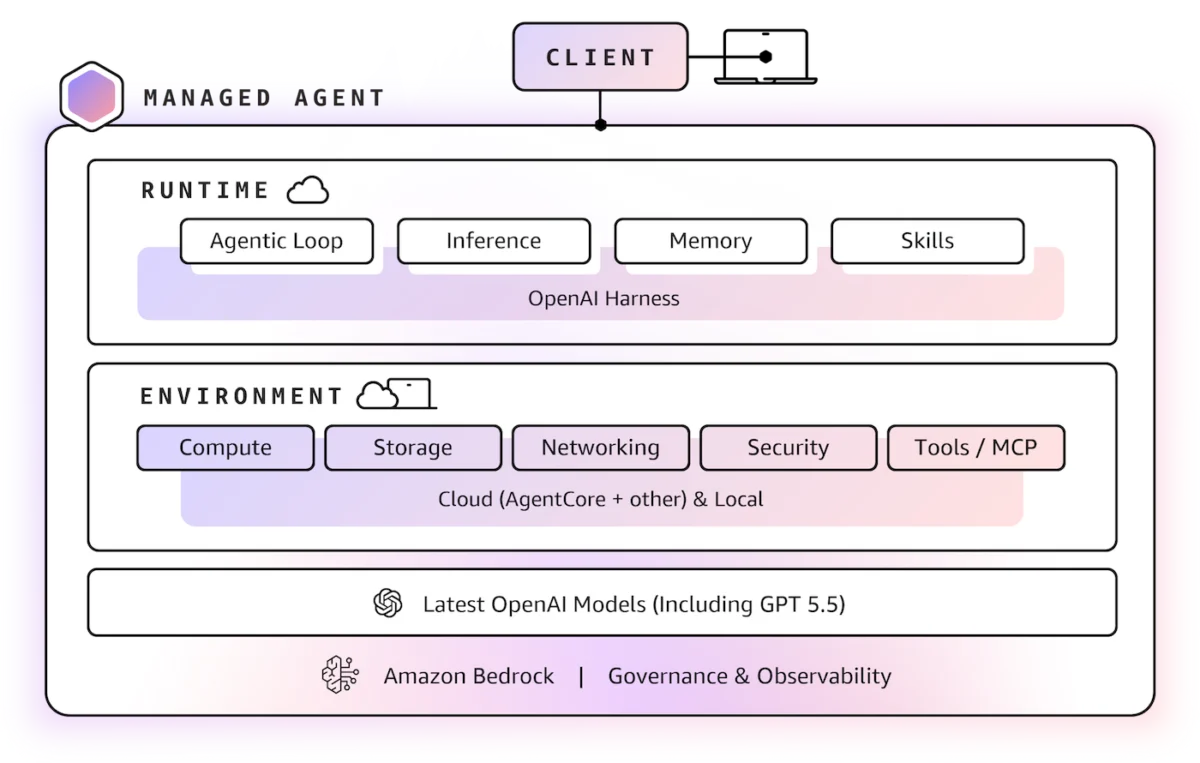
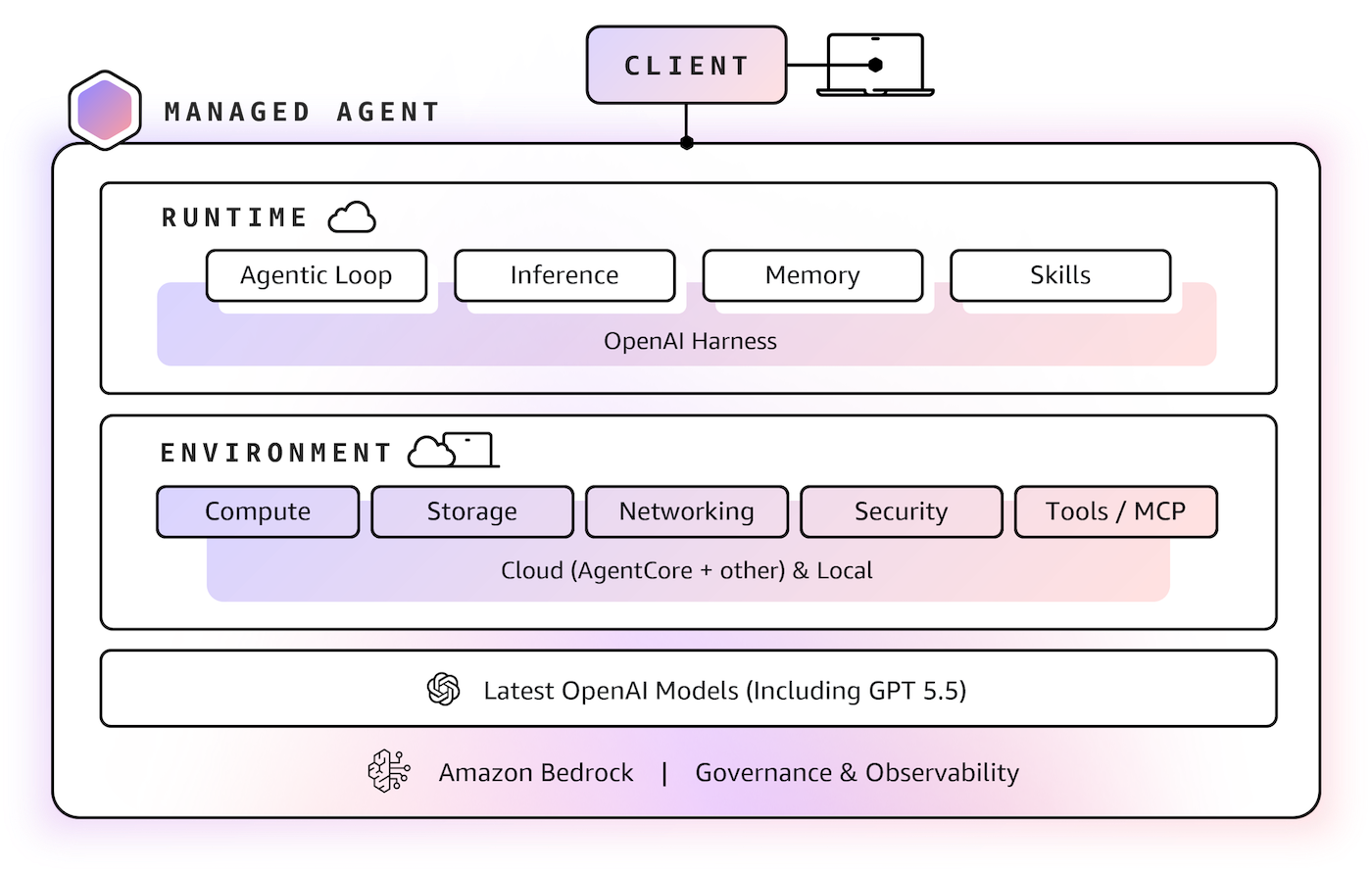
Under the new preview offering, developers and enterprise architects can choose between two primary execution environments to suit their operational models and infrastructure requirements. The first option is self-hosted compute, which allows technical teams to leverage existing development machines, containerized workflows, or current compute environments to manage their agent workloads.
The second option introduces the Amazon Bedrock AgentCore Runtime. This fully managed execution environment provides managed runtime sessions alongside configurable storage options hosted directly within a customer’s AWS account. By decoupling the execution layer while maintaining tight integration with AWS Identity and Access Management and centralized governance controls, organizations can minimize the administrative overhead typically associated with orchestrating distributed AI systems.
According to technical documentation released alongside the announcement, the architecture is designed to streamline how autonomous agents interact with internal APIs, databases, and third-party enterprise tools. By embedding these capabilities directly into Amazon Bedrock, AWS aims to simplify the lifecycle management of complex, multi-step AI workflows that require persistent state handling and secure credential management.
Expanding Frontier Model Ecosystem on Amazon Bedrock
The introduction of OpenAI-powered managed agents coincides with ongoing efforts by AWS to broaden its frontier model ecosystem. Amazon Bedrock has historically positioned itself as a model-agnostic platform, allowing enterprise customers to select from a diverse portfolio of foundational models supplied by leading artificial intelligence laboratories and open-source communities.
By continuously expanding model choices, AWS addresses the heterogeneous needs of enterprise developers. Different workloads require distinct balances of reasoning capability, latency, cost efficiency, and context window capacity. The addition of deeply integrated, high-performance agent frameworks enables enterprises to transition artificial intelligence proofs-of-concept into production-grade systems capable of executing complex business logic autonomously.
Lifecycle Management and Service Availability Updates
In tandem with its artificial intelligence product announcements, AWS released routine updates regarding its service availability and product lifecycle changes. Cloud computing providers frequently update their product portfolios, transitioning older generation features and services into maintenance phases, sunset periods, or ultimate end-of-support states as newer, more efficient architectures are introduced.

For the September and October 2026 lifecycle update cycle, AWS has outlined specific timelines to help enterprise customers manage migrations and minimize operational disruptions. Services designated for the maintenance phase will no longer be accessible to new customers starting October 29, 2026. Concurrently, other features are entering distinct sunset and end-of-support phases.
AWS has emphasized that these lifecycle transitions are standard operational procedures designed to maintain high performance, security standards, and resource optimization across its global infrastructure. Enterprise clients affected by these changes are encouraged to consult official AWS product documentation or coordinate directly with AWS Support teams to identify recommended migration paths and alternative managed services.
Industry Implications and Enterprise Impact
The convergence of OpenAI agent technology with AWS cloud infrastructure carries substantial implications for the enterprise software market. Historically, organizations deploying third-party large language models often had to navigate complex multi-cloud environments or build custom, brittle API bridges to connect external AI services with internal data storage and security perimeters.
By offering a native execution framework, AWS reduces the friction of enterprise AI adoption. Data sovereignty and compliance remain paramount concerns for regulated industries such as finance, healthcare, and public sector organizations. When AI agents operate within a governed AWS account—bound by established security groups, Virtual Private Cloud configurations, and precise IAM policies—security teams retain comprehensive visibility and control over data flows and automated decision-making processes.
Furthermore, the shift toward managed agent runtimes reflects the maturation of generative AI from static text-generation interfaces to dynamic, action-oriented systems. Agents are designed not merely to answer queries, but to autonomously execute multi-phase tasks across enterprise software stacks, such as retrieving customer records, executing code, and generating comprehensive analytical reports. Providing a robust, secure runtime environment for these agents within a trusted cloud platform addresses the primary enterprise anxiety regarding autonomous system security.
Community Engagement and Upcoming Events
As the cloud computing and artificial intelligence sectors continue to evolve at a rapid pace, AWS maintains an active schedule of developer-focused events, community gatherings, and major conferences. Upcoming industry events, including the annual AWS re:Invent conference and regional AWS Community Days, serve as primary venues for engineers, architects, and industry leaders to discuss emerging architectural patterns, share deployment best practices, and examine real-world case studies involving generative AI.
The expansion of the AWS Builder Center and dedicated startup programs further underscores the company’s strategy to foster a collaborative ecosystem. By engaging directly with builders and providing centralized access to documentation, architectural blueprints, and peer-to-peer technical forums, AWS aims to accelerate the development and deployment of next-generation cloud and artificial intelligence solutions.
As the public preview of Amazon Bedrock Managed Agents progresses, enterprise feedback will likely shape the final General Availability release. Organizations looking to adopt these capabilities are advised to review the comprehensive technical documentation provided by AWS, evaluate their compliance and governance requirements against the available execution environments, and participate in ongoing developer forums to stay informed of subsequent updates and feature enhancements.
