
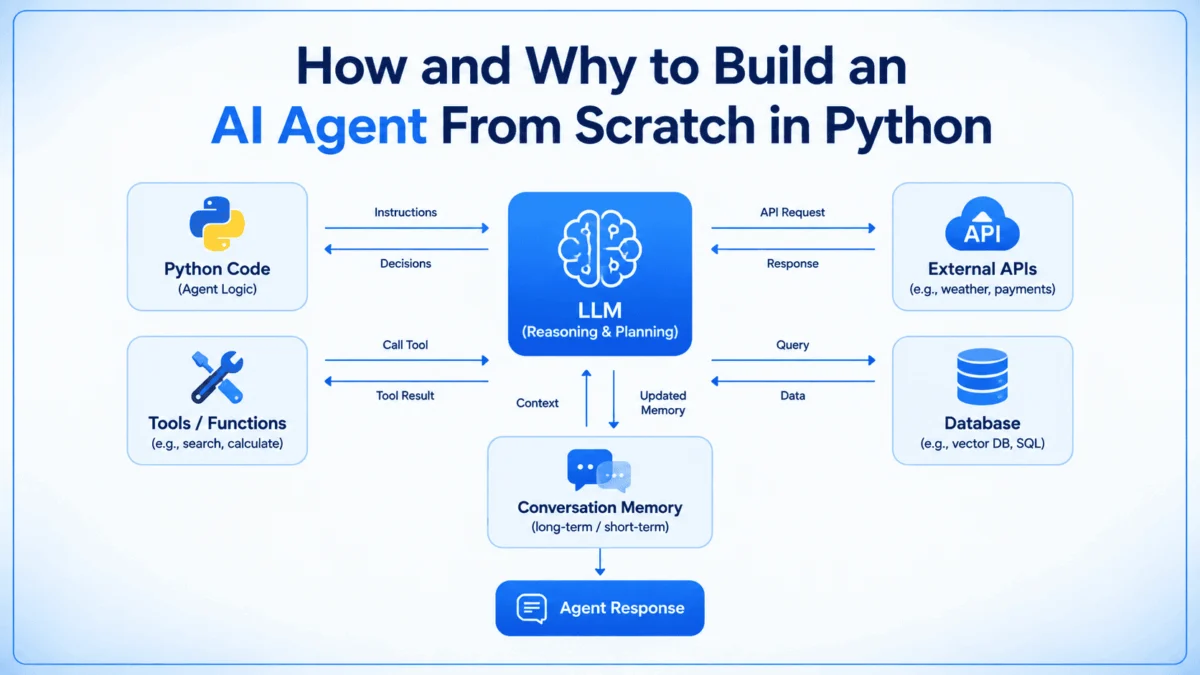

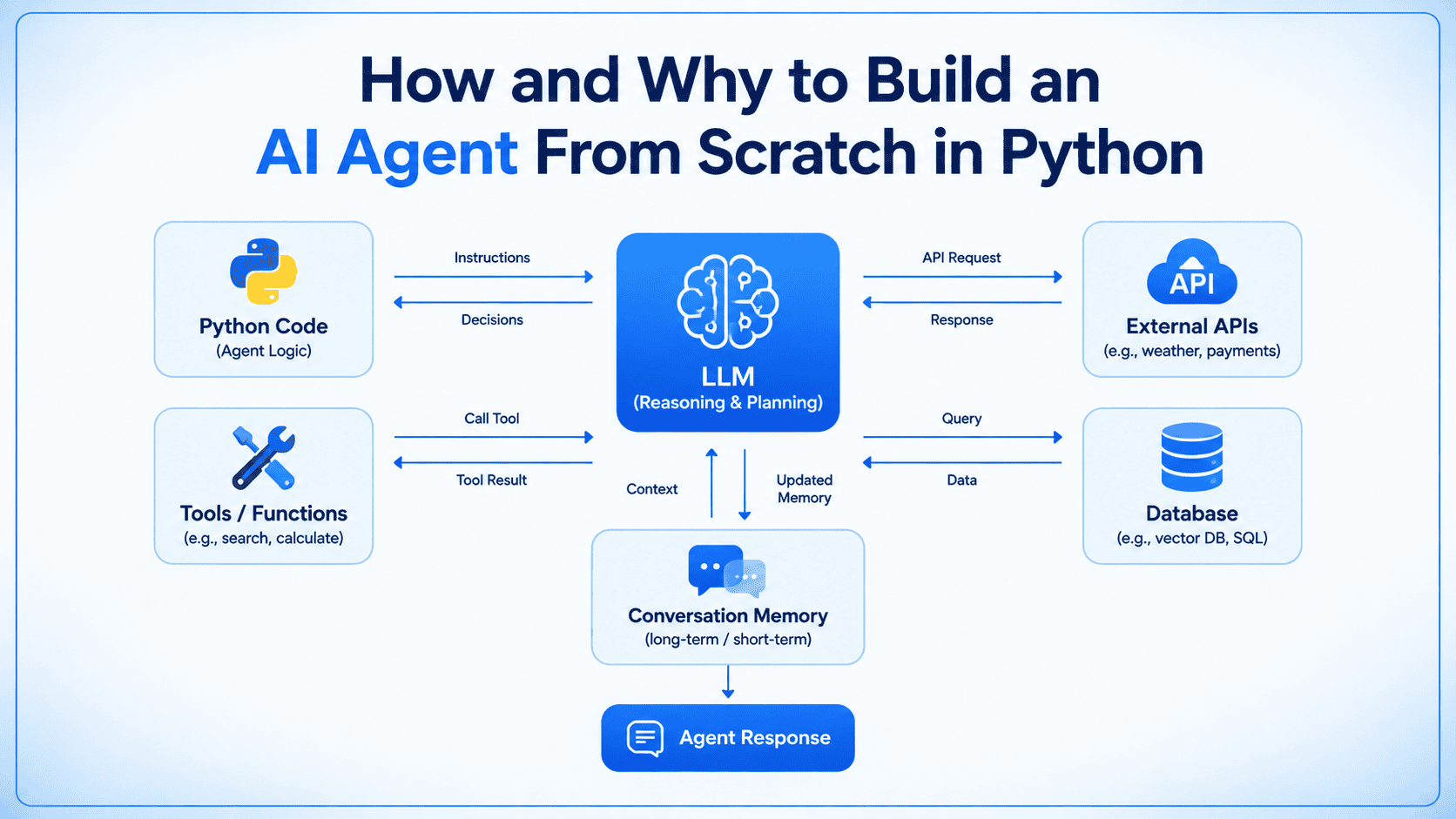
The integration of artificial intelligence into enterprise workflows has shifted from simple prompt-response interactions toward autonomous agents capable of executing multi-step tasks. While the current market is saturated with high-level orchestration frameworks designed to simplify this transition, a growing cohort of software engineers and system architects are returning to the fundamentals. By building an AI agent from scratch in Python using raw API calls, developers gain granular control over execution loops, state management, and memory, ultimately reducing the technical debt associated with third-party abstractions.
The fundamental limitation of standard large language models (LLMs) lies in their reliance on static training data. When an enterprise application requires real-time information—such as querying a SQL database, checking a live order management system, or interacting with an external API—a standalone model remains blind to these inputs. The transition from a "model" to an "agent" occurs when the system is granted the ability to call external tools and incorporate those results into its reasoning process.
The Architectural Shift Toward Agentic Systems
The industry trend toward agentic workflows began in earnest in 2023, following the release of models with robust tool-calling capabilities. Prior to this, developers were forced to rely on complex "chain-of-thought" prompting, which often suffered from hallucination and instability. The current paradigm, popularized by Anthropic’s Claude 3.5 and 4.5 iterations, allows the model to pause mid-generation, request specific data via a function, and wait for the system to provide the result before finalizing its response.
Building this architecture manually involves three distinct components: the model interface, the tool definition schema, and the iterative execution loop. By implementing these components without a framework, developers can bypass the "black box" nature of many modern libraries. This transparency is critical for debugging complex failures, particularly when an agent enters an infinite loop or fails to interpret a schema correctly.
Technical Foundations: The Execution Loop
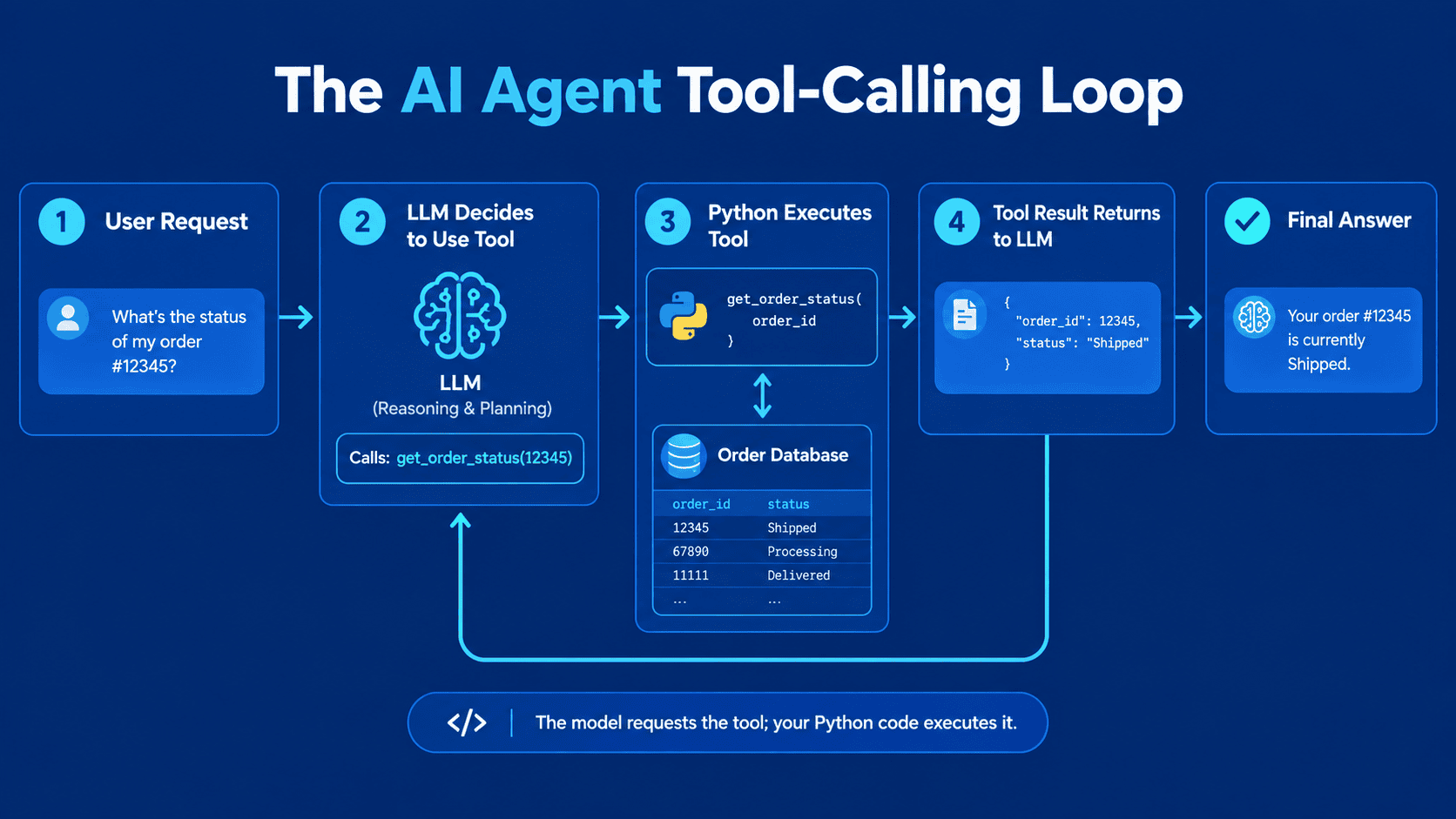
At the core of a custom-built agent is the message history loop. In a production environment, the process begins by defining a set of tools represented as JSON schemas. These schemas act as a contract, informing the model of available functions, expected parameters, and the intent behind each tool.
When a user submits a query, the agent performs an initial API call. If the model determines that the query requires external data, it returns a tool_use signal. The Python script must then intercept this signal, execute the corresponding function, and append the output back to the message history. This pattern of "request-execute-append" repeats until the model determines it has sufficient information to formulate a comprehensive answer.
The primary risk in this manual implementation is the potential for uncontrolled recursion. Without a predefined max_iterations constraint, an agent might repeatedly call a tool that returns unhelpful data, leading to excessive latency and rising API costs. Engineering teams have largely converged on a standard practice: capping the execution loop at five or six iterations, followed by a graceful fallback to a manual response or an error message.
Memory Management and State Persistence
A common failure point in minimalist agent design is the lack of persistent memory. If an agent initializes a fresh conversation object for every turn, it effectively suffers from "short-term memory loss," unable to link a user’s current question to previous context.
To address this, developers must transition from simple functional scripts to object-oriented structures. By encapsulating the messages list within an Agent class, the developer ensures that the history of interactions—including previous tool calls and their respective outputs—remains accessible. This allows the model to resolve pronouns (e.g., "When will it arrive?") by referencing the state preserved in the class instance.
However, scaling this memory model presents its own set of challenges. As the conversation grows, it consumes more of the model’s context window, leading to increased token costs and potential degradation in response quality. Advanced implementations often incorporate a "pruning" mechanism, where older turns are summarized or archived to a database, ensuring the agent remains focused on the most relevant information without losing historical context.
Industry Implications and Strategic Trade-offs
The decision to avoid orchestration frameworks is not merely an exercise in academic coding; it carries significant strategic weight for businesses. Frameworks often lock organizations into specific coding paradigms and introduce dependencies that can become obsolete within months. By utilizing a "clean-room" approach, engineering teams can maintain a lightweight codebase that is easier to unit test and audit for security vulnerabilities.
From a regulatory and safety perspective, building from scratch allows for more rigorous oversight of how an agent interacts with sensitive data. When every function call is explicitly handled in the main loop, it is easier to implement logging, access control, and data sanitization. This level of visibility is often harder to achieve in abstracted frameworks where the underlying logic is hidden behind multiple layers of middleware.
Looking Ahead: The Evolution of Agentic Capabilities
The lifecycle of these tools is rapid. As noted by industry standards, specific model versions—such as the Claude Sonnet 4.5 mentioned in development documentation—are subject to deprecation cycles, often within a twelve-month window. This volatility reinforces the value of a modular architecture: if the underlying model changes, a custom-built agent can be updated by simply swapping the API call, rather than re-architecting the entire application logic.
As of late 2026, the industry is moving toward more complex, multi-agent systems where specialized agents act as supervisors, delegating tasks to sub-agents. The foundational knowledge of building a single agent, however, remains the prerequisite for designing these more sophisticated systems. Whether the objective is automating supply chain logistics, database management, or internal customer support, the ability to manage the interaction between language models and external code remains the most vital skill for modern AI developers.
Summary of Best Practices for Custom Agents
To ensure the reliability of a custom-built agent, architects should adhere to the following principles:
- Schema Integrity: Ensure that tool descriptions are as descriptive as possible. The model’s ability to select the right tool is directly proportional to the clarity of the schema’s metadata.
- Deterministic Fallbacks: Always provide a non-agentic path if the model fails to return a valid tool call or if the loop limit is reached.
- External State Persistence: While the
Agentclass provides session-level memory, developers must eventually move that state to a persistent data store, such as a Redis cache or a PostgreSQL database, to support cross-session interactions. - Iterative Testing: Because agent behavior can be non-deterministic, implementing comprehensive unit tests for every tool is essential to prevent cascading errors in the agent’s logic.
By maintaining control over the loop and the data state, developers position their applications for long-term sustainability, regardless of which LLM provider dominates the market. As the sector matures, the ability to build "framework-free" agents will likely distinguish high-performing engineering teams from those tethered to the constraints of external, opaque abstraction layers.
