
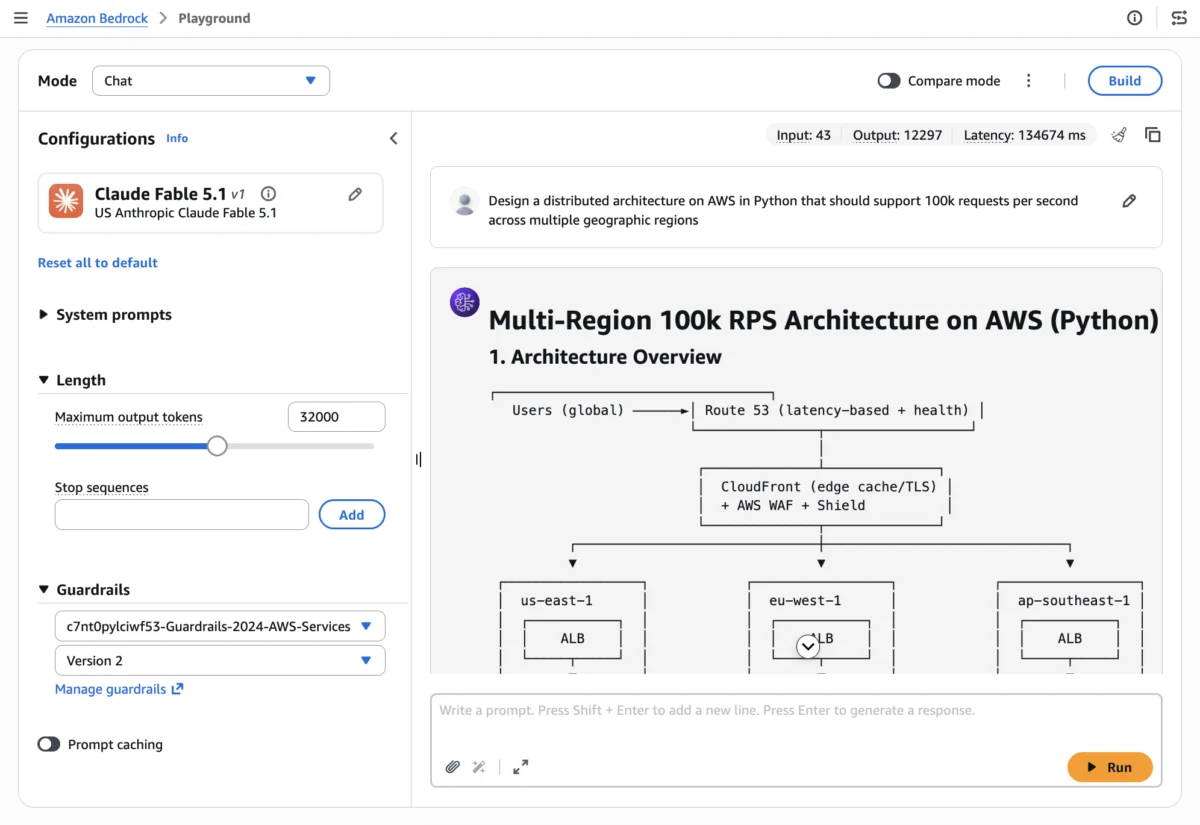

Amazon Web Services has officially introduced Anthropic’s Claude Fable 5.1 to its cloud ecosystem, marking a significant milestone in the integration of frontier artificial intelligence models into enterprise infrastructure. Released last week, Claude Fable 5.1 is engineered to handle complex, long-running computational and creative tasks that span multiple applications over extended periods. According to Anthropic and Amazon, the new model is tailored for high-stakes environments requiring deep contextual awareness, advanced coding capabilities, exhaustive scientific research synthesis, and end-to-end enterprise workflow management.
The deployment of Claude Fable 5.1 on AWS reflects the accelerating demand among corporate and institutional clients for generative AI systems that can operate with a high degree of autonomy. Unlike traditional models optimized for short, single-turn interactions, Fable 5.1 is architected to independently manage substantial software engineering projects. This includes maintaining coherence across an entire codebase, conducting rigorous code reviews, and executing performance optimization tasks across sessions that can last for hours without human intervention.
Architectural Capabilities and Long-Horizon Operations
The core differentiator of Claude Fable 5.1 lies in its capacity for long-horizon execution. In software engineering and scientific research, artificial intelligence tools have historically been constrained by context windows and limitations in maintaining multi-step logical consistency over prolonged tasks. Claude Fable 5.1 addresses these bottlenecks by leveraging advanced underlying neural architectures developed by Anthropic, combined with the scalable computational muscle of Amazon Bedrock and the Claude Platform on AWS.
In enterprise software development settings, the model can own significant portions of a project lifecycle. It is capable of scaffolding features, debugging legacy systems, tracking dependencies across distributed repositories, and ensuring compliance with software architecture standards. For research-driven enterprises, the model provides sophisticated data analysis pipelines, literature synthesis, and hypothesis generation that can dramatically reduce the time required to bring complex projects from conception to execution.
Industry analysts note that the ability to sustain context and operational focus over hours-long workflows bridges the gap between AI as a conversational assistant and AI as an active, autonomous collaborator in enterprise environments.
Governance, Data Retention, and Security Frameworks
Alongside its computational prowess, the introduction of Claude Fable 5.1 introduces a refined security and governance paradigm designed to meet the strict compliance requirements of regulated industries such as finance, healthcare, and government contracting. Anthropic has designated Fable 5.1 as a Covered Model, subjecting it to specialized data retention, security auditing, and access control policies wherever it is deployed.
A central component of this governance framework is the newly introduced aws_review data retention mode. Under this configuration, AWS securely retains user prompts and model outputs within the strict boundaries of the AWS cloud environment for up to 30 days. This data is subject to targeted human review by authorized Amazon personnel specifically for safety and alignment auditing.
This mechanism supersedes the legacy provider_data_share approach. Under the current architecture implemented by Amazon Bedrock, user data is strictly isolated and is not shared with the third-party model provider, Anthropic, thereby ensuring that proprietary enterprise intellectual property remains shielded from external model training pipelines.
Furthermore, AWS and Anthropic have collaborated to deploy Enterprise Frontier Safeguards, a suite of native security controls. EFS enables eligible enterprise customers to harness the advanced capabilities of Covered Models while retaining absolute administrative and cryptographic control over their data environments, satisfying rigorous international data residency and privacy mandates.
Ecosystem Integration and Access Channels
Enterprise architects and developers can access Claude Fable 5.1 through two primary channels within the AWS ecosystem: Amazon Bedrock, the fully managed service for building generative AI applications with foundation models, and the specialized Claude Platform on AWS.
Amazon Bedrock provides organizations with the flexibility to integrate Fable 5.1 into existing applications using API calls without managing underlying infrastructure. It allows teams to combine the model with proprietary data lakes, enterprise knowledge bases, and custom retrieval-augmented generation pipelines. Meanwhile, the Claude Platform on AWS offers tailored deployment configurations optimized for high-throughput, latency-sensitive workloads.
Detailed technical specifications, model behavior parameters, and configuration guidelines are documented in the official Claude Fable 5.1 model card on Amazon Bedrock, alongside implementation guides provided through the Claude Platform documentation portal.
Background Context and Industry Chronology
The rollout of Claude Fable 5.1 is the latest development in a multi-year strategic partnership between Amazon and Anthropic. The collaboration began in earnest when Amazon committed billions of dollars to support Anthropic’s research initiatives, positioning AWS as a primary cloud provider for the AI safety and research firm.

Over the past eighteen months, the partnership has yielded a steady cadence of model integrations, beginning with earlier iterations of the Claude family and scaling toward increasingly specialized, autonomous systems. The evolution from general-purpose chat models to agentic, long-running systems like Fable 5.1 mirrors the broader maturation of the generative AI market. Enterprises have moved past the initial phase of experimentation and proof-of-concept deployments, demanding robust tools capable of driving measurable return on investment through deep operational integration.
Throughout 2025 and into 2026, cloud providers have intensified competition around enterprise trust, data sovereignty, and security. The introduction of the aws_review mode and Enterprise Frontier Safeguards represents a direct response to enterprise concerns regarding data exposure and regulatory compliance when utilizing frontier intelligence models.
Implications for the Enterprise AI Landscape
The arrival of Claude Fable 5.1 on AWS carries significant implications for the enterprise technology sector. By empowering AI models to handle complex, multi-hour engineering and research workflows safely, organizations can potentially accelerate product development cycles and alleviate talent shortages in specialized technical fields.
However, the model also raises critical operational considerations. As AI systems assume greater autonomy over codebases and enterprise workflows, organizations must establish robust internal governance frameworks to monitor automated outputs. The reliance on human-in-the-loop review mechanisms, as facilitated by AWS’s aws_review mode, underscores the ongoing necessity of oversight in high-stakes operational environments.
As businesses continue to evaluate the integration of frontier models into their core architectures, the combination of advanced reasoning capabilities and enterprise-grade security controls demonstrated in the release of Claude Fable 5.1 sets a new benchmark for cloud-delivered artificial intelligence.
