

The Paradigm Shift: From Keywords to Concepts
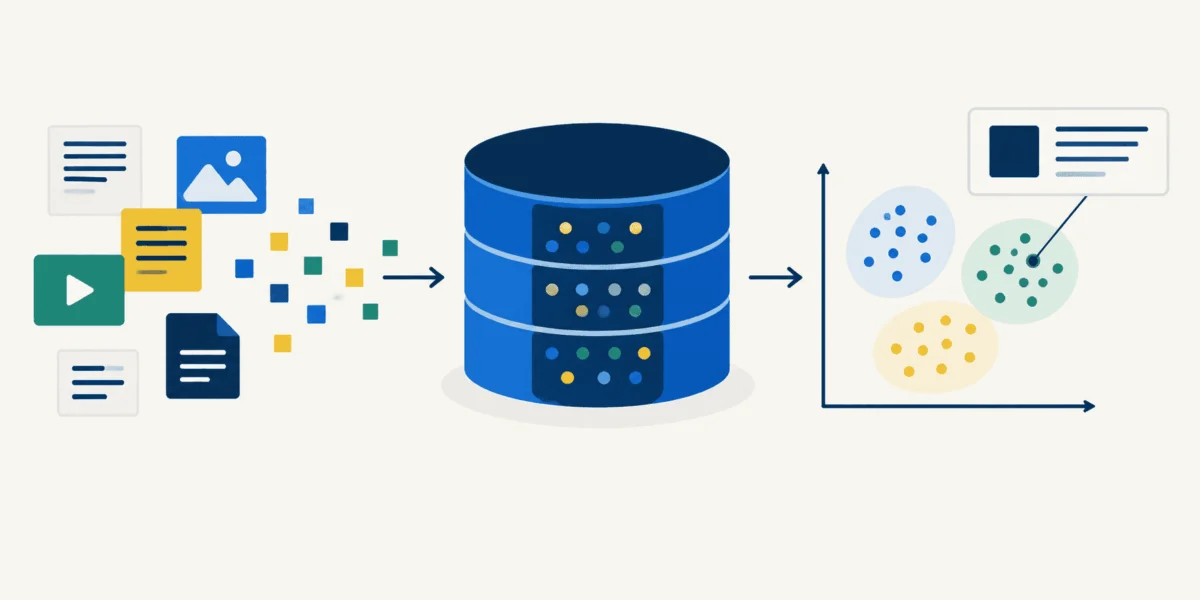
In traditional database systems, search operations rely heavily on lexical matching—an approach that scans documents for specific character strings or keywords. If a user queries "cell energy" but a document uses the term "mitochondria" without explicitly mentioning "cell energy," a keyword-based system may fail to retrieve the relevant information. Vector databases resolve this by transforming text into dense numerical representations, known as embeddings. These embeddings map the semantic meaning of a document into a multidimensional space where the proximity of vectors corresponds to the conceptual similarity of the content.
The rise of Large Language Models (LLMs) and Retrieval-Augmented Generation (RAG) has propelled vector databases into the spotlight. As businesses attempt to ground their AI agents in proprietary data, understanding the underlying index—often referred to as the "memory" of an AI—has become a prerequisite for senior engineering roles.
Architectural Foundations and Procedural Setup
The implementation of a custom vector database requires a structured approach to data ingestion. The process begins with the installation of fundamental dependencies: numpy for high-performance matrix operations and sentence-transformers for the generation of semantic embeddings.
The tutorial establishes a modular codebase divided into three core components: the vector storage engine, the corpus repository, and a comprehensive test suite. By executing a series of ten incremental steps, developers observe how a collection of 25 heterogeneous documents—ranging from biological texts to comic book summaries—can be converted into a uniform (25, 384) matrix of floating-point numbers.
A critical observation during the initial indexing phase is the predictability of memory consumption. Regardless of the length or complexity of the input text, the resulting index size remains constant per document. This characteristic is a cornerstone of the scalability of vector databases, allowing developers to estimate infrastructure costs based solely on the volume of entries rather than the cumulative word count of the database.
Semantic Retrieval and the Mechanics of Similarity
The core of the vector search operation lies in the transformation of a user’s natural language query into a vector of the same dimensionality as the indexed documents. The system then performs a dot product calculation across the entire corpus. By normalizing these vectors to a length of one, the dot product effectively calculates the cosine similarity, ranking results from the most semantically relevant to the least.
Evidence of the efficacy of this method is clear when analyzing queries that share no common vocabulary with the indexed documents. When searching for "why does my loaf taste sour," the system correctly identifies documents related to sourdough fermentation and lactic acid bacteria, despite the absence of the word "loaf" in the corpus. This underscores the power of latent semantic representation, which transcends simple lexical overlaps to capture the underlying intent of the inquiry.
Metadata Filtering and System Constraints
While raw semantic similarity is powerful, real-world applications require precise control. The integration of metadata—such as topic tags—serves as a crucial filtering mechanism. By applying "where" clauses, developers can restrict the search space before the ranking phase, ensuring that a query about biological cellular processes does not return unrelated results about comic book characters, even if the latter shares high conceptual similarity.
The tutorial highlights the necessity of "guard rails" within the database. Because vector databases operate on strict matrix dimensions, input sanitization is mandatory. A failure to enforce one-to-one mapping between text entries and their corresponding metadata can lead to silent data corruption, rendering the entire index unusable. Implementing robust error handling during the add() phase is therefore not merely a best practice but a functional requirement for data integrity.
Performance Scaling and Computational Efficiency
One of the most significant takeaways for developers is the scalability of matrix-based search. In the provided analysis, the search time for 1,000 documents is measured at 0.01 milliseconds, increasing to 3.73 milliseconds for 100,000 documents. These benchmarks demonstrate that for most mid-sized enterprise applications, a brute-force approach utilizing NumPy’s optimized matrix multiplication is sufficiently performant.
It is worth noting that the initial "warm-up" time for matrix operations—often due to the spin-up of internal thread pools—can create a misleading impression of latency in small datasets. However, as the document count scales into the millions, the linear nature of the scan remains predictable. While specialized algorithms like Hierarchical Navigable Small World (HNSW) graphs are often employed to further accelerate retrieval in massive datasets, the underlying principle of cosine similarity via dot products remains the industry standard.
Broader Implications for AI Infrastructure
The transition from a custom-built, 25-document database to a production-grade system mirrors the trajectory of many modern AI startups. The fundamental logic remains identical: the maintenance of the index, the storage of vectors in compact binary formats like .npy, and the reliance on pre-trained embedding models.
The primary difference between a DIY implementation and commercial solutions like Pinecone, Milvus, or Weaviate lies in the added layers of distributed storage, horizontal scaling, and real-time index updates. However, by understanding the "under-the-hood" mechanics—specifically how vectors are stored, how similarity is calculated, and how metadata informs search results—engineers are better equipped to troubleshoot performance bottlenecks in larger systems.
Summary of Technical Takeaways
- Normalization is Key: Ensuring vectors are normalized to a length of one allows for the use of simple dot products to calculate cosine similarity, which is computationally efficient.
- Predictability: The memory footprint of a vector database is a function of the number of documents and the model’s dimensionality, not the length of the documents themselves.
- Independence of Meaning: Semantic search succeeds where keyword search fails, matching intent rather than exact terminology.
- Metadata as a Guardrail: Efficient search requires a hybrid approach, combining semantic vectors with traditional metadata filtering to ensure result accuracy.
- Data Integrity: Maintaining strict synchronization between document lists, metadata entries, and the embedding index is the most common point of failure in custom-built databases.
By demystifying these ten steps, the tutorial reinforces that the complexity of vector databases is largely a matter of engineering scale rather than esoteric mathematics. For developers, the ability to build and manipulate these systems from scratch provides a significant advantage in an industry increasingly reliant on the sophisticated, yet fundamentally logical, world of high-dimensional vector search. As the demand for AI-driven information retrieval grows, these foundational skills will remain a cornerstone of effective software architecture.
