
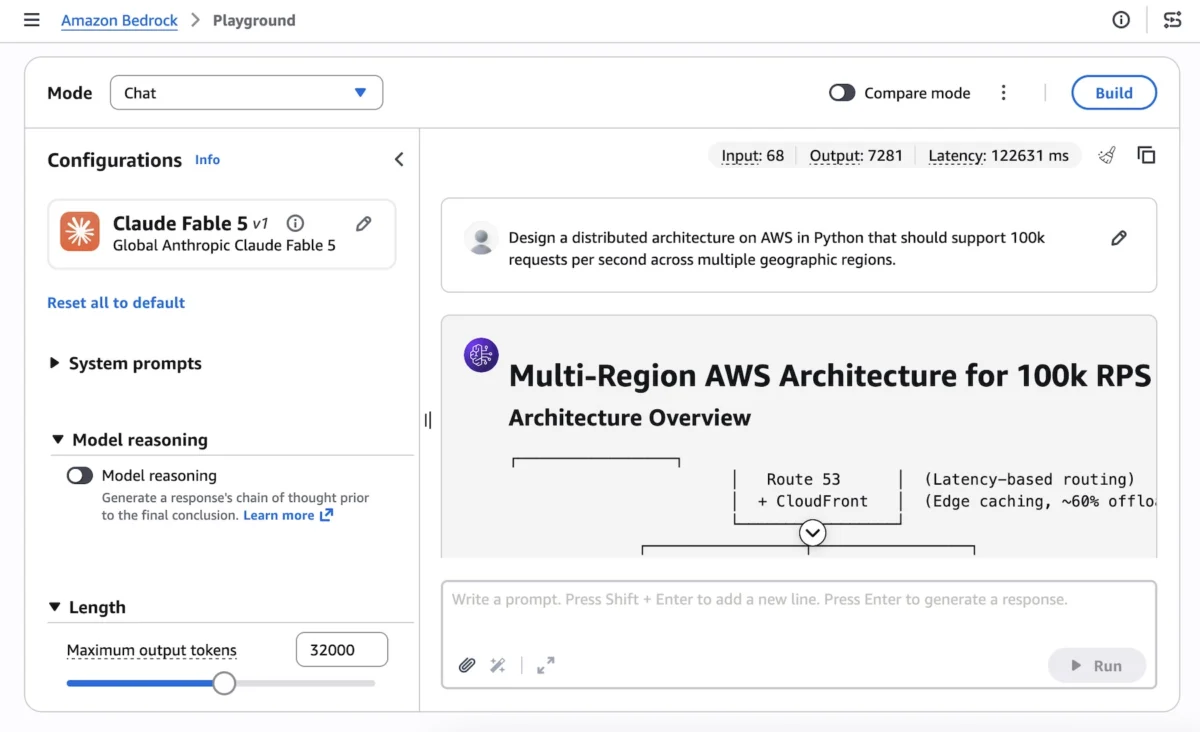

In a rapidly unfolding development that underscores the increasing intersection of advanced artificial intelligence, commercial deployment, and international regulatory frameworks, Anthropic’s highly anticipated Claude Fable 5 and Claude Mythos 5 foundational models were briefly made available on Amazon Bedrock and the Claude Platform on AWS, only to have their access revoked for all users just two days later. The revocation, announced on June 12, 2026, was a direct consequence of a request from Anthropic to AWS, citing the need to support compliance with a US Government export control directive. This swift withdrawal has sent ripples through the AI developer community and highlights the growing complexities of deploying cutting-edge AI globally.
A Brief Window of Advanced AI Access: The Launch of Claude Fable 5 and Mythos 5
Prior to the revocation, the announcement of Claude Fable 5’s availability on Amazon Bedrock and the Claude Platform on AWS marked a significant moment for enterprises seeking to leverage state-of-the-art AI capabilities. Claude Fable 5 was positioned as a groundbreaking model, offering "Mythos-level capabilities" to a broad customer base, meticulously engineered with robust safeguards to ensure its safe and responsible application across various sectors. Anthropic touted Fable 5 as a leader across nearly all tested benchmarks, demonstrating exceptional performance in critical areas such as software engineering, complex knowledge work tasks, and advanced vision applications. Its design was geared towards supporting ambitious, long-running projects, promising a step-change in what organizations could achieve with AI models.
A key distinction was drawn between Claude Fable 5 and its counterpart, Claude Mythos 5. While Fable 5 incorporated stringent safeguards that limited its performance in domains identified as having elevated misuse risks—such as cybersecurity, biology, chemistry, and health, where prompts would fall back to be handled by Opus 4.8—Mythos 5 represented the unfiltered version of the same powerful model. Access to Claude Mythos 5 was intended to be highly restricted, reserved only for a small, carefully vetted group of customers, underscoring the inherent power and potential sensitivities of its capabilities.
The integration into Amazon Bedrock meant that customers could build and scale inference workloads within their existing AWS environments, benefiting from AWS’s robust infrastructure, security, and scalability. Alternatively, access was also provided through the Claude Platform on AWS, offering users Anthropic’s native platform experience for those who preferred it. This dual access strategy aimed to maximize flexibility for developers and enterprises, allowing them to choose the environment best suited to their operational needs.
Seamless Technical Integration and Initial Access Requirements
For developers eager to harness the power of Claude Fable 5, the technical integration into Amazon Bedrock was designed to be straightforward yet required specific configurations. Users could programmatically access the model via the Anthropic Messages API, calling either the bedrock-runtime or bedrock-mantle endpoints through the Anthropic SDK. Additionally, the AWS Command Line Interface (AWS CLI) and AWS SDK provided alternative methods, utilizing the Invoke and Converse APIs on bedrock-runtime for a unified multi-model experience.
A crucial prerequisite for accessing Claude Fable 5 was an explicit opt-in to data sharing. This involved configuring a data retention setting via the Data Retention API, setting the mode to provider_data_share. This setting allowed Amazon Bedrock to retain and share inference data with model providers, in accordance with their requirements. Anthropic, for instance, mandated a 30-day retention of inputs and outputs, coupled with human review for abuse detection and model improvement. While the initial launch did not include a console user interface for this setting, developers were provided with curl commands and later, AWS CLI commands, to programmatically enable this essential compliance feature. This requirement highlighted the growing emphasis on data governance and responsible AI practices, even before the regulatory intervention.
Regionally, Claude Fable 5 was initially made available on Amazon Bedrock in key AWS regions, including US East (N. Virginia) and Europe (Stockholm), with plans for expansion. The Claude Platform on AWS offered even broader regional coverage, spanning North America, South America, Europe, and Asia Pacific. This global rollout strategy indicated Anthropic and AWS’s ambition to make these advanced models accessible to a wide international audience.
The Abrupt Halt: US Government Export Control Directive
The promising trajectory of Claude Fable 5 and Mythos 5 took an unexpected turn on June 12, 2026. An update to the initial announcement declared that access to both models had been revoked for all users. The reason provided was direct and unequivocal: Anthropic had requested AWS to cease access to support compliance with a US Government export control directive. This directive, whose specific details were not immediately disclosed in the public announcement, effectively halted the global deployment of these particular advanced AI models. Critically, the notice reassured users that all other Anthropic models, including Opus 4.8, remained unaffected and fully accessible, ensuring continuity for existing applications built on those models.
This incident immediately brought to the forefront the increasing geopolitical dimensions influencing the development and deployment of cutting-edge technologies like advanced AI. Export controls are typically imposed by governments to restrict the transfer of sensitive technologies, software, or information to certain foreign countries, entities, or individuals, often for national security, foreign policy, or non-proliferation reasons. The application of such a directive to advanced AI models like Fable 5 and Mythos 5 suggests that these models are now considered "dual-use" technologies—having both civilian and potential military applications—or otherwise deemed strategically sensitive by the US government.
Statements, Inferred Reactions, and Broader Implications
Anthropic’s public statement, referenced in the revocation notice, likely elaborated on their commitment to complying with government regulations and ensuring responsible AI deployment. For AWS, as a platform provider, the action demonstrated their adherence to partner requests and national legal frameworks, maintaining the integrity and compliance of their Bedrock service.
The sudden revocation undoubtedly created significant disruption and uncertainty within the developer and enterprise communities that had either begun integrating or were planning to adopt Claude Fable 5. Developers who had invested time in understanding its capabilities, configuring access, and potentially developing proof-of-concept applications would face immediate pivots. Enterprises relying on the promise of its "state-of-the-art" performance for critical tasks would need to re-evaluate their AI strategies, potentially reverting to older models or exploring alternatives. This event serves as a stark reminder of the volatile nature of the advanced AI landscape, where technological innovation can quickly encounter geopolitical barriers.

Analysis of the Regulatory Landscape and Future Impact
This incident is not isolated but rather indicative of a broader trend where governments worldwide are grappling with how to regulate powerful AI systems. The US, in particular, has been increasingly focused on export controls for advanced technologies, including semiconductors, quantum computing, and now, evidently, sophisticated AI models. The rationale often revolves around preventing adversaries from leveraging such technologies for military applications, surveillance, or other activities deemed contrary to national interests.
The application of an export control directive to specific AI models like Claude Fable 5 and Mythos 5 sets a significant precedent. It signals that certain AI capabilities are now considered strategic assets, subject to the same level of scrutiny and control as other critical technologies. This could lead to a more fragmented global AI ecosystem, where access to the most advanced models is dictated not just by commercial availability but by nationality, regulatory compliance, and geopolitical alignments.
For AI developers and platform providers, this development necessitates a heightened awareness of the regulatory environment. Companies like Anthropic and AWS must navigate a complex web of international laws and government directives, which can rapidly change. The proactive implementation of safeguards, as seen with Claude Fable 5, might not always be sufficient to circumvent broader governmental export control mandates, especially concerning models deemed to have critical strategic implications.
Furthermore, this event highlights the increasing challenge for companies operating at the forefront of AI. Balancing the drive for innovation and widespread commercialization with the imperative for responsible development and compliance with national security concerns becomes a tightrope walk. The transparency, or lack thereof, regarding the specific directive also creates ambiguity for the broader industry, making it harder for other AI developers to anticipate and mitigate similar risks.
Continuing Operations and Lessons Learned
Despite the setback with Fable 5 and Mythos 5, the broader ecosystem of Anthropic models on AWS Bedrock remains robust. The continued availability of models like Opus 4.8 reassures users that foundational AI capabilities are still accessible for a wide range of applications. This emphasizes the importance of a diversified model strategy for enterprises, reducing reliance on any single cutting-edge offering that might be subject to unforeseen regulatory changes.
In conclusion, the brief appearance and swift revocation of Anthropic’s Claude Fable 5 and Mythos 5 on Amazon Bedrock represent a pivotal moment in the commercialization of advanced AI. It vividly illustrates the growing influence of national security and export control policies on technology deployment. As AI capabilities continue to advance, the interplay between technological innovation, corporate strategy, and governmental oversight is set to become an increasingly complex and defining characteristic of the global AI landscape, compelling all stakeholders to remain vigilant and adaptable in this evolving environment.
