

The semiconductor industry is currently undergoing one of its most significant architectural shifts in decades as curvilinear masks transition from experimental laboratory applications into high-volume manufacturing (HVM). This transition is not merely a change in geometric preference but a fundamental requirement driven by the physics of sub-5nm lithography. As chipmakers push the boundaries of Moore’s Law, the traditional "Manhattan" layout—characterized by strictly horizontal and vertical edges—is proving insufficient for maintaining the pattern fidelity and process windows required for modern silicon wafers. The industry is consequently pivoting toward curvilinear designs, facilitated by Inverse Lithography Technology (ILT) and advanced Optical Proximity Correction (OPC). However, this shift has introduced a critical bottleneck in Mask Data Preparation (MDP): the massive explosion of data volume and the risk of losing geometric intent when complex curves are converted into traditional digital formats.
The Technological Impetus for Curvilinear Architectures
To understand the necessity of curvilinear masks, one must look at the limitations of traditional photolithography. In standard rectilinear OPC, designers add small rectangular "serifs" and "hammerheads" to the corners of features to compensate for the rounding effects that occur during the exposure process. While effective for older nodes, these approximations fail at the extreme dimensions of the 3nm and 2nm nodes. Curvilinear shapes, by contrast, represent the mathematically "ideal" mask patterns identified by ILT. By using smooth, continuous curves, manufacturers can significantly enlarge the wafer process window—the range of focus and exposure levels within which a circuit can be successfully printed.
The move toward these shapes is also a response to the "mask-to-wafer" error budget. As features shrink, the Edge Placement Error (EPE) becomes increasingly sensitive to the slightest variations. Curvilinear patterns provide superior pattern fidelity, ensuring that the final shape on the silicon wafer matches the intended design with far higher precision than square-edged approximations.

A Chronology of Mask Writing and Data Standards
The journey toward native curvilinear processing has been decades in the making, marked by several key technological milestones:
- The Era of Variable Shaped Beam (VSB) Writing (1990s–2010s): For years, VSB writers were the industry standard. These machines "paint" masks using rectangular shots. While efficient for Manhattan layouts, VSB writers struggle with curves, requiring an astronomical number of shots to approximate a single smooth arc, which leads to prohibitively long write times.
- The Introduction of Multi-Beam Mask Writers (MBMW) (Circa 2016): The commercialization of multi-beam writers by companies such as IMS Nanofabrication and NuFlare changed the landscape. Unlike VSB, multi-beam writers use thousands of individual beams to write in a pixel-based raster fashion. This means the complexity of the shape does not significantly impact the write time, finally making curvilinear masks economically viable for production.
- The Development of SEMI P49 OASIS (2020–2023): Recognizing that traditional data formats like GDSII and standard OASIS were being choked by the millions of small segments needed to describe curves, the industry collaborated on the SEMI P49 specification. This introduced the MULTIGON, a native curvilinear extension.
- The HVM Transition (2024–Present): With the hardware and standards in place, the industry is now focused on the software "bridge"—the fracture engines and MDP tools that can handle these native curves without converting them back into cumbersome polygons.
The Data Explosion Challenge in Mask Data Preparation
Despite the capabilities of multi-beam writers, the software path between design and the mask-writer remained a point of friction. Traditionally, a curve would be "digitized" into a piecewise linear representation—essentially a polygon with thousands of tiny edges. While this allows the data to be read by older tools, it creates two major problems.
First is the issue of data volume. A single curvilinear feature, when approximated by short line segments to maintain high fidelity, can result in a data footprint orders of magnitude larger than its rectilinear counterpart. For a full-chip mask, this can lead to file sizes that are unmanageable for standard servers, increasing turnaround time (TaT) and storage costs.
Second is the loss of geometric intent. Every time a curve is sampled and converted into a polygon, an approximation error is introduced. If the sampling is too coarse, the EPE on the silicon wafer increases. If the sampling is too fine, the vertex count becomes so high that downstream verification tools and fracture engines may crash or run for days rather than hours. This "approximation tax" has been a primary hurdle for mask shops attempting to scale curvilinear production.

SmartFracture: Native Curve Handling and the MULTIGON Advantage
To address these challenges, Synopsys introduced SmartFracture, a next-generation fracture engine designed to operate natively on curvilinear data. Unlike traditional engines that require curves to be flattened into polygons before processing, SmartFracture handles MULTIGON data directly. This format supports Bézier and B-spline curves, allowing the software to "see" the smooth curve as a single mathematical entity rather than a collection of segments.
SmartFracture is built upon the SmartEngine foundation, which also powers SmartMRC (Mask Rule Checking). By integrating these tools, Synopsys has created a unified flow where the design intent is preserved from the initial OPC/ILT output through to the final mask-writer instructions.
One of the most significant technical hurdles in mask fracturing is "monotonicity." Most mask-writer formats require that curved shapes be split into monotonic sections—pieces where the curve moves in only one direction relative to an axis. If this splitting is done inefficiently, it results in excessive "cut-lines," which further inflate the file size. SmartFracture utilizes optimized cutting algorithms to choose the most efficient direction for these splits, significantly reducing the point count and ensuring the smallest possible output file.
Performance Data and Industry Validation
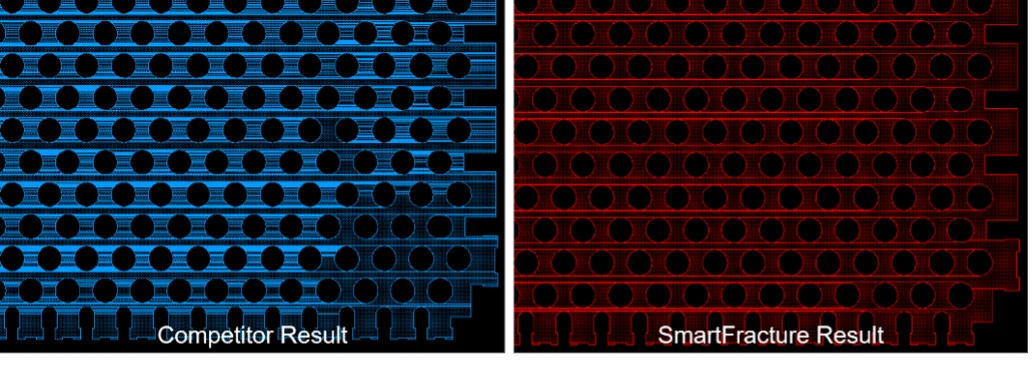
Technical data presented at industry forums, including Photomask Japan 2025 and SPIE conferences, highlights the performance gap between native curve processing and traditional methods. In comparative studies involving circular hole patterns—some of the most common features in advanced memory and logic chips—SmartFracture demonstrated a marked advantage.

According to data released by Synopsys, SmartFracture can produce more periodic fracture segments compared to competing tools. This periodicity is crucial because it allows the data to be compressed more effectively. In head-to-head tests, the tool showed:
- Reduced Turnaround Time (TaT): By eliminating the need for expensive polygonal decomposition and operating directly on mathematical curves, the engine processes complex layouts significantly faster than traditional fracture tools.
- Smaller File Sizes: Optimized monotonicity and native MULTIGON handling lead to output files that are easier to transport and store, reducing the infrastructure burden on mask shops.
- Higher Geometric Fidelity: By avoiding the digitization step, the tool eliminates the rounding errors and EPE issues associated with piecewise linear approximations.
Industry Reactions and Strategic Implications
The shift toward native curve processing has been met with cautious optimism by mask manufacturers and foundries. Lead engineers from major semiconductor manufacturers have noted that the "old way" of fracturing was becoming a primary risk factor for project delays. "The ability to maintain the integrity of ILT shapes through the entire MDP flow is no longer a luxury; it is a prerequisite for the 2nm node," noted one industry analyst following the Photomask Japan 2025 presentations.
Furthermore, the integration of SmartFracture with the legacy CATS platform—a long-standing industry standard for mask data preparation—provides a safety net for manufacturers. It allows mask shops to maintain their existing Manhattan-based workflows while simultaneously spinning up advanced curvilinear lines on the same platform. This dual-capability is seen as vital for the economic stability of mask shops that must support both mature and cutting-edge nodes.
Broader Impact on the Semiconductor Ecosystem
The implications of SmartFracture and native curvilinear processing extend far beyond the mask shop. By enabling the full potential of ILT and curvilinear masks, these technologies are directly contributing to the feasibility of High-NA EUV (Extreme Ultraviolet) lithography. As the industry moves toward 1.4nm and 1nm nodes, the precision afforded by curvilinear masks will be essential to overcome the stochastic effects and photon shot noise that plague ultra-fine features.

Moreover, this evolution signals a shift in the EDA (Electronic Design Automation) landscape. Software is no longer just a tool for managing design; it is becoming a critical component of the physical manufacturing process. The ability to handle complex mathematical curves natively allows for a more "holistic" approach to chip design, where the limitations of the manufacturing equipment are integrated into the design software from the very beginning.
Conclusion
As curvilinear masks move into the mainstream of high-volume production, the semiconductor industry is successfully navigating the transition from approximation to precision. Tools like Synopsys SmartFracture represent the culmination of years of collaborative effort across the mask writing, data standard, and software sectors. By providing a production-oriented path that preserves native curve accuracy while managing the operational realities of file size and runtime, the industry is ensuring that the next generation of silicon will be defined by the smooth, efficient geometry of the curve rather than the rigid constraints of the past. With native MULTIGON handling and optimized fracture engines, the "curvilinear revolution" is no longer a future prospect—it is a production reality.
