
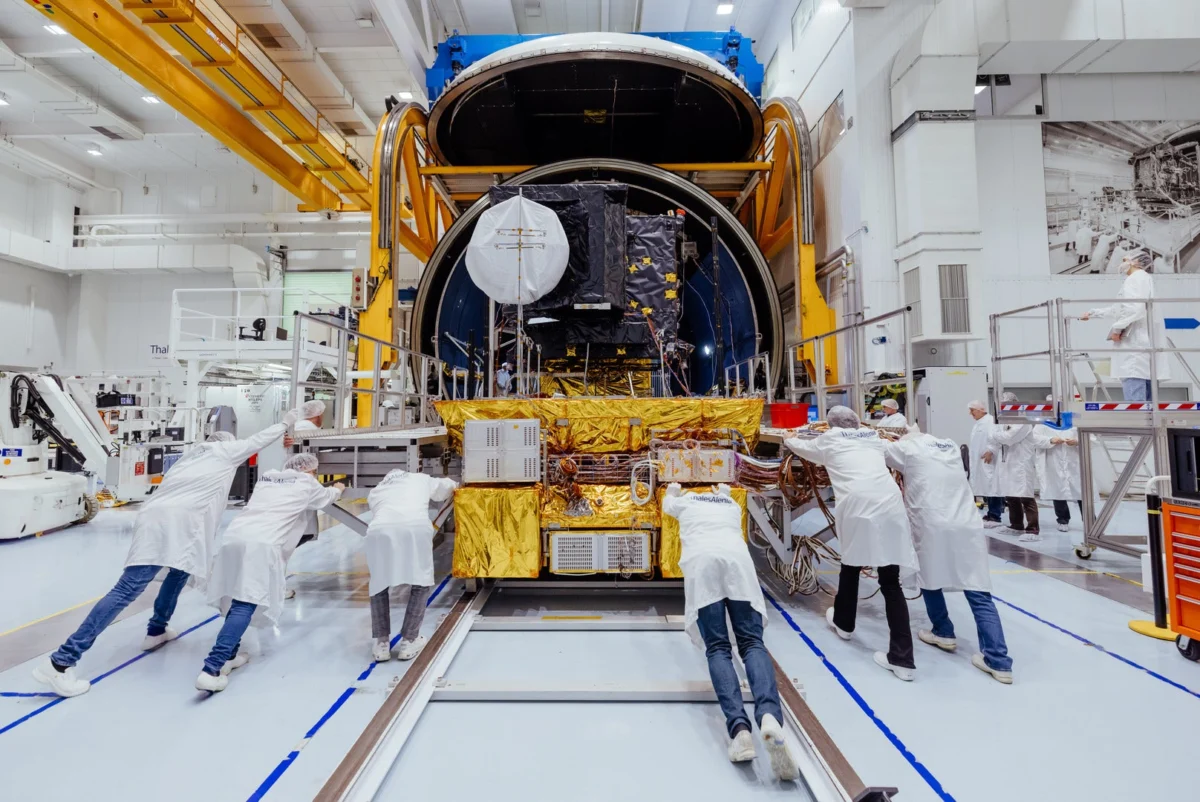

Arianespace has officially confirmed the mission parameters for its fourth Ariane 6 flight of the current year, marking a significant milestone in the operational ramp-up of Europe’s next-generation heavy-lift launch vehicle. Scheduled for August 27, the mission will deploy the second Meteosat Third Generation Imager satellite, known as MTG-I2, into a Geostationary Transfer Orbit (GTO). This flight represents a critical juncture for the European space sector, as it will be the first time the Ariane 6 is utilized for a dedicated GTO mission this year and the ninth flight of the Ariane 6 program since its inception. The mission will utilize the Ariane 62 configuration, which features two P120C solid rocket boosters, tailored specifically for medium-lift requirements and high-precision orbital injections.
The MTG-I2 satellite, a cornerstone of the European meteorological infrastructure, arrived at the Félix Eboué Airport in Cayenne, French Guiana, on June 12. Since its arrival, the spacecraft has been undergoing a rigorous series of pre-launch preparations at Europe’s Spaceport in Kourou. On July 20, Arianespace announced that the satellite had successfully transitioned into the final phases of environmental and electrical testing. These preparations are essential to ensure that the complex instrumentation on board can withstand the extreme vibrations of launch and the harsh thermal environment of space.
The Evolution of European Meteorological Surveillance
The Meteosat Third Generation (MTG) program is one of the most ambitious and complex Earth observation systems ever designed. It is intended to succeed the Meteosat Second Generation (MSG) system, which has been the backbone of European weather forecasting for two decades. The transition to the third generation represents a quantum leap in technological capability, offering higher spatial resolution, faster imaging cycles, and a broader range of spectral channels.
The MTG system is designed as a constellation that will eventually consist of six satellites: four imaging satellites (MTG-I) and two sounding satellites (MTG-S). The MTG-I2 is the second of the imaging satellites, following the successful launch and commissioning of MTG-I1. By operating in geostationary orbit—approximately 36,000 kilometers above the Earth—these satellites maintain a constant view of Europe and Africa, providing the continuous data streams necessary for "nowcasting." Nowcasting refers to the high-resolution, real-time detection of rapidly evolving weather phenomena, such as severe thunderstorms, flash floods, and localized wind shear.
The primary objective of MTG-I2 is to enhance the accuracy of short-term weather forecasts. In an era where climate change is increasing the frequency and intensity of extreme weather events, the ability to provide early warnings is vital for protecting lives and property. The MTG system is expected to provide a 10-fold increase in data volume compared to its predecessor, allowing meteorologists to observe the atmosphere with unprecedented clarity.
Technical Specifications and Industrial Collaboration
The development of the MTG-I2 satellite is the result of an extensive pan-European industrial partnership. The European Space Agency (ESA) is responsible for the definition and procurement of the satellites, acting on behalf of the European Organisation for the Exploitation of Meteorological Satellites (EUMETSAT). EUMETSAT, in turn, defines the user requirements, develops the ground segments, and operates the satellites once they are in orbit.
A consortium of European aerospace leaders, headed by Thales Alenia Space as the prime contractor, built the MTG-I2. Thales Alenia Space was responsible for the overall satellite architecture and the integration of the primary imaging instruments. OHB System in Germany served as a major partner, providing the satellite platform and various structural components. Leonardo, the Italian aerospace giant, contributed the critical Lightning Imager (LI), a revolutionary sensor that marks a first for European geostationary weather satellites.
The MTG-I2 carries two primary instruments:
- The Flexible Combined Imager (FCI): This instrument scans the full Earth disc every 10 minutes and Europe every 2.5 minutes. It operates across 16 spectral bands, providing detailed information on cloud structures, water vapor, and surface temperatures.
- The Lightning Imager (LI): This sensor continuously monitors lightning activity across the entire field of view, detecting both cloud-to-cloud and cloud-to-ground flashes. By tracking lightning trends, meteorologists can better predict the intensification of severe storms, as lightning activity often spikes just before a storm becomes dangerous.
The Ariane 62: Precision Engineering for Geostationary Missions
The choice of the Ariane 62 configuration for this mission highlights the versatility of the Ariane 6 family. Designed to replace the venerable Ariane 5, the Ariane 6 was developed to reduce launch costs while maintaining the high reliability associated with European heavy-lift rockets. The Ariane 62, with its two boosters, provides the exact amount of thrust required to deliver the nearly four-metric-ton MTG-I2 satellite into GTO without the excess capacity of the four-booster Ariane 64 variant.
This mission is particularly significant as it tests the Ariane 6’s performance in GTO delivery—a high-energy orbit that requires precise timing and engine burns. The rocket’s upper stage, powered by the restartable Vinci engine, allows for multiple burns, enabling the vehicle to deploy payloads into very specific orbits before performing a deorbit maneuver to mitigate space debris. This capability is a cornerstone of Europe’s commitment to sustainable space operations.
The August 27 launch is the ninth in the Ariane 6 manifest, indicating that the vehicle is successfully transitioning from its qualification phase into a high-cadence operational phase. For Arianespace, maintaining this schedule is paramount to clearing a significant backlog of institutional and commercial missions, including those for the European Commission and various global telecommunications operators.
Timeline of Operations and Pre-Launch Milestones
The path to the August 27 launch has been characterized by meticulous logistical planning. The journey began in early June when the MTG-I2 was encapsulated in a specialized transport container at the Thales Alenia Space facility in Cannes, France. From there, it was transported to the port of Nice and then flown to French Guiana.
Since its arrival on June 12, the satellite has undergone the following milestones:
- Unpacking and Visual Inspection: Ensuring no damage occurred during transit across the Atlantic.
- Health Checks: Powering up the satellite’s subsystems to verify that the onboard computers, batteries, and communication links are functioning correctly.
- Fueling Preparations: The satellite will soon be loaded with the hypergolic propellants required for its onboard propulsion system, which it will use to circularize its orbit and maintain its position over the equator for the next 15 to 20 years.
- Combined Operations: In the weeks leading up to August 27, the satellite will be mated to the payload adapter and then encapsulated within the Ariane 6 fairing.
Once the fairing is secured, the entire assembly will be transported to the launch pad and hoisted atop the Ariane 6 core stage. A final "Dress Rehearsal" will be conducted 48 hours before liftoff to simulate the countdown and verify ground-to-rocket communications.
Strategic Implications for European Sovereignty and Climate Science
Beyond the technical achievements, the launch of MTG-I2 carries profound strategic and economic implications. For Europe, the MTG program is a symbol of "space sovereignty." By maintaining its own fleet of weather satellites and its own launch vehicles, the European Union ensures that it is not dependent on foreign entities for critical environmental data. This data is essential for sectors ranging from aviation and agriculture to emergency management and defense.
From a scientific perspective, the MTG-I2 will contribute to a more comprehensive understanding of climate change. By providing long-term, high-quality data on atmospheric composition and cloud dynamics, the MTG constellation allows researchers to track subtle shifts in weather patterns over decades. This information is vital for refining climate models and developing adaptation strategies for a warming planet.
EUMETSAT Director-General Phil Evans has previously emphasized that the MTG system is "a game-changer" for weather forecasting. The ability to detect a storm’s development minutes earlier can be the difference between a successful evacuation and a disaster. With the MTG-I2 joining its sister satellite in orbit, Europe will have a redundant and highly capable system that ensures no gap in coverage occurs, even if one satellite experiences technical difficulties.
Future Outlook and Conclusion
Following the successful deployment of MTG-I2, the focus of the MTG program will shift toward the first sounding satellite, MTG-S1. The sounding satellites will carry the Infrared Sounder (IRS), which will provide vertical profiles of temperature and humidity through the atmosphere—a first for geostationary orbit.
For Arianespace, the August 27 mission is a test of its operational tempo. Having four Ariane 6 launches in a single year demonstrates that the production lines and launch pad infrastructure are reaching the desired level of maturity. As the global launch market becomes increasingly competitive, the success of the MTG-I2 mission will serve as a powerful advertisement for the reliability and precision of the Ariane 6.
As the countdown to August 27 begins, the global meteorological community watches with anticipation. The data that will soon flow from MTG-I2 promises to transform our understanding of the atmosphere, providing the tools necessary to navigate an increasingly turbulent climate. Through the combined efforts of ESA, EUMETSAT, and the European industrial base, the upcoming launch represents not just a flight into orbit, but a significant step forward for global safety and scientific discovery.
