
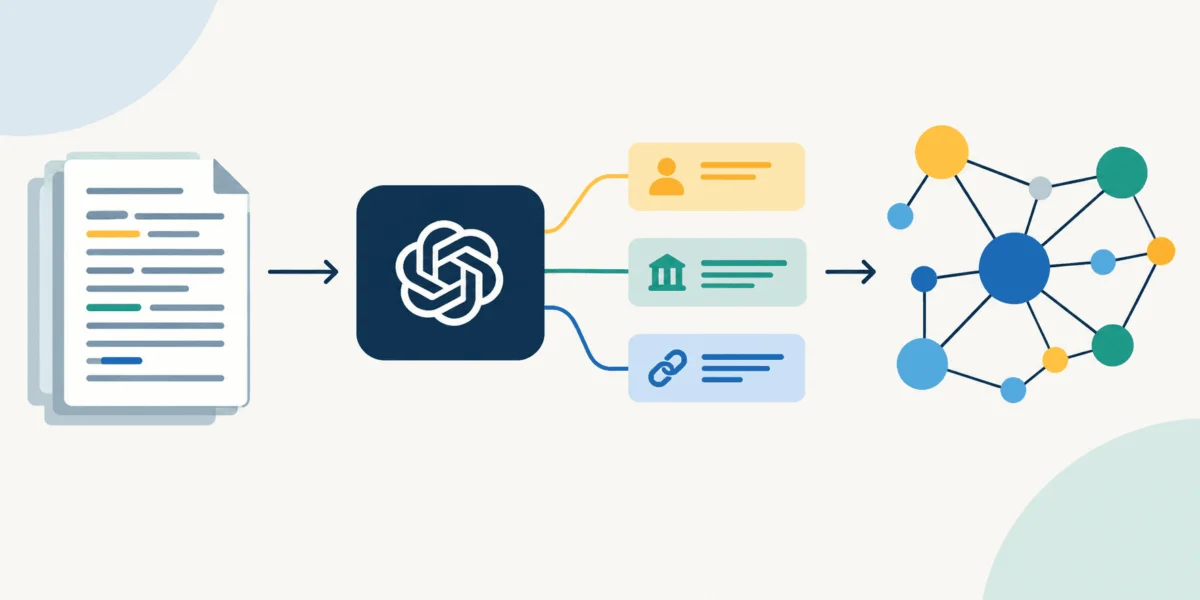

The paradigm of information retrieval is undergoing a significant shift as developers transition from traditional vector-based search to more deterministic, graph-augmented architectures. While vector search relies on semantic similarity—often resulting in the probabilistic "hallucinations" that plague large language models (LLMs)—Graph-Retrieval-Augmented Generation (Graph-RAG) offers a grounded alternative. By populating a structured database with discrete facts, engineers can ensure that the models reference verifiable, ground-truth data. This article outlines the technical framework for automating the extraction of structured knowledge from raw text and populating a local knowledge graph using the open-source Ollama ecosystem.
The Evolution of Knowledge Representation
At the heart of this methodology is the transition from RDF triples to SPOC quads. Traditional Resource Description Framework (RDF) models use triples consisting of a Subject, a Predicate, and an Object. While effective for simple relational mapping, this structure lacks the provenance necessary for complex, enterprise-grade AI applications. By introducing a fourth dimension—Context (SPOC)—systems can track the origin of a fact, its temporal validity, and its source reliability.
For instance, a statement regarding a historical figure or a corporate event can be tagged with its source, such as "Wikipedia" or "Internal Quarterly Report." This contextual tagging allows the RAG system to resolve conflicts between contradictory data points, effectively allowing the system to prioritize higher-authority sources when queried.
Infrastructure and Prerequisites
Implementing a local, private, and free knowledge extraction pipeline requires a robust set of tools. The architecture described herein utilizes Ollama, a lightweight tool for running LLMs locally, which mitigates privacy concerns associated with cloud-based API calls. The Llama 3.2 model is particularly well-suited for this task due to its efficiency and its high degree of adherence to structured output formats.
To begin, the environment must be configured with both the Ollama runtime and necessary Python libraries, such as wikipedia for data ingestion and requests for interfacing with the local API. In a standard Linux-based environment or a Google Colab instance, the installation process is straightforward. Using the subprocess module, developers can programmatically initiate the Ollama server as a background process, ensuring that the model is ready to parse incoming streams of unstructured data.
Constructing the Knowledge Engine
The efficacy of a knowledge graph is contingent upon the structure of the database engine itself. A minimalist implementation of a QuadStore in Python provides the necessary functionality to store and query these SPOC quads. By utilizing a simple list-based architecture, developers can build a foundation that mimics more complex graph databases, allowing for the addition of facts and the retrieval of data based on specific constraints—such as filtering by subject or source context.
The process of data extraction from raw text follows a strict pipeline:
- Data Ingestion: Using the Wikipedia API, the system retrieves raw text. For high-accuracy extraction, it is critical to disable automatic suggest features, ensuring the retrieval of the exact target entity.
- Text Normalization: Large blocks of text are segmented into manageable paragraphs to optimize the LLM’s attention span and ensure that the extraction engine does not become overwhelmed.
- Structured Prompting: The LLM is instructed to act as an expert data extraction agent. By mandating a strict JSON output format, the system ensures that the extracted information can be immediately serialized into a Python-compatible format.
The Extraction Workflow: A Technical Deep Dive
The core logic of the extraction function relies on the LLM’s ability to map narrative sentences into distinct relational triples. When processing a summary of a biography, such as that of Alan Turing, the LLM identifies the primary subject, the nature of the relationship, and the object of that relationship.
By setting the temperature of the model to 0.0, developers ensure deterministic output. In the context of knowledge graphs, randomness is a liability; the goal is to consistently identify the same facts regardless of the number of execution attempts. The extraction function is designed to handle potential inconsistencies in the LLM’s output by performing a secondary pass of normalization. This involves converting keys to lowercase and stripping whitespace, ensuring that variations like "Subject" and "subject" do not result in duplicate or malformed data entries.
Chronology and Data Integrity
The process of populating the knowledge graph is not merely a technical exercise but a form of data curation. When extracting facts about historical figures, the chronology of events—birth, education, professional milestones, and contributions—must be maintained. By assigning a specific context label to each batch of extracted quads, the system preserves the timeline associated with the source document.
For example, when extracting facts from a Wikipedia article, the context label "Wikipedia_Alan_Turing" acts as a metadata tag. If the system later ingests a academic paper on the same subject, it can create a separate set of quads with a different context. During the retrieval phase of the RAG pipeline, the system can then distinguish between general encyclopedic knowledge and specialized, peer-reviewed findings.
Analysis of Implications
The shift toward automated knowledge extraction holds significant implications for the future of artificial intelligence. Currently, many enterprise LLMs are treated as "black boxes" that ingest vast amounts of data without explicit understanding of the relationships between entities. By explicitly mapping these relationships into a graph, organizations can move toward "explainable AI."
When a model provides an answer, the RAG system can now point to the specific SPOC quads that informed that answer. This transparency is vital for sectors such as legal, medical, and financial services, where the ability to verify the provenance of a fact is not just a preference but a regulatory requirement. Furthermore, this approach drastically reduces the cost of maintaining high-quality knowledge bases. Instead of manual data entry, which is prone to human error and scaling limitations, the pipeline leverages the linguistic capabilities of LLMs to automate the ingestion of information at scale.
Challenges and Future Considerations
While the automated population of knowledge graphs is a powerful tool, it is not without challenges. LLMs can occasionally misinterpret ambiguous sentences, leading to "noisy" data in the graph. To mitigate this, developers should implement a verification layer that checks extracted quads against existing data, potentially using a confidence score provided by the LLM itself or a secondary validation model.
Moreover, as the graph grows, the efficiency of the QuadStore query mechanism becomes paramount. While a list-based approach is sufficient for proof-of-concept and small-scale applications, larger implementations will eventually require more sophisticated database technologies, such as Neo4j or dedicated RDF triple stores, which support complex traversal algorithms and graph-based indexing.
Conclusion
The convergence of local LLM technology and graph-based data structures marks a maturation point for the industry. By closing the loop between raw, unstructured text and structured, queryable knowledge, developers can build systems that are not only more accurate but also more accountable. As demonstrated through the integration of the QuadStore and the Llama 3.2 model, the tools required to build these advanced systems are now widely available and accessible to researchers and engineers alike. The transition to deterministic RAG architectures is likely to become the standard for any application where factual accuracy is non-negotiable, paving the way for a more reliable and transparent future in artificial intelligence.
