

In February 2026, researchers unveiled a critical shift in the cyber threat landscape: malicious actors are now leveraging sophisticated, custom-built Artificial Intelligence (AI) setups to automate attacks directly into the cyber kill chain, fundamentally altering the speed and scale of cyber warfare. This development signifies a profound escalation from previous AI applications in cybersecurity, moving beyond mere content generation for phishing campaigns to autonomous execution of complex attack sequences.
The implications of this advancement are staggering. No longer are we observing AI merely assisting in crafting more convincing phishing emails or generating polymorphic malware. Instead, autonomous AI agents are demonstrating capabilities such as mapping extensive Active Directory infrastructures and seizing Domain Administrator credentials within minutes, effectively bypassing traditional human-centric defensive measures with unprecedented speed and efficiency. This rapid, automated infiltration capability poses an existential threat to organizational security postures built on reactive, manual processes.
The Accelerating Threat: AI at Machine Speed
The traditional cybersecurity defense paradigm, characterized by sequential handoffs and siloed operations, is proving increasingly inadequate against an adversary operating at machine speed. A typical defensive workflow involves a Cyber Threat Intelligence (CTI) team identifying a new threat, subsequently passing this intelligence to a Red Team for validation and testing. The findings from these tests then eventually make their way to the Blue Team, responsible for patching vulnerabilities and implementing remedial actions. This multi-stage process is inherently fraught with friction, communication gaps, and significant delays, creating a critical window of opportunity for AI-powered attacks.
The stark reality is unambiguous: attempting to combat an AI adversary moving at machine speed with a defense mechanism that operates at the pace of a calendar invite is a losing battle. The gap between attack velocity and defense reaction time has widened to an unsustainable degree, demanding an urgent re-evaluation of current security strategies and technological investments. Industry reports, though varied in their specifics, generally indicate that the average time to detect and contain a data breach has remained stubbornly high, often exceeding several months, even as attack sophistication has surged. This latency, now exacerbated by AI, grants threat actors ample time to achieve their objectives before defenders can even initiate a response.
Evolution of AI in Cyber Warfare
The journey of AI in cybersecurity has seen several evolutionary stages. Initially, AI and machine learning algorithms were primarily deployed by defenders for anomaly detection, identifying unusual network traffic patterns or user behaviors that might signal an intrusion. This marked a significant improvement over signature-based detection but remained largely reactive. Subsequently, threat actors began experimenting with AI for reconnaissance, automating data collection, and later, for generating malicious content. This included AI-powered tools to create highly personalized phishing emails, develop evasive malware, and even craft social engineering narratives that exploited psychological biases with greater efficacy.
The current stage, as identified in February 2026, represents a quantum leap. Here, AI is not merely a tool for generating components of an attack but is orchestrating and executing entire segments of the kill chain autonomously. This includes automated vulnerability scanning, exploit chain development, privilege escalation, lateral movement, and data exfiltration. The ability for AI agents to adapt, learn from defensive responses, and dynamically adjust attack vectors in real-time makes them incredibly difficult to counter using static, predefined security rules or manual intervention.
Bridging the Gap: The Rise of Autonomous Exposure Validation
To address this rapidly escalating challenge, a new defensive paradigm is emerging: Autonomous Exposure Validation. This innovative approach seeks to revolutionize how organizations proactively identify and remediate their security vulnerabilities by operating at a speed commensurate with the AI-driven threat. Picus Security, a recognized leader in breach and attack simulation (BAS) and continuous security validation, is at the forefront of this shift. They are hosting a technical deep dive to unveil the intricacies and practical applications of this transformative defensive strategy.
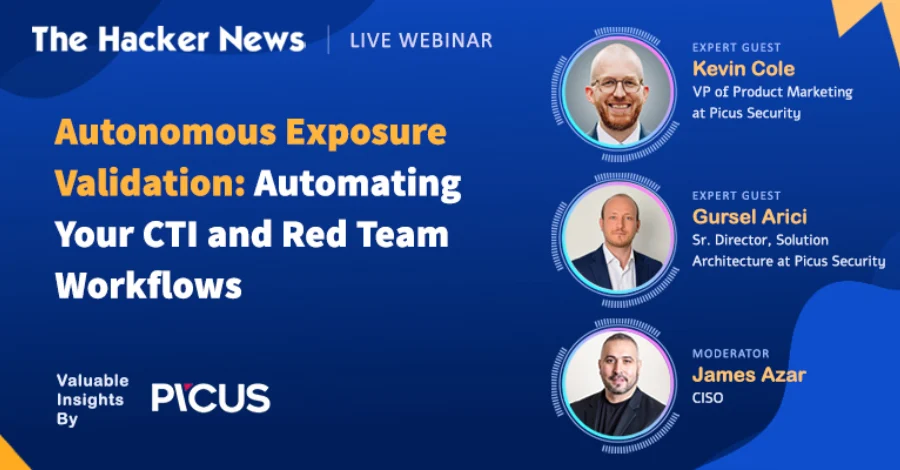
The webinar, titled "Autonomous Exposure Validation," promises to provide cybersecurity professionals with actionable insights into how to flip the script on AI adversaries. Leading this crucial session are two distinguished experts from Picus Security: Kevin Cole, Vice President of Product Marketing, and Gursel Arici, Senior Director of Solution Architecture. Their combined expertise in strategic threat intelligence and deep technical engineering offers a unique perspective on navigating this complex landscape. Attendees can expect a comprehensive exploration of how autonomous validation works, its technical underpinnings, and its immediate benefits.
Key Learnings from the Deep Dive
Participants in the webinar are poised to gain invaluable knowledge and practical takeaways essential for fortifying their defenses in the AI era. While the original article did not list specific bullet points for what attendees would learn, a comprehensive session on Autonomous Exposure Validation would logically cover:
- Understanding the AI Threat Landscape: A detailed breakdown of how advanced AI is being weaponized by threat actors, including specific examples of autonomous attack techniques, their targets (e.g., Active Directory, cloud environments), and their operational speed. This would include insights into the current capabilities of AI in reconnaissance, exploit development, and post-exploitation activities.
- The Inadequacy of Traditional Defenses: An in-depth analysis of why current security operations, characterized by manual processes, siloed teams (CTI, Red Team, Blue Team), and reactive postures, are fundamentally outmatched by AI-driven attacks. This section would highlight the friction points and delays inherent in conventional workflows.
- Principles of Autonomous Exposure Validation: A comprehensive explanation of the core concepts behind this new defensive paradigm. This would delve into how AI-powered validation platforms continuously and automatically simulate real-world attacks against an organization’s infrastructure, identifying exploitable vulnerabilities and misconfigurations before adversaries can.
- Technical Implementation and Best Practices: Practical guidance on how organizations can deploy and integrate autonomous exposure validation solutions into their existing security ecosystems. This would include discussions on agent-based vs. agentless approaches, API integrations, and how to configure the platform to mimic specific threat actor tactics, techniques, and procedures (TTPs).
- Automating the Remediation Workflow: Strategies for leveraging the output of autonomous validation to trigger automated remediation actions, thereby drastically reducing the time between vulnerability discovery and patching. This could involve integration with security orchestration, automation, and response (SOAR) platforms or existing patch management systems.
- Measuring and Improving Security Posture: Techniques for establishing continuous metrics to track the effectiveness of security controls and demonstrate measurable improvements in resilience against advanced threats. This would empower security teams to move beyond compliance-driven checks to genuine, data-driven security posture management.
- Future-Proofing Defenses: A forward-looking perspective on how organizations can evolve their security strategies to stay ahead of the curve as AI capabilities continue to advance. This might include discussions on the role of defensive AI, adversarial AI testing, and building adaptive security architectures.
- Real-World Case Studies and Demonstrations: Practical examples and live demonstrations illustrating how autonomous exposure validation can identify critical vulnerabilities (e.g., Active Directory misconfigurations leading to Domain Admin compromise) and provide actionable intelligence for immediate remediation.
Broader Implications and the Future of Cybersecurity
The advent of AI-driven autonomous attacks necessitates a fundamental shift in how cybersecurity is conceived and executed. This isn’t merely an upgrade in tools; it’s a paradigm shift demanding agility, automation, and continuous validation. The implications extend far beyond technical implementations, touching upon organizational structure, skill development, and strategic investment.
Organizations must transition from a reactive "detect and respond" model to a proactive "predict, prevent, and continuously validate" posture. This requires breaking down the traditional silos between CTI, Red, and Blue Teams, fostering a more integrated and automated security operations center (SOC) environment where intelligence, testing, and remediation occur in a fluid, continuous loop. The "friction, silos, and delays" described in the original article must be systematically eliminated through intelligent automation.
Furthermore, the demand for cybersecurity professionals with expertise in AI, machine learning, and automation will skyrocket. The role of human analysts will evolve from manual alert triaging to overseeing automated systems, interpreting complex AI-driven insights, and focusing on strategic threat intelligence and high-level risk management. Training and upskilling initiatives will be crucial to bridge this evolving skills gap.
Economically, the cost of breaches is already substantial. Data from various cybersecurity firms consistently shows that the average cost of a data breach can run into millions of dollars, encompassing fines, legal fees, reputational damage, and lost business. With AI-accelerated attacks, these costs are projected to escalate dramatically if defenses remain static. Investing in autonomous exposure validation and similar advanced defensive technologies will become not just a best practice, but an economic imperative to mitigate financial and reputational risks.
The ethical dimension also warrants consideration. As defensive AI systems mature, the cybersecurity landscape could evolve into a continuous "AI vs. AI" conflict, raising questions about autonomous decision-making in security, potential for unintended consequences, and the need for human oversight. While still nascent, these considerations underscore the complexity of the future security environment.
The message is clear: the attackers have already upgraded their toolkits, leveraging the exponential power of AI to achieve their objectives with unparalleled speed and precision. It is now incumbent upon defenders to do the same. Remaining static in the face of this evolving threat is no longer an option. For anyone working in cybersecurity, understanding and implementing autonomous exposure validation is not just beneficial; it is essential to maintaining organizational resilience in this new era of AI-driven cyber warfare.
Seize the Opportunity for Enhanced Defense
The opportunity to delve into this critical topic and equip oneself with the knowledge to counter these advanced threats is paramount. Registering for the upcoming webinar with Picus Security is a crucial step towards understanding and implementing the necessary defensive upgrades.
Save Your Spot Today: Register for the Webinar Here
Even for those unable to attend the live session, registration is highly encouraged. A full recording of the deep dive will be provided to all registrants, ensuring that these vital insights are accessible to every cybersecurity professional committed to fortifying their defenses against the AI adversary. This strategic investment in knowledge and advanced defensive paradigms represents the future of cybersecurity, moving beyond reactive measures to proactive, intelligent, and autonomous security validation.
