
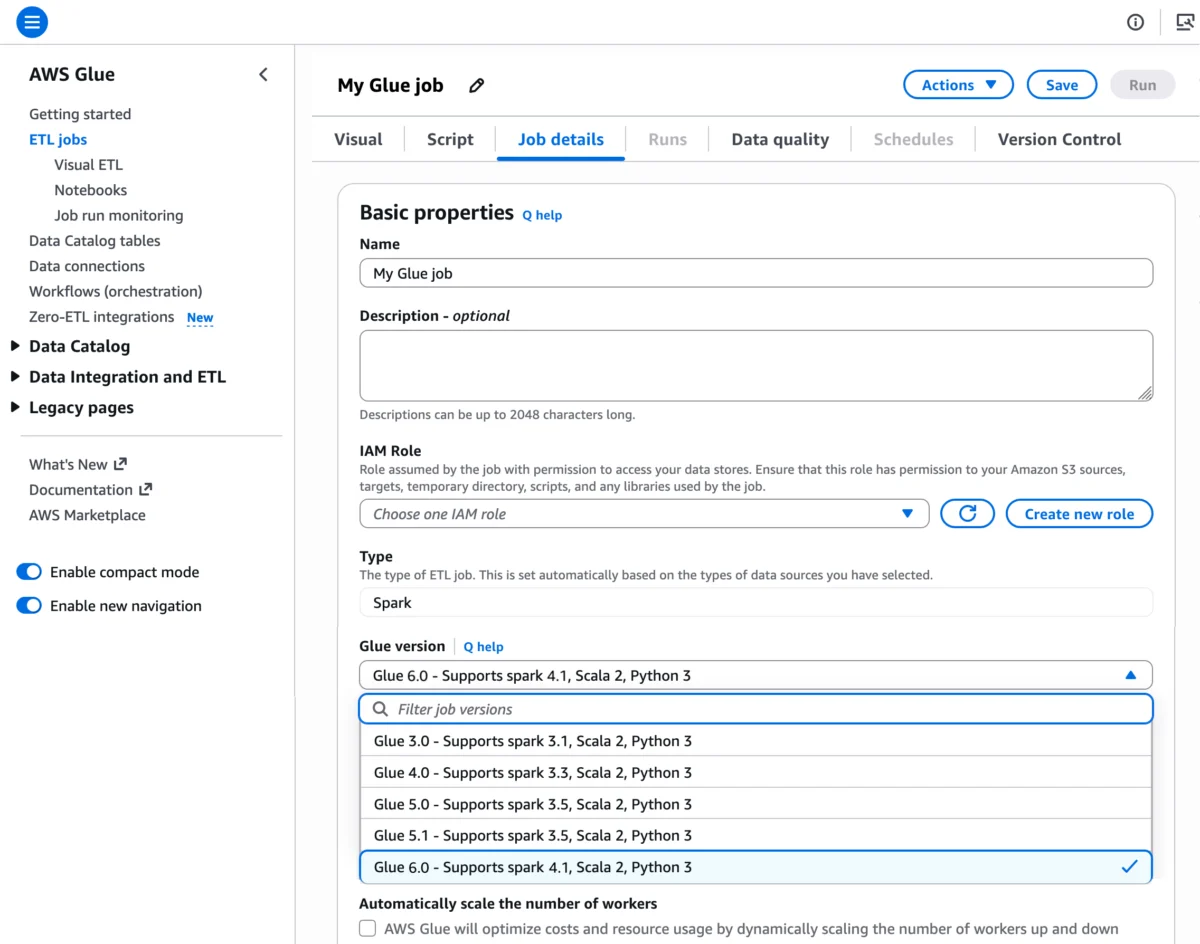

Amazon Web Services has officially announced the general availability of AWS Glue 6.0, marking a major milestone in the evolution of its fully serverless data integration and extract, transform, and load (ETL) service. The latest iteration introduces a significant 30 percent price reduction compared to previous versions, alongside comprehensive support for Apache Iceberg v3. Built on a modernized runtime stack consisting of Apache Spark 4.1, Python 3.13, and Scala 2.13, AWS Glue 6.0 is engineered to deliver faster computational performance, enhanced developer productivity, and advanced semi-structured data management for enterprise workloads.
Core Features and Technological Upgrades
At the heart of AWS Glue 6.0 is its updated runtime environment, which leverages Apache Spark 4.1. This foundation brings substantial performance optimizations, empowering data engineering teams to execute complex data pipelines with greater speed and efficiency. Furthermore, the inclusion of Python 3.13 and Scala 2.13 ensures that developers can utilize modern programming language features, libraries, and security patches while building and maintaining their data workflows.
The standout capability of this release is its comprehensive implementation of the Apache Iceberg v3 specification, built on Iceberg version 1.11.0. This makes AWS Glue 6.0 the most complete Iceberg v3 implementation available across any fully serverless managed Spark service. Central to this integration is the introduction of the VARIANT data type, which comes equipped with advanced shredding support.
Traditionally, handling semi-structured data formats such as JSON, application logs, and event streams required converting data into string columns, flattening complex schemas, generating duplicate data copies, or writing custom parsing logic. These traditional methods frequently introduced maintenance overhead and caused pipeline breakages whenever upstream schemas changed. With the new VARIANT data type and shredding capabilities in AWS Glue 6.0, organizations can ingest, store, and query semi-structured data natively without schema flattening. This drastically improves query read performance, eliminates data redundancy, and safeguards downstream analytics pipelines from unexpected schema evolution.
Chronology and Development Path
The release of AWS Glue 6.0 is the culmination of years of iterative development by Amazon Web Services to align its serverless data ecosystem with the rapidly growing adoption of open-table formats like Apache Iceberg. Over the past several cycles, AWS has steadily introduced native support for open-source analytics storage standards, responding to enterprise demand for decoupled storage and compute architectures, often referred to as the modern data lakehouse.

Throughout the development of Apache Iceberg, data practitioners sought tighter integration between query engines, catalogs, and serverless compute layers. Recognizing this demand, AWS prioritized building a robust, serverless execution layer capable of handling Iceberg v3 features natively. Following rigorous internal testing and preview phases, AWS finalized the integration of Spark 4.1 and Iceberg v3 in mid-2026, leading directly to the general availability rollout across all global AWS regions.
Economic Implications and Cost Structure
Beyond performance enhancements, the economic model of AWS Glue 6.0 represents a pivotal shift for cost-conscious enterprise data teams. By introducing a 30 percent price reduction compared to earlier versions, AWS is actively lowering the barrier to entry for large-scale data processing.
The pricing architecture remains transparent and usage-based. Customers continue to pay an hourly rate billed by the second for crawlers used in data discovery and ETL jobs responsible for processing and loading information. For the AWS Glue Data Catalog, enterprises are charged a simplified monthly fee for storing and accessing metadata. To encourage adoption and trial, AWS maintains a generous free tier, offering the first million objects stored and the first million metadata accesses free of charge.
Industry analysts note that this aggressive pricing strategy is designed to capture market share from competing cloud-native data platforms, enticing organizations to migrate legacy ETL pipelines to a more cost-effective serverless framework.
Migration Pathways and Getting Started
To minimize operational friction during adoption, AWS has ensured that transitioning to Glue 6.0 does not require manual API rewrites for existing infrastructure. Users can provision jobs on the new runtime by specifying the existing --glue-version parameter within the create-job or update-job APIs via the AWS Command Line Interface (AWS CLI), AWS Software Development Kits (SDKs), or integrated developer environments.
Within the user interface, developers operating inside the AWS Glue Studio console can select the designated version labeled "Glue 6.0 – Supports Spark 4.1, Scala 2, Python 3" under the Job Details tab. For interactive data science workflows, users working within AWS Glue Studio notebooks or Jupyter notebooks can activate the runtime by specifying version 6.0 within the %glue_version magic command.

To assist organizations with large-scale migrations, AWS has incorporated the Spark upgrade agent directly into AWS Glue Studio. This tool is designed to analyze existing codebases, identify deprecations or syntax updates required for Spark 4.1, and streamline the transition process. Alternatively, enterprises can leverage the auto-upgrade feature to seamlessly transition qualifying jobs to the new version.
Industry Impact and Outlook
The introduction of AWS Glue 6.0 addresses several long-standing bottlenecks in big data engineering. As enterprises grapple with exponential data growth, particularly in semi-structured logs and streaming telemetry, the demand for high-performance, cost-efficient ingestion frameworks has never been higher.
By combining the performance gains of Apache Spark 4.1 with the governance and flexibility of Apache Iceberg v3, AWS provides a compelling architecture for building enterprise data lakehouses. The integration of the VARIANT data type reduces the engineering hours previously squandered on custom parsing and schema maintenance, allowing data teams to redirect their focus toward high-value analytics and machine learning initiatives.
AWS Glue 6.0 is generally available immediately across all commercial AWS regions where the service operates. Organizations looking to evaluate regional compliance, architectural roadmaps, or API documentation can access detailed specifications through the official AWS documentation portals or utilize the AWS Model Context Protocol (MCP) Server and associated plugins within their preferred AI-assisted development tools.
