
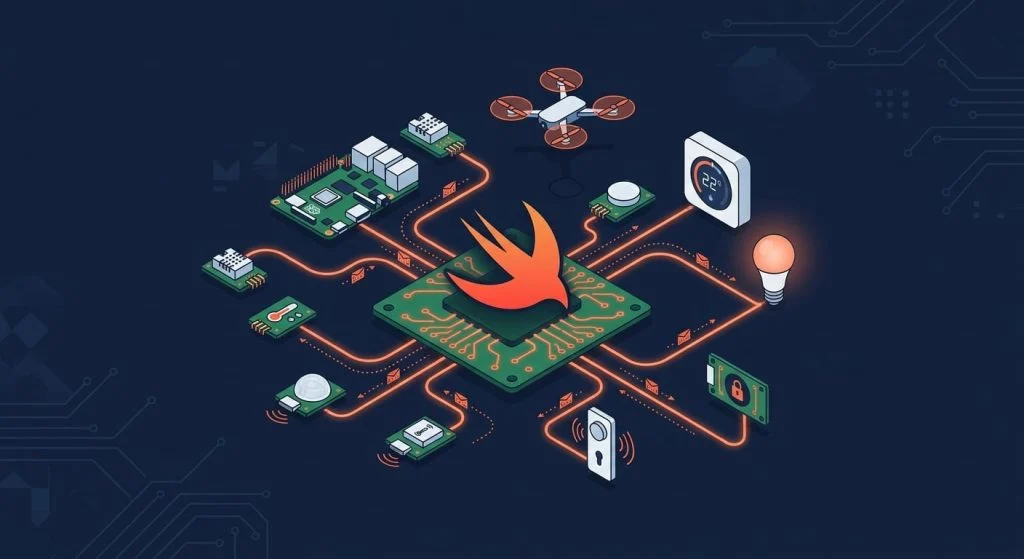

Amazon Web Services (AWS) has significantly advanced its offerings across edge computing, artificial intelligence, and cloud database management with a series of major announcements, including the general availability of the AWS IoT Device SDK for Swift. This release marks a pivotal moment for developers working within the Apple ecosystem, extending the reach of Swift, a language increasingly recognized for its performance and safety, from server-side applications to a vast array of Internet of Things (IoT) devices. Complementing this, AWS has also rolled out crucial updates for enterprise cloud adoption, enhancing data resilience with Amazon Cognito’s multi-Region replication and democratizing access to cutting-edge AI models from OpenAI on Amazon Bedrock.
The Ascendance of Swift at the Edge: A New Frontier for IoT Development
The general availability of the AWS IoT Device SDK for Swift represents a strategic move to empower a broader segment of the developer community to build robust, secure, and high-performance IoT applications. Swift, known for its modern syntax, strong type safety, and excellent performance, has traditionally been the language of choice for Apple platforms (iOS, macOS, tvOS, watchOS). However, its influence has steadily grown, particularly within server-side development through initiatives like the Swift Server Workgroup (SSWG), where AWS plays an active role. This new SDK now extends Swift’s capabilities to macOS, iOS, tvOS, and Linux environments, positioning it as a versatile language for a wide spectrum of connected devices.
The AWS IoT Device SDK for Swift provides production-ready connectivity and functionality essential for modern IoT solutions. Key features include support for MQTT 5, the latest version of the Message Queuing Telemetry Transport protocol, which offers enhanced messaging capabilities, session management, and error handling crucial for reliable communication in often constrained IoT environments. Furthermore, the SDK integrates seamlessly with core AWS IoT services such as Device Shadow, allowing applications to store and retrieve a device’s last reported state; Jobs, for remote management and updates of device fleets; and fleet provisioning, streamlining the onboarding of large numbers of devices securely.
This expansion of Swift into IoT is not an isolated event but rather indicative of a broader industry trend towards running high-performance, safe languages at the very edge of the network. The concept of "edge computing" involves processing data closer to its source, reducing latency, conserving bandwidth, and enabling real-time decision-making. Swift’s inherent advantages, such as its compiled nature and memory safety features, make it an attractive candidate for these demanding environments where resources can be limited and reliability paramount.
One compelling example illustrating this trend is WendyOS, an open-source operating system specifically designed for physical AI applications. WendyOS offers first-class Swift support for deploying applications to popular edge hardware platforms like NVIDIA Jetson and Raspberry Pi. This synergy between Swift and specialized edge hardware underscores the language’s burgeoning utility beyond its traditional domains. Industry analysts note that as the global IoT market continues its rapid expansion—projected to exceed hundreds of billions of dollars in the coming years with tens of billions of connected devices—the demand for efficient, secure, and developer-friendly tools will only intensify. The AWS IoT Device SDK for Swift is poised to capture a significant share of this burgeoning market, particularly among developers familiar with the Apple ecosystem looking to leverage their existing skill sets in new, exciting areas. This move by AWS not only validates Swift’s maturity as a general-purpose language but also accelerates its adoption in critical infrastructure and consumer-facing IoT applications, potentially fostering a new wave of innovation at the edge.
Enhancing Enterprise Cloud Migrations: Amazon RDS for SQL Server Supports Bring Your Own Media
In a significant move to facilitate enterprise cloud adoption and cost optimization, Amazon RDS for SQL Server now supports the "Bring Your Own Media" (BYOM) feature. This capability allows customers to reuse their existing Microsoft SQL Server licenses, including those covered by Software Assurance, when migrating their SQL Server applications from on-premises environments to Amazon RDS. This is achieved through Microsoft’s License Mobility program, a crucial offering for large organizations with substantial investments in perpetual software licenses.
For many enterprises, the cost of re-licensing software, particularly for database systems, can be a major barrier to cloud migration. BYOM directly addresses this challenge by allowing companies to leverage their existing assets, thereby reducing the total cost of ownership (TCO) and accelerating their journey to the cloud. This flexibility is particularly valuable for complex legacy applications that require specific SQL Server versions or editions. The integration of BYOM with AWS License Manager further enhances its utility, providing customers with a centralized tool for tracking license usage and ensuring compliance across their AWS deployments. This visibility is vital for maintaining audit readiness and optimizing license expenditure.
The strategic implication of BYOM is profound. It removes a significant financial hurdle for enterprises considering migrating their extensive SQL Server estates to the managed service environment of Amazon RDS. By offering a path for customers to bring their own licenses, AWS is making its cloud platform more attractive to organizations burdened by legacy licensing agreements, fostering smoother transitions and deeper cloud integration. This aligns with AWS’s broader strategy of providing a flexible and cost-effective environment for enterprise workloads, acknowledging the diverse licensing models that exist within traditional IT infrastructures. The move is expected to particularly benefit industries with large, established SQL Server deployments, such as financial services, healthcare, and manufacturing, enabling them to modernize their infrastructure without incurring prohibitive re-licensing costs.
Fortifying User Identity and Resilience: Amazon Cognito Multi-Region Replication
Ensuring high availability and resilience for user authentication and authorization services is paramount for any modern application. Amazon Cognito, AWS’s managed service for user identity, has now introduced multi-Region replication, a critical enhancement for business continuity and disaster recovery strategies. This new feature allows organizations to synchronize user and machine identity data—including credentials, user pool configurations, and federation setups—to a secondary user pool in a standby AWS Region in near real-time.
The primary benefit of multi-Region replication is the ability to maintain application availability even in the rare event of a disruption in a primary AWS Region. Should an outage occur, signed-in users can continue accessing their applications without the need to re-authenticate, and registered users can sign in with their existing credentials, often with minimal to no perceptible interruption. This seamless failover capability significantly improves the user experience and reduces potential downtime, which can be critical for applications handling sensitive transactions or requiring continuous access.
The importance of multi-Region replication cannot be overstated in today’s globalized and always-on digital economy. Organizations face increasing pressure to meet stringent Service Level Agreements (SLAs) and demonstrate robust disaster recovery capabilities. By providing an automated and near real-time replication mechanism, Amazon Cognito helps businesses achieve higher levels of resilience, minimize recovery point objectives (RPOs) and recovery time objectives (RTOs) for identity data, and simplify their overall disaster recovery architecture. This feature is available as an add-on for user pools in Essentials or Plus feature tiers and is supported across 16 AWS Regions, offering broad geographic coverage for global deployments. This ensures that enterprises can deploy their identity solutions with confidence, knowing that their users can access services reliably, irrespective of regional disruptions.
Democratizing Advanced AI: OpenAI GPT-5.5, GPT-5.4, and Codex on Amazon Bedrock
The accelerating pace of innovation in artificial intelligence, particularly in large language models (LLMs), continues to reshape how applications are built and how businesses operate. AWS has further cemented its commitment to providing broad access to leading AI models by making OpenAI’s GPT-5.5, GPT-5.4, and Codex generally available on Amazon Bedrock. This strategic integration allows developers and enterprises to leverage these powerful models within production workloads, benefiting from the robust security, governance, and operational controls inherent to the AWS ecosystem.
Amazon Bedrock serves as a fully managed service that offers a choice of high-performing foundation models (FMs) from leading AI companies, alongside AWS’s own models, through a single API. This approach simplifies the development of generative AI applications by abstracting away the complexities of managing and scaling these models. The addition of OpenAI’s latest models significantly enhances Bedrock’s capabilities, providing customers with even more options to select the best model for their specific use cases.
GPT-5.5 stands out as OpenAI’s most capable model to date, demonstrating exceptional prowess in complex tasks such as agentic coding, sophisticated data analysis, and multi-step autonomous processes. Its advanced reasoning and generation abilities make it ideal for developing intelligent agents, automating intricate workflows, and extracting deeper insights from large datasets. GPT-5.4 offers another powerful option, providing a balance of capability and efficiency for a wide range of generative AI tasks.
Codex, a model specifically fine-tuned for code generation, is also now available on Amazon Bedrock. It empowers AI-powered software development through various interfaces, including the Codex App, the Codex CLI, and integrations with popular Integrated Development Environments (IDEs) such as Visual Studio Code, JetBrains, and Xcode. This enables developers to rapidly generate code, debug, and refactor, significantly boosting productivity and accelerating the software development lifecycle. The availability of Codex on Bedrock means that enterprises can integrate advanced code AI capabilities into their development pipelines with the same enterprise-grade security and compliance standards they expect from AWS.

AWS’s decision to offer these OpenAI models on Bedrock reflects a broader strategy of model agnosticism, providing customers with flexibility and choice in their AI endeavors. This approach differentiates Bedrock in the competitive landscape of AI services, allowing organizations to experiment with and deploy cutting-edge models from various providers without vendor lock-in. Furthermore, pricing for these models on Bedrock matches OpenAI’s first-party rates, and usage counts towards existing AWS commitments, providing transparent and integrated billing. This move democratizes access to advanced AI capabilities, enabling a wider range of businesses, from startups to large enterprises, to innovate and build next-generation applications leveraging the power of generative AI and intelligent coding assistance.
Broader Implications and Market Trends
These recent announcements collectively underscore AWS’s multi-faceted strategy to drive innovation across critical technology domains. The expansion of Swift into IoT and edge computing highlights a growing industry demand for performant, memory-safe languages in resource-constrained environments, pushing computation closer to data sources. This trend is crucial for applications requiring real-time processing, such as autonomous vehicles, industrial automation, and smart city infrastructure.
The BYOM support for Amazon RDS for SQL Server is a testament to AWS’s understanding of enterprise pain points during cloud migration. By offering licensing flexibility, AWS continues to remove barriers for large organizations, accelerating their transition to managed cloud services and enabling greater agility and cost efficiency. This caters to a significant segment of the market still operating with substantial on-premises infrastructure.
Amazon Cognito’s multi-Region replication directly addresses the increasing imperative for robust disaster recovery and business continuity in an interconnected world. As applications become more critical, ensuring uninterrupted access and data integrity for user identities is non-negotiable, and this feature significantly enhances AWS’s offering in this regard.
Finally, the integration of OpenAI’s advanced GPT-5.5, GPT-5.4, and Codex models on Amazon Bedrock reinforces AWS’s position as a leading platform for generative AI development. By providing a managed service that offers a diverse portfolio of foundation models with enterprise-grade controls, AWS is empowering organizations to experiment, build, and deploy AI applications responsibly and at scale. This strategy is vital in an era where AI is rapidly moving from theoretical promise to practical implementation across every industry sector. These developments collectively signify AWS’s ongoing commitment to providing comprehensive, flexible, and cutting-edge solutions that cater to the evolving needs of developers and enterprises worldwide.
Looking Ahead
AWS consistently releases new features and services, demonstrating a relentless pace of innovation. Developers and businesses are encouraged to monitor the "What’s New with AWS" page for the latest updates and announcements. Furthermore, AWS continues to host a variety of events globally, including AWS-led in-person and virtual events, startup events, developer-focused events, AWS Summits, and AWS Community Days. These platforms provide invaluable opportunities for learning, networking, and staying abreast of the latest cloud technologies and best practices. The AWS Builder Center also serves as a vital resource for connecting with other builders, sharing solutions, and accessing content that supports ongoing development initiatives. The continuous evolution of AWS services ensures that the cloud ecosystem remains dynamic, powerful, and responsive to the demands of modern technology.
