
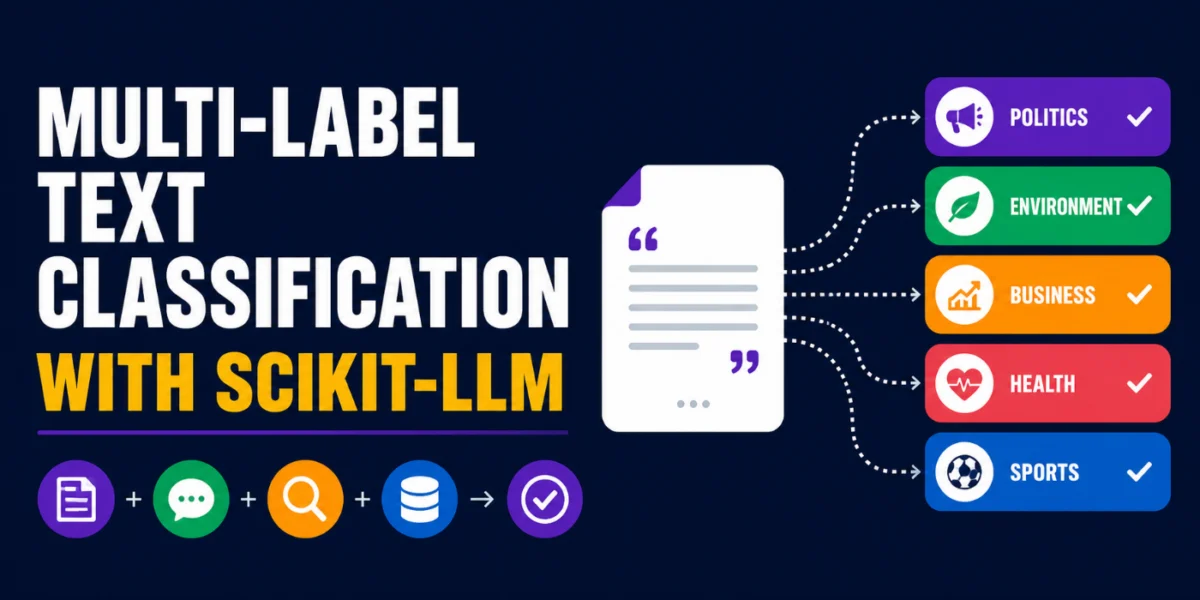

The landscape of natural language processing (NLP) is undergoing a profound transformation, driven by the exponential advancements in large language models (LLMs). A particularly challenging area, multi-label text classification, traditionally demanded extensive labeled datasets and sophisticated neural network architectures. However, a new methodology, leveraging the zero-shot reasoning capabilities of LLMs via the scikit-LLM library, is democratizing this complex task, enabling accurate classification without the arduous need for labeled training data or intricate model development. This breakthrough signifies a paradigm shift for developers and organizations aiming to extract nuanced insights from textual data with unprecedented efficiency and accessibility.
Understanding the Intricacies of Multi-Label Text Classification
Text classification is a foundational task in NLP, typically involving assigning a single category to a piece of text. Common examples include classifying a product review as "positive" or "negative," or routing a customer inquiry to a specific department. Yet, real-world text often defies such simplistic categorization. Human language, particularly in expressive forms like social media comments or customer feedback, frequently conveys multiple sentiments or topics simultaneously. Consider a statement like, "I absolutely love the enhanced battery life, but the new design is incredibly awful." This single sentence articulates both "joy" and "anger," illustrating the necessity of multi-label classification – a more sophisticated task capable of assigning several relevant categories to a data object concurrently.
Traditionally, building multi-label classifiers has been a resource-intensive endeavor. It typically involves:
- Manual Annotation: Human experts painstakingly label vast quantities of text with all applicable categories. This process is time-consuming, expensive, and prone to inconsistencies.
- Complex Model Architectures: Training models for multi-label tasks often requires advanced deep learning frameworks, such as recurrent neural networks (RNNs) or transformer models, coupled with specialized loss functions and output layers.
- Computational Resources: Training these complex models demands significant computational power, including high-performance GPUs, which can be a barrier for many organizations.
- Data Scarcity: For niche domains or emerging topics, obtaining sufficient labeled data is often impossible, rendering traditional approaches infeasible.
These challenges have historically limited the widespread adoption of multi-label classification, pushing many to settle for less granular, single-label solutions or to invest heavily in annotation efforts.
The Emergence of Large Language Models and Zero-Shot Learning
The advent of Large Language Models (LLMs) has fundamentally reshaped the possibilities within NLP. Pre-trained on colossal datasets encompassing text and code, LLMs like OpenAI’s GPT series or Meta’s Llama models have developed remarkable emergent abilities, including sophisticated reasoning, contextual understanding, and generalization. One of their most powerful features is "zero-shot learning."
Zero-shot learning refers to an LLM’s capacity to perform a task it has never explicitly been trained on, simply by being provided with instructions and examples (or even just instructions) at inference time. For classification, this means an LLM can categorize text based on a given set of labels, without requiring any prior examples of how to map text to those specific labels. The model leverages its vast pre-training knowledge to understand the semantic meaning of the text and the labels, then infers the most appropriate assignments. This capability bypasses the need for traditional fine-tuning, which involves updating the model’s weights with task-specific labeled data.
This development is particularly revolutionary for multi-label classification. Instead of collecting thousands of labeled examples for each category combination, an LLM can be presented with a text and a list of potential labels, and it will apply its inherent understanding to identify all relevant categories. This drastically reduces the time, cost, and expertise required to deploy sophisticated text classification systems.
Scikit-LLM: Bridging Traditional ML Workflows with Advanced LLMs
While LLMs offer unprecedented power, integrating them into existing machine learning pipelines can still present complexities. This is where libraries like scikit-LLM prove invaluable. Scikit-LLM acts as a robust wrapper, providing a familiar scikit-learn-like interface for interacting with LLMs. For data scientists and machine learning engineers accustomed to scikit-learn’s intuitive API (e.g., fit(), predict()), scikit-LLM significantly lowers the barrier to entry for leveraging advanced LLM capabilities. It allows users to treat powerful, pre-trained LLMs as if they were conventional machine learning models, abstracting away the intricacies of API calls, prompt engineering, and model management.
A significant advantage of scikit-LLM is its flexibility, supporting both commercial LLMs (like those from OpenAI) and free, open-source models. This democratizes access, allowing practitioners to experiment and deploy solutions without incurring substantial API costs, especially during development phases. The library’s design emphasizes ease of use, making it an ideal tool for rapid prototyping and deployment of LLM-powered applications.
A Practical Demonstration: Zero-Shot Multi-Label Sentiment Analysis
To illustrate the practical application of scikit-LLM, let us examine a multi-label sentiment classification problem using a real-world, open-source dataset. The goal is to assign one or multiple emotional labels to Reddit comments.
1. Setting Up the Environment and API Access:
The initial step involves installing the necessary libraries: scikit-llm for LLM integration and datasets for convenient access to public datasets.
pip install scikit-llm datasetsFor LLM inference, an API key is often required, particularly for models hosted by third-party providers. In this demonstration, we utilize a free LLM from Groq, known for its fast inference capabilities. Users must register on the Groq console and obtain an API key. This key is then configured within scikit-LLM, along with the custom API endpoint URL.
from skllm.config import SKLLMConfig
from skllm.models.gpt.classification.zero_shot import MultiLabelZeroShotGPTClassifier

# 1. Setting your API key
SKLLMConfig.set_openai_key("YOUR_FREE_API_KEY") # Use your Groq API key here

# 2. Setting the custom endpoint URL for Groq
SKLLMConfig.set_gpt_url("https://api.groq.com/openai/v1/")

# 3. Initializing the classifier with a Groq model
clf = MultiLabelZeroShotGPTClassifier(model="custom_url::llama-3.3-70b-versatile", max_labels=3)
Here, MultiLabelZeroShotGPTClassifier is instantiated, specifically configured to use a Groq-hosted Llama 3 model. The max_labels=3 parameter instructs the model to predict up to three labels for each text, preventing an overwhelming number of classifications for potentially ambiguous inputs.
2. Data Acquisition and Preparation:
For demonstration purposes, a subset of the go_emotions dataset from Hugging Face’s repository is loaded. This dataset, derived from Reddit comments, is well-suited for multi-label emotion classification.
from datasets import load_dataset
import pandas as pd

# 1. Load a sample from the go_emotions dataset
dataset = load_dataset("google-research-datasets/go_emotions", split="train[:100]")
df = dataset.to_pandas()

# Extract the raw text comments
texts = df['text'].tolist()

print(f"Loaded len(texts) comments.")
print(f"Sample: 'texts[0]'")
This snippet loads the first 100 training examples, converts them into a Pandas DataFrame, and extracts the raw text comments. A sample output confirms the successful loading:
Loaded 100 comments.
Sample: 'My favourite food is anything I didn't have to cook myself.'
3. Defining the Classification Task (Zero-Shot "Training"):
A crucial aspect of zero-shot learning is defining the problem space by providing the LLM with a list of candidate labels. These labels represent the categories the model should consider for classification. In this case, a set of common emotional states is chosen:
candidate_labels = [
    "admiration", "amusement", "anger", "annoyance",
    "approval", "curiosity", "disappointment", "joy",
    "sadness", "surprise"
]
The "training" phase with scikit-LLM for zero-shot classification is unique. Instead of traditional model training with input features (X) and target labels (y), the fit() method is used to configure the LLM with the specified label set. The input X is set to None, signifying that no actual training data is being used to update model weights.
# Fitting the model entirely zero-shot by passing X as None for no actual training,
# and providing our labels as a nested list
clf.fit(None, [candidate_labels])
This step is not about learning patterns from labeled examples but rather about informing the LLM about the specific categories it needs to identify within the input texts during inference.
4. Performing Inference and Interpreting Results:
With the LLM configured, predictions can now be made on the extracted text comments.
# Run the predictions on our Reddit comments
predictions = clf.predict(texts)

# Display the results for the first five comments
for i in range(5):
    print(f"Comment: texts[i]")
    print(f"Predicted Sentiments: predictions[i]")
    print(f"-" * 50)
The output clearly demonstrates the multi-label capability, assigning multiple sentiments where appropriate:
100%|██████████| 100/100 [03:01<00:00,   1.82s/it]
Comment: My favourite food is anything I didn't have to cook myself.
Predicted Sentiments: ['amusement' 'joy']
--------------------------------------------------
Comment: Now if he does off himself, everyone will think he's having a laugh screwing with people instead of actually dead
Predicted Sentiments: ['anger' 'annoyance' 'surprise']
--------------------------------------------------
It is noteworthy that the inference process can be computationally intensive and take a considerable amount of time, especially when making numerous API calls for each text. This is a common characteristic when leveraging powerful LLMs, as each prediction involves complex reasoning and computation. The time taken for inference significantly outweighs the "fitting" time because the latter merely involves configuration, whereas the former involves substantial processing for each input.
Implications and Advantages for Industry
The convergence of LLMs and libraries like scikit-LLM for zero-shot multi-label classification carries profound implications across various industries:
- Efficiency and Cost Reduction: Eliminating the need for extensive labeled training data drastically cuts down on manual annotation costs and the time-to-deployment for text classification systems. Businesses can iterate faster and respond to evolving data landscapes more agilely.
- Democratization of AI: By simplifying the process and reducing data requirements, these tools make sophisticated AI capabilities accessible to a wider range of developers and organizations, including those with limited ML expertise or data science resources.
- Enhanced Nuance and Granularity: Multi-label classification provides a richer, more detailed understanding of textual content, which is crucial for applications requiring subtle distinctions. For instance, customer feedback can be analyzed for multiple pain points or positive aspects simultaneously.
- Rapid Prototyping and Exploration: Data scientists can quickly experiment with different label sets and LLMs to identify the most relevant categories for a given problem, accelerating the discovery phase of projects.
- Broadening Use Cases: This technology can revolutionize applications in:
- Customer Service: Automatically tagging support tickets with multiple issue types (e.g., "billing," "technical," "refund request").
- Content Moderation: Identifying harmful content that might exhibit multiple problematic traits (e.g., "hate speech," "harassment," "misinformation").
- Market Research: Extracting nuanced sentiments and product features from social media or review platforms.
- Legal & Compliance: Categorizing documents based on multiple legal clauses or regulatory requirements.
- Healthcare: Classifying patient notes by symptoms, diagnoses, and treatment plans.
Challenges and Considerations
Despite its immense promise, this approach is not without its considerations:
- Computational Intensity of Inference: As observed, LLM inference can be slow, especially for large datasets. While Groq offers faster inference, commercial API usage often comes with per-token costs, making large-scale real-time applications potentially expensive.
- API Dependencies: Relying on external LLM APIs introduces dependencies on third-party services, including potential latency, downtime, and cost fluctuations.
- Model Bias: LLMs, trained on vast internet data, can inherit and perpetuate societal biases. It is crucial to be aware of potential biases in predictions, particularly in sensitive applications like sentiment analysis or content moderation.
- Explainability: While LLMs perform well, understanding why they assigned specific labels can be challenging, a common issue with complex neural networks.
- Defining Optimal Labels: Crafting a comprehensive and non-overlapping set of
candidate_labelsrequires careful domain expertise to ensure meaningful and accurate classifications.
The Future Landscape of Text AI
The ability to perform multi-label text classification without extensive labeled data represents a significant leap forward in AI’s capacity to understand and organize human language. Libraries like scikit-LLM are pivotal in making these advanced capabilities accessible to a broader audience, fostering innovation across industries.
Looking ahead, the field will likely see continued advancements in LLM efficiency, with models becoming faster and more cost-effective to deploy. Further developments in libraries like scikit-LLM will enhance flexibility, offering more control over prompt engineering, model selection, and integration with various data sources. For practitioners, the next steps involve refining label sets to better capture domain-specific nuances, experimenting with different LLM backends (e.g., other Groq models or local open-source models), and, crucially, establishing robust evaluation pipelines. Measuring label-level precision and recall against held-out annotated samples remains essential to understand model performance, identify areas for improvement, and ensure responsible deployment in production environments. The era of democratized, powerful text understanding is here, and its potential is only beginning to be realized.
