

Amazon Web Services (AWS) has announced the immediate availability of AWS CloudFormation Express mode, a significant enhancement designed to dramatically accelerate infrastructure deployments. This new deployment mode promises to reduce deployment times by up to four times for iterative development workflows and critical production scenarios, directly addressing a long-standing challenge for developers and modern AI tools that rely on rapid infrastructure provisioning and iteration. The introduction of Express mode marks a pivotal moment in the evolution of Infrastructure as Code (IaC) on the AWS platform, emphasizing speed and agility without compromising the robust capabilities of CloudFormation.
The Foundation of Cloud Agility: Understanding Infrastructure as Code
At its core, Infrastructure as Code (IaC) represents a revolutionary approach to managing and provisioning computing infrastructure through machine-readable definition files, rather than physical hardware configuration or interactive configuration tools. AWS CloudFormation, launched in 2011, has been a cornerstone of this paradigm on the AWS platform. It allows users to model their entire AWS infrastructure, from compute instances and databases to networking components and application services, in a declarative template. These templates, written in YAML or JSON, define the desired state of the infrastructure, and CloudFormation handles the provisioning and configuration of the resources. This approach offers numerous benefits: consistency, version control, reusability, and reduced manual errors, all of which are crucial for scalable and reliable cloud operations.
However, even with the power of IaC, deployment times can sometimes become a bottleneck, particularly in environments requiring rapid iteration. CloudFormation’s traditional "Standard mode" meticulously performs stabilization checks after resource configuration is applied. These checks are vital for ensuring that resources are not just provisioned but fully operational and ready to serve traffic before the deployment is marked complete. While this meticulous approach guarantees robust and stable deployments, it can introduce latency. For instance, creating a complex network setup or deploying services that require extensive initialization can lead to deployment times stretching into minutes or even tens of minutes, hindering quick feedback loops essential for modern development practices.
The Genesis of Speed: Why Express Mode is a Game Changer
The demand for faster deployment cycles has intensified with the rise of continuous integration/continuous delivery (CI/CD) pipelines, agile development methodologies, and increasingly, AI-assisted infrastructure management. Developers iterate frequently, testing small changes and requiring immediate feedback on their infrastructure adjustments. Similarly, AI tools, which may programmatically generate or modify infrastructure, benefit immensely from sub-minute feedback loops to optimize their output and ensure rapid experimentation. The conventional wait times, inherent in full stabilization checks, although serving a critical purpose for ensuring operational readiness, often proved excessive for these specific, high-velocity use cases.
AWS recognized this growing need and engineered Express mode to cater specifically to these scenarios. The core innovation lies in when CloudFormation declares a deployment complete. Instead of waiting for the full gamut of extended stabilization checks, Express mode concludes the deployment process as soon as CloudFormation confirms that the resource configuration has been successfully applied. This fundamental shift allows resources to continue becoming fully operational in the background, freeing up the developer or the automated system to proceed with subsequent tasks without undue delay.
Under the Hood: How Express Mode Delivers Accelerated Deployments
Express mode doesn’t alter how resources are provisioned; rather, it redefines the completion criteria for a deployment. In Standard mode, a deployment reaches completion only after all resources within the stack have not only been configured but also passed various health and operational readiness checks. This can involve waiting for database instances to fully initialize, for load balancers to register healthy targets, or for network interfaces to establish stable connections. While essential for production deployments where immediate traffic serving is required, these checks can be bypassed when the immediate need is to confirm configuration application and move to the next iteration.
To mitigate potential issues arising from resources not being fully stable, Express mode incorporates built-in resilience. It automatically retries dependent resources that encounter transient failures during provisioning within the same stack. This intelligent retry mechanism operates without requiring any customer intervention, effectively handling timing issues that might occur between resources as they asynchronously stabilize. This ensures that even with the accelerated completion, the underlying provisioning process remains robust and reliable, gracefully managing the eventual consistency model.
Transforming Developer Workflows: Iteration at Unprecedented Speeds
The impact of Express mode on iterative development workflows is profound. Developers often build infrastructure incrementally, adding resources one at a time or making minor configuration adjustments. In the past, each small change could trigger a lengthy deployment cycle, disrupting focus and slowing down the development pace. With Express mode, these cycles are dramatically shortened, enabling a more fluid and responsive development experience.
Consider a developer building a new microservice. They might start by deploying an IAM role, then add a Lambda function, and finally an SQS queue with an event source mapping. Each of these steps, traditionally, would incur a waiting period. With Express mode, these sequential deployments can be executed with minimal pauses, creating a near real-time feedback loop. For example, deploying an Amazon Simple Queue Service (SQS) queue with a dead letter queue (DLQ) in Standard mode might take approximately 64 seconds. With Express mode, this process can complete in as little as 10 seconds. Even more striking is the example of deleting an AWS Lambda function with network interface attachment, which could take 20 to 30 minutes in Standard mode due to the complexities of network resource de-provisioning. Express mode slashes this to just 10 seconds, based on internal AWS benchmarking. Such reductions are not merely incremental; they represent a step-change in productivity for developers engaged in frequent infrastructure experimentation and refinement.
Empowering AI and Automation: Sub-Minute Feedback for Intelligent Infrastructure
Beyond human-driven development, Express mode holds immense promise for the burgeoning field of AI-assisted infrastructure development. Tools like Kiro, mentioned in the announcement, leverage artificial intelligence to design, generate, and manage cloud infrastructure. For these AI systems to be effective and efficient, they require extremely fast feedback loops. An AI generating a complex CloudFormation template needs to quickly validate if the generated configuration can be applied and then move on to optimizing or refining the next set of resources. The traditional multi-minute waits would severely hamper the iterative learning and deployment cycles of such AI tools.
With Express mode, AI models can deploy, test, and iterate on infrastructure configurations in sub-minute intervals. This acceleration facilitates rapid prototyping, automated testing, and continuous optimization of cloud environments by intelligent agents. It enables a new era of proactive, self-healing, and self-optimizing infrastructure where AI can rapidly experiment with configurations, identify optimal states, and deploy changes with unprecedented agility, pushing the boundaries of autonomous cloud management.
Seamless Integration and Operational Considerations
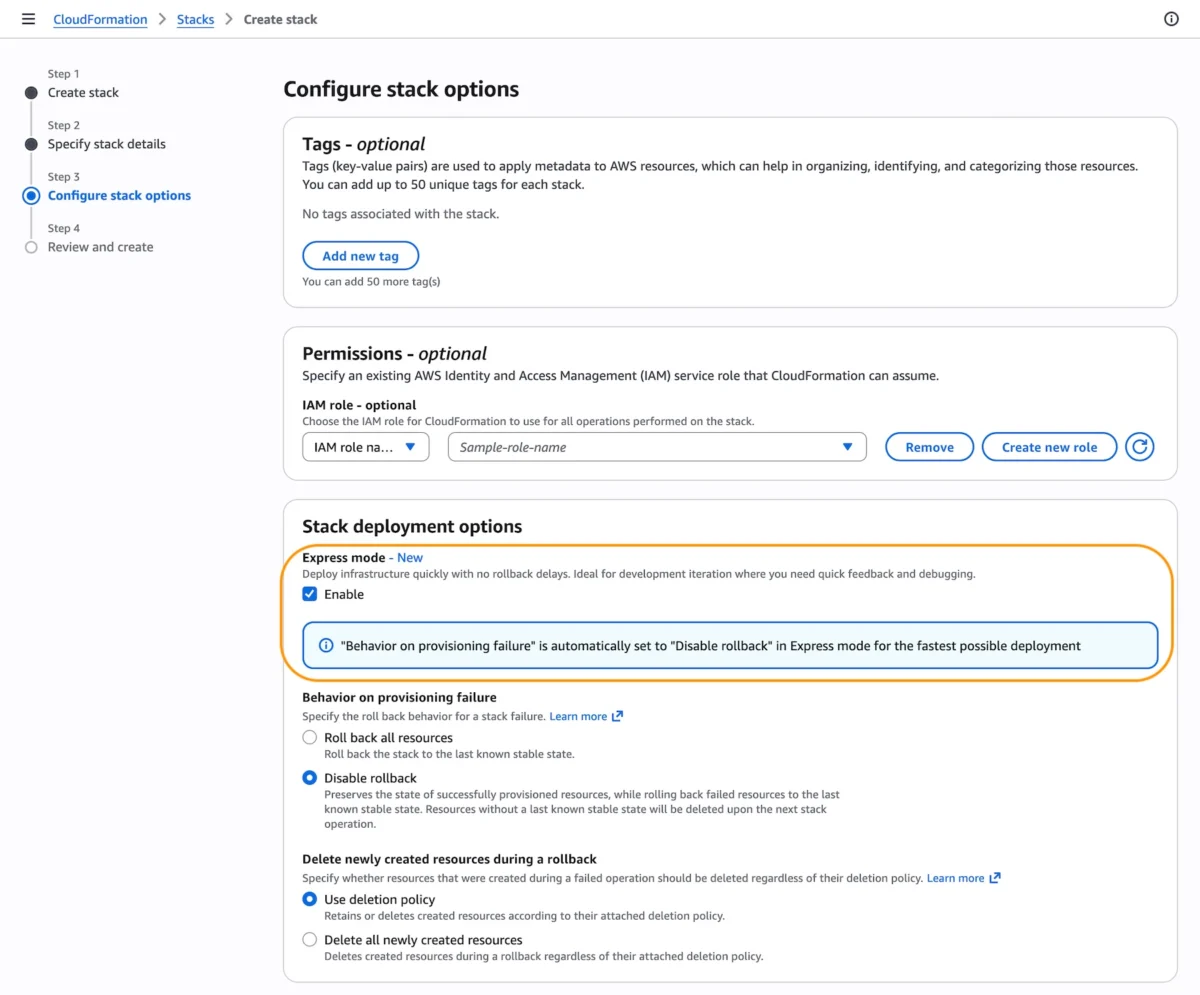
AWS has ensured that Express mode is straightforward to adopt and integrate into existing workflows. Users can enable it directly from the AWS Management Console by selecting "Enable" under "Express mode" within the "Stack deployment options" when creating a CloudFormation stack. For programmatic control, Express mode can be activated via the AWS Command Line Interface (AWS CLI), AWS SDKs, and popular Infrastructure as Code tools such as AWS Cloud Development Kit (CDK).
When using the AWS CLI, developers simply set the --deployment-config parameter to EXPRESS during create-stack, update-stack, or delete-stack operations. No modifications to existing CloudFormation templates are required, ensuring backward compatibility and ease of adoption.

A key operational consideration with Express mode is its default behavior of disabling rollback for the fastest iteration experience. While this is ideal for development and testing environments, production scenarios often necessitate robust rollback capabilities in case of deployment failures. For such environments, users can re-enable rollback by setting disableRollback to false within the deployment-config. Alternatively, organizations may implement their own monitoring and cleanup mechanisms for failed Express mode deployments in production. AWS advises that IAM role templates should continue to adhere to the principle of least privilege, regardless of the deployment mode, to maintain security best practices.
Furthermore, Express mode is fully compatible with all existing CloudFormation features, including change sets for previewing proposed changes and nested stacks for modular infrastructure management. When Express mode is enabled on a parent stack, all its nested stacks automatically inherit the Express mode behavior, simplifying the management of complex, multi-layered architectures. It is important to reiterate that for workflows requiring resources to be fully operational and ready to serve traffic before the deployment is marked complete, the default Standard mode, with its comprehensive stabilization checks, remains the recommended approach.
Broader Industry Implications and Expert Perspectives
The launch of AWS CloudFormation Express mode is not just a technical feature update; it signals a broader strategic direction for AWS and the cloud industry at large. It underscores the increasing emphasis on developer experience and the relentless pursuit of efficiency in cloud operations. Industry analysts suggest that this move will further solidify CloudFormation’s position as a leading IaC tool, particularly for organizations pushing the boundaries of continuous delivery and AI-driven automation.
"Faster feedback loops are the holy grail of modern software development," commented a hypothetical industry analyst specializing in cloud technologies. "AWS CloudFormation Express mode directly tackles one of the most persistent bottlenecks in cloud provisioning. This isn’t just about saving minutes; it’s about enabling developers to maintain flow, experiment more freely, and ultimately deliver innovations at a pace previously unimaginable. For AI tools, this could unlock entirely new capabilities in autonomous cloud management."
From a competitive standpoint, Express mode enhances AWS’s IaC offering, distinguishing it in a crowded market where speed and developer productivity are key differentiators. It reinforces the platform’s commitment to supporting the most agile and demanding cloud workloads, from startups rapidly prototyping new ideas to large enterprises deploying complex, mission-critical applications. The fact that Express mode is available at no additional cost further democratizes access to these accelerated deployment capabilities, making advanced IaC practices more accessible to a wider range of users.
Availability and the Road Ahead
AWS CloudFormation Express mode is available today in all AWS commercial Regions, ensuring broad accessibility for global customers. This widespread immediate availability highlights AWS’s commitment to delivering high-impact features across its entire operational footprint. Detailed information on regional availability and a future roadmap can be found on the AWS Capabilities by Region page. For developers seeking to leverage APIs, explore documentation, or troubleshoot issues related to this new feature, resources like the AWS MCP Server and its plugins, compatible with various AI tools, are available. Comprehensive documentation for CloudFormation is also readily accessible for in-depth learning.
The introduction of Express mode is a clear indicator of AWS’s ongoing investment in enhancing its foundational services. It empowers developers and AI systems to build, test, and deploy infrastructure with unprecedented speed, driving innovation and efficiency across the cloud ecosystem. As cloud architectures become more dynamic and automation more pervasive, features like Express mode will be instrumental in shaping the next generation of cloud operations, pushing the boundaries of what is possible with Infrastructure as Code. Developers are encouraged to begin leveraging Express mode today to accelerate their deployments and provide feedback via AWS re:Post for AWS CloudFormation or through their standard AWS Support channels.
