
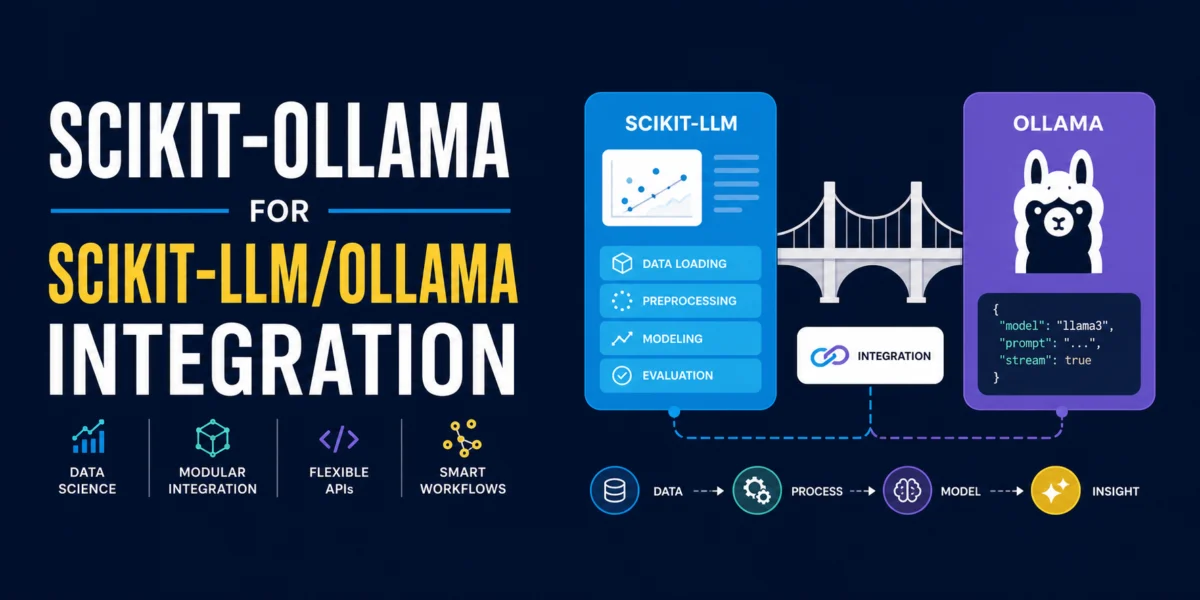

The rapidly evolving landscape of artificial intelligence has witnessed a significant shift towards more accessible and private large language model (LLM) deployments, a movement powerfully exemplified by the introduction of scikit-ollama. This innovative Python library seamlessly integrates the widely adopted scikit-learn interface with locally running Ollama models, enabling robust zero-shot text classification without the inherent costs, latency, or data privacy concerns associated with cloud-based LLM APIs. This development marks a pivotal moment for data scientists and organizations seeking to leverage the advanced capabilities of LLMs within their secure, on-premise environments.
The Evolution of LLM Deployment: From Cloud Reliance to Local Autonomy
The advent of large language models fundamentally transformed the way organizations interact with text data, offering unprecedented capabilities in natural language understanding and generation. Initially, the primary avenue for accessing these powerful models was through commercial cloud APIs offered by industry giants such as OpenAI, Google, and Anthropic. While these services provided convenient access to cutting-edge models, they presented several challenges that limited their universal adoption and raised critical concerns for many enterprises.
Foremost among these challenges were the significant operational costs associated with API usage, often fluctuating based on token consumption and traffic volume. For applications requiring high-volume processing or continuous inference, these costs could quickly become prohibitive. More critically, the reliance on third-party cloud services necessitated sending potentially sensitive or proprietary data over the internet, triggering stringent data privacy and security compliance issues. Regulations like GDPR, HIPAA, and various national data protection laws impose strict requirements on how personal and confidential information is handled, making external API calls a complex hurdle for many industries, including finance, healthcare, and legal services. Furthermore, network latency and the potential for vendor lock-in presented additional operational and strategic risks.
Responding to these limitations, the open-source community rapidly accelerated the development of smaller, more efficient LLMs capable of running on local hardware. Projects like Llama, Mistral, and Gemma demonstrated that powerful models could be quantized and optimized for consumer-grade GPUs and even CPUs. This gave rise to platforms like Ollama, which emerged as a crucial facilitator in democratizing local LLM deployment. Ollama simplifies the process of downloading, setting up, and serving various open-source LLMs on a local machine, abstracting away the complexities of model management and inference serving. This shift towards local deployment offered a compelling alternative, promising enhanced data security, reduced operational costs, lower latency, and greater control over the model lifecycle.
Scikit-Learn’s Enduring Legacy and the Bridge to LLMs
The scikit-learn library has long been the cornerstone of traditional machine learning in Python, celebrated for its consistent, intuitive, and widely understood API. Its standardized fit() and predict() methods have made complex machine learning tasks accessible to millions of developers and researchers, fostering a vibrant ecosystem of tools and applications. The library’s design principles emphasize simplicity, efficiency, and interoperability, making it an ideal candidate for bridging new technologies into established workflows.
Recognizing the desire to integrate the power of LLMs into these familiar scikit-learn paradigms, the scikit-llm project emerged, providing a scikit-learn-compatible interface for cloud-based LLMs. Building upon this foundation, scikit-ollama takes a decisive step further by specifically targeting locally deployed Ollama models. This innovative approach ensures that users can leverage the full reasoning capabilities of LLMs through the familiar scikit-learn syntax, all while keeping their data securely within their own infrastructure. The library effectively translates standard machine learning tasks, such as classification, into expertly crafted prompts for the local LLM, then parses the LLM’s output to conform to expected scikit-learn formats. This ingenious abstraction allows practitioners to treat a sophisticated LLM like Llama 3 as just another classifier in their existing machine learning pipeline.
Zero-Shot Classification: Unlocking Immediate Value
One of the most compelling features enabled by scikit-ollama is zero-shot text classification. Traditionally, training a robust text classifier required a substantial, carefully labeled dataset. This process is often time-consuming, expensive, and resource-intensive, particularly for specialized domains where labeled data is scarce. Zero-shot learning, by contrast, allows a model to classify inputs into categories it has not explicitly been trained on, relying instead on its vast pre-existing knowledge acquired during its general-purpose training.
With scikit-ollama, this means a general-purpose LLM like llama3:latest, once running locally via Ollama, can instantly perform classification tasks with remarkable accuracy. When a ZeroShotOllamaClassifier is initialized with a local model and "fitted" with a list of candidate labels (e.g., "positive," "negative," "neutral"), the library intelligently reformulates the classification problem into a text generation prompt. The LLM then uses its understanding of language to assign the most appropriate label from the provided list, without requiring any gradient updates or specific fine-tuning on labeled examples for that particular task. This method significantly accelerates development cycles and reduces the barrier to entry for deploying advanced NLP solutions.
For instance, in the realm of sentiment analysis for movie reviews, scikit-ollama can categorize reviews as "positive," "negative," or "neutral" with immediate effect. The process involves loading a dataset (such as those provided by skllm.datasets), instantiating the ZeroShotOllamaClassifier with the desired local Ollama model (e.g., llama3:latest), and then "fitting" the model by merely providing the target labels. Subsequent calls to predict() on new text inputs will then leverage the local LLM to infer the sentiment, delivering results in a structured format consistent with scikit-learn‘s output. This capability is particularly transformative for businesses needing to quickly analyze customer feedback, categorize support tickets, or monitor social media sentiment without investing heavily in custom model training.
Implementation and Technical Considerations
To leverage scikit-ollama, users need a Python environment version 3.9 or higher. The installation is straightforward via pip install scikit-ollama. The critical prerequisite, however, is the local installation of Ollama itself, along with the specific LLM model intended for use. For example, to use Llama 3, the command ollama pull llama3:latest would be executed in the terminal. These steps ensure that the computational backbone for LLM inference is securely established on the user’s machine.
The library’s design choice to build upon scikit-llm is strategic. scikit-llm laid the groundwork for integrating LLMs into the scikit-learn interface, abstracting the complexities of interacting with LLM APIs. scikit-ollama extends this by replacing the external API calls with direct communication to a local Ollama server, thereby eliminating external dependencies and enhancing performance for on-premise deployments. This architectural decision empowers developers with full control over their models and data, fostering an environment of greater transparency and security.
Broader Implications and Future Outlook
The advent of scikit-ollama and the broader trend of local LLM deployment carry significant implications across various sectors:
- Enhanced Data Privacy and Security: Industries dealing with highly sensitive data, such as healthcare, finance, and legal, can now leverage advanced NLP capabilities without compromising data integrity or violating regulatory compliance. This opens new avenues for innovation in these traditionally conservative fields.
- Cost Efficiency: By eliminating recurring API costs, organizations can achieve substantial savings, particularly for high-volume or enterprise-wide LLM applications. This democratizes access to powerful AI tools, making them feasible for smaller businesses and academic institutions.
- Reduced Latency and Offline Capabilities: Local processing ensures minimal latency, crucial for real-time applications. Furthermore, models can operate entirely offline, a significant advantage for deployments in remote locations or environments with unreliable internet connectivity.
- Greater Customization and Control: While
scikit-ollamafocuses on zero-shot inference, the underlying local Ollama models offer greater flexibility for fine-tuning and customization. This allows organizations to adapt models more precisely to their specific domain knowledge and tasks, moving beyond generic LLM capabilities. - Democratization of AI: The ease of integrating local LLMs into familiar
scikit-learnworkflows lowers the barrier to entry for developers and data scientists. This fosters innovation and encourages a wider adoption of AI technologies across diverse skill levels and organizational sizes.
Experts in the machine learning community view scikit-ollama as a crucial step towards a more decentralized and private AI ecosystem. Andreas Karasenko, the principal developer behind scikit-ollama, along with the broader scikit-llm community, has championed a vision where advanced natural language processing is not beholden to external service providers. This initiative aligns with a growing industry demand for greater autonomy and control over AI infrastructure. The trajectory suggests a future where hybrid models – combining the scalability of cloud solutions with the privacy and control of local deployments – will become increasingly prevalent, allowing organizations to tailor their AI strategy to specific needs and constraints.
In conclusion, scikit-ollama represents a significant leap forward in making powerful LLM capabilities accessible, private, and cost-effective. By skillfully bridging the gap between the familiar scikit-learn interface and the burgeoning ecosystem of local Ollama models, it empowers a new generation of AI applications, firmly embedding advanced natural language processing within the secure confines of local machine learning workflows. This development not only addresses critical industry challenges but also paves the way for a more robust, secure, and democratic future for artificial intelligence.
