

Fifteen years after its initial market debut in 2011, Amazon Web Services (AWS) has announced a transformative evolution for its flagship application management service, AWS Elastic Beanstalk. The platform, historically trusted by millions of developers to deploy full-stack applications across languages like Java, .NET, Python, Node.js, PHP, Ruby, and Go without managing underlying infrastructure, is undergoing its most significant operational overhaul to date. Moving far beyond its traditional role as a simpler deployment utility, Elastic Beanstalk is now designed to take full, continuous operational responsibility for production environments throughout their entire lifecycle.
This latest evolution introduces a fully managed Cluster Mode. By leveraging Amazon Elastic Kubernetes Service (Amazon EKS) beneath the hood, this new capability addresses the modern enterprise challenge of managing large portfolios of microservices. Rather than forcing development and operations teams to manually stitch together container orchestration tools, Elastic Beanstalk Cluster Mode provides a unified operational baseline. Organizations can now bring their source code, Dockerfiles, or pre-built container images and rely on AWS to handle continuous deployment, scaling, patching, monitoring, and upgrading. As organizations scale from a handful of applications to hundreds, resource pooling via Cluster Mode significantly reduces per-application infrastructure costs while completely abstracting away the underlying operational complexity.
The Genesis and Evolution of AWS Elastic Beanstalk
To understand the magnitude of this 2026 update, one must examine the trajectory of AWS Elastic Beanstalk since its inception in January 2011. During the early days of cloud computing, spinning up compute instances, configuring load balancers, and setting up autoscaling groups required substantial manual engineering effort. Elastic Beanstalk arrived as a Platform-as-a-Service (PaaS) solution designed to bridge the gap between raw infrastructure and high-level application logic. Developers could simply upload their code, and the service would automatically provision and manage the requisite AWS resources, predominantly anchored by Amazon Elastic Compute Cloud (Amazon EC2).
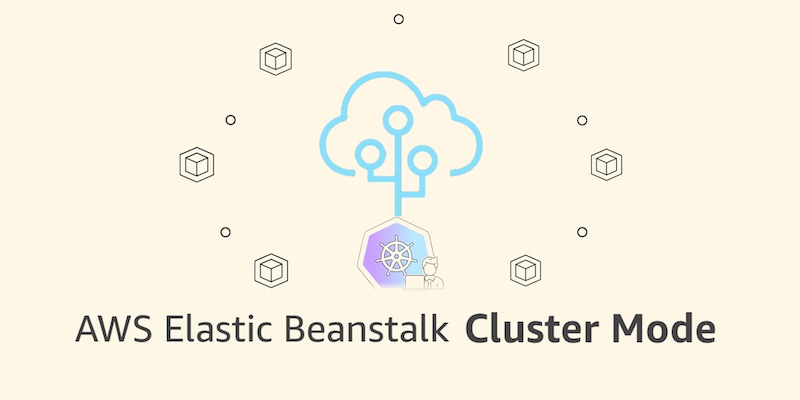
Over the subsequent decade and a half, the software engineering landscape shifted dramatically. Monolithic architectures gave way to microservices, and containerization engines—most notably Docker and Kubernetes—became the industry standard for application packaging and orchestration. While Kubernetes offered unprecedented flexibility and scalability, it simultaneously introduced a steep learning curve and a heavy administrative burden. Managing control planes, worker nodes, ingress controllers, and networking policies often diverted engineering talent away from core product development.
Recognizing this market friction, AWS systematically modernized the engine underneath Elastic Beanstalk over the past several years. Recent updates have transformed the service into an intelligent, highly observable operations platform. In early 2026, AWS introduced AI-powered environment analysis, a capability that automatically diagnoses application health anomalies and suggests precise remediation steps. Concurrently, the introduction of official GitHub Action integrations enabled engineering teams to trigger production deployments directly from their existing CI/CD pipelines via streamlined YAML configurations. Furthermore, the platform’s infrastructure foundation was completely re-architected to natively support OpenTelemetry-based observability, traffic-splitting deployments with automated rollbacks, event-driven autoscaling, centralized secrets management via AWS Secrets Manager, and HTTPS configuration by default through AWS Certificate Manager.
Deconstructing Cluster Mode: Architecture and Multi-Application Portfolios
The centerpiece of today’s announcement is the new Cluster Mode architecture. Built specifically for engineering organizations maintaining diverse portfolios of applications, Cluster Mode fundamentally alters how resources are allocated and managed in the cloud.
In traditional deployment models, isolated applications often result in fragmented infrastructure footprints, underutilized server capacity, and administrative overhead. Cluster Mode solves this by allowing multiple applications and microservices to share a common, highly scalable infrastructure foundation driven by Amazon EKS. This shared-resource model delivers profound economic efficiencies. As an enterprise grows its application portfolio, the underlying compute resources are optimized across workloads, driving down the per-application cost without introducing infrastructural chaos.

Whether an enterprise operates ten distinct services or a hundred interconnected microservices, administrators manage them through a single, cohesive console experience. This uniformity ensures that every application stack—regardless of the programming language or framework used—inherits the exact same rigorous operational guarantees, security baselines, and monitoring standards.
Hands-On Implementation: Deployment via Console and CLI
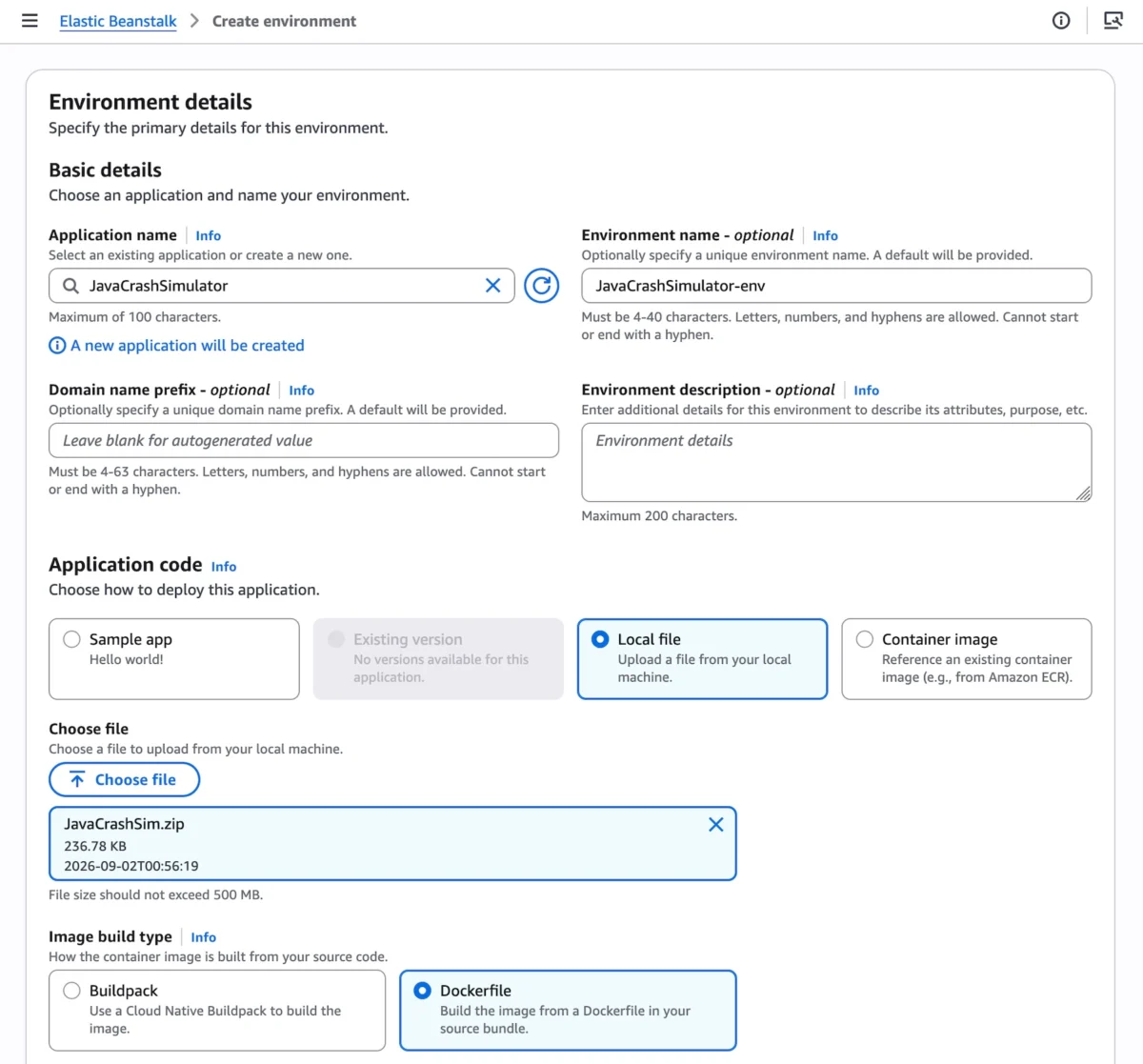
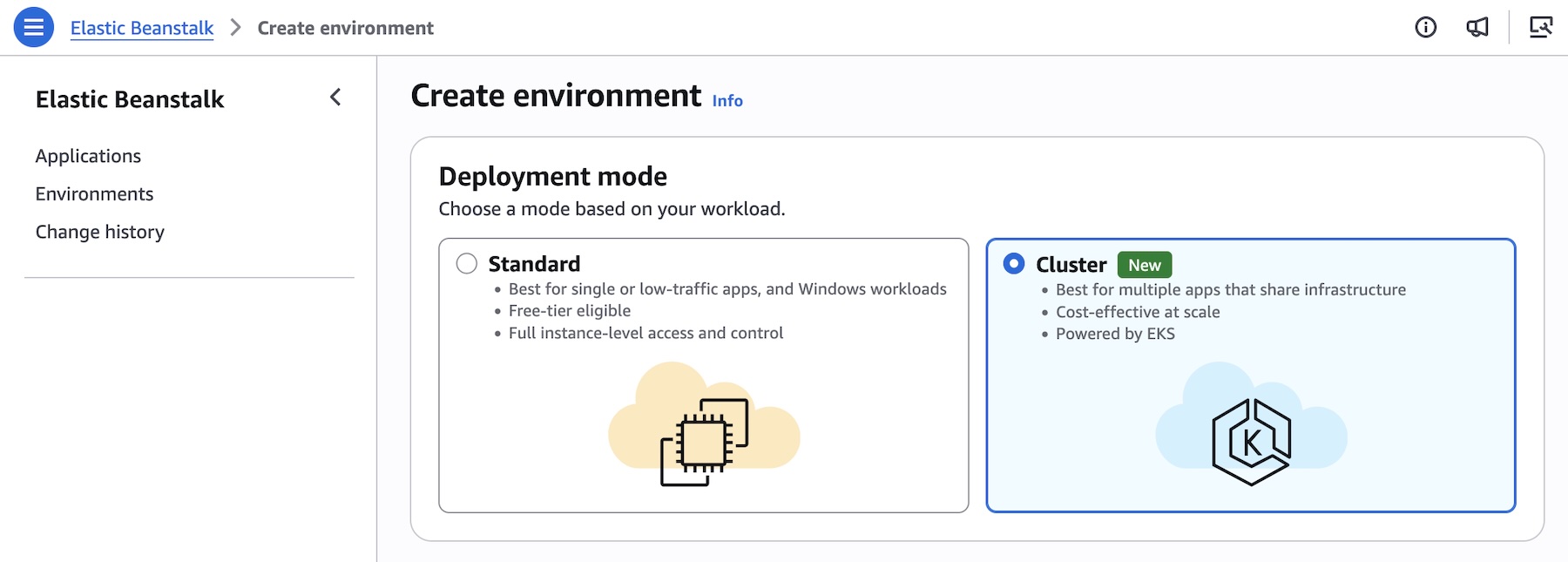
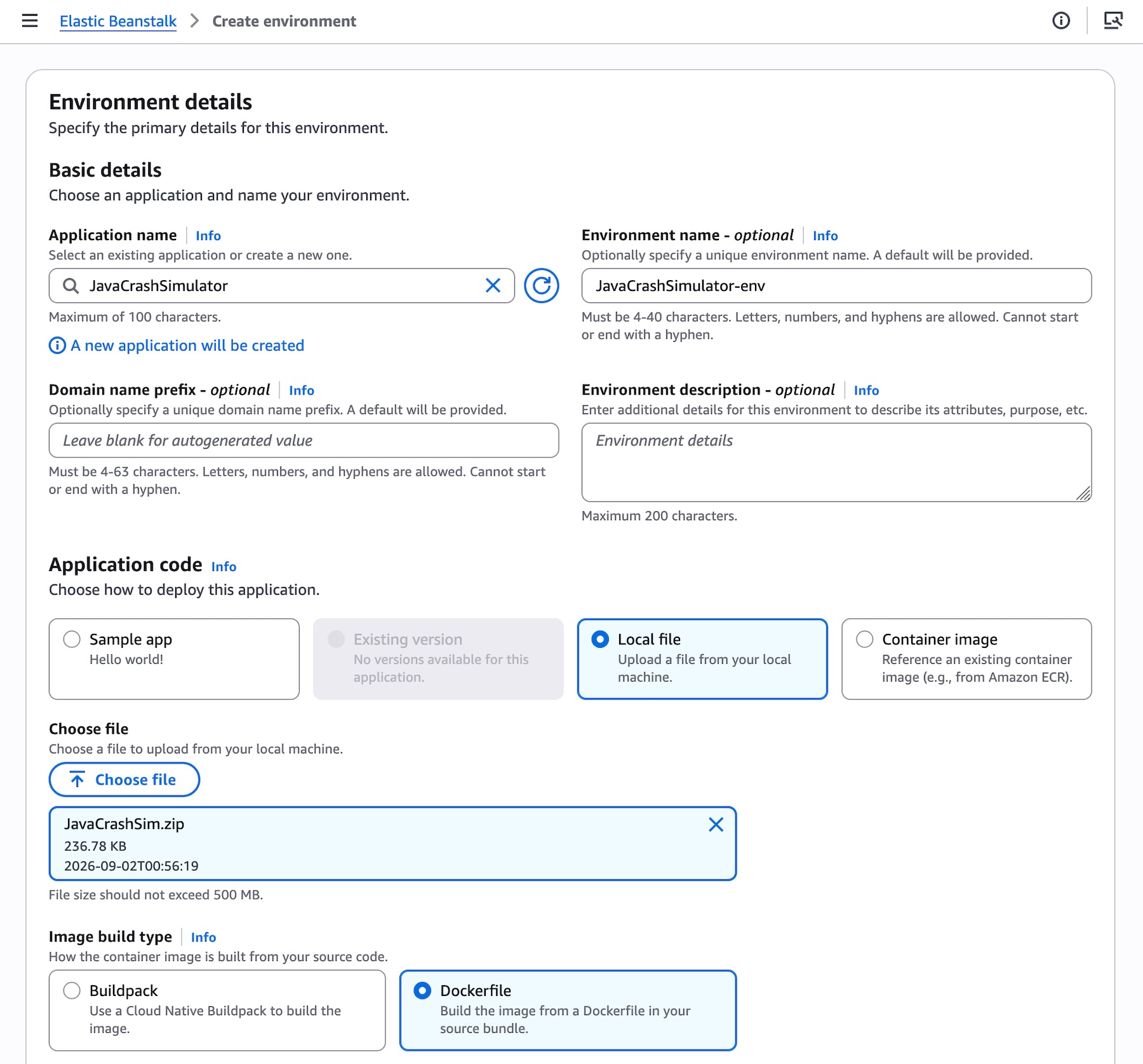
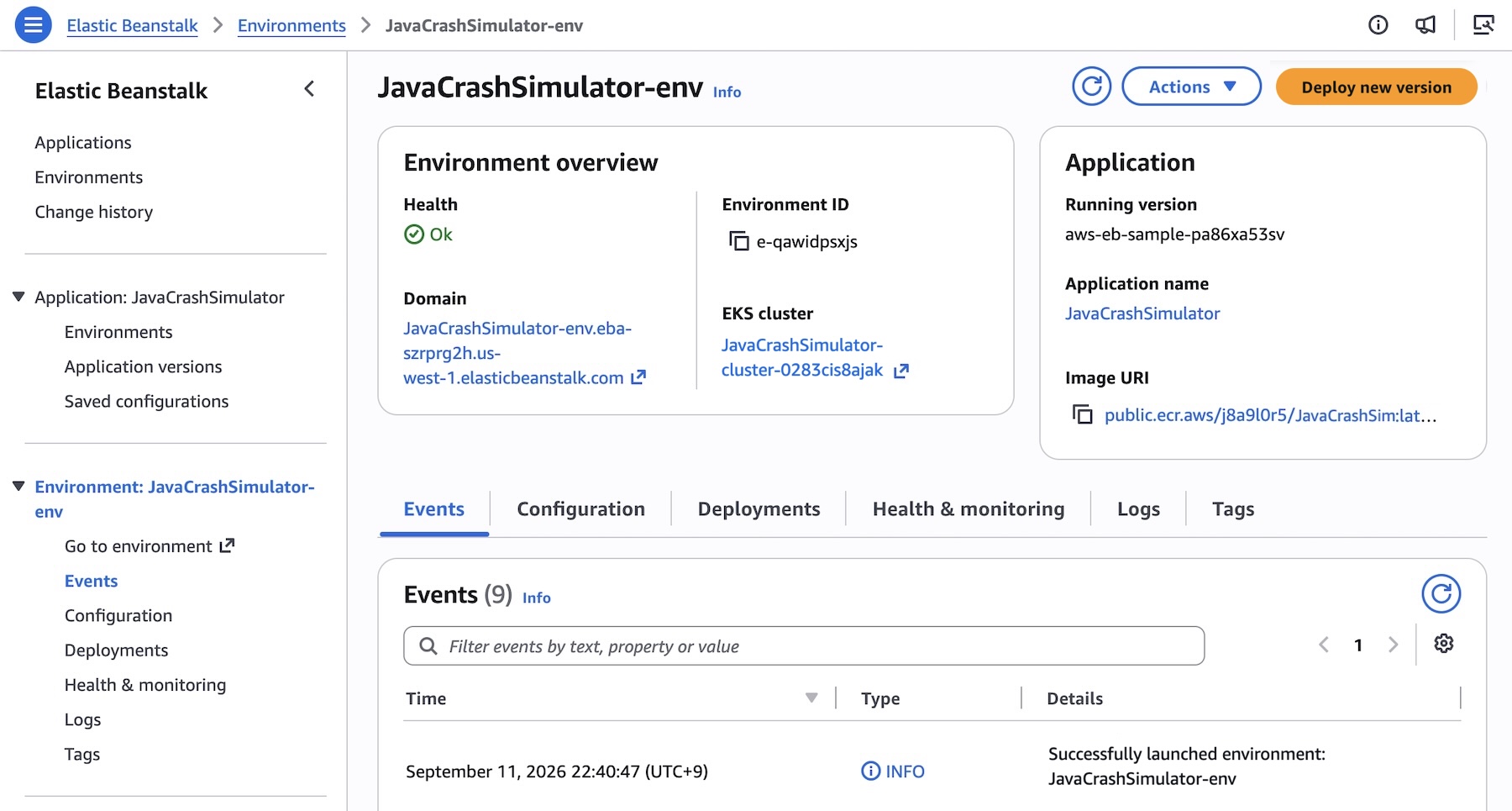
For development teams eager to test the new architecture, transitioning to Cluster Mode requires minimal friction. Within the AWS Elastic Beanstalk console, initiating a cluster-based deployment is as simple as creating a new environment and selecting "Cluster" under the Deployment Type dropdown menu.
Engineers can supply their application payloads via local source code files, Dockerfiles, or pre-existing container images hosted in repositories like Amazon Elastic Container Registry (Amazon ECR). Upon initiating creation, AWS provisions the necessary EKS cluster infrastructure—a background process that typically takes approximately ten minutes for initial setup. Subsequent deployments execute significantly faster, as they seamlessly leverage the already-running EKS cluster foundation.
For automation enthusiasts and DevOps practitioners who prefer programmatic workflows, the capability is fully supported across the AWS Command Line Interface (AWS CLI), the specialized EB CLI, and standard AWS SDKs. Consider, for example, a modern e-commerce application structured as a suite of microservices comprising a frontend, cart service, payment service, and shipping service.
Administrators begin by registering individual pre-built container images from Amazon ECR as distinct application versions using shell scripting and the AWS CLI:
IMAGES=(
    "frontend-v1|public.ecr.aws/my-microservices/frontend:v1"
    "cartservice-v1|public.ecr.aws/my-microservices/cart:v1"
    "paymentservice-v1|public.ecr.aws/my-microservices/payment:v1"
    "shippingservice-v1|public.ecr.aws/my-microservices/shippment:v1"
)

for entry in "$IMAGES[@]"; do
    IFS='|' read -r label uri <<< "$entry"
    aws elasticbeanstalk create-application-version
        --application-name "my-microservice"
        --version-label "$label"
        --image-configuration Source="Uri=$uri"
        --region "us-west-2"
    echo "Registered: $label"
done
Following version registration, teams define service-specific configuration parameters via JSON namespaces. For instance, the public-facing frontend service requires an internet-facing Application Load Balancer (ALB) and a designated HTTP health-check path, whereas internal microservices remain safely isolated within the cluster network:
[
    "Namespace": "aws:elasticbeanstalk:eks", "OptionName": "cluster-role", "Value": "arn:aws:iam::0123456789012:role/...",
    "Namespace": "aws:elasticbeanstalk:eks", "OptionName": "node-role", "Value": "arn:aws:iam::0123456789012:role/...",
    "Namespace": "aws:elasticbeanstalk:eks:environment", "OptionName": "observability-role", "Value": "arn:aws:iam::0123456789012:role/...",
    "Namespace": "aws:elasticbeanstalk:eks:environment", "OptionName": "subnets", "Value": "subnet-1,subnet-2,subnet-3",
    "Namespace": "aws:elasticbeanstalk:eks:environment:autoscaling", "OptionName": "min-replica", "Value": "1",
    "Namespace": "aws:elasticbeanstalk:eks:environment:autoscaling", "OptionName": "max-replica", "Value": "2",
    "Namespace": "aws:elasticbeanstalk:eks:environment", "OptionName": "cpu", "Value": "0.5",
    "Namespace": "aws:elasticbeanstalk:eks:environment", "OptionName": "memory", "Value": "256Mi",
    "Namespace": "aws:elasticbeanstalk:eks:environment", "OptionName": "memory-limit", "Value": "512Mi",
    "Namespace": "aws:elasticbeanstalk:eks:environment", "OptionName": "service-port", "Value": "8080",
    "Namespace": "aws:elasticbeanstalk:eks:alb", "OptionName": "scheme", "Value": "internet-facing",
    "Namespace": "aws:elasticbeanstalk:eks:alb", "OptionName": "healthcheck-path", "Value": "/_healthz"
]
The environment is then provisioned instantly using the standard Elastic Beanstalk environment creation command, specifying the cluster tier:
aws elasticbeanstalk create-environment
    --application-name my-microservice
    --environment-name frontend
    --version-label frontend-v1
    --tier Name=Cluster,Type=EKS
    --option-settings file:///tmp/frontend-options.json
    --region "us-west-2"
Coexistence: Standard Mode and Cluster Mode
AWS has explicitly confirmed that Elastic Beanstalk Standard Mode, powered by Amazon EC2, will continue to receive full support and active maintenance. Recognizing that enterprise migrations require careful planning and incremental execution, AWS designed Standard Mode and Cluster Mode to run side-by-side within the exact same Elastic Beanstalk application construct.
This architectural coexistence enables engineering teams to migrate workloads environment by environment at their own pace. Automated validation checks run prior to any transition, verifying compatibility and ensuring that no team is forced into an abrupt or disruptive migration timeline. Standard Mode remains the optimal choice for specific legacy monolithic workloads, applications requiring direct kernel-level access, or environments tightly bound to traditional EC2 instance configurations.
Economic Implications and Pricing Structure
The introduction of Cluster Mode brings a highly transparent and cost-effective pricing model. AWS has announced that there is no additional platform surcharge for utilizing Elastic Beanstalk Cluster Mode. Customers pay strictly for the underlying AWS resources consumed by their applications.
This consumption-based billing includes the standard EKS control plane fee, EKS Auto Mode compute resources, Amazon ECR storage and data transfer, and Amazon CloudWatch telemetry logs. Prospective users should note that Elastic Beanstalk Cluster Mode is not included under the AWS Free Tier. Comprehensive pricing calculators and regional availability details are accessible directly through the official AWS Elastic Beanstalk Pricing portal.
Industry Reception and Future Roadmap
Initial reactions from the developer community and cloud infrastructure analysts have been overwhelmingly positive. By fusing the developer-friendly abstraction layer of Elastic Beanstalk with the enterprise-grade power of Amazon EKS, AWS has effectively bridged the historical divide between simplistic PaaS offerings and complex container orchestration platforms. Organizations that previously lacked the specialized Kubernetes engineering staff can now effortlessly harness containerized microservices without incurring the steep administrative tax typically associated with native Kubernetes deployments.
For regional availability and upcoming feature roadmap milestones, developers are encouraged to consult the AWS Capabilities by Region directory. Furthermore, teams seeking programmatic assistance can leverage the AWS MCP Server and integrated plugins with their preferred AI-assisted development tools to query API documentation, search technical guides, and troubleshoot configuration parameters in real time.
As software delivery cycles accelerate and cloud architectures grow increasingly sophisticated, the reimagined AWS Elastic Beanstalk stands ready to shoulder the heavy operational burden, allowing builders to focus exclusively on what matters most: writing exceptional application code.
