

Amazon Web Services (AWS) has officially entered the fast-evolving landscape of specialized artificial intelligence decision models with the Thursday launch of Strands Decider 2B. Designed to handle structured routing, tool selection, output evaluation, and action verification, the new model arrives as major cloud providers and independent developers race to optimize autonomous agent architectures. The release positions AWS directly alongside competitive systems like TypeSafe’s Jev, Kev, imajev, and Laya, signaling a profound industry shift toward separating free-form conversational generation from rigid decision-making pipelines.
The current wave of decision models was catalyzed weeks prior by the introduction of TypeSafe’s Jev, which demonstrated the utility of models optimized exclusively for scoring predefined choices rather than generating unconstrained text. Since then, enterprise vendors have mobilized to integrate similar frameworks into their ecosystems. OpenAI recently previewed its Decisions API utilizing the Luna model, which targets questions with predefined answers via a hosted cloud interface. AWS, however, has taken a distinct open-weights route, providing developers with a downloadable model alongside the complete dataset and training scripts utilized during its development.
Anatomy and Technical Architecture of Strands Decider 2B
Unlike traditional large language models (LLMs) built to generate continuous streams of natural language, decision models trade open-ended text synthesis for selecting from developer-supplied options or returning precise numerical scores. This restricted output space serves a vital function in agentic workflows: it eliminates the risk of hallucinated tool arguments while drastically reducing execution latency.
Strands Decider 2B leverages the open-weights Qwen3.5-2B language model as its core foundation, colloquially referred to by the AWS engineering team as the "torso." Rather than maintaining a standard language-model head capable of generating vocabulary tokens, the developers removed this component and replaced it with a specialized pointer head designed exclusively to score pre-provided answer choices. This tailored pointer head contains approximately one million parameters, while the underlying backbone integrates a rank-16 low-rank adaptation (LoRA) training adapter.

By constraining the available answer space, the architecture prevents the model from introducing external or unauthorized options. While this constraint does not guarantee absolute accuracy—a limitation shared by all generative and discriminative AI architectures—it introduces critical efficiency gains. Developers receive high-speed determinations accompanied by calibrated confidence scores that can be systematically evaluated before downstream systems execute programmatic actions.
Ensuring Agent Reliability and Pre-Action Safety
The practical utility of Strands Decider 2B is prominently demonstrated in safety and routing checks for autonomous agents, particularly when integrated with the open-source Strands agent framework. In standard operational scenarios, an end-user might submit an ambiguous request, such as asking for a weather forecast without specifying a geographic location. An autonomous agent typically attempts to resolve this ambiguity by guessing a municipality and preparing an immediate API call to a weather retrieval tool.
Before the execution of such tool calls, Strands Decider intervenes. The model evaluates whether the supplied argument values are properly grounded in the preceding conversational context and whether the agent possesses sufficient validated parameters to proceed safely. Upon detecting insufficient information, the model routes the interaction back to the conversational layer, prompting the application to ask the user for clarification regarding the missing city name.
This mechanism operates through Strands’ integrated intervention system. Developers retain granular control over execution paths, allowing them to configure automated workflows to proceed with tool calls, outright deny them, trigger mandatory human-in-the-loop confirmations, or feed corrective error context back into the primary agent loop. During these operations, Strands Decider runs locally at the edge or on local development machines, while the primary agent continues to invoke larger generative reasoning models through services like Amazon Bedrock. AWS has confirmed that it is actively developing dedicated integration libraries to streamline this dual-execution paradigm.
Open-Weights Ecosystem and Empirical Benchmarking
The release of Strands Decider 2B underscores the growing reliance of enterprise AI experimentation on open-weights foundation models. Following the precedent set by community-driven models like Kev—which has long supported local deployment and fine-tuning—AWS has made its training data and optimization scripts publicly accessible via Hugging Face and GitHub. This transparency allows enterprise engineering teams to inspect the underlying training recipe, audit data provenance, and adapt the model for domain-specific industrial tasks.

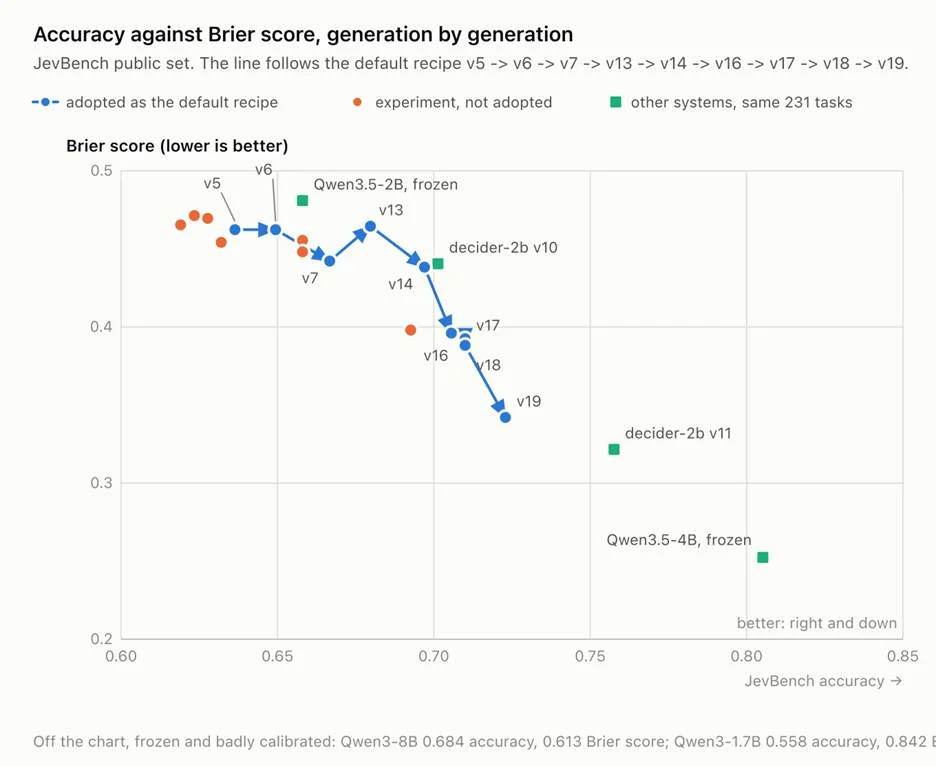
During the development cycle, AWS engineering focused heavily on balancing three core metrics: accuracy, calibration, and latency. In the context of decision architectures, calibration measures how reliably the model’s reported confidence scores reflect its actual empirical correctness.
On the public JevBench evaluation suite, Strands Decider 2B achieved notable results, ranking second among all public models in the two-billion-parameter category and securing the top position among public models that provide a complete, reproducible training recipe. Furthermore, AWS reported that Strands Decider 2B successfully answers every evaluation item within the "easy" tier of JevBench, validating its readiness for routine operational routing and standard agentic gating tasks.
Performance benchmarks published alongside the release highlight the model’s computational efficiency. Running on an Nvidia RTX 3090 GPU, Strands Decider consistently delivers inference and scoring decisions in under 100 milliseconds, with processing durations scaling moderately as task complexity increases. When deployed locally on an Apple M3 MacBook, median response times for lightweight tasks hover around 150 milliseconds.
Chronological Evolution and Strands Labs Incubation
The model released to the public represents the second major architectural iteration of the project. AWS disclosed that an earlier design of the pointer head yielded significantly lower accuracy benchmarks. In a commitment to open scientific progress, the development team preserved every prior experimental iteration within the official GitHub repository, granting researchers a transparent audit trail of how the model architecture evolved over time.
Strands Decider 2B was incubated within Strands Labs, a dedicated internal AWS division established earlier this year to explore unconventional and experimental methodologies in agentic artificial intelligence. This release closely follows the introduction of Strands Harness, a packaging utility designed to equip developers with the foundational tooling and operational scaffolding required to maintain stateful, long-lived autonomous agents in production environments.

Broader Industry Implications and the Path to Production
The rapid proliferation of specialized decision models marks a structural maturation in how enterprises design software around large language models. Rather than relying on monolithic, generalized models to simultaneously handle conversational nuance, complex reasoning, logic execution, and strict programmatic routing, modern architecture is pivoting toward modular orchestration. By delegating strict binary or multi-choice classification tasks to lightweight models like Strands Decider, organizations can drastically cut operational inference costs while mitigating security vulnerabilities associated with unconstrained agentic behavior.
Despite these advantages, questions remain regarding enterprise deployment pathways. While local execution and hybrid architectures provide optimal flexibility for rapid prototyping and localized security compliance, enterprise-scale production environments often demand fully managed, highly available cloud infrastructure. Industry analysts note that a crucial next step for AWS will be determining whether to introduce a fully managed, hosted counterpart to Strands Decider within its existing cloud services portfolio, bridging the gap between local open-source experimentation and enterprise-grade production deployment.
