

Amazon Web Services (AWS) today announced the general availability of AWS Interconnect, a significant new managed private connectivity service designed to simplify and enhance how enterprises connect their diverse cloud environments and on-premises infrastructure to AWS. This launch introduces two core capabilities: AWS Interconnect – multicloud, providing direct, private connections between Amazon Virtual Private Cloud (Amazon VPC) instances and VPCs on other major cloud providers, and AWS Interconnect – last mile, which streamlines the establishment of high-speed, private connections from branch offices, data centers, and remote locations to AWS through existing network providers. This strategic offering addresses long-standing challenges faced by large organizations increasingly adopting multicloud strategies, aiming to reduce operational complexity, improve security, and ensure predictable network performance.
Addressing the Evolving Landscape of Enterprise IT
The modern enterprise IT landscape is characterized by a growing reliance on hybrid and multicloud architectures. Organizations are often compelled to distribute workloads across multiple cloud providers due to a variety of strategic imperatives. These include leveraging specialized services unique to a particular provider, adhering to stringent data residency and compliance regulations in different geographies, or accommodating development teams that have standardized on distinct cloud platforms. However, the benefits of multicloud adoption have historically been tempered by significant networking complexities. Establishing reliable, secure, and performant connectivity between these disparate environments has traditionally demanded extensive coordination, involving the manual configuration of VPN tunnels, intricate negotiations with colocation facilities, and the integration of third-party network fabrics. This often translates into networking teams dedicating substantial time and resources to "undifferentiated heavy lifting"—tasks that, while critical, do not directly contribute to the core business value or application innovation.

AWS Interconnect emerges as a direct response to these operational bottlenecks. It is engineered as a fully managed connectivity service that abstracts away much of the underlying infrastructure complexity, offering a "turnkey experience" for establishing private, high-speed network connections with dedicated bandwidth. The service empowers users to configure resilient, end-to-end connectivity with unprecedented ease, often requiring just a few clicks within the AWS Console. This streamlined process involves selecting desired locations, partner cloud providers, preferred AWS Regions, and bandwidth requirements, effectively removing the friction of partner discovery and the intricacies of manual network provisioning. The fundamental principle underpinning both multicloud and last-mile capabilities is a commitment to offloading infrastructure management from the customer, allowing their teams to reallocate focus towards business-critical applications and strategic initiatives.
AWS Interconnect – Multicloud: Bridging Cloud Ecosystems
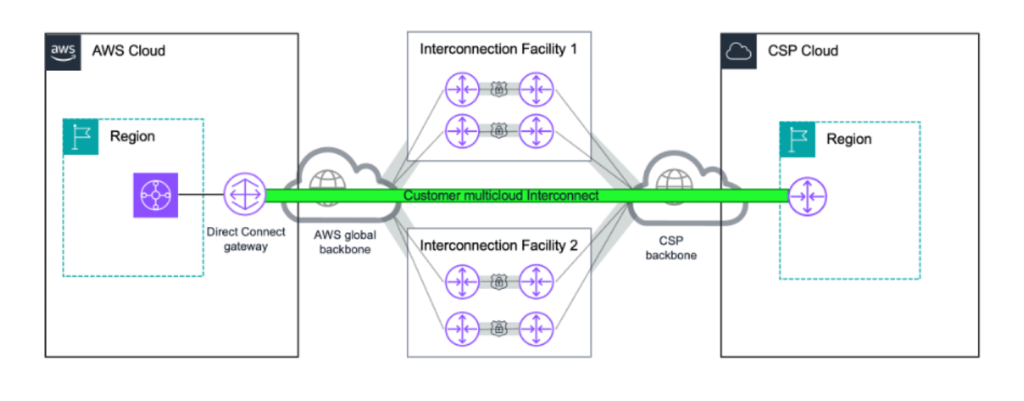
The AWS Interconnect – multicloud capability provides a managed Layer 3 connection that allows private communication between an AWS environment and other cloud providers. At launch, this includes Google Cloud, with support for Microsoft Azure and Oracle Cloud Infrastructure (OCI) slated for introduction later in 2026. A pivotal feature of this service is that traffic traversing these connections flows entirely over the AWS global backbone and the partner cloud’s private network infrastructure. This design ensures that data never traverses the public internet, a critical factor for enterprises demanding predictable latency, consistent throughput, and enhanced isolation from internet congestion and security threats.
Security is a paramount concern for inter-cloud connectivity, and AWS Interconnect – multicloud addresses this with built-in measures. Every connection between AWS routers and partner cloud provider routers at the interconnection facilities utilizes IEEE 802.1AE MACsec encryption on the physical links. This hardware-level encryption is automatically enabled and does not require separate configuration by the customer, significantly enhancing data protection in transit. While AWS manages encryption on its segment, customers are advised to review the specific encryption documentation of their chosen partner cloud provider to ensure their overall deployment meets all relevant compliance requirements. Resiliency is also architected into the service by default; each connection spans multiple logical links distributed across at least two physically distinct facilities. This architectural redundancy ensures that a single device failure or even a localized building outage will not interrupt critical connectivity, thereby maintaining business continuity.
For robust operational oversight, AWS Interconnect – multicloud integrates seamlessly with Amazon CloudWatch. This integration provides a Network Synthetic Monitor included with each connection, offering vital metrics such as round-trip latency and packet loss. Additionally, bandwidth utilization metrics are available to support proactive capacity planning and performance optimization.
In a move demonstrating a commitment to industry collaboration and fostering a broader ecosystem, AWS has publicly released the underlying technical specification for AWS Interconnect on GitHub under the Apache 2.0 license. This open-source approach invites any cloud service provider to collaborate and integrate with AWS Interconnect – multicloud. To become an official AWS Interconnect partner, cloud providers must implement this technical specification and adhere to stringent AWS operational requirements, encompassing resiliency standards, support commitments, and service level agreements. This open model is expected to accelerate the expansion of supported cloud providers and further standardize secure, high-performance inter-cloud connectivity.
Simplified Provisioning and Operational Workflow
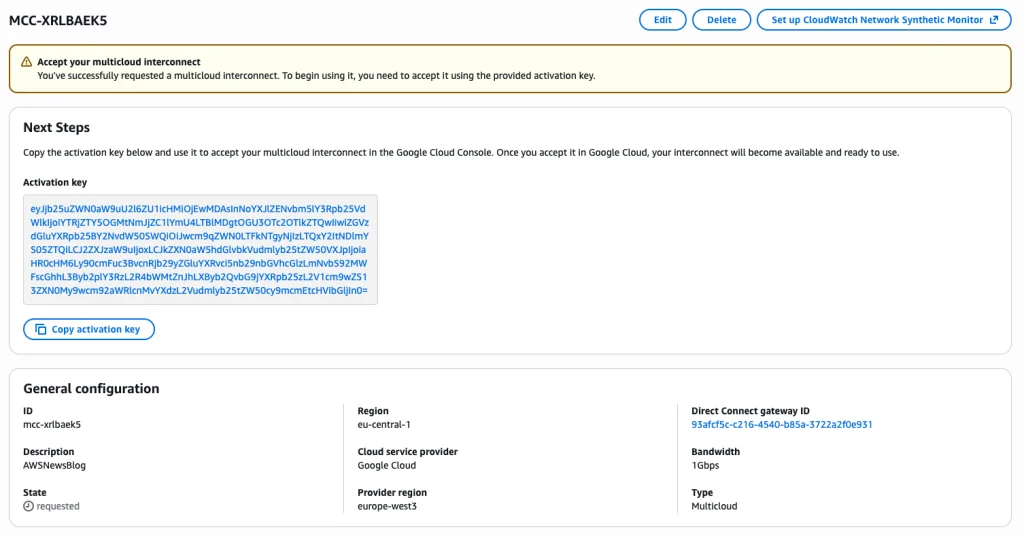
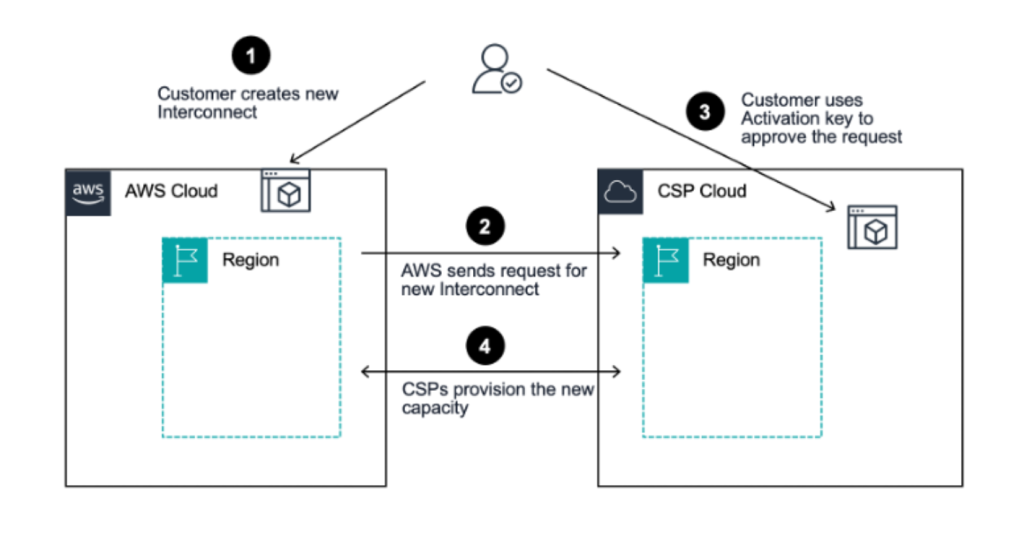
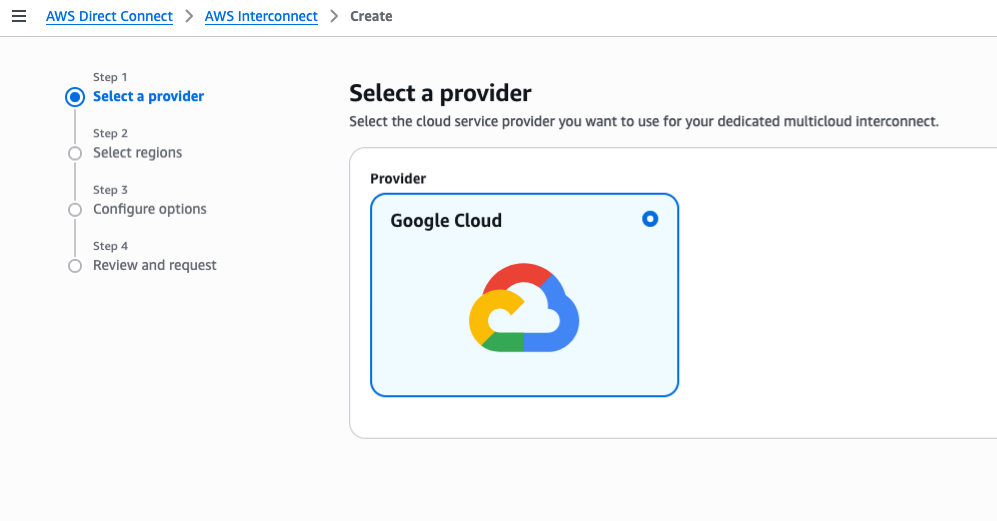
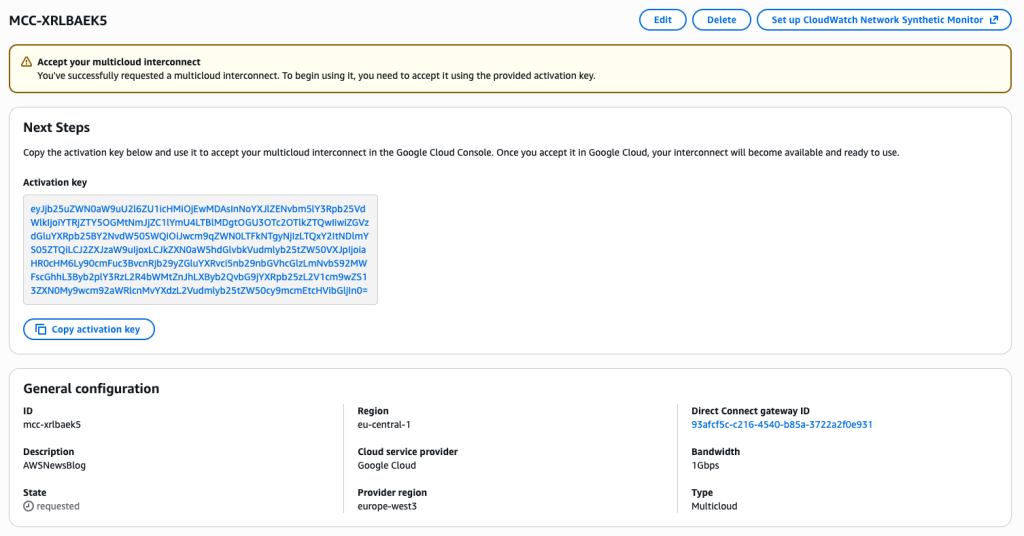
The provisioning process for an AWS Interconnect connection is designed for speed and simplicity, taking mere minutes to complete. The workflow, initiated from the AWS Direct Connect console, involves navigating to the AWS Interconnect section and selecting the desired cloud provider (e.g., Google Cloud). Users specify source and destination regions, required bandwidth, and provide the relevant project ID for the partner cloud. AWS then generates an activation key, which is subsequently used on the partner cloud’s side to complete the connection. A key benefit is the automatic propagation of routes in both directions, enabling workloads to begin exchanging data shortly after activation.
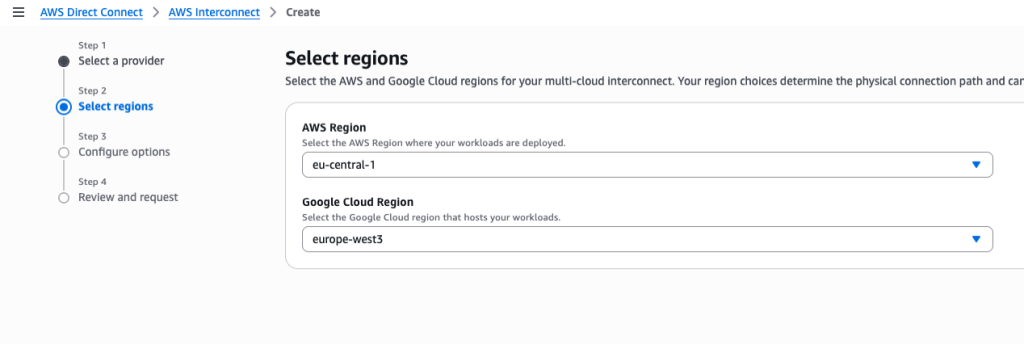
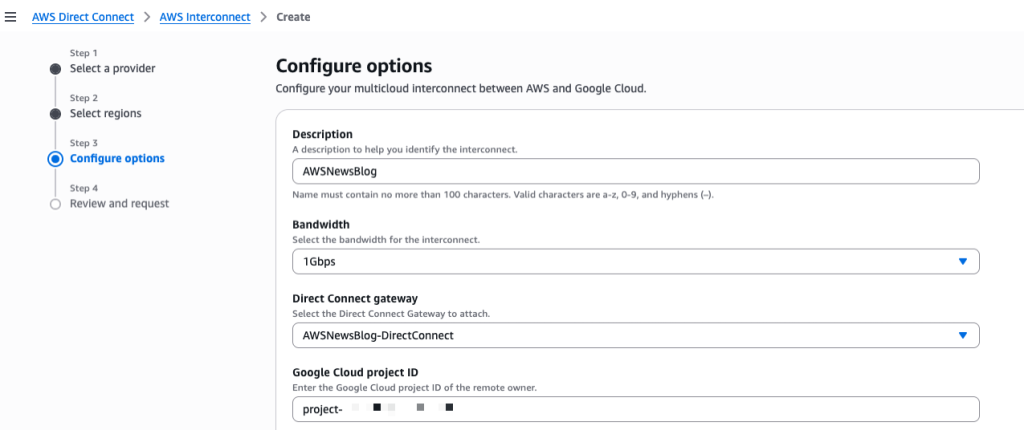
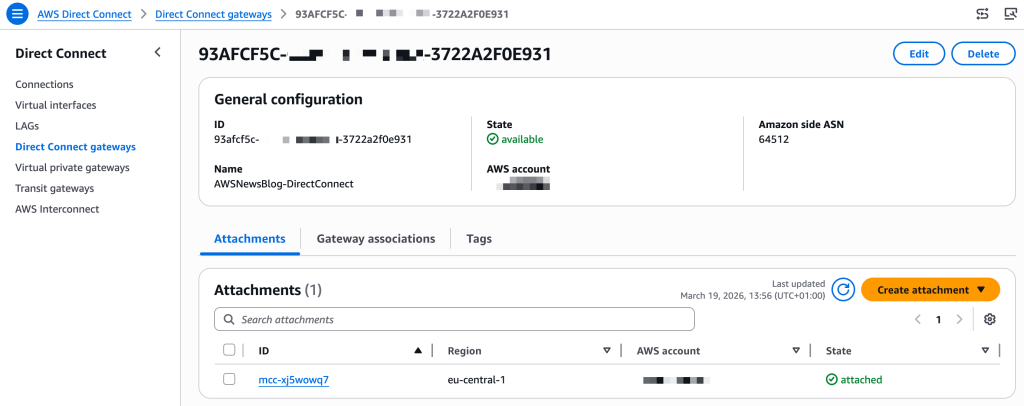
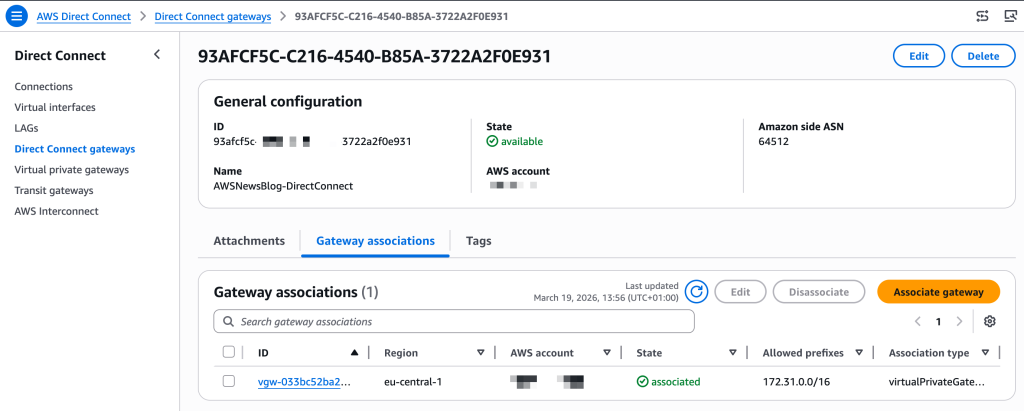
For instance, in a demonstration scenario connecting an AWS VPC to a Google Cloud VPC, the process highlights this ease. After initiating the request in the AWS Management Console, selecting regions (e.g., eu-central-1 and europe-west3), bandwidth, and attaching a Direct Connect gateway, an activation key is generated. On the Google Cloud Platform (GCP) side, the activation key is used with the gcloud network-connectivity transports create command, specifying the region, network, and advertised routes. Following this, a peering connection is established between the GCP VPC and the newly created transport. Once the peering is verified and the AWS Interconnect status becomes "available," the final step on the AWS side involves associating the Direct Connect gateway with a Virtual Private Gateway (VGW) in the same AWS Region and adding a route entry in the VPC Route tables to direct traffic for the GCP IP address range through the VGW. This entire process, culminating in a successful curl command from a GCP instance to an AWS web server, exemplifies the seamless, private network route entirely managed by the respective cloud service providers.
AWS Interconnect – Last Mile: Extending the Cloud to the Edge
Mirroring the architectural principles and design philosophy of its multicloud counterpart, AWS Interconnect – last mile offers a similarly streamlined experience for connecting on-premises or remote locations directly to AWS. This capability leverages participating network providers’ last-mile infrastructure, allowing customers to provision and manage these connections directly from the AWS Management Console.
The onboarding process is intuitive: customers select a network provider, authenticate, and specify their connection endpoints and desired bandwidth. AWS then generates an activation key, which is used within the chosen provider’s console to finalize the configuration. A notable feature of AWS Interconnect – last mile is its automated provisioning of four redundant connections, strategically distributed across two physical locations. This inherent redundancy, combined with automatic BGP routing configuration and default activation of MACsec encryption and Jumbo Frames, ensures a highly resilient and performant private connection to AWS. This approach aligns with industry best practices without imposing the burden of manual component configuration on the customer.
AWS Interconnect – last mile supports a wide range of bandwidths, from 1 Gbps up to 100 Gbps, with the added flexibility of adjusting bandwidth directly from the console without requiring reprovisioning or service disruption. The service comes with a robust 99.99% availability SLA up to the Direct Connect port and includes the CloudWatch Network Synthetic Monitor for continuous connection health monitoring. Like the multicloud offering, AWS Interconnect – last mile attaches to a Direct Connect Gateway, which can then connect to a Virtual Private Gateway, AWS Transit Gateway, or an AWS Cloud WAN deployment, providing scalable and flexible integration options for diverse enterprise network architectures.
Scott Yow, SVP Product at Lumen Technologies, an initial partner for AWS Interconnect – last mile, underscored the transformative potential of this offering: "By combining AWS Interconnect – last mile with Lumen fiber network and Cloud Interconnect, we simplify the last-mile complexity that often slows cloud adoption and enable a faster, and more resilient path to AWS for customers." This sentiment is expected to be echoed by other forthcoming partners such as AT&T and Megaport, as the service expands its partner ecosystem and regional availability.

Advanced Architectures and Global Scalability
For enterprises with expanding deployments involving multiple VPCs within a single region, AWS Interconnect integrates seamlessly with AWS Transit Gateway. This provides a centralized routing hub, enabling all VPCs to connect through a single Interconnect attachment. This centralized approach facilitates traffic segmentation, allows for the application of consistent routing policies, and supports the integration of services like AWS Network Firewall for granular inspection of traffic crossing cloud boundaries.

At a global scale, where workloads are distributed across multiple AWS Regions and multiple partner cloud environments, AWS Cloud WAN extends this model. Cloud WAN enables any region in a customer’s network to reach any Interconnect attachment globally, offering centralized policy management and segment-based routing that applies consistently across worldwide operations. This provides a unified, highly scalable, and manageable global network fabric for the most demanding multicloud and hybrid deployments. The architectural implications and best practices for building resilient and scalable multicloud connectivity using these services are further detailed in specialized AWS blog posts, providing comprehensive guidance for enterprise architects.
Pricing, Availability, and Future Outlook
The pricing structure for both AWS Interconnect – multicloud and AWS Interconnect – last mile is based on a flat hourly rate for the requested capacity, billed pro-rata. The cost varies depending on the bandwidth tier selected by the customer. For multicloud connections, pricing also varies by region pair, reflecting the underlying network infrastructure costs associated with connecting different geographical cloud regions. Deployments utilizing AWS Cloud WAN, with its global any-to-any routing model, may incur costs influenced by traffic traversing multiple regions. Customers are strongly advised to consult the dedicated pricing pages for AWS Interconnect – multicloud and AWS Interconnect – last mile for detailed rate cards specific to region pairs and capacity tiers before finalizing their connection sizing.
At its general availability, AWS Interconnect – multicloud is accessible in five strategic region pairs: US East (N. Virginia) to Google Cloud N. Virginia, US West (N. California) to Google Cloud Los Angeles, US West (Oregon) to Google Cloud Oregon, Europe (London) to Google Cloud London, and Europe (Frankfurt) to Google Cloud Frankfurt. The phased rollout will see Microsoft Azure support introduced later in 2026, followed by Oracle Cloud Infrastructure (OCI). AWS Interconnect – last mile is initially launching in US East (N. Virginia), with Lumen serving as the inaugural partner. Plans are underway to onboard additional partners, including AT&T and Megaport, and to expand regional availability progressively.
This launch represents a pivotal moment in cloud networking, signaling AWS’s commitment to addressing the complex reality of multicloud enterprise environments. By offering a fully managed, secure, and resilient connectivity service, AWS is significantly lowering the barrier to entry for robust multicloud and hybrid strategies. This move not only strengthens AWS’s position as a foundational cloud provider but also fosters an environment where enterprises can truly optimize their cloud investments, focusing on innovation rather than infrastructure plumbing. The open specification for AWS Interconnect further promises to accelerate the evolution of inter-cloud connectivity standards, potentially leading to a more integrated and interoperable future for global enterprise IT.
