

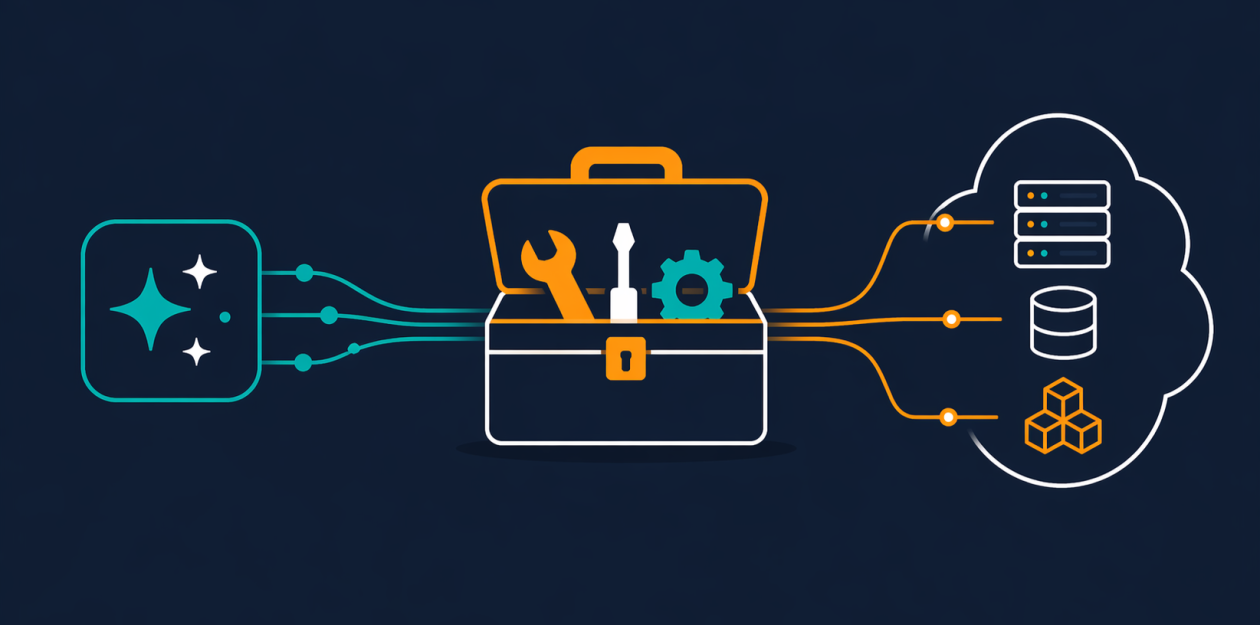
The landscape of software development is undergoing a profound transformation, driven by the rapid advancements in artificial intelligence. As AI agents and coding assistants become increasingly sophisticated, their ability to interact securely and effectively with complex cloud environments has emerged as a critical challenge. For developers and organizations leveraging the power of AI to automate infrastructure provisioning, code generation, and operational tasks on Amazon Web Services (AWS), a persistent question has lingered: how to grant these agents real, authenticated access to AWS resources without compromising security by effectively "handing over the keys to the kingdom." Today, a significant answer arrives with the general availability of the AWS MCP Server, a managed remote Model Context Protocol (MCP) server designed to provide AI agents and coding assistants with secure, authenticated access to the entirety of AWS services through a compact, fixed set of tools.
This strategic release marks a pivotal moment in the integration of AI with cloud infrastructure, directly addressing the security, efficiency, and accuracy limitations previously encountered by AI agents. The AWS MCP Server is an integral component of the broader Agent Toolkit for AWS, a comprehensive suite of tools that includes the MCP Server, alongside specialized skills and plugins. This toolkit is meticulously engineered to empower coding agents to build on AWS with unparalleled effectiveness and efficiency, pushing the boundaries of what AI-driven development can achieve in a secure, production-ready manner.
Addressing Critical Challenges in AI-Powered Cloud Development
Prior to the introduction of the AWS MCP Server, AI coding agents, despite their considerable utility for many development tasks, frequently encountered significant hurdles when attempting to engage with AWS at any meaningful depth. These challenges manifested in several key areas, impacting both the security and operational viability of AI-generated cloud infrastructure.
The "Keys to the Kingdom" Dilemma
One of the most pressing concerns for enterprises adopting AI agents has been the inherent security risk associated with granting them access to cloud environments. Traditional methods often necessitated providing broad, unconstrained credentials, which posed a substantial threat of unauthorized access or unintended modifications. The principle of least privilege, a cornerstone of cloud security, was difficult to enforce effectively with autonomous agents, leading to infrastructure that might function in a demonstration but was far from production-ready due to overly permissive AWS Identity and Access Management (IAM) policies. Organizations required a robust mechanism to separate human and agent permissions, allowing for fine-grained control and comprehensive auditability of all agent actions.
Bridging the Knowledge Gap: The Challenge of Timely Information
Another significant limitation stemmed from the nature of AI model training data. Large Language Models (LLMs) are trained on vast datasets, but this information has a cutoff date. Consequently, agents often relied on training data that could be months, or even years, out of date. This temporal lag meant they were unaware of newly launched AWS services, features, or updated best practices. For instance, services like Amazon S3 Vectors, Amazon Aurora DSQL, or Amazon Bedrock AgentCore, which represent cutting-edge advancements, would be completely unknown to an agent whose knowledge cutoff preceded their launch. This absence of current information frequently led agents to propose suboptimal or outdated solutions, hindering innovation and efficiency.
From Demo to Production: Ensuring Best Practices
Beyond security and up-to-date knowledge, AI agents often struggled to adhere to AWS best practices. When tasked with building infrastructure, they frequently defaulted to using the AWS Command Line Interface (AWS CLI), a powerful but often verbose and less declarative approach, rather than modern infrastructure-as-code tools like the AWS Cloud Development Kit (AWS CDK) or AWS CloudFormation. This preference often resulted in less maintainable, less scalable, and more error-prone infrastructure. Moreover, the IAM policies generated by agents tended to be far broader than necessary, violating the principle of least privilege and creating unnecessary attack surfaces. The output, while functional, lacked the robustness, security, and architectural soundness required for enterprise-grade deployments.
Core Capabilities of the AWS MCP Server
The AWS MCP Server directly addresses these multifaceted challenges through a compact and intelligent set of tools, designed not only to provide secure access but also to optimize the agent’s contextual understanding and operational efficiency. A key design principle is to keep the tool list short and predictable, which significantly reduces the likelihood of "hallucination" by the agent and helps maintain its focus on relevant tasks.
Secure API Access with call_aws
At the heart of the AWS MCP Server’s functionality is the call_aws tool. This powerful tool enables AI agents to execute any of the over 15,000 AWS API operations using the user’s existing IAM credentials. This direct and authenticated access is transformative, allowing agents to perform real-world actions on AWS resources. Crucially, as AWS continues to innovate and launch new APIs, the MCP Server is engineered to support these new operations within days, ensuring that agents always have access to the most current and comprehensive set of AWS capabilities. This capability eliminates the need for agents to rely on static, potentially outdated knowledge bases for executing cloud operations.
Real-time Knowledge with search_documentation and read_documentation
To combat the challenge of outdated training data, the AWS MCP Server integrates search_documentation and read_documentation tools. These tools are designed to retrieve current AWS documentation, best practices, and service details at query time. This real-time access ensures that the AI agent consistently works from up-to-date information, regardless of its underlying model’s knowledge cutoff date. This dynamic information retrieval is critical for leveraging new AWS services, understanding their nuances, and applying the latest architectural recommendations. For instance, an agent inquiring about vector embeddings on S3 would be able to pull the latest documentation on Amazon S3 Vectors, even if that service was launched long after its training data was compiled.
Enhanced Efficiency through run_script
A significant new capability introduced with general availability is the run_script tool. This feature allows an AI agent to write and execute short Python scripts server-side within a sandboxed environment. This sandbox inherits the user’s IAM permissions but operates without network access, effectively isolating the agent’s computational tasks. This means an agent can process data or perform complex logic without gaining access to the local file system or a shell, mitigating significant security risks. The run_script tool is particularly valuable for complex, multi-step workflows. Instead of making multiple, slow, and context-consuming API calls one at a time, the agent can chain API calls, filter responses, and compute results within a single round-trip, dramatically improving both speed and context efficiency. This capability moves beyond simple API calls, enabling agents to perform more sophisticated, programmatic interactions with AWS.
Elevating Agent Performance with Skills
The transition from "Agent SOPs" (Standard Operating Procedures) to "Skills" represents a crucial evolution in agent guidance. Skills provide curated guidance and best practices specifically for tasks where agents commonly make mistakes. These skills are contributed and maintained directly by AWS service teams, ensuring their accuracy, relevance, and alignment with current best practices. By integrating these validated skills, agents can complete work faster, with fewer errors, and using fewer tokens – all of which translate into significant time and cost savings for developers. This approach keeps the internal tool list presented to the agent concise and predictable, further reducing hallucination and helping the agent stay focused on the task at hand. This structured guidance is paramount for elevating AI agents from mere code generators to reliable cloud development partners.

New Features and General Availability Enhancements
The general availability of the AWS MCP Server introduces several key enhancements that refine its capabilities and expand its utility for a broader range of use cases.
Fine-Grained Access Control with IAM Context Keys
A notable improvement is the server’s support for IAM context keys. This enhancement eliminates the previous requirement for a separate IAM permission to use the server itself. Instead, developers can now express highly fine-grained access policies directly within standard IAM policies. This aligns the MCP Server’s authorization model with established AWS security practices, providing greater flexibility and control over what an agent can and cannot do on AWS.
Streamlined Documentation Access
Another practical enhancement is that documentation retrieval no longer requires separate authentication. This simplifies the process of an agent accessing crucial, up-to-date information, making the search_documentation and read_documentation tools more readily available and efficient for information gathering.
Optimized Resource Consumption
For complex, multi-step workflows, the number of tokens required per interaction is a critical factor influencing both cost and performance. AWS has addressed this by reducing the token count required per interaction, making AI agent operations more cost-effective and faster, particularly for intensive development tasks.
Architecting for Enterprise-Grade AI Operations
For enterprise customers, the AWS MCP Server provides robust features that are essential for maintaining security, compliance, and governance standards in AI-driven operations.
Separation of Permissions for Human and Agent
The server offers a clear and enforceable separation between human and agent permissions. Organizations can leverage standard IAM policies or Service Control Policies (SCPs) to precisely define the scope of actions. For example, a policy could specify that a human user can perform mutating operations (e.g., create, modify, delete resources), while the MCP server, and by extension the AI agent, is strictly restricted to read-only actions. This granular control is vital for preventing unintended changes and maintaining a secure operational posture.
Comprehensive Audit Trails and Observability
To meet stringent compliance and auditing requirements, the AWS MCP Server integrates seamlessly with AWS’s robust monitoring and logging services. Amazon CloudWatch metrics published under the AWS-MCP namespace allow organizations to observe MCP server calls distinctly from direct human calls. This provides a transparent audit trail, enabling compliance teams to track and verify all actions initiated by AI agents. Furthermore, Amazon CloudTrail captures all API calls, offering a complete and immutable record of every interaction with AWS services, whether initiated by a human or an AI agent through the MCP Server. This level of observability and auditing is crucial for enterprise adoption, ensuring accountability and adherence to regulatory frameworks.
Demonstrating the Power of Real-time Information Access
To illustrate the transformative impact of the AWS MCP Server, a practical demonstration highlights its ability to overcome the knowledge cutoff limitations of AI models. The chosen AI agent for this demonstration is Claude Code, configured to utilize the Anthropic Opus 4.6 model. Opus 4.6, like other advanced models, possesses a knowledge cutoff date, in this case, May 2025. This means it has no inherent knowledge of events or services introduced after that specific date.
The Baseline: AI Agents with Outdated Knowledge
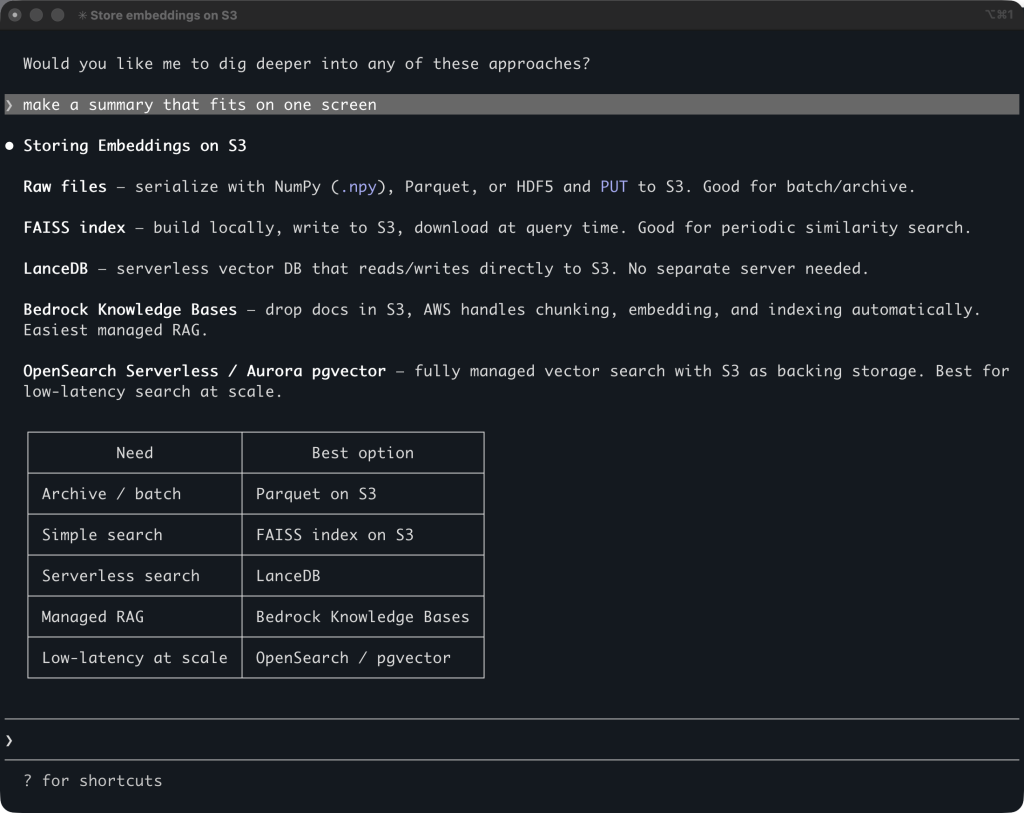
The demonstration begins by posing a question about a recently introduced AWS service: "how to store embedding on S3?" (embeddings being a type of vector). Amazon S3 Vectors, the dedicated service for this purpose, was launched in preview in July 2025 and reached General Availability in December 2025 – well after the Opus 4.6 model’s knowledge cutoff. Without the AWS MCP Server, Claude Code, relying solely on its internal knowledge, provided five correct solutions for storing embeddings on S3. However, none of these solutions leveraged Amazon S3 Vectors, as the model was simply unaware of its existence. This scenario perfectly encapsulates the core problem: AI agents, despite their intelligence, are constrained by the temporal limits of their training data, leading to incomplete or suboptimal recommendations for current cloud challenges.
Integrating the AWS MCP Server: A Step-by-Step Overview
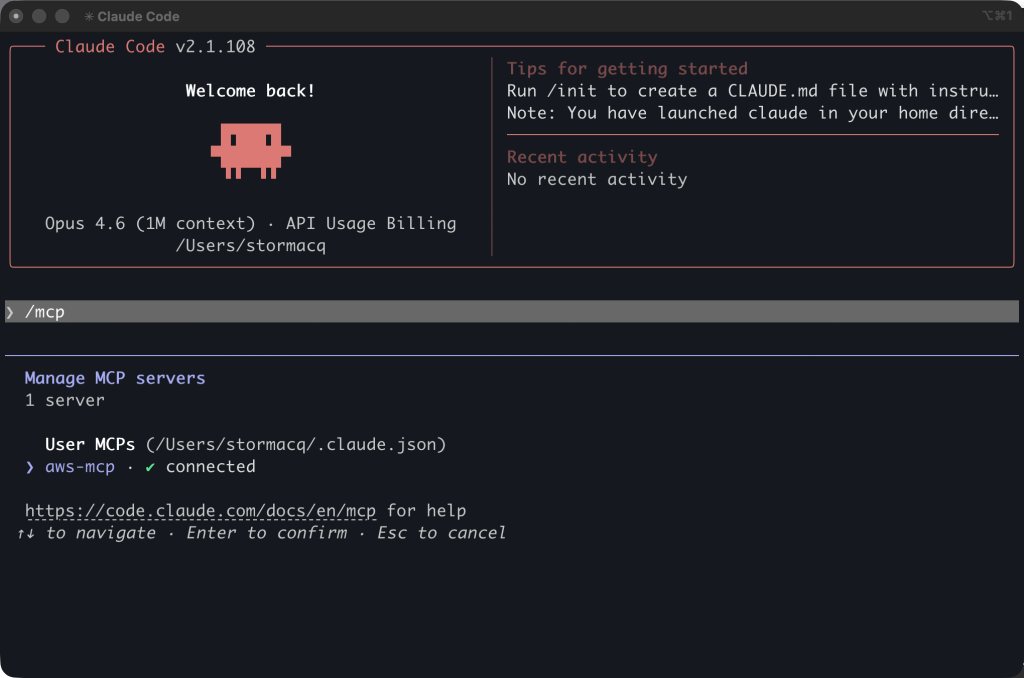
To enable Claude Code to access real-time AWS information, the AWS MCP Server is integrated. This process involves configuring the AI coding agent to call the AWS MCP Server via a proxy, specifically the open-source MCP Proxy for AWS. This proxy, running locally, bridges the world of IAM authentication (used by the MCP Server via SigV4) with OAuth 2.1, which is typically supported by AI agent clients. The configuration is straightforward, using a command to add the AWS MCP Server as an available tool, requiring uv for setup. After installation, a quick verification confirms the AWS MCP Server is correctly installed and can utilize the user’s AWS credentials.
The Transformative Impact on Query Responses
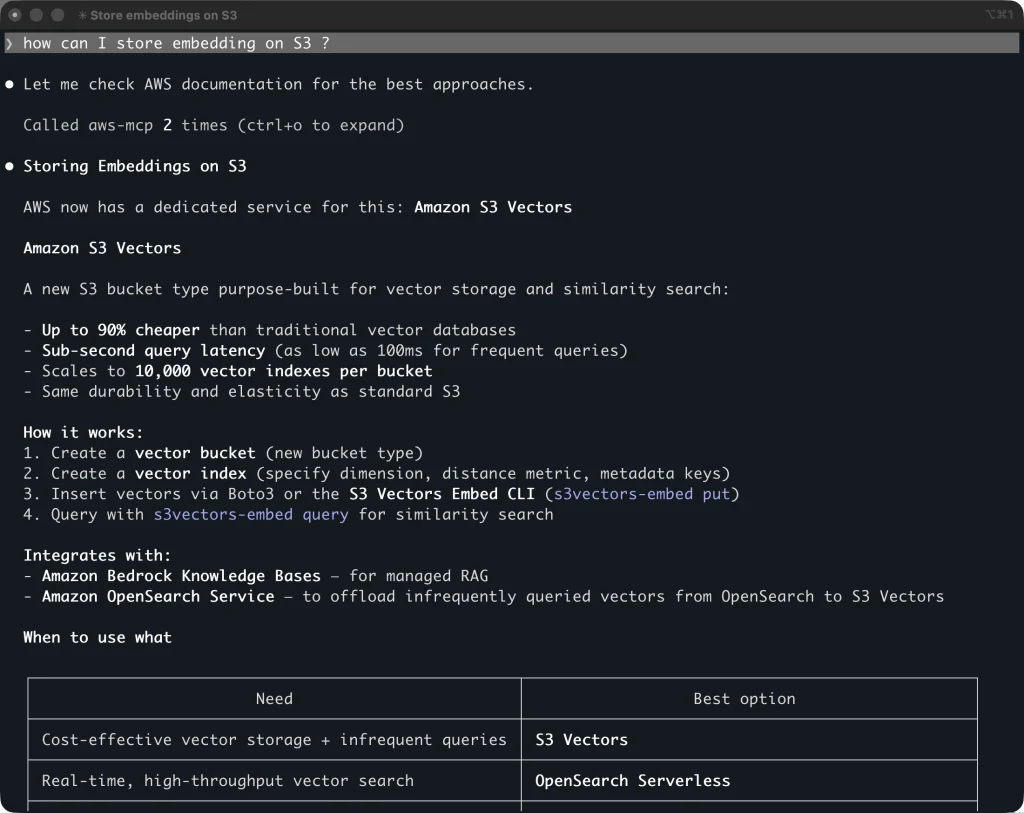
With the AWS MCP Server enabled, the same question is posed: "how can I store embedding on S3?" This time, the AI agent recognizes that it possesses a relevant tool – aws___search_documentation – to address the query. It requests permission to invoke this tool. Within seconds, the agent provides a correct and up-to-date answer: "AWS now has a dedicated service for this: Amazon S3 Vectors…" This dramatic shift in response highlights the critical value of real-time documentation access. The AWS MCP Server empowers the AI agent to overcome its inherent knowledge limitations, providing accurate, current, and optimal solutions, thereby significantly enhancing its utility for cloud development tasks.
Availability and Economic Considerations
The AWS MCP Server is currently available in the US East (N. Virginia) and Europe (Frankfurt) AWS Regions, with the capability to make API calls to any AWS Region globally. A key aspect of its economic model is its pricing structure: there is no additional charge for the AWS MCP Server itself. Customers are solely responsible for the costs of the AWS resources they create and any applicable data transfer fees. This approach makes the service highly accessible, encouraging broad adoption without introducing new, complex licensing models.
The AWS MCP Server is designed for broad compatibility, working seamlessly with Claude Code, Kiro CLI, Kiro, Cursor, OpenAI Codex, and any other MCP-compatible client. This broad interoperability ensures that developers can integrate the MCP Server into their existing AI agent workflows without being locked into a specific vendor ecosystem. Comprehensive guidance on getting started is available through the AWS MCP Server User Guide.
The Future of AI-Driven Cloud Development
The release of the AWS MCP Server marks a significant milestone in the evolution of AI-driven cloud development. It addresses long-standing challenges that have hindered the practical application of AI agents in secure, enterprise-grade AWS environments. The combination of authenticated API access, real-time documentation, and sandboxed script execution within a single, managed server fundamentally alters the capabilities of AI agents on AWS.
This innovation is poised to unlock new levels of developer productivity, enabling AI agents to contribute to more complex and critical tasks with greater accuracy and security. By standardizing secure interaction through the Model Context Protocol and providing essential guardrails, AWS is fostering an environment where AI can truly augment human developers, reducing manual effort, enforcing best practices, and accelerating innovation. The implications extend beyond individual developer workflows, promising to enhance organizational agility, strengthen cloud security postures, and streamline compliance efforts in an increasingly AI-centric world. As developers begin to leverage these powerful new capabilities, the potential for what AI agents can build on AWS is set to expand dramatically, ushering in a new era of intelligent cloud automation.
