
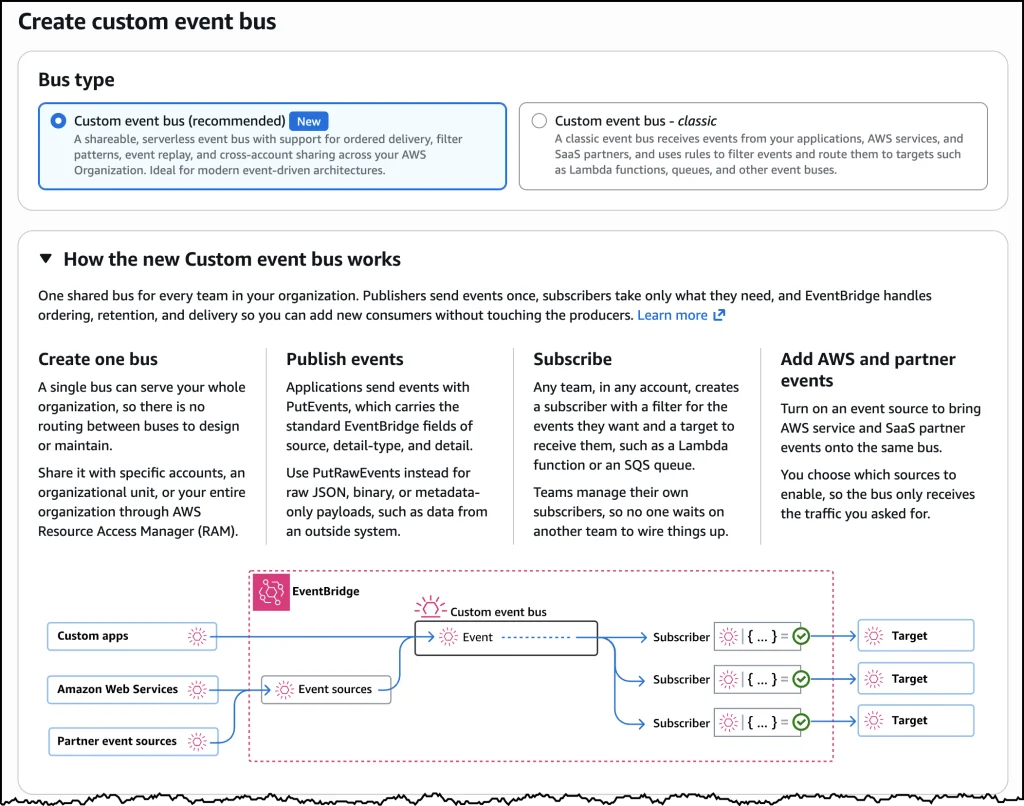

Cloud computing infrastructure has long promised to abstract away the operational overhead of managing servers, routing packets, and maintaining complex network topologies. Yet, as enterprise adoption of serverless computing matured over the past decade, a persistent architectural friction point emerged around event-driven messaging systems. Organizations scaling their cloud footprints across dozens or even hundreds of distinct accounts frequently encountered a maze of cross-account permissions, compounding routing fees, and fragmented visibility. To address these systemic bottlenecks, Amazon Web Services (AWS) has announced the official launch of an enhanced custom event bus in Amazon EventBridge. This next-generation capability is purpose-built to unify event-driven applications across complex organizational topologies without sacrificing security, performance, or financial predictability.
The Evolution of Event-Driven Complexity
To understand the engineering significance of this release, one must examine the historical trajectory of Amazon EventBridge and its predecessor, Amazon CloudWatch Events. In the early days of serverless application development, engineering teams typically operated within a single AWS account. A solitary custom event bus handled decoupled microservices seamlessly, routing payloads from producers to consumers with minimal latency.
However, enterprise governance models rarely remain monolithic. Security best practices, compliance mandates, and the rapid expansion of cross-functional software teams necessitated a decentralized multi-account architecture. Under this prevailing paradigm, individual business units operate inside isolated AWS accounts to maintain strict boundaries for security, auditing, and billing.
While this multi-account strategy successfully isolates risk, it introduces severe friction into event-driven workflows. To route an event generated in an engineering team’s sandbox account to a processing service running in a data analytics account, cloud architects traditionally had to configure complex webs of cross-account resource policies, EventBridge resource-based permissions, and inter-bus routing rules.
This intricate web of workarounds effectively re-introduced the very operational complexity that serverless frameworks were designed to eliminate. Platform engineering teams lost holistic visibility into system-wide event flows, struggling to map which downstream services subscribed to specific upstream data streams. Furthermore, compounding data transfer charges and per-event routing costs associated with multi-bus configurations strained cloud budgets. Worst of all, applications demanding strict sequencing—such as financial transaction processors or real-time logistics tracking systems—were frequently forced to abandon native event architectures entirely or implement cumbersome intermediate queuing layers, such as Amazon SQS, just to preserve message ordering.
Core Architectural Enhancements and Capabilities
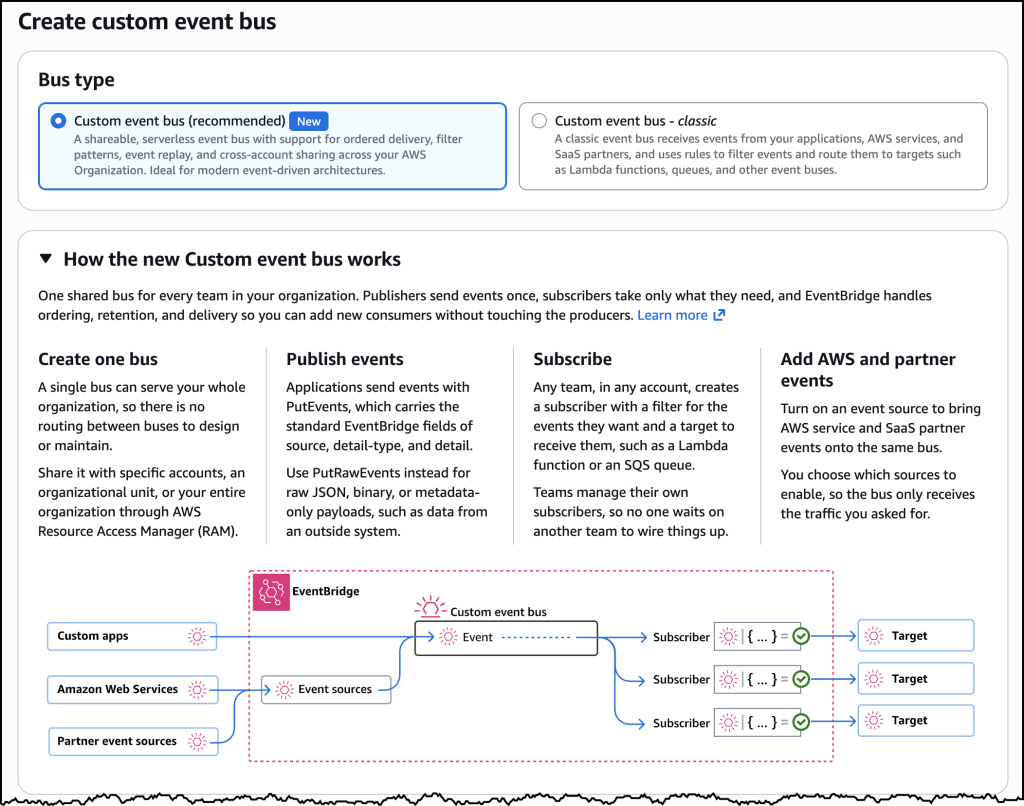
The newly introduced enhanced custom event bus fundamentally redesigns how enterprise organizations manage large-scale event meshes. Rather than maintaining a patchwork of fragmented buses scattered across dozens of individual AWS accounts, platform teams can now provision a single, centralized event bus and securely share it across an entire AWS organization.

This organization-wide distribution relies on native integration with AWS Resource Access Manager (AWS RAM). By leveraging AWS RAM, platform administrators can seamlessly grant publishing and subscribing privileges down to specific AWS accounts, organizational units, or predefined IAM roles and users without manually orchestrating cross-account resource policies or brittle bus-to-bus routing rules.
At the operational core of this release are three transformative capabilities: centralized organization-wide sharing, native event ordering, and the unified Subscriber resource.
Streamlining Administration with Subscriber Resources
In legacy EventBridge configurations, connecting a consumer to an event required an intricate orchestration of separate rules, target specifications, retry policies, and dead-letter queues. The enhanced custom event bus consolidates these disparate moving parts into a single, cohesive entity known as the Subscriber resource.
A Subscriber resource acts as a self-contained operational unit that defines precisely which events a consumer wishes to ingest, how those payloads should be filtered, where they must be delivered, and how downstream failures should be managed via automated retries and dead-letter destinations. Additionally, these resources incorporate variable start-time parameters, radically simplifying the onboarding of new microservices and enabling rapid event replay workflows for disaster recovery or database hydration scenarios.
Resolving the Ordering Dilemma in Distributed Systems
Decoupled architectures inherently favor asynchronous processing models where absolute message sequencing is secondary to high throughput and horizontal scalability. Nevertheless, real-world enterprise workloads frequently present exceptions. In modern supply chain management, inventory tracking, and financial ledger updates, processing an out-of-sequence event can lead to critical data corruption or erroneous automated decisions based on stale state vectors.
The enhanced custom event bus solves this structural challenge by introducing native event ordering capabilities alongside traditional asynchronous delivery on the same bus. Publishers can attach an optional EventGroupId metadata tag to outgoing payloads. EventBridge intelligently routes all events sharing an identical EventGroupId in strict chronological sequence exclusively to subscribers configured for ordered delivery. Meanwhile, other concurrent consumers on the same bus can continue to process messages asynchronously without performance degradation.
To support this ordered execution reliably, AWS has introduced synchronous invocation modes for downstream targets such as AWS Lambda. By confirming successful processing before acknowledging receipt of the event, the architecture eliminates the legacy requirement of interposing Amazon SQS queues between the event bus and compute functions merely to guarantee operational reliability.

Advanced Payload Evaluation and Transformation
Beyond routing and ordering, the upgraded event bus introduces sophisticated payload inspection tools designed to minimize client-side boilerplate code. Content-based deduplication allows EventBridge to automatically detect and drop redundant retries caused by network timeouts or partial failures. By hashing meaningful attributes within the event payload and collapsing identical matches arriving within a five-minute sliding window, the service delivers exactly-once processing semantics without demanding that publishers generate and track custom idempotency tokens.
For teams operating with complex data formats, the platform incorporates native JSONata expression support. Subscribers can dynamically reshape, filter, or project specific fields out of incoming events before they reach downstream APIs. Furthermore, for organizations utilizing schema standards such as Apache Avro or Protocol Buffers, EventBridge can natively deserialize these binary payloads into standard JSON, empowering consumers to execute granular filter patterns across the entire event body without maintaining custom parsing infrastructure.
A Scalable Economics and Pricing Model
Financial governance has historically been a major pain point for engineering leaders scaling event-driven topologies. Traditional EventBridge pricing assessed a flat fee per event published, which compounded rapidly when events hopped across multiple intermediate buses in multi-account environments.
The enhanced custom event bus introduces an innovative ingress and egress throughput pricing structure. Under this revised economic model, publishers absorb costs solely based on the volume of events ingested into the central bus, while subscribers incur charges proportional to the volume of events successfully delivered to their endpoints. This structural shift decouples producer costs from consumer scale, significantly improving cost allocation transparency and cost-efficiency for large-scale distributed enterprises.
Chronology and Strategic Rollout
The release of the enhanced custom event bus represents the culmination of years of enterprise feedback gathered by AWS serverless product teams. Throughout the developmental lifecycle of Amazon EventBridge, enterprise customers repeatedly voiced the need for centralized governance that respects multi-account security boundaries.
The transition pathway for existing workloads has been carefully designed to prevent disruption. Legacy custom event buses will remain fully supported and operational, automatically designated as "Custom event bus – classic" within the AWS Management Console and API surfaces. These classic buses will continue to ingest and route events using established rule-based mechanisms without requiring immediate code modifications or architectural migrations.
Conversely, the newly enhanced custom event bus is available immediately as an optional, opt-in resource configuration. Platform engineers can provision the new centralized bus structure at their own operational pace.
At launch, the enhanced custom event bus is globally available across a robust footprint of AWS Regions, spanning North America, Europe, and Asia-Pacific. Supported regions include US East (N. Virginia, Ohio), US West (Oregon), Europe (Ireland, Frankfurt, Stockholm, Spain), and Asia Pacific (Hong Kong, Malaysia, Mumbai, Singapore, Sydney, Thailand, Tokyo). Organizations can provision and manage these resources immediately through the AWS Management Console, the AWS Command Line Interface (AWS CLI), or programmatic EventBridge APIs.
Industry Implications and Future Outlook
The introduction of the enhanced custom event bus marks a mature turning point in the adoption curve of serverless architectures. For years, critics of serverless computing pointed to the operational overhead of managing complex multi-account event flows as a structural ceiling that limited microservice scalability.
By centralizing multi-account event governance, automating message sequencing, unifying subscriber lifecycle management, and rationalizing pricing, AWS has effectively lowered the barrier to entry for enterprise-grade event-driven architectures. Platform engineering teams are now positioned to reclaim centralized oversight over distributed software ecosystems without stripping away the agility and autonomy that microservice development teams require.
As enterprises continue to migrate mission-critical, state-sensitive workloads to serverless environments, capabilities that bridge the gap between high-throughput asynchronous messaging and strict transactional consistency will become standard operational prerequisites. With this release, Amazon EventBridge establishes a modernized blueprint for cloud-native messaging, setting a high benchmark for scalability, governance, and architectural simplicity in modern distributed computing.
