
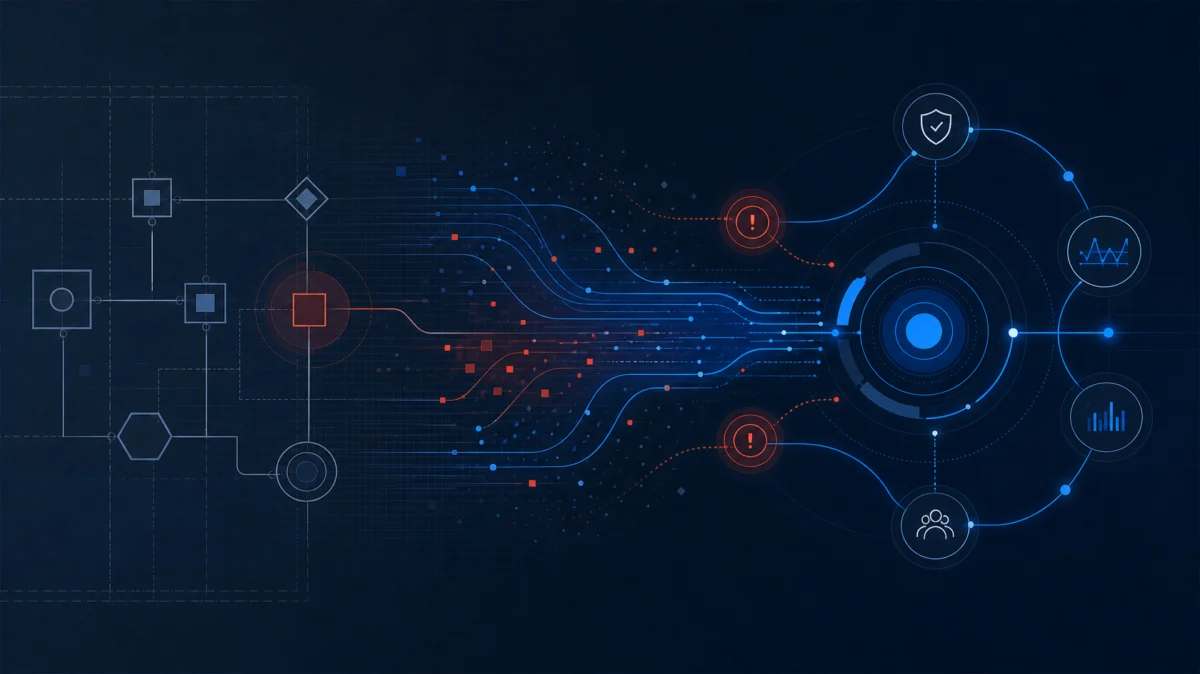

The landscape of enterprise artificial intelligence is undergoing a profound structural evolution, shifting away from a primary reliance on standalone frontier models toward integrated, application-centric architectures. Speaking at the recent AI World conference, Simon de Montfort Walker, Executive Vice President of Industry Applications at Oracle, outlined a critical industry realization: while general-purpose artificial intelligence models have rapidly evolved, achieving fully autonomous, agentic enterprise processes is no longer merely a technical hurdle. Instead, it is an organizational and operational challenge requiring a fundamental redesign of how corporate teams are structured, governed, and deployed at runtime.
This maturation marks a significant departure from the industry discourse of previous years. When enterprise technologists gathered at AI World in 2025, the predominant dialogue centered on the limitations of frontier models—specifically, the observation that generic models could only fulfill approximately 60 percent of specialized industry application requirements. Bridging the remaining 40 percent was viewed through a purely technical lens, prompting software vendors to rush out specialized context layers, retrieval-augmented generation frameworks, and custom domain-specific toolsets.
By contrast, the 2026 conference revealed a more mature technological baseline. Over the past twelve months, the foundational architecture required to build an "agentic enterprise" has become remarkably clear. Organizations increasingly understand where frontier models excel, where they fall short, and how to implement necessary context layers. Technical governance, maintenance frameworks, and data orchestration are solidifying, largely driven by intensive educational initiatives undertaken by major enterprise software vendors.
However, as the underlying technology stabilizes, a new operational bottleneck has emerged. Enterprise software providers have frequently promised to "redefine the operating model" for modern businesses, yet they have often struggled to articulate what this transformation requires of the human organizations tasked with running these systems. As enterprises increasingly transition from design-time planning to runtime execution, the friction point has shifted from software capabilities to human resource allocation and internal corporate governance.
The Shift from Model-Centric to Application-Centric Architecture
The foundational philosophy guiding enterprise software development has experienced a reversal. Last year, the frontier model served as the undisputed center of gravity for AI development, with applications functioning merely as wrappers around powerful foundational algorithms. Today, according to Oracle’s leadership, the application itself has reclaimed its position at the apex of the enterprise technology stack.
Modern industry applications encapsulate a massive accumulation of critical enterprise logic, including complex authority matrices, strict usage rights, regulatory compliance guardrails, and deterministic input-output workflows. Rather than functioning as standalone entities, generic AI models are increasingly utilized as intelligent agents that navigate and leverage the deterministic logic residing securely within established enterprise applications. This orchestration allows generic models to effectively bridge the gap to 100 percent functionality for specific business use cases without compromising corporate safety or compliance.
This realization has left major software providers notably more bullish regarding their core enterprise application portfolios. The past year of development has focused less on the raw capabilities of the underlying models and more on the operational runtime environment: determining what is running, where it is executing, who maintains administrative control, and within what operational boundaries the agentic system is permitted to operate.
Achieving this level of reliability requires sophisticated data orchestration, model orchestration, and runtime trust mechanisms. It represents a fundamental departure from traditional software assurance methodologies, which relied overwhelmingly on design-time validation. Historically, IT departments could satisfy regulatory requirements by demonstrating how a system was designed to function, detailing expected inputs and outputs during the initial planning phase.
In a dynamic agentic environment characterized by living, breathing, and autonomously adapting systems, design-time documentation remains essential, but runtime assurance becomes paramount. Because autonomous agents can execute workflows differently depending on contextual variables, enterprises must implement robust telemetry, real-time guardrails, and hybrid systems that combine deterministic rules with probabilistic artificial intelligence to ensure reliable outcomes.
Democratization of Development and the Rise of Cheap Functionality
The proliferation of advanced AI development tools has dramatically lowered the barrier to creating functional software, democratizing the building process across corporate enterprises. Functionality that once required months of dedicated engineering can now be generated rapidly. While this agility empowers business units to innovate at unprecedented speeds, it introduces severe organizational risks for Chief Information Officers and enterprise technology leaders.
When software creation becomes exceptionally inexpensive, the potential for sprawl and inefficiency multiplies exponentially. Industry veterans frequently draw parallels to the early days of low-code and no-code platforms, such as Oracle’s APEX tool, where empowering non-technical employees to build applications occasionally resulted in dozens of orphaned internal tools that lacked proper oversight, security hardening, or ongoing maintenance.
When building applications becomes frictionless, establishing a rigorous business case, enforcing architectural standards, and maintaining a centralized common platform become critical priorities rather than optional best practices. Organizations that simply hand advanced AI development tools over to traditional IT departments, treating them like routine software upgrade projects, risk stagnation and technical debt. Instead, modern enterprises are discovering that unlocking the true value of agentic systems requires deliberately restructuring internal workflows and team topologies.
Internal Restructuring: The "Brigade System"
To successfully harness the efficiency gains of agentic AI, organizations must rethink how teams are structured and how labor is divided. Oracle’s internal transformation serves as a prime case study in organizational redesign. While the introduction of AI-assisted development tools initially accelerated individual coding tasks, the most profound productivity gains materialized only when the company fundamentally overhauled its team structures—an operational methodology Oracle refers to as the "brigade system."
In traditional product development lifecycles, responsibilities are heavily siloed. User experience designers formulate interface interactions and conceptual workflows, subsequently handing off their design specifications to developers who write the underlying code. In an AI-accelerated enterprise, those traditional boundaries are collapsing. Design professionals are evolving into full-stack engineers capable of collaborating directly with domain experts and leveraging generative tokens to rapidly prototype functional applications.
Once a prototype is generated, it is handed off to a specialized, secondary brigade whose sole mandate is technical architecture, security hardening, and rigorous integration with enterprise security tooling. This separation of concerns—balancing rapid, AI-driven prototyping with disciplined, centralized security and governance—is what enables organizations to achieve a fully trusted runtime environment for agentic applications.
Deploying platforms such as Oracle’s newly introduced Fusion Claw and the AI Agent Studio for Industry Applications provides the technical scaffolding necessary for these workflows. However, technology executives emphasize that software platforms alone cannot solve structural deficiencies. Realizing the promised efficiencies requires corporate leadership to grant multidisciplinary teams the autonomy to experiment, accept controlled failures, and iteratively discover the optimal operating models for their specific industries.
Broader Implications and the Future of Enterprise Governance
As enterprises continue to integrate agentic systems into their core operations, the broader implications for the global software economy are coming into sharper focus. Rather than wholesale replacing existing enterprise resource planning systems with bespoke, in-house artificial intelligence architectures, organizations are overwhelmingly choosing to extend their trusted platform providers. This approach minimizes migration friction while leveraging existing data governance frameworks.
However, the horizontal nature of agentic systems—their ability to traverse traditional departmental boundaries and automate complex, multi-step business processes—forces corporate management to rethink organizational hierarchies. Traditional enterprise structures, built around rigid functional silos, are poorly suited for systems designed to optimize fluid, end-to-end business outcomes.
Industry analysts and enterprise leaders alike agree that navigating the transition to autonomous agentic operations will require more than technical proficiency. As the noise surrounding token economics and raw model capabilities subsides, the ultimate competitive advantage will belong to organizations that successfully synchronize their technological architectures with innovative, resilient internal operating models. Bridging the gap between technological potential and organizational reality remains the defining challenge for enterprise leadership in the current technological era.
