

Amazon Web Services (AWS) today unveiled AWS Transform – continuous modernization (preview), a significant new capability designed to tackle the pervasive and costly challenge of technical debt for enterprises globally. This innovation builds upon the existing AWS Transform suite, extending its reach to provide continuous, autonomous analysis and remediation of tech debt across vast codebases, addressing a critical pain point that has long burdened engineering organizations.
Understanding the Challenge: The Growing Burden of Technical Debt
Technical debt, often likened to financial debt, refers to the accumulated cost of choosing an easy (but limited) solution now instead of using a better (but more complex) approach that would take longer. This debt manifests in various forms: outdated software dependencies, deprecated frameworks, security vulnerabilities, inconsistent coding standards, and inefficient architectures. Industry estimates consistently place the cost of technical debt at a staggering figure, consuming a substantial portion of IT budgets—often cited as high as 30% of engineering resources—that could otherwise be allocated to innovation and new feature development.
For decades, enterprises have grappled with the sheer scale and complexity of managing this debt. Traditional approaches involve periodic, manual audits, often relying on disparate point solutions. One tool might identify dependency issues, another flags security vulnerabilities, and yet another assesses code quality. The result is a fragmented, labor-intensive process that demands significant engineering capacity, pulling developers away from strategic initiatives. Project leaders frequently rely on self-reported team statuses, which often lag reality, hide regressions, and fail to provide a comprehensive, real-time view of the codebase’s health.
The advent of AI-assisted development tools, while accelerating the pace of code generation and deployment, paradoxically exacerbates the tech debt problem. As coding agents generate code faster, the accumulation of technical debt can outpace human developers’ ability to identify, prioritize, and remediate it. This creates a vicious cycle where agility is undermined by an ever-growing backlog of maintenance tasks, impacting everything from system performance and reliability to security posture and developer morale. Recognizing this escalating challenge, AWS has introduced a capability specifically designed to detect, prioritize, and remediate technical debt continuously, autonomously, and at scale.
Introducing AWS Transform: A Foundation for Modernization
Before delving into the specifics of continuous modernization, it is crucial to understand its foundation. AWS Transform is a comprehensive suite of tools and services aimed at assisting enterprises in their journey to migrate applications and infrastructure from on-premises data centers to the cloud, as well as modernize existing applications. Its core mission is to alleviate the undifferentiated heavy lifting associated with software maintenance and evolution.
Existing functionalities within AWS Transform already enable organizations to:
- Migrate out of data centers: Streamlining the complex process of moving legacy systems to AWS.
- Modernize mainframe and Windows applications: Providing pathways to re-platform or refactor critical business applications.
- Handle software maintenance: Automating routine but essential tasks such as upgrading Java versions, replacing deprecated frameworks, and updating AWS Lambda runtimes before they reach their end-of-life. This proactive approach helps prevent outages, security breaches, and performance degradation that can arise from running outdated software components.
The introduction of AWS Transform – continuous modernization marks a significant evolution, extending the platform’s capabilities to offer an always-on, proactive defense against the accumulation of technical debt, thereby ensuring that modernization efforts are not one-off projects but an ongoing state of operational excellence.
The New Frontier: Continuous Modernization Explained
The newly announced capability within AWS Transform addresses two primary challenges: achieving comprehensive visibility into the state of an enterprise’s codebase and enabling autonomous, scalable remediation of identified issues. This new experience empowers customers with full visibility across thousands of repositories, presenting prioritized findings, and, crucially, generating the necessary pull requests to implement fixes automatically.
Deep Dive into Continuous Analysis
One of the most significant advancements is the "continuous analysis" feature. To combat the visibility challenge inherent in large, distributed engineering environments, AWS Transform – continuous modernization automatically scans code repositories against configurable baselines. This process, which once took weeks or months through manual efforts, can now generate detailed findings in mere hours.
Out-of-the-box, the service includes a robust set of policies designed to detect common sources of technical debt, such as:
- End-of-life dependencies: Identifying libraries or components that are no longer supported, posing security risks and compatibility issues.
- Deprecated frameworks: Flagging older versions of frameworks that should be updated to leverage new features, performance improvements, or security patches.
- Other common tech debt patterns: Covering a wide array of best practices and known anti-patterns.
Beyond these standard policies, organizations can extend the system with their own custom remediation patterns. This flexibility is critical for enterprises with unique internal coding standards, preferred libraries, or specific tech debt policies enforced by their platform teams. For instance, if an internal library has been deprecated in favor of a newer alternative, or if a particular logging pattern is mandated across the organization, these rules can be codified as policies and continuously applied across all connected repositories.

The continuous nature of this analysis provides "ground truth" directly from the source code, eliminating the guesswork and potential inaccuracies of periodic manual reviews. When a repository deviates from its configured baseline, platform teams are immediately notified, gaining precise insights into which components are behind and by how much. This real-time visibility negates the need for time-consuming status check-ins, manual compliance tracking, and subjective assessments, offering an always-current, objective view of the organization’s technical debt landscape. This shift from reactive firefighting to proactive management represents a paradigm change in how enterprises approach code quality and maintainability.
Empowering Autonomous Remediation at Scale
Identifying technical debt is only half the battle; the true challenge lies in its remediation. AWS Transform – continuous modernization introduces "autonomous remediation at scale," a groundbreaking feature that automates the generation of pull requests for affected repositories once findings have been identified and prioritized.
The service provides a library of out-of-the-box remediation transformations for common scenarios, including:
- Java version upgrades: Automating the complex process of updating Java runtimes.
- SDK migrations: Facilitating transitions between different versions or entirely new SDKs.
- Library updates: Ensuring that all dependencies are current and secure.
For organization-specific patterns, customers can also create custom transformations. This allows enterprises to encode their unique solutions to common internal tech debt problems, ensuring consistency and efficiency across their development ecosystem.
When a remediation campaign is launched, the continuous modernization capability automatically creates a pull request for each affected repository. These pull requests come with a clear, concise message for the owning team, such as: "This repository is behind on your organization’s baseline for this dependency. Here’s a PR that resolves it." This direct communication streamlines the remediation process. Development teams can then review and merge the pull request, or, if they prefer, implement the fix using their own approach. Regardless of the chosen method, the continuous analysis feature automatically detects when the fix is in place, providing verifiable ground truth without requiring manual confirmation or reporting.
A crucial aspect of this new capability is its integration with AWS Security Agent. This integration means that security vulnerabilities detected at the source-code level are automatically fed into the same prioritized list and pull-request workflow as other forms of technical debt. This holistic approach ensures that security findings are not siloed but are treated as an integral part of the overall code quality and modernization effort, allowing organizations to maintain a robust security posture alongside their development velocity.
A User’s Perspective: Navigating the New Capability
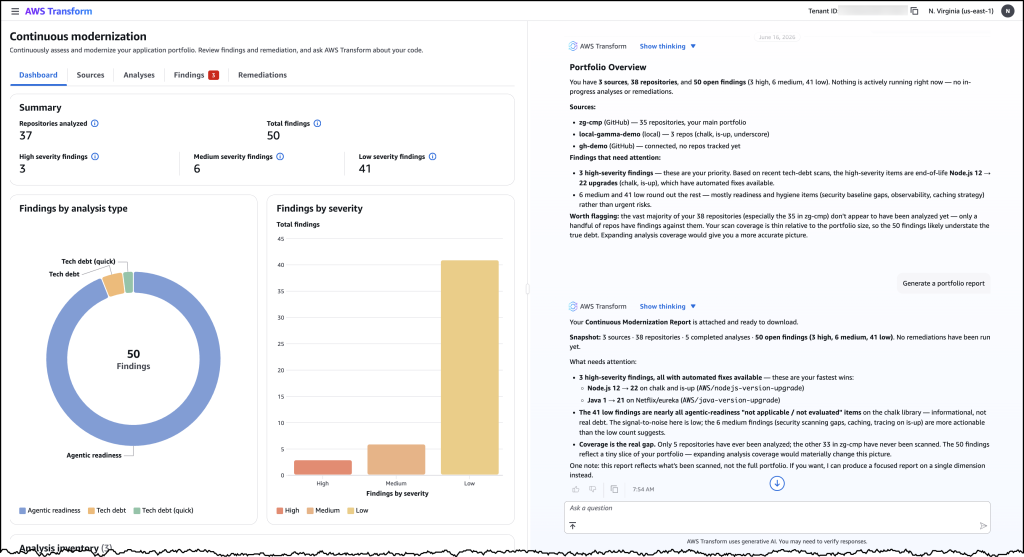
To illustrate the practical application, consider a scenario where an engineering leader initiates the process through the AWS Transform web application. The dashboard immediately presents an overview of the organization’s repositories, highlighting their current status against predefined baselines.
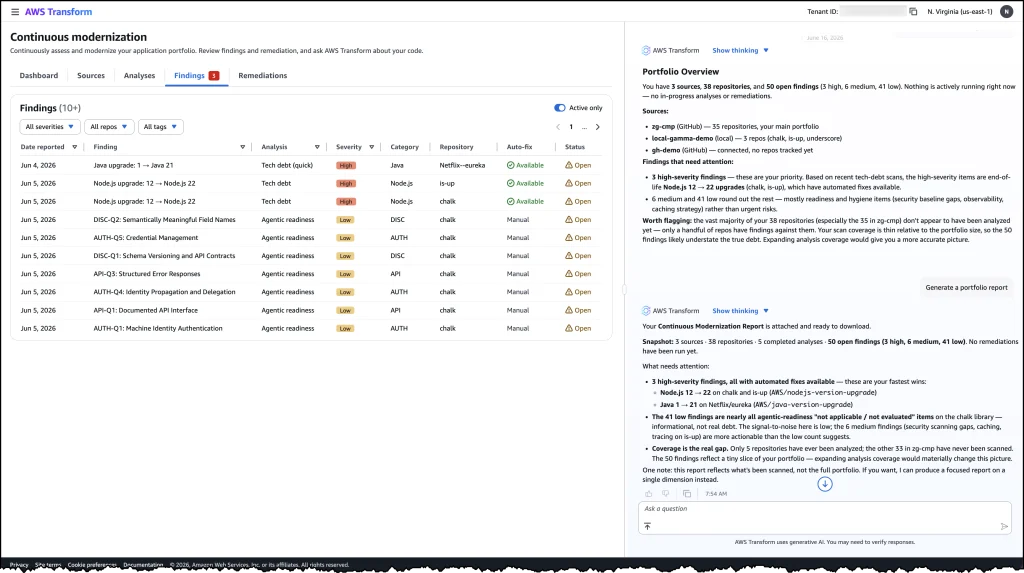
The initial step involves connecting the organization’s source control system (e.g., GitHub, GitLab, AWS CodeCommit) and configuring the desired policies. Once initiated, the continuous analysis engine begins scanning. Within hours, the system populates the dashboard with findings across hundreds or even thousands of repositories. The leader can visualize which repositories are behind the baseline, and by how much. The findings are granular, detailing severity levels, the number of affected files, and the specific tech debt patterns detected (e.g., "Outdated Spring Boot version," "Use of deprecated logging library," "Unsecured API endpoint").
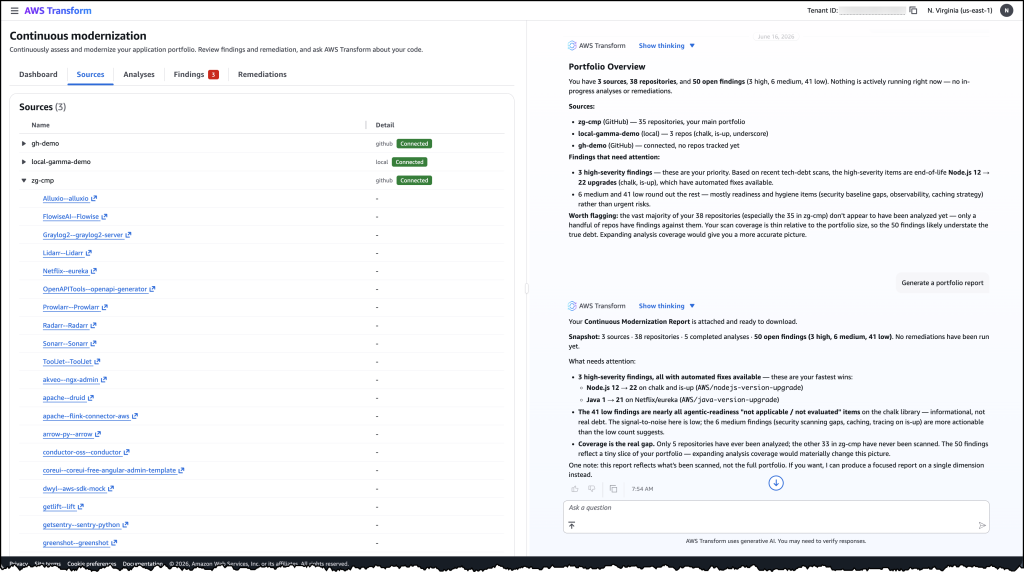
From this detailed view, the leader can select a group of high-priority findings—perhaps all instances of a critical security vulnerability or an urgent framework upgrade—and launch a remediation campaign. AWS Transform – continuous modernization then automatically generates pull requests for each affected repository. The progress of this campaign can be monitored in real time, providing transparency into which PRs have been created, which have been merged by development teams, and which repositories have successfully returned to compliance. Visual aids like the dashboard (Image 1 in the original context) offer a portfolio overview of technical debt findings, while detailed views (Image 2) list individual items by severity, category, and repository, along with available remediation options. The sources view (Image 3) confirms which repositories are actively being tracked for analysis. This intuitive workflow transforms a previously arduous and opaque process into a transparent, actionable, and largely automated one.
Dual Modes of Operation: Continuous vs. Campaign Modernization
AWS Transform – continuous modernization supports two distinct, yet complementary, approaches to code modernization, allowing organizations to tailor their strategy to the scale and nature of the task at hand.
-
Continuous Mode: This mode is designed for the ongoing, day-to-day work of keeping codebases current. It involves continuously monitoring for and addressing evolving baselines, such as routine library upgrades, applying security patches as they emerge, and enforcing internal coding standards across the organization. This mode ensures that technical debt is managed incrementally, preventing large, unmanageable accumulations. It fosters a culture of continuous improvement and proactive maintenance.
-
Campaign Mode: For larger, more complex modernization projects, such as migrating an entire portfolio of applications from one major framework version to another, or upgrading a critical runtime across hundreds of interdependent services, AWS Transform continues to offer its flexible primitive for campaign-based modernization. This mode allows for targeted, project-based efforts with defined start and end points, typically involving more significant architectural shifts or mass updates. While AWS Transform provides the underlying engine for these larger transformations, AWS Transform – continuous modernization is purpose-built for the recurring, high-volume work that platform teams manage every day, ensuring that the foundation remains stable and secure while larger projects unfold.
Industry Context and Expert Commentary
The introduction of AWS Transform – continuous modernization comes at a time when digital transformation initiatives are paramount for competitive advantage. Industry analysts have long highlighted the paradox where the pursuit of agility often leads to the accumulation of technical debt, which then hinders future agility. This new offering directly addresses that paradox.
An AWS spokesperson, potentially a product leader for AWS Transform, might emphasize: "Enterprises are under immense pressure to innovate faster, but technical debt has become a silent inhibitor. Our new continuous modernization capability is designed to break this cycle, empowering engineering teams to maintain clean, secure, and up-to-date codebases without sacrificing velocity. It shifts the burden of undifferentiated maintenance from developers to intelligent automation, freeing them to focus on delivering value."
Such a sentiment underscores AWS’s strategic commitment to providing tools that not only facilitate cloud adoption but also ensure sustainable operational excellence in the cloud. The integration with existing AWS services and the flexibility for custom policies highlight a comprehensive approach that can adapt to diverse enterprise needs.
Broader Implications for Enterprise IT
The implications of AWS Transform – continuous modernization are far-reaching for enterprise IT:
- Enhanced Efficiency and Cost Savings: By automating the detection and remediation of technical debt, organizations can significantly reduce the engineering hours spent on maintenance. This translates directly into cost savings and allows development teams to reallocate resources to innovation, new feature development, and strategic initiatives.
- Improved Security Posture: The seamless integration with AWS Security Agent ensures that security vulnerabilities are identified and addressed proactively at the source-code level, significantly reducing the attack surface and bolstering overall system security.
- Increased Developer Productivity and Morale: Developers can spend less time on tedious, repetitive maintenance tasks and more time on creative problem-solving and building new functionalities. This not only boosts productivity but also improves job satisfaction and retention.
- Faster Time-to-Market: A clean, modern codebase is inherently more agile. By continuously reducing technical debt, organizations can accelerate their development cycles, deploy new features faster, and respond more quickly to market demands.
- Better Compliance and Governance: The continuous analysis against configurable baselines provides an auditable, real-time record of compliance with internal standards and external regulations, simplifying governance and reporting.
- Strategic Advantage: Organizations that effectively manage technical debt gain a significant competitive edge, allowing them to innovate faster, operate more securely, and deliver superior customer experiences.
Availability and Next Steps
AWS Transform – continuous modernization (preview) is available today, offering enterprises a tangible solution to a long-standing challenge. Organizations interested in leveraging this new capability can get started through the AWS Transform web application. Further integration options are available via AWS Transform Kiro Power, and through MCP and skills for seamless integration with existing coding agents. Detailed information and guidance are provided in the comprehensive AWS Transform documentation, enabling customers to quickly onboard and begin their journey toward continuous, autonomous code modernization. This release marks a pivotal step in enabling enterprises to not just migrate and modernize, but to sustain a state of perpetual readiness and innovation in the cloud era.
