

Amazon Web Services (AWS) today announced the launch of AWS Lambda MicroVMs, a significant evolution in its serverless computing portfolio designed to address the burgeoning demand for highly isolated, stateful, and rapidly responsive execution environments. This new serverless compute primitive within AWS Lambda empowers developers to run user-generated or AI-produced code in dedicated, isolated environments, offering the robust security of virtual machines with the agility and operational simplicity characteristic of serverless architectures. Leveraging Firecracker, the lightweight virtualization technology that already underpins trillions of monthly Lambda function invocations, Lambda MicroVMs promise near-instant launch and resume capabilities, direct control over environment lifecycle, and persistent state management, all without the overhead of infrastructure management or deep virtualization expertise.
The Evolution of Serverless: Addressing a Critical Gap
The journey of cloud computing has been marked by a continuous quest for greater abstraction, efficiency, and scalability. AWS Lambda, launched in 2014, revolutionized the landscape by popularizing the Functions-as-a-Service (FaaS) model, enabling developers to execute code without provisioning or managing servers. This paradigm proved immensely successful for event-driven, stateless, and short-lived workloads, swiftly becoming a cornerstone of modern application development. However, as the cloud matured and new application patterns emerged, certain limitations of traditional FaaS became apparent, particularly for applications requiring long-running, interactive sessions or the safe execution of untrusted code.
Over the past few years, a distinct class of multi-tenant applications has surged in popularity. These include sophisticated AI coding assistants that execute user-proposed code snippets, interactive development environments (IDEs) hosted in the cloud, advanced data analytics platforms processing sensitive user queries, vulnerability scanners that need to inspect arbitrary code, and online game servers running user-supplied scripts. A common thread across these applications is the imperative to provide each end-user or session with its own secure, dedicated execution environment.
Historically, developers building such capabilities faced a difficult choice, often involving significant trade-offs:
- Traditional Virtual Machines (VMs): While offering strong isolation, VMs are notoriously slow to start, often taking minutes to boot. This latency is unacceptable for interactive user experiences. Managing VMs also entails substantial operational overhead.
- Containers: Containers launch in seconds, offering a much faster startup time. However, their shared-kernel architecture means that to safely contain untrusted code, significant custom hardening and security expertise are required to prevent potential escape vulnerabilities. This adds complexity and a burden of responsibility on developers.
- Functions-as-a-Service (FaaS): Optimized for ephemeral, request-response workloads, FaaS is typically stateless. Maintaining environment state across user interactions or running long-duration interactive sessions was not its primary design goal, making it unsuitable for applications requiring persistent context.
This dilemma forced developers to either compromise on performance, isolation, or invest heavily in building and operating complex custom virtualization infrastructure. Such an undertaking demands deep, specialized expertise, diverting valuable engineering resources from core product development. AWS Lambda MicroVMs has been purpose-built to precisely bridge this gap, offering a solution that combines the best aspects of these disparate technologies without their inherent drawbacks.

Firecracker: The Foundation of Enhanced Isolation and Performance
At the heart of AWS Lambda MicroVMs lies Firecracker, an open-source virtualization technology developed by AWS. Firecracker is a crucial innovation that has quietly powered the incredible scale and security of AWS Lambda since its inception, alongside other serverless services like AWS Fargate. Designed specifically for serverless workloads, Firecracker creates lightweight virtual machines (MicroVMs) that are significantly more efficient than traditional VMs. These MicroVMs boot in milliseconds, consume minimal resources, and provide the same strong security isolation as full-fledged VMs.
The fact that Firecracker has successfully handled over 15 trillion monthly Lambda function invocations speaks volumes about its operational maturity, robustness, and performance at an unprecedented scale. By leveraging this battle-tested technology, Lambda MicroVMs inherit a foundation of enterprise-grade security and reliability. Each session within a Lambda MicroVM runs in its own dedicated virtual machine, ensuring no shared kernel or resources between users. This robust isolation guarantees that untrusted code supplied by one user is securely contained within their execution environment, preventing any unauthorized access to other environments or the underlying system. This level of isolation is paramount for applications dealing with sensitive data or user-generated content, offering developers peace of mind regarding security boundaries.
A New Paradigm for Stateful Serverless
AWS Lambda MicroVMs introduces three groundbreaking capabilities that, until now, were not simultaneously available in a single AWS compute service:
-
Virtual Machine Level Isolation: As mentioned, this is powered by Firecracker. It means each user or session gets a truly isolated environment. Unlike containers, which share the host operating system kernel, MicroVMs run in their own kernel, providing a stronger security boundary against malicious or faulty user code. This makes them ideal for multi-tenant applications where code from different users must be strictly separated.
-
Rapid Launch and Resume: This is a game-changer for interactive applications. The model follows an "image-then-launch" approach. Developers create a MicroVM Image by providing a Dockerfile and application code, typically packaged as a zip artifact in Amazon S3. Lambda then executes the Dockerfile, initializes the application, and critically, takes a Firecracker snapshot of the running environment’s memory and disk state. Subsequent MicroVMs launched from this image resume from this pre-initialized snapshot rather than undergoing a cold boot. This innovative approach drastically reduces startup latency, achieving near-instant launches and idle resumes. Even complex, multi-gigabyte interactive sessions can come back online quickly enough to feel entirely responsive to the end-user, eliminating the frustrating delays associated with traditional VM provisioning.
-
Stateful Execution: A core differentiator, a running MicroVM retains its memory, disk state, and running processes throughout the user’s session. This persistence is crucial for interactive applications where context needs to be maintained. Furthermore, during periods of inactivity, a MicroVM can be suspended – with its complete memory and disk state preserved – and then rapidly resumed when new traffic arrives. This means installed packages, loaded machine learning models, and working filesets are immediately available when a user returns to their session. This capability supports diverse use cases, from software vulnerability scans that complete in minutes, to complex data analytics applications running for hours, and interactive coding sessions with extended idle periods. Lambda MicroVMs support up to 8 hours of total runtime, and the ability to automatically suspend after a configurable idle window significantly optimizes costs while preserving the full application state for a fast resume. Developers should, however, note that applications generating unique content, establishing network connections, or loading ephemeral data during initialization may require integration with service-provided hooks for compatibility, given that they are started from pre-initialized snapshots.

Developer Experience: From Image to Execution
The process of deploying and managing applications on Lambda MicroVMs is designed to be intuitive and aligned with existing AWS workflows, accessible via the AWS Console or the AWS Command Line Interface (CLI).
To begin, developers navigate to the AWS Lambda console, where Lambda MicroVMs now appear in the left-hand navigation menu. The first step involves creating a MicroVM Image. For instance, a developer might package a Flask web application and its Dockerfile into a zip archive and upload it to an Amazon Simple Storage Service (Amazon S3) bucket.
A typical Flask application (app.py) might look like this:
import logging
from flask import Flask, jsonify

app = Flask(__name__)
logging.basicConfig(level=logging.INFO)

@app.route("/")
def hello():
    app.logger.info("Received request to hello world endpoint")
    return jsonify(message="Hello, World!")

if __name__ == "__main__":
    app.run(host="0.0.0.0", port=5000)
And its corresponding Dockerfile, based on the public.ecr.aws/lambda/microvms:al2023-minimal base image, would set up the Python environment, install dependencies, and define the application’s entry point:
FROM public.ecr.aws/lambda/microvms:al2023-minimal
RUN dnf install -y python3 python3-pip && dnf clean all

WORKDIR /app

COPY requirements.txt .
RUN pip install --no-cache-dir -r requirements.txt

COPY app.py .

EXPOSE 5000

CMD ["gunicorn", "--bind", "0.0.0.0:5000", "app:app"]
Once the code and Dockerfile are ready, the MicroVM Image can be created using a CLI command:
aws lambda-microvms create-microvm-image
--code-artifact uri=<path/to/s3/artifact.zip> --name <VM_image_name>
--base-image-arn arn:aws:lambda:us-east-1:aws:microvm-image:al2023-1
--build-role-arn <IAM role ARN>
Upon execution, Lambda retrieves the zip artifact from S3, runs the Dockerfile to build the environment, initializes the application within it, and then takes a Firecracker snapshot of the running disk and memory state. Build logs are streamed in real-time to Amazon CloudWatch under /aws/lambda/microvms/<image-name>, providing full visibility into the image creation process. Once complete, the image appears in the console with its Amazon Resource Name (ARN) and version number, ready for deployment.

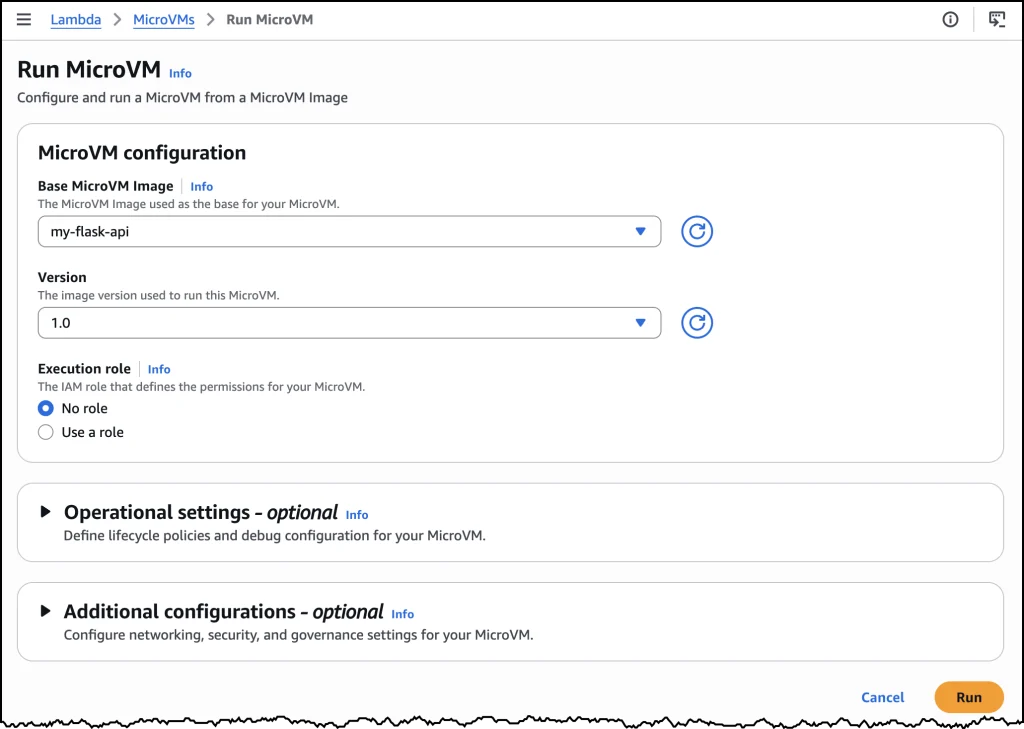
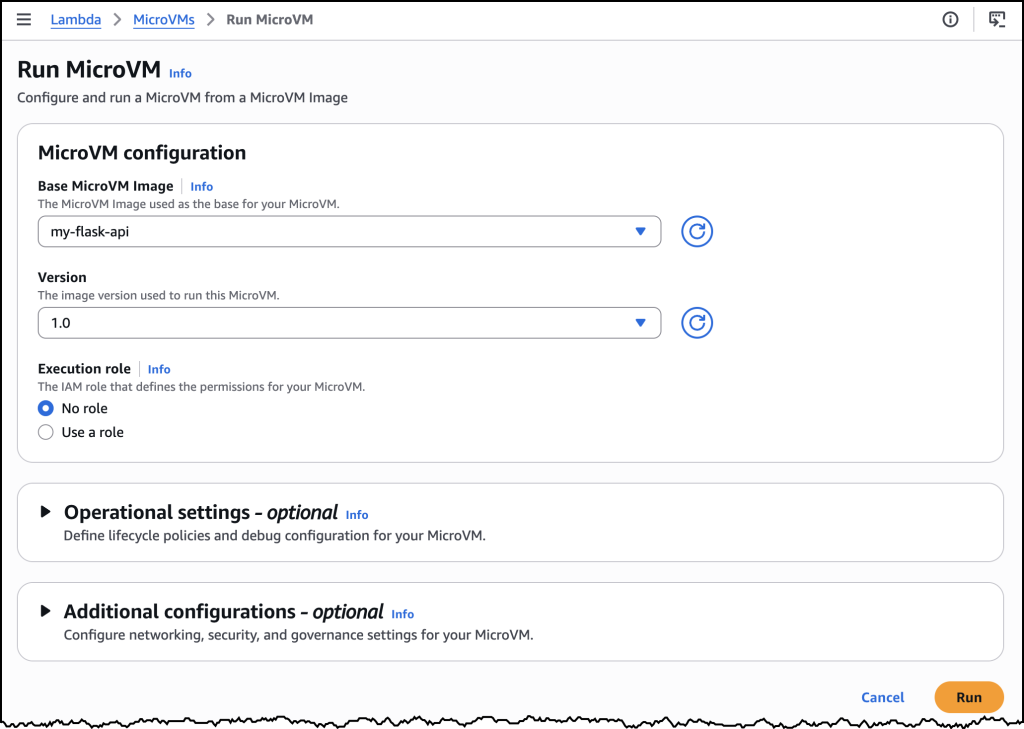
Launching a MicroVM is equally straightforward. Using the CLI, a developer can specify the image ARN and an idle policy:
aws lambda-microvms run-microvm
--image-identifier arn:aws:lambda:<region>:<acct>:microvm-image:my-image
--execution-role-arn arn:aws:iam::<acct>:role/MicroVMExecutionRole
--idle-policy '"maxIdleDurationSeconds":900,"suspendedDurationSeconds":300,"autoResumeEnabled":true'
This command configures the MicroVM to auto-suspend after 15 minutes (900 seconds) of inactivity and auto-resume instantly upon the next incoming request. Crucially, no complex networking setup is required. Lambda automatically assigns the MicroVM a unique ID and returns a dedicated endpoint URL. The new MicroVM starts with the Flask application already running, having resumed from the pre-initialized snapshot. This means that a single API call yields a fully initialized, bootstrapped compute environment, ready to serve requests immediately.
To interact with the running MicroVM, a short-lived authentication token is generated via the CLI and attached to a standard HTTPS request using the X-aws-proxy-auth header. The request lands directly on the Flask application. A compelling demonstration of the stateful capabilities involves letting the MicroVM sit idle past its suspend threshold. Once suspended, its memory and disk state are snapshotted and stored. Subsequently sending another request triggers an automatic resume, with the application state fully intact. From the client’s perspective, the pause is virtually imperceptible, showcasing the seamless user experience enabled by this feature.
Distinguishing MicroVMs from Traditional Lambda Functions
It is crucial to understand that Lambda MicroVMs are a new resource within AWS Lambda, featuring a distinct API surface, and are not intended to replace traditional Lambda Functions. Instead, they complement each other, addressing different sets of use cases.
- Lambda Functions: Remain the optimal choice for event-driven, stateless, and short-duration request-response workloads. They excel in scenarios like processing messages from queues, responding to API Gateway requests, or reacting to database changes, where each invocation is independent and typically completes within seconds.
- Lambda MicroVMs: Are purpose-built for multi-tenant applications that require handing each end user or session their own isolated, stateful, and potentially long-running environment for executing user- or AI-generated code. This includes interactive applications, development environments, and secure sandboxes where persistent state and strong isolation are paramount.
The two services can be integrated seamlessly. An application leveraging Lambda Functions for its event-driven backend can call into Lambda MicroVMs for specific steps that necessitate running untrusted code in isolation, or for interactive sessions requiring persistent state. This synergy allows developers to utilize the right tool for the right job, optimizing both performance and cost across their application stack. The service effectively delivers the execution environment, allowing developers to focus solely on their application logic.
Strategic Implications for the Cloud Ecosystem
The introduction of AWS Lambda MicroVMs carries significant implications for the broader cloud ecosystem and the future of application development:
- Democratization of Secure Sandboxing: Lambda MicroVMs democratizes access to robust, VM-level sandboxing. Previously, achieving this level of isolation with rapid startup and state persistence required deep expertise in virtualization, operating systems, and security engineering. Now, any developer can leverage this capability with the simplicity of a serverless model. This will accelerate innovation in areas like generative AI, online learning platforms, and collaborative coding environments.
- Expansion of Serverless Use Cases: This offering significantly expands the addressable market for serverless computing. Complex, stateful, and interactive applications that were previously difficult or impractical to build with FaaS can now fully embrace the serverless paradigm, benefiting from its inherent scalability, pay-per-use pricing, and reduced operational burden.
- Enhanced Developer Productivity: By abstracting away the complexities of infrastructure management and virtualization, Lambda MicroVMs frees developers to focus on writing application code. The ability to quickly provision isolated environments with persistent state streamlines development workflows, reduces time-to-market for new features, and minimizes the need for specialized DevOps or security teams.
- Cost Optimization for Interactive Applications: The intelligent suspend-and-resume capability, coupled with a pay-for-active-use model, offers significant cost advantages for interactive applications with intermittent usage. Instead of incurring continuous costs for idle VMs, developers pay only when the MicroVM is active or for the storage of its suspended state, leading to more efficient resource utilization.
- Competitive Landscape: This move by AWS further solidifies its leadership in the serverless domain, pushing the boundaries of what is possible with managed compute services. Industry analysts anticipate that this innovation will likely spur similar offerings from other cloud providers, driving further advancements in cloud-native architectures.
Availability and Future Outlook
AWS Lambda MicroVMs is now generally available in key AWS Regions: US East (N. Virginia), US East (Ohio), US West (Oregon), Europe (Ireland), and Asia Pacific (Tokyo). The service currently supports the ARM64 architecture, offering configurations with up to 16 vCPUs, 32 GB of memory, and 32 GB of disk per MicroVM. The availability across these regions underscores AWS’s commitment to providing global access to its cutting-edge services.
Idle MicroVMs can be suspended explicitly via an API call or automatically through a configurable lifecycle policy. This intelligent management of resources significantly reduces running costs while ensuring that the full application state is preserved for fast resumption, offering an optimal balance between performance and economic efficiency. Detailed pricing information, which reflects the innovative suspend-and-resume model, can be found on the AWS Lambda pricing page.
Developers eager to explore this new capability can get started by visiting the AWS Lambda console or learning more on the dedicated Lambda MicroVMs product page. Comprehensive documentation is also available in the Lambda MicroVMs Developer Guide, providing in-depth technical details and practical examples.
AWS Lambda MicroVMs represents a pivotal moment in the evolution of serverless computing. By combining the strong isolation of virtual machines with the agility, statefulness, and operational simplicity of serverless, AWS has created a powerful new primitive that promises to unlock a new wave of innovative, secure, and highly interactive cloud applications, further empowering developers to build at scale without the traditional complexities.
