
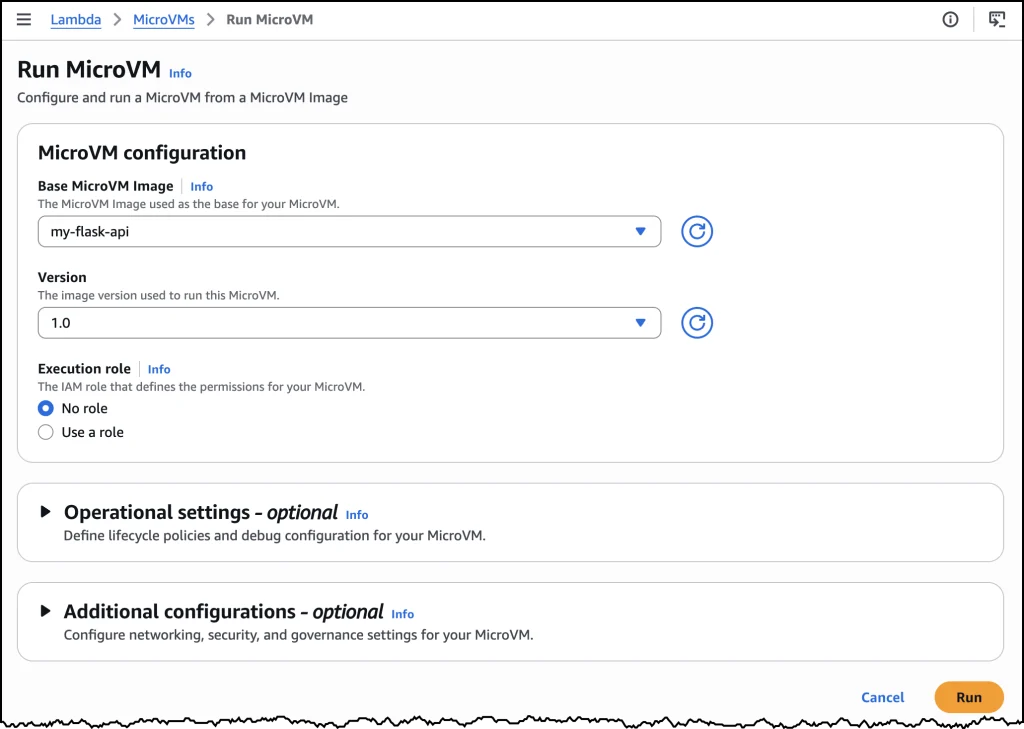

Amazon Web Services (AWS) today announced the launch of AWS Lambda MicroVMs, a groundbreaking new serverless compute primitive designed to provide isolated, stateful execution environments for user-generated or AI-generated code. This innovative service, powered by the robust Firecracker virtualization technology, promises to redefine how multi-tenant applications handle untrusted code, offering virtual machine-level isolation with the agility of serverless functions. Available initially in key AWS Regions including US East (N. Virginia, Ohio), US West (Oregon), Europe (Ireland), and Asia Pacific (Tokyo), Lambda MicroVMs supports ARM64 architecture, offering up to 16 vCPUs, 32 GB of memory, and 32 GB of disk per MicroVM, with a flexible idle policy for cost optimization.
Addressing a Critical Gap in Cloud Computing
For years, developers building multi-tenant applications that allow end-users to run custom code have faced a difficult dilemma. Traditional virtual machines (VMs) offer strong isolation but suffer from slow startup times, often taking minutes to provision. Containers, while launching in seconds, operate on a shared-kernel architecture, necessitating extensive custom hardening to safely contain untrusted code and prevent potential security breaches between tenants. Functions-as-a-Service (FaaS) solutions, like existing AWS Lambda functions, are optimized for event-driven, stateless, request-response workloads and are not designed for long-running, interactive sessions that require retaining environment state across user interactions. This left a significant gap, forcing developers to compromise on performance, isolation, or invest substantial engineering resources into building and maintaining complex, bespoke virtualization infrastructure—a task that diverts critical resources from core product development.
AWS Lambda MicroVMs directly addresses this challenge by providing a purpose-built solution. It offers a dedicated, isolated execution environment for each end-user or session, capable of launching rapidly, maintaining memory and disk state throughout the session, and pausing to a low idle cost when not actively in use. This blend of strong isolation, speed, and statefulness is a crucial advancement for a burgeoning class of applications.
The Rise of User-Generated and AI-Driven Applications

The demand for such a service has grown exponentially with the emergence of several application categories. AI coding assistants, which generate and execute code snippets on behalf of users, require secure sandboxes. Interactive code environments, online compilers, and educational platforms need isolated spaces for students and developers to experiment without affecting others. Data analytics platforms that allow users to upload and run custom scripts, vulnerability scanners that execute potentially malicious code in a controlled environment, and even game servers running user-supplied mods or scripts all exemplify this need. These applications necessitate an execution model that combines the security of a VM with the agility and scalability of serverless computing, a combination previously unattainable without significant operational overhead.
"The landscape of cloud applications is rapidly evolving, with more platforms empowering users and AI to generate and execute code directly," stated an AWS spokesperson, emphasizing the strategic importance of the new service. "Lambda MicroVMs represents a pivotal step in our serverless journey, enabling developers to build highly interactive, secure, and cost-effective multi-tenant applications that were previously impractical or prohibitively complex. We are essentially democratizing advanced virtualization techniques for every developer, abstracting away the underlying infrastructure complexity."
Firecracker: The Engine of Isolation and Speed
At the heart of AWS Lambda MicroVMs is Firecracker, an open-source virtualization technology initially developed by AWS and publicly released in November 2018. Firecracker revolutionized serverless computing by enabling the creation of lightweight micro-virtual machines (MicroVMs) that are purpose-built for running ephemeral, stateless functions. It provides a minimal guest operating system environment, focusing solely on the essentials needed to run applications securely and efficiently. This lean design results in incredibly fast startup times and a significantly reduced attack surface compared to traditional VMs.
Firecracker has already been the bedrock of AWS Lambda’s immense scalability, powering trillions of monthly function invocations. Its proven track record of providing robust isolation and efficiency at an unprecedented scale makes it the ideal foundation for Lambda MicroVMs. By leveraging Firecracker, AWS can deliver VM-level isolation – where each session runs in its own dedicated MicroVM with no shared kernel or resources between users – ensuring that untrusted code from one user is securely contained, without access to other environments or the underlying system. This inherent security model is critical for applications handling sensitive user data or executing potentially vulnerable code.
Operational Mechanics: Image-Then-Launch for Instant Readiness

The operational flow for Lambda MicroVMs is designed for developer ease and application responsiveness. The process begins with creating a MicroVM Image. Developers package their application code, along with a Dockerfile, into a zip artifact and upload it to an Amazon Simple Storage Service (Amazon S3) bucket. AWS Lambda then retrieves this artifact, executes the Dockerfile to build the environment, initializes the application, and critically, takes a Firecracker snapshot of the running disk and memory state. This pre-initialized snapshot is the key to the service’s rapid launch and resume capabilities.
Every subsequent MicroVM launched from this image resumes directly from this pre-initialized state, bypassing the typical cold boot process of a traditional VM or container. This means applications are already running the moment the launch completes, achieving near-instant startup latency. Even multi-gigabyte interactive sessions can come online quickly enough to feel truly responsive to the end-user. Build logs stream in real-time to Amazon CloudWatch, providing transparency into the image creation process.
Once an image is ready, developers can launch a MicroVM via the AWS Console or AWS CLI, specifying the image ARN and an idle policy. This idle policy is a powerful feature for managing costs and user experience. For instance, a MicroVM can be configured to auto-suspend after a set period of inactivity (e.g., 15 minutes), with its memory and disk state snapshotted and stored. When traffic resumes, the MicroVM is brought back online, with the application state fully intact, from the last suspended state. From the client side, this pause is virtually imperceptible, making for a seamless user experience while significantly reducing running costs during idle periods. No complex networking setup is required; Lambda assigns each MicroVM a unique ID and a dedicated endpoint URL.
Stateful Execution and Cost Efficiency
One of the most significant advancements offered by Lambda MicroVMs is its support for stateful execution. A running MicroVM retains memory, disk, and running processes throughout the user’s session. This means that installed packages, loaded models, and working filesets are readily available when a user resumes their session, eliminating the need to re-initialize everything. This persistent state is crucial for interactive applications, development environments, and long-running data processing tasks.
MicroVMs support up to 8 hours of total runtime, making them suitable for a wide range of applications, from software vulnerability scans that complete in minutes to complex data analytics applications running for several hours. The configurable idle window and automatic suspension capabilities are central to its cost-efficiency. By suspending MicroVMs when inactive, developers can preserve the full application state while dramatically reducing compute costs, paying only for active compute time and storage of the suspended state. This "pause-and-resume" model provides an economic advantage over continuously running VMs or containers for intermittent interactive workloads.

However, AWS notes that applications generating unique content, establishing network connections, or loading ephemeral data during initialization may need to integrate with service-provided hooks for compatibility, given that MicroVMs are started from pre-initialized snapshots. This ensures that dynamic elements are properly handled upon resume.
Broader Implications and Industry Impact
The introduction of AWS Lambda MicroVMs is poised to have far-reaching implications across various industries:
- AI and Machine Learning: Facilitates the creation of secure, interactive environments for AI model development, testing, and deployment, particularly for AI coding assistants that need to execute user-generated code safely.
- Education and Development: Transforms online learning platforms and interactive coding tutorials by providing dedicated, persistent, and isolated environments for each student, fostering experimentation without risk.
- Gaming: Enables game developers to safely run user-generated content, mods, or custom scripts within a game, enhancing community engagement while maintaining platform stability and security.
- Cybersecurity: Offers ideal sandboxing for vulnerability scanners, malware analysis, and security research, allowing potentially harmful code to be executed in a fully isolated and controlled environment.
- Data Analytics: Empowers data scientists and analysts to run custom scripts and complex computations in a dedicated environment, retaining state across sessions, which is critical for iterative data exploration.
Industry analysts are already weighing in on the potential impact. "AWS Lambda MicroVMs is more than just another compute service; it’s a strategic move that significantly lowers the barrier to entry for building complex multi-tenant applications," commented Sarah Chen, a principal analyst at CloudTech Insights. "By abstracting away the complexities of virtualization and offering a compelling balance of isolation, speed, and statefulness, AWS is effectively enabling a new wave of innovation in areas like generative AI and interactive online services. This will likely accelerate the adoption of serverless architectures for workloads previously considered too challenging for FaaS."
Complementing the Existing Lambda Ecosystem
It is important to note that Lambda MicroVMs are a new resource within AWS Lambda, with a distinct API surface, and are not intended to replace existing Lambda Functions. Lambda Functions remain the optimal choice for event-driven, stateless, request-response workloads, such as processing API requests, reacting to database changes, or handling file uploads. Lambda MicroVMs, conversely, are purpose-built for the specific needs of multi-tenant applications requiring isolated, stateful environments for user- or AI-generated code.
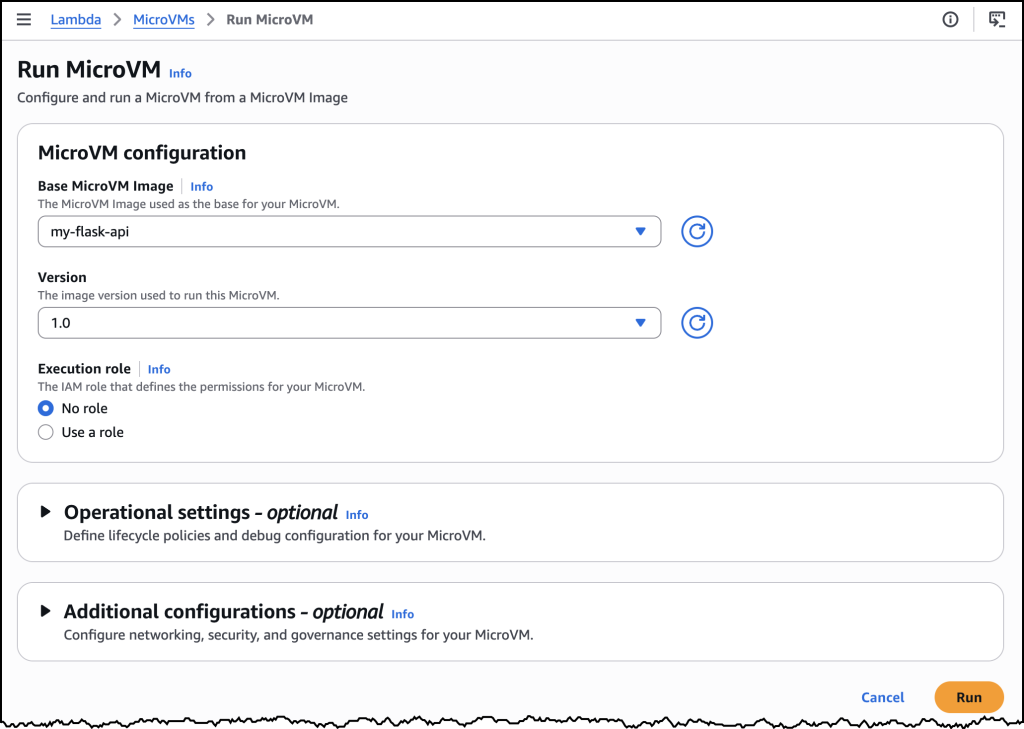
The two services are designed to complement each other. An application leveraging Lambda Functions for its event-driven backend and API gateway can seamlessly integrate calls into Lambda MicroVMs for specific steps that require running untrusted code in isolation. This allows developers to choose the most appropriate compute primitive for each component of their application, optimizing for both performance and cost.
Availability and Future Outlook
AWS Lambda MicroVMs is now generally available in US East (N. Virginia, Ohio), US West (Oregon), Europe (Ireland), and Asia Pacific (Tokyo) Regions. The service currently supports the ARM64 architecture, offering configurations up to 16 vCPUs, 32 GB of memory, and 32 GB of disk per MicroVM. Pricing details, which account for active compute time and storage of suspended states, are available on the AWS Lambda pricing page. This flexible pricing model, combined with the auto-suspend feature, underscores AWS’s commitment to providing cost-effective solutions for dynamic workloads.
Developers are encouraged to explore the new capabilities through the AWS Lambda console, the Lambda MicroVMs product page, and the comprehensive Lambda MicroVMs Developer Guide. As the cloud computing landscape continues its rapid evolution, services like Lambda MicroVMs highlight AWS’s ongoing commitment to pushing the boundaries of serverless computing, enabling developers to build increasingly sophisticated, secure, and responsive applications without the burden of infrastructure management. The future of serverless appears to be more isolated, more stateful, and more powerful than ever before.
